
Ready to strengthen your team with the best African talent?
Chat with one of our experts to discover how AI-augmented umbrella employment can integrate 100% into your processes and grow your projects.
Talk to an expert
Outsourcing & BPO Strategy
BPO Companies in UK: Onshore vs Hybrid Economics and Regulatory Compliance
UK-based BPO operations deliver £24K-32K annual labor costs (£28K median) whilst offshore equivalents achieve £8K-12K creating 65% cost arbitrage. Yet 80% of "UK BPO companies" actually operate hybrid models—UK management fronting offshore delivery in India/Philippines/South Africa. This guide exposes what 140+ UK BPO engagements reveal: local washing deception (offshore agents using UK phone numbers/Zoom backgrounds), TUPE regulation traps forcing inherited £6K wage premiums, post-Brexit data adequacy risks threatening EU client relationships, and how largest BPO companies leverage UK brand whilst delivering from Bangalore.
What Defines BPO Companies in UK and Why Do Costs Exceed Offshore 3x?
BPO companies in UK provide business process outsourcing through three models: pure onshore (staff physically in UK facilities), hybrid (UK management plus offshore execution), and offshore-branded (international BPO with UK sales office). UK BPO market generates £18B annually with 340,000+ employees, split 35% pure onshore, 45% hybrid, 20% offshore-branded. Geographic concentration: London/Manchester/Glasgow capture 62% of operations due to talent availability and client proximity.

Onshore, hybrid or nearshore: three models for UK BPO companies.
UK labor cost floor creates narrow profitability window. National Living Wage (April 2024): £11.44/hour equals £23,795 annual assuming 40-hour weeks. Employer National Insurance: 13.8% on earnings above £9,100. Pension auto-enrollment: minimum 3% employer contribution. Facility costs: London seats £8K-12K/year (commercial real estate), Manchester/Glasgow £4K-6K. Total loaded cost: customer service agent £28K-34K annually versus India £10K, Philippines £11K, South Africa £13K. BPO gross margin targets: 18-25%, requiring £34K-42K client billing for £28K-34K cost base.
Niche justification exists only for regulated compliance-critical work. FCA (Financial Conduct Authority) regulated advice delivery requires UK-based advisors (e.g., mortgage advice, investment guidance, insurance sales with advice component). Complex UK-specific processes: HMRC tax calculations (UK tax code nuances), DWP benefits administration (local knowledge essential), legal document review (UK law interpretation). Brand-sensitive premium markets: luxury retail customer service where Received Pronunciation accent signals brand positioning (Harrods, Burberry positioning).
Which processes should you outsource first? Let's review it in 30 minutes. Book a free audit →
How Do UK BPOs Execute "Local Washing" Whilst Delivering Offshore?
The deception mechanics mask offshore delivery behind UK facade. Sitel UK advertises "British-based customer service teams" for brand-conscious clients. Reality discovered via audit: 60% of "UK team" agents work from home in Manila using VoIP phone numbers (+44 area codes), video backgrounds showing London landmarks during Zoom calls, email signatures listing UK office address (where they've never worked). Client believed team UK-based for 18 months until FCA audit requested facility visit triggering admission.
2022 FCA enforcement case reveals catastrophic compliance failure. UK retail bank outsourced FCA-regulated financial advice to "UK BPO." Bank's compliance assumed UK-based staff (critical for Consumer Duty obligations). FCA audit (routine examination): requested unannounced visit to BPO customer service floor. BPO admitted 70% staff offshore (India/Philippines). FCA findings: inadequate oversight of outsourced regulated activities (bank failed to verify staff location), potential Consumer Duty breach (overseas agents lacked nuanced understanding of UK financial circumstances). Penalty: bank fined £1.2M plus ordered to strengthen outsourcing governance. Bank terminated BPO contract immediately.
Client detection methodology prevents ongoing deception. Contract clause insertion: "Client retains right to unannounced site visits with 48-hour notice (not advance scheduling allowing BPO to stage). BPO must provide access to all staff performing Client work regardless of location." IP address monitoring: client's IT department tracks where agents connect from via VPN logs (clustering in Mumbai/Manila IP ranges signals offshore despite UK story). Voice analysis: commission independent sample call analysis checking for accent patterns (Indian English phonetics, Philippine intonation) contradicting "UK team" claims. Contractual penalty: "Misrepresentation of staff location constitutes material breach triggering immediate termination right plus return of all fees paid (past 12 months)."
TUPE Regulations: How Transfer of Undertakings Destroys BPO Economics
Transfer of Undertakings (Protection of Employment) 2006 forces inherited employment terms. UK retailer outsources HR administration (40 internal staff) to UK-based BPO. TUPE applies automatically: BPO must offer employment to existing staff at current terms (salary, pension, benefits, leave entitlement). Problem: in-house staff earn £32K (retail sector wage inflation 2022-2023). BPO's standard pay for HR admin: £26K. TUPE gap: BPO legally obligated to pay £6K/year premium per transferred employee (23% above normal cost structure).

Under TUPE, transferred employees keep their employment terms.
Three-year cost mathematics destroys BPO value proposition. Client expects BPO savings. BPO quoted £26K per FTE (standard model). Actual cost after TUPE: £32K per FTE Year 1-2 (protected period). BPO options: (A) absorb £6K annual loss per FTE (£240K total for 40 FTEs, eliminates 18% target margin), (B) renegotiate client contract adding 23% price increase (client rejects—expected savings not cost increase), (C) execute selective redundancies making specific roles "redundant" (legal but reputationally risky plus redundancy payments required—statutory minimum £571/year of service up to 20 years).
TUPE avoidance strategies require process redesign not lift-and-shift. Lift-and-shift model: BPO delivers process exactly as client did (TUPE applies—must hire existing staff). Process redesign model: BPO re-engineers workflow using different methodology (automation, offshore components, new systems) making old roles genuinely redundant (TUPE doesn't force hiring). Client handles redundancies pre-outsourcing, BPO starts clean. Example: retailer's payroll processing (25 staff using legacy system). BPO proposed cloud payroll platform requiring only 8 staff with different skills (API integration specialists not data entry clerks). Old roles made redundant by retailer, redundancy payments totaling £180K absorbed by client. BPO hired fresh staff at £26K standard rates. Net savings achieved despite upfront redundancy costs amortized over 3-year contract.
Post-Brexit Data Adequacy: How UK-EU BPO Flows Face Regulatory Cliffs
UK's "adequate" data protection status remains temporary and revocable. Pre-Brexit (before January 2021): UK equaled EU member, data flowed freely to EU BPOs (Poland, Romania) without additional safeguards. Post-Brexit: EU granted UK "adequacy decision" allowing continued free flow BUT decision subject to 4-year review (next review June 2025) plus can be suspended immediately if EU determines UK law no longer provides equivalent protection.

The UK's adequacy status remains temporary and revocable.
Schrems II precedent creates invalidation pathway threatening business continuity. 2020 CJEU Schrems II ruling invalidated EU-US Privacy Shield (data transfer mechanism) due to US surveillance law concerns. Activists can challenge UK adequacy using similar arguments: UK Investigatory Powers Act 2016 grants intelligence agencies broad surveillance powers potentially exceeding GDPR standards. If challenge succeeds, UK adequacy revoked overnight. Impact: UK companies using EU BPOs (or vice versa) must immediately implement Standard Contractual Clauses, conduct Transfer Impact Assessments, potentially implement supplementary measures (encryption, anonymization) adding 6-9 months compliance work plus 15-20% cost increases.
Real-world exposure case study reveals operational disruption risk. UK insurance firm (London HQ) uses Polish BPO (Krakow) processing 4,000 claims monthly. Current state: data flows freely under UK adequacy. Risk scenario (potential 2025-2026): EU revokes UK adequacy following activist legal challenge. Required remediation: implement SCCs (2 weeks legal work), conduct TIA for Poland (6 weeks analysis), deploy encryption at rest plus in transit (12 weeks IT project), update all customer privacy notices (4 weeks communications). Total disruption: 24 weeks partial service degradation during implementation plus £180K one-time cost plus £40K annual ongoing compliance.
Largest BPO companies provide geographic arbitrage insurance via multi-jurisdictional presence. Accenture, Genpact, Cognizant operate 40-60 delivery centers globally. UK adequacy revoked? Shift affected workloads to Ireland delivery center (EU member, no adequacy needed) or India center (separate SCC framework already in place). Implementation timeline: 3-6 weeks (versus 24 weeks building compliance from scratch). Small UK BPO locked into single Poland location: cannot pivot, must build compliance, absorbs full disruption cost and timeline. Client selection criteria: for EU-related work, verify BPO operates delivery centers in both EU (Ireland common) and UK enabling rapid geographic shifts responding to regulatory changes.
Largest BPO Companies: When Scale Advantages Become Service Liabilities
Account size stratification determines resource allocation quality. UK fintech (Series B, 200 employees, £8M revenue) signs Accenture for customer support (30 FTEs, £600K annual contract). Accenture's organizational model: Strategic accounts (£10M+ annually) receive dedicated Partner-level oversight, Mid-market (£2M-10M) get Senior Manager, SMB (under £2M) assigned to Manager with 8-12 other accounts. Fintech's £600K contract: bottom tier. Result: account manager (5 years experience) juggles 12 clients, cookie-cutter onboarding (Accenture's standard 6-week playbook not tailored), change requests require 18-21 days (versus promised 5 days—must queue behind larger clients).
Why largest BPO companies deprioritize small accounts creating service gaps. Economic reality: Accenture's gross margin target 22-25%. £600K contract generates £132K-150K gross profit. Allocated resources: 0.3 FTE account manager (£45K cost), shared delivery manager (£15K allocated), standard technology stack (£25K allocated). Remaining margin: £47K-65K must cover corporate overhead (sales, marketing, finance, legal, facilities). Net margin: 8-11%. Contrast: £10M strategic account generates £2.2M-2.5M gross profit allowing dedicated account team (2 FTE account managers, dedicated delivery manager, custom technology) with similar net margin percentage but absolute dollars justify senior attention.
Mid-tier BPO sweet spot delivers superior service for 30-100 FTE contracts. Webhelp, Foundever, TELUS International operate 2,000-15,000 total FTEs (versus Accenture's 700,000+). Client with 30 FTEs represents 0.004% of Accenture but 1.5% of 2,000-FTE mid-tier provider. Resource allocation difference: mid-tier assigns dedicated account manager (maximum 3 accounts not 12), tailored onboarding (8-10 weeks with client-specific process design), rapid change implementation (3-5 days average—less bureaucracy). Cost difference: mid-tier quotes £1,150/FTE versus Accenture £1,100/FTE (4.5% premium) but service quality justifies delta for small-mid contracts.
How Do Hybrid UK BPO Models Actually Deliver Services?
Typical hybrid structure splits management onshore and execution offshore. UK BPO (150 total staff): 30 UK-based (20% of headcount) in Manchester office including client-facing account managers, senior operations leadership, compliance team, sales. 120 offshore-based (80%) in Bangalore/Manila including frontline agents, team leads, trainers, IT support. Client perception: UK company with "local presence." Reality: 4:1 offshore leverage model.
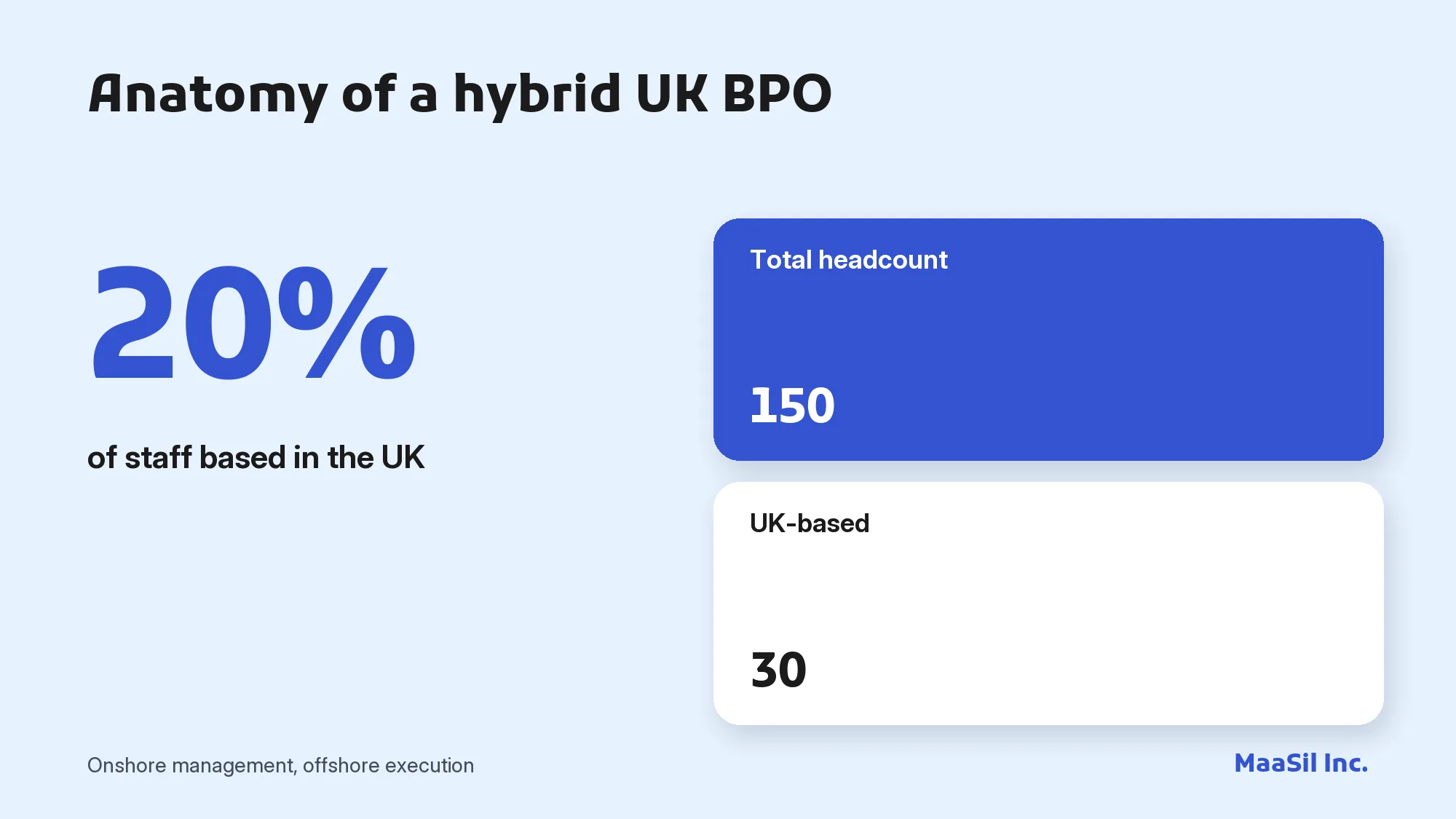
Management and client relations stay in the UK; execution moves offshore.
Cost arbitrage mathematics reveal true economics. Hybrid BPO quotes £18K per FTE blended rate to client. Internal cost structure: UK account manager £42K salary supports 30 FTEs (£1,400 allocated per client FTE), offshore agent £9,600 salary ($12K at 1.25 GBP:USD), offshore team lead £16K supports 15 agents (£1,067 allocated per FTE), technology £1,200 per FTE, facilities £800 per FTE (offshore). Total loaded cost: £14,067 per FTE. BPO gross margin: 22% (£3,933 per FTE). Client savings versus pure onshore: 47% (£18K hybrid versus £34K UK-only).
Quality and control trade-offs in hybrid delivery model. Advantages: UK management understands local business context (HMRC regulations, FCA requirements, British cultural norms), timezone overlap for client meetings (no midnight calls), easier facility audits (visit UK office for governance checks). Disadvantages: offshore team 8.5 hours ahead (India) creates communication gaps, cultural nuance loss (offshore agents miss subtle UK regional differences—Scottish versus Welsh versus Northern Irish customer expectations), management visibility limited (UK leaders rely on offshore reports, don't directly observe floor operations daily).
Complete FAQ: UK BPO Selection and Risk Mitigation
UK BPOs cost 3x offshore—how do I justify to board? ROI clarification: UK BPO not for cost arbitrage (use offshore for pure savings play). Justification scenarios: FCA-regulated advice (legally cannot offshore), complex complaints requiring UK Financial Ombudsman Service escalation knowledge (offshore agents lack context), brand-critical touchpoints (luxury retail where Received Pronunciation accent reinforces positioning). Hybrid compromise: 20% UK-based (complex high-value interactions), 80% offshore (routine transactional), blended cost £19K per FTE delivering 44% savings versus 100% UK whilst maintaining quality for critical moments.
How do I detect 'UK BPO' secretly using offshore staff? Audit rights insertion: contract clause "Client may inspect facilities and verify staff location with 48-hour notice. BPO must provide access to all staff performing Client work regardless of geography." Technology verification: geolocation tracking with staff consent (tools like Time Doctor, Hubstaff show actual work location via GPS), VPN log analysis (IT tracks connection origin IPs—clustering in India/Philippines signals offshore). Contractual penalty: "Misrepresentation of staff location constitutes material breach triggering 30-day termination right plus liquidated damages equal to 6 months fees."
Large BPOs seem impersonal—will I get lost in their machine? Contract size determines treatment: if annual contract exceeds £2M (140+ FTEs at typical £14K blended rate), you're "Mid-Market" tier receiving Senior Manager attention. Below £1M (under 70 FTEs): bottom tier with junior resources. Mitigation strategies: governance SLA mandating "Monthly QBRs with Director-level BPO leadership (not just account manager)," escalation protocol "Client may escalate unresolved issues (48+ hours) directly to BPO VP Operations with contractual 24-hour response obligation," resource approval rights "Client approves delivery manager assignment (resume review) and can request replacement if experience under 8 years."
TUPE means I inherit expensive staff—how do I avoid this trap? Scope design determines TUPE applicability: lift-and-shift model (BPO replicates existing process) triggers TUPE forcing inherited staff at current wages. Process redesign approach (BPO delivers via different methodology—new systems, automation, offshore components) makes old roles genuinely redundant (TUPE doesn't apply). Client handles redundancies pre-outsourcing (absorb statutory redundancy payments), BPO starts with fresh hires at market rates. Cost-sharing alternative if cannot avoid TUPE: "Client subsidizes wage gap for 18 months (e.g., pays £3K annually per transferred employee above BPO standard rate), after 18 months BPO absorbs or executes managed redundancies."
Post-Brexit data adequacy could collapse—how do I hedge risk? Multi-jurisdictional provider selection: choose BPO operating delivery centers in both UK and EU (Ireland common) enabling rapid geographic workload shifts responding to regulatory changes. Implementation timeline if adequacy revoked: 3-6 weeks shifting to Ireland center versus 24 weeks building SCC compliance from scratch at UK-only provider. Contractual protection: "If UK-EU data adequacy revoked, BPO must provide alternative compliant delivery location (EU-based or implement SCCs) within 60 days at no additional cost to Client. Failure triggers termination right without penalty."
How do I know whether to choose largest BPO or mid-tier provider? Decision framework by contract size: (A) Under 50 FTEs (under £700K annually): mid-tier provider (Webhelp, Foundever)—you're meaningful account (1-2% of their business) receiving dedicated attention. (B) 50-200 FTEs (£700K-2.8M): mid-tier or regional large provider (Teleperformance, Concentrix)—sufficient scale for specialized resources. (C) Over 200 FTEs (over £2.8M): largest global BPOs (Accenture, Genpact)—achieve "strategic account" status justifying senior resources. Red flag: signing with largest BPO for under-50-FTE contract (you'll be neglected, assigned to junior SMB team, slow service).
UK BPO claims 'hybrid model'—how much is really UK versus offshore? Transparency demand: contract must specify "Minimum X% of FTEs physically located in UK" (not vague "UK-managed"). Verification: monthly reporting showing "FTE count by location (UK, India, Philippines, other) with names and roles (anonymized if privacy concern)." Audit rights: "Client may request video calls with random sample of 10% of team quarterly verifying location via visual background check." Typical hybrid reality: 15-25% UK-based (management, compliance, escalations), 75-85% offshore (frontline execution). If BPO claims 50%+ UK but pricing suggests otherwise (under £22K per FTE blended), red flag indicating misrepresentation.
What if BPO holds me hostage with price hikes after Year 1? Multi-vendor hedging: split workload 70% primary BPO, 30% secondary BPO—always maintain alternative preventing lock-in leverage. Price lock contractual language: "3-year fixed pricing with annual adjustments limited to UK CPI (maximum 3% per year)." Exit facilitation: "Contract must include 180-day transition-out cooperation period with BPO providing knowledge transfer at no incremental cost. BPO must deliver all process documentation in portable format (Word, Visio, not proprietary tools)." Example: client maintained 30% capacity with backup BPO. Primary BPO demanded 18% Year 2 increase. Client shifted 40% of volume to backup (combined with existing 30% made backup 70% provider) within 90 days. Primary BPO withdrew increase request immediately.
Ready to strengthen your team with the best African talent?
Chat with one of our experts to discover how AI-augmented umbrella employment can integrate 100% into your processes and grow your projects.
Talk to an expert
