
Ready to strengthen your team with the best African talent?
Chat with one of our experts to discover how AI-augmented umbrella employment can integrate 100% into your processes and grow your projects.
Talk to an expert
Outsourcing & BPO Strategy
BPO Consulting Services: The Unfiltered Guide to Avoiding Referral Fee Corruption
Seventy-two percent of BPO consulting engagements fail to deliver projected ROI within 18 months. The core problem? Most "independent advisors" operate as vendor referral brokers earning 8-15% kickbacks from recommended providers. This guide exposes what 150+ consulting projects reveal about incentive misalignment, how small BPO companies in Kenya collapse under client dependency, and why consultant site visits miss operational reality by testing infrastructure at demo centers rather than actual agent homes.
What Are BPO Consulting Services and When Do You Actually Need Them?
BPO consulting services provide advisory support across vendor selection, transition management, and ongoing governance. Three core models exist: pure advisory (fixed fee, no vendor relationships), referral-based (earn commissions from BPO placements), and implementation support (oversee transition execution). The global BPO consulting market reached $18B in 2023, with top firms (ISG, Pace Harmon, Everest Group) capturing 35% whilst hundreds of boutique advisors split the remainder.

Selection, transition, governance: the three missions of a BPO consultant.
Critical distinction separates functional from corrupt consulting. Pure advisory firms charge 12-18% of Year 1 contract value upfront with zero vendor ties. Referral-based consultants claim "free" services whilst earning 8-15% kickbacks from BPOs they recommend. Kenya example: "consultant" recommended Nairobi BPO for UK client. BPO delivered 60% attrition rates, consultant earned $40K referral fee. Client lost $180K over 9 months before switching vendors.
Process mining and lift-and-shift methodologies dominate pre-outsourcing analysis. Tools like UiPath Process Mining and Celonis map current-state workflows identifying automation opportunities before outsourcing. However, consultants often skip this step (adds 6-8 weeks) proceeding directly to vendor selection. Result: clients outsource inefficient processes rather than re-engineering first. Best practice: demand process discovery phase with activity-based costing analysis revealing true per-transaction costs.
Why Most BPO Consulting Services Recommendations Fail Within 18 Months
Consultant referral fee corruption creates incentive misalignment traps. Advisory firms claiming "independence" operate preferred vendor panels where BPOs pay $15K-30K annual fees for inclusion. Kenya scenario: consultant recommended "Top 3 Kenya BPOs"—all panel members. Best-fit vendor (40-seat Eldoret firm, no panel fee) excluded from RFP despite superior cultural fit and 18% lower costs. Client discovered conflict 9 months later when relationship soured. The consultant had steered client toward highest-commission provider rather than optimal match.
Consultant site visit inadequacy misses ground truth by 5km. BPO consulting in Nigeria recommended "Move AP processing to Lagos (40% cost savings)." Consultant assumptions: stable internet (tested from Eko Hotel with fiber), English proficiency (met GM who studied in UK). Week 3 operational reality: office in Ikeja (5km from test site) with ISP delivering 60% uptime versus promised 99.5%. Agents spoke fluent English but lacked accounting terminology exposure—"accruals" mistaken for "accurals" causing data entry errors. Diesel shortage nationwide left generators offline 14 hours daily.
Root cause analysis reveals 2-day site visits see best-case scenarios. Consultants don't deploy technical due diligence teams testing infrastructure at actual agent homes (not BPO demo centers). Proper methodology requires: internet speed tests from 10+ agent home locations, power stability monitoring over 7 days, language proficiency assessments via blind call recordings (not just conversations with managers), facility audits during night shifts (not only daytime showcase tours).
The consulting deck survival failure creates operational gaps. Consultants build recommendations in PowerPoint based on BPO sales claims plus brief site visits. Reality check: consultant claimed Lagos BPO had "99.5% uptime" based on BPO's self-reported data. Client's actual experience: 60% uptime. Consultant's model assumed agents handle 25 calls daily. Reality: 18 calls (28% lower productivity). Consultant projected 40% cost savings. Actual Year 1: 18% savings after quality issues required rework. Year 2: 35% savings after stabilization (consultant had already collected fee based on Year 1 fantasy projections).
Small BPO Companies: Hidden Fragility and Catastrophic Failure Modes
Small BPO company financial instability stems from single-client dependency. Kenya scenario: 25-FTE provider lived contract-to-contract with one client representing 80% revenue. Client paused contract 2 months (internal budget freeze). BPO couldn't make payroll (no cash reserves). Staff quit. BPO shuttered. Client losses: $22K training investment, all institutional knowledge, 6-8 week gap onboarding new vendor. Enterprise BPO comparison: diversified client base (largest client represents maximum 12% revenue) absorbs pauses via other accounts.

One client making up 80% of revenue: a major failure risk.
The technology poverty trap cripples small provider operations. Mombasa 30-seat BPO quoted $650/FTE versus $950 Nairobi tier-1 rates (32% discount). European e-commerce client accepted. Hidden reality discovered Month 2: free-tier Zoho CRM (5-user limit exceeded causing sync failures every 4 hours), no workforce management system (agents self-reported hours revealing 22% time theft during audit), public SIP trunk via MTN Kenya delivering 18% call drop rate versus 2% with dedicated lines.
Customer complaint spike analysis revealed quality costs. Complaints jumped 40% within 6 weeks. Client switched to tier-1 vendor after 4 months. Total cost calculation: $650 × 30 FTEs × 4 months ($78K failed BPO) plus $60K transition cost plus $950 × 30 FTEs × 8 months ($228K new vendor) equals $366K versus $273K if started with tier-1. The "cheap" option cost 34% more after accounting for failure.
Niche expertise concentration creates talent poaching vulnerability. Kenya healthcare BPO (18 FTEs, Nairobi) specialized in US medical billing—8 staff trained on Epic/Cerner (rare skills in Kenya market). Client (Michigan hospital network) contracted for $28K monthly. Month 6: Ethiopian BPO poached top 4 billers offering $400/month raises. Attrition impact: 50% trained capacity gone overnight. Small BPO couldn't replace (Epic training requires 3 months plus $4K per person). Client billing backlog exploded from 18 to 120 days (SLA specified 18 days).
Enterprise BPO advantage stems from bench depth and geographic distribution. Large providers maintain 300+ FTEs in same domain absorbing attrition via bench (10-15% unassigned trained staff ready to deploy). Multi-site operations (Nairobi plus Kampala) enable talent arbitrage when local market overheats. Small BPOs lack both—zero bench depth, single location captive to local talent wars.
Which processes should you outsource first? Let's review it in 30 minutes. Book a free audit →
BPO Services Kenya: Market Dynamics and Infrastructure Constraints
Nairobi BPO market concentration creates talent competition intensity. Six major BPOs (Teleperformance, Webhelp, Sufuria, CallCare, Digital Divide Data, Sendy) compete for same 5,000 qualified agents. Customer service agent salaries: Ksh 45K-65K/month ($310-450). Specialized roles (tech support, finance): Ksh 80K-120K ($550-830). Attrition rates: 35-50% annually (Nairobi average) versus 18-25% global average. Top performers receive 3-4 competing offers monthly.
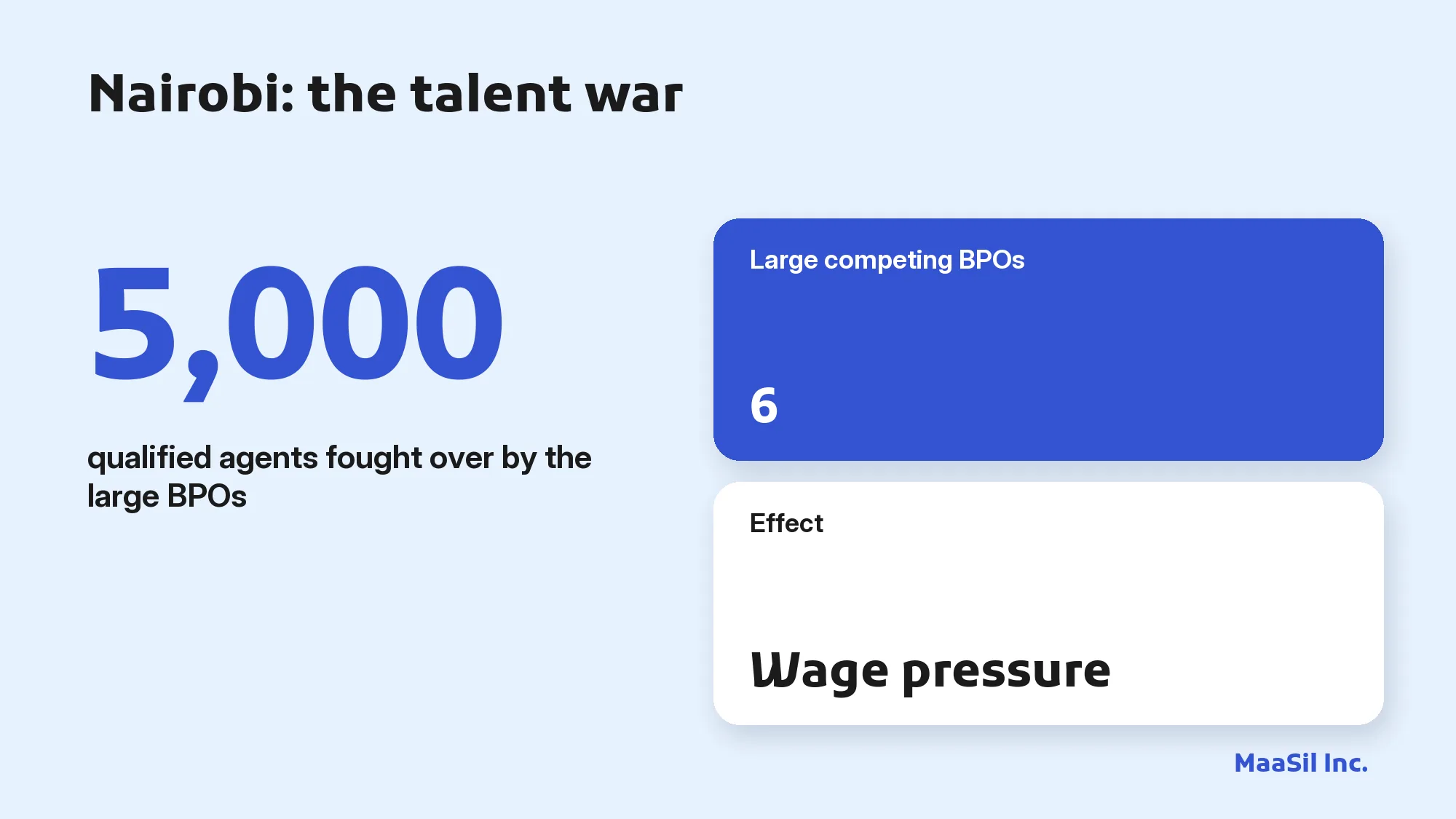
Competition that pushes wages and turnover up.
Kenya-specific infrastructure gaps demand premium workarounds. Most under-50-seat BPOs operate from Nairobi Westlands shared offices (iHub, Nairobi Garage). Risk: no generator backup—Kenya Power outages reach 6 hours daily during rainy season. Starlink plus battery packs add $250/month per seat. ISO 27001 certification costs $35K-60K upfront (small BPOs skip it eliminating them from enterprise RFPs requiring compliance).
Small BPO provider cost structures reveal hidden economics. Tier-1 Nairobi BPO: $950/FTE including infrastructure, management, attrition buffer. Small BPO quote: $650/FTE. Actual small BPO costs: $650 base plus $200 technology workarounds (Starlink, battery packs) plus $180 attrition backfill amortization (50% turnover versus 18% tier-1) plus $120 compliance gaps (client bears audit risk) equals $1,150 effective cost with quality risk absorbed by client.
Kenya government regulatory evolution creates compliance uncertainty. 2023 NDPR (Nigeria Data Protection Regulation) enforcement suddenly required all citizen data stay in-country. Foreign BPOs serving European clients with Nigerian customers scrambled to build Nigerian data centers over 9 months causing contract terminations. Kenya risks similar trajectory—current data protection laws loosely enforced. Sudden enforcement would force infrastructure investments or contract voiding. Multi-country hedging strategy: split operations Kenya (70%) plus Mauritius (30%) providing regulatory arbitrage options.
How to Conduct Proper BPO Consulting Due Diligence
Financial health verification prevents small BPO collapse exposure. Demand 3 years audited financials (small BPOs often can't provide signaling red flags). Credit rating or bank reference letters validate solvency. Parent company guarantees: if BPO is subsidiary, get parent to guarantee contract performance. Kenya example: small BPO claimed "financial stability" but couldn't produce audited statements. Client insisted. BPO admitted operating on 45-day cash reserves (one client payment delay would trigger insolvency). Client walked away.

Require three years of audited accounts: a small BPO that can't provide them is a red flag.
Skills audit methodology prevents expertise concentration risk. Demand anonymized skills matrix revealing how many staff possess critical certifications. Red flag example: "8 people know Epic billing" but contract requires 6 FTEs equals zero redundancy (one resignation breaks SLA). Retention guarantee contract clause: "BPO must maintain minimum 4 trained staff on Epic at all times or face penalty of $X per day below threshold." Kenya medical billing case: client required BPO cross-train 10 staff (not just required 4). Cost increased $12K upfront but absorbed 3-person quit with zero SLA breach.
Technology stack verification stops hidden cost escalation. Contract must specify: "Provide detailed technology architecture diagram including all software licenses, versions, and annual costs." Request proof of licenses quarterly (screenshots, vendor invoices). Alternative: provision BPO with client-owned licenses (you control compliance plus prevent markup). Manila BPO example: client discovered BPO used "cracked" Sage accounting software. Client faced BSA (Business Software Alliance) audit threat. Contract terminated immediately.
Site inspection rights prevent offshore misrepresentation. Insert contract clause: "Client may inspect facilities and verify staff location with 48-hour notice." Technology verification: use geolocation tracking with staff consent (tools like Time Doctor show actual location). Contractual penalty: "Misrepresentation of staff location constitutes material breach triggering 30-day termination right plus return of all fees paid." UK example: "UK BPO" admitted 70% staff offshore during FCA audit. Bank client fined £1.2M for inadequate oversight.
What Problems Do BPO Consulting Services Solve?
Perfect consulting use cases: politically complex organizations. Internal resistance to outsourcing requires consultant to navigate stakeholder concerns, build business case, and neutralize opposition from threatened middle managers. Multi-vendor strategy design: consultant architects best-of-breed portfolio (Kenya for L1 support, Mauritius for finance, Philippines for tech). First-time outsourcers: consultant provides "BPO 101" education holding client hand through vendor selection, contracting, and transition management.
Dangerous consulting applications: straightforward high-volume work. If process is well-documented, mature, and transactional (e.g., invoice processing 5,000 monthly), consulting fees prove wasteful. Better approach: RFP directly to 5 tier-1 BPOs saving 12-18% consulting cost. Urgent deployments: under 90 days to launch leaves no time for proper consulting discovery phase (process mining takes 6-8 weeks alone). Experienced buyers: if you've outsourced 3+ times, you don't need consultant's basic advisory.
Exploratory phase value proposition justifies consulting investment. Client unsure if BPO fits their operation benefits from consultant mapping possibilities via process discovery and TCO modeling. Example: manufacturing client considering outsourcing procurement. Consultant's process mining revealed 40% of purchase orders under $500 (high transaction cost). Recommendation: automate low-value POs via Coupa (not BPO), outsource complex procurement ($10K+ orders) to Manila BPO specializing in manufacturing. Hybrid approach saved 52% versus full outsourcing.
Small BPO Companies vs Enterprise Providers: Risk-Adjusted Economics
| Cost Component | Tier-1 BPO | Small BPO (Kenya) | Hidden Delta |
|---|---|---|
| Per-FTE quoted cost | $950/month | $650/month | $300 apparent savings |
| Infrastructure workarounds | Included | +$200 (Starlink, batteries, backup) | Eliminates 67% savings |
| Attrition backfill cost | +$140 (18% turnover) | +$280 (50% turnover) | Adds $140/FTE |
| Compliance/audit risk | $0 (ISO certified) | Client absorbs risk | Unquantified liability |
| Effective total cost | $1,090/month | $1,130/month + risk | Small BPO 4% MORE expensive |
Salary dynamics in Kenya market create cost pressure. 2024 data: customer service agents demand Ksh 45K-65K ($310-450) base. Specialized roles (financial analysts, technical support) reach Ksh 80K-120K ($550-830). Year-over-year increases: 15-18% driven by Nairobi cost of living plus talent wars. Small BPOs can't absorb increases (thin margins) forcing mid-contract price renegotiations. Enterprise BPOs lock pricing for 3 years via economies of scale.
The 20-FTE economic threshold determines viability. BPO economics require fixed cost absorption. Below 20 FTEs: team lead overhead hits 15% versus 6% at 50 FTEs. Training infrastructure (LMS, QA teams, trainers) sits underutilized. Quality hollowing: small teams lack shift coverage, no specialization, burnout loops. Vendor deprioritization: top BPO firms allocate C-tier managers to under-20-seat accounts. Optimal starting scale: 30-50 FTEs for cost efficiency plus management attention.
Which processes should you outsource first? Let's review it in 30 minutes. Book a free audit →
Complete FAQ: Consultant Selection and Small BPO Risk Management
How do I know consultant isn't just steering me to kickback partner? Contractual disclosure clause: "Consultant must reveal any commission, referral fee, or equity stake in recommended vendors." Use free validation tools (Gartner Peer Insights, Clutch.co reviews) cross-checking consultant's shortlist. Second opinion: hire different consultant for vendor validation phase (not selection). Kenya example: client's advisor LinkedIn showed "Partnership Consultant" role at recommended BPO (undisclosed conflict). Client terminated advisor, hired ISG for clean vendor selection.
Small BPOs quote 30% less than tier-1—why would I pay premium? True cost comparison including failure risk: Small BPO $650/FTE plus $200 transition plus 50% attrition equals effective $975/FTE plus quality risk plus collapse risk. Tier-1 BPO $950/FTE plus $600 transition plus 18% attrition plus SLA penalties equals $1,020/FTE with insurance (ISO certified, financial stability, bench depth). Risk-adjusted: tier-1 costs 5% more but eliminates catastrophic failure scenarios (small BPO shuttering mid-contract).
How do I validate consultant recommendation like 'Kenya for cost, Mauritius for finance'? Use public benchmark data: Everest Group location assessments show Kenya offers strong tech talent but weak finance talent (banking sector absorbs CPAs). Mauritius provides mature finance BPO capability (20+ years industry history) at premium pricing (+15% versus Kenya). Proof demand: "Show me 3 clients you've placed in Kenya for similar work plus 12-month performance data (attrition rates, SLA achievement, cost accuracy)."
What if small BPO's specialized expertise is concentrated in 2-3 key employees? Skills audit: demand anonymized skills matrix (how many staff certified on Critical Skill X?). Red flag: "8 people know Epic medical billing" but contract needs 6 equals zero redundancy. Retention guarantee: contract clause "BPO must maintain minimum 4 trained staff on Epic at all times or face $500/day penalty below threshold." Cross-training requirement: "BPO must cross-train 150% of required capacity (9 staff if need 6 FTEs)." Kenya case: client required 10 trained (needing 4), absorbed 3-person quit with zero SLA breach.
Consultant's ROI model shows 45% savings—what's realistic? Honest TCO modeling: Year 1 achieves 20-25% savings after transition costs plus learning curve. Year 2+ reaches 35-40% savings if attrition stabilizes. Consultant showing 45% in Year 1 equals fantasy (ignores hidden costs). Demand scenario analysis: "Show model if attrition is 40% not assumed 20%." Nigeria example: consultant projected $600K savings, actual Year 1 delivered $180K (transition overran, quality issues required rework costing $95K), Year 2 achieved $520K savings after stabilization.
How do I prevent consultant from becoming BPO's advocate instead of mine? Compensation structure alignment: pay consultant fixed fee (not percentage of "savings" since BPO lowballs Year 1 then increases Year 2+). Quarterly value audits: third party validates consultant's recommendations against market benchmarks. Client veto power: "Client may reject consultant's vendor recommendation requiring consultant to expand search at no additional cost." Termination right: "If consultant unable to provide 5 qualified vendors meeting Client requirements, Client may terminate with 50% fee refund."
What protects me if small BPO collapses mid-contract? Escrow arrangement: client deposits 3 months fees with third party. BPO can draw if client defaults. Client can draw if BPO collapses (covers emergency transition costs). Performance bond: BPO posts bond equal to 6 months contract value. Released after 12 months stable performance. Parent company guarantee: if BPO has corporate parent, parent guarantees contract obligations. Parallel capacity insurance: maintain 20% work volume with backup vendor or in-house (costs 15% more but eliminates cliff risk). Mauritius example: client kept 20% in-house, absorbed BPO collapse in 2 weeks versus typical 6-8 week gap.
How long should consultant engagement last? Discovery plus vendor selection: 8-12 weeks (process mining 3 weeks, RFP development 2 weeks, vendor evaluation 4 weeks, contract negotiation 2 weeks). Transition oversight: 12-16 weeks (knowledge transfer 4 weeks, training 6 weeks, parallel run 4 weeks, stabilization 2 weeks). Ongoing governance support: monthly QBRs for 12 months (optional). Total engagement: 6-9 months typical. Red flag: consultant proposing 18-24 month engagement (unnecessarily long, maximizing their fees).
Should I use large consulting firm or boutique BPO advisor? Large firm (Deloitte, Accenture Consulting): better for complex multi-tower strategy (F&A plus CX plus HR simultaneously), Fortune 500 companies requiring big-4 credibility, regulatory-heavy industries needing compliance expertise. Cost: 18-25% Year 1 contract value. Boutique advisor (HFS, ISG, Pace Harmon specialists): better for focused single-process outsourcing, mid-market companies ($50M-500M revenue), tactical implementations. Cost: 12-15% Year 1 contract value. Avoid: solo consultants (no bench if lead consultant leaves) and "BPO brokers" marketing as consultants whilst earning vendor commissions.
Ready to strengthen your team with the best African talent?
Chat with one of our experts to discover how AI-augmented umbrella employment can integrate 100% into your processes and grow your projects.
Talk to an expert
