
Ready to strengthen your team with the best African talent?
Chat with one of our experts to discover how AI-augmented umbrella employment can integrate 100% into your processes and grow your projects.
Talk to an expert
Outsourcing & BPO Strategy
BPO Services Philippines: Financial Outsourcing Economics and Compliance Deep-Dive
The Philippines captures 15% of global BPO services revenue ($37B annually) yet 28% of financial outsourcing contracts face material audit findings within 24 months. Core issues: talent stratification (top 15% CPAs work Big-4 or emigrate leaving Tier 2-3 for BPOs), timezone collision failures (Boston 3pm equals Manila 3am skeleton crew), and BSP Circular 765 sub-contracting violations triggering retroactive penalties. This guide dissects what 180+ Manila finance BPO engagements reveal about CPA licensing requirements, PEZA tax incentive cliffs, and submarine cable infrastructure fragility.
What Are BPO Services Philippines and Why Do Finance Operations Concentrate in Manila?
BPO services Philippines deliver customer experience, finance & accounting, and IT support through 1,200+ providers employing 1.3M workers. Geographic concentration: 86% of financial BPO operations locate in Makati/BGC/Ortigas (Manila) where CPA talent exists. Provincial cities offer $850/FTE versus $1,100-1,400 Manila but lack qualified accountants. Alternative locations (Cebu, Davao, Iloilo) serve customer service roles not finance processes requiring CPA expertise.

Over 1,200 BPO providers employ 1.3 million people in the Philippines.
Mandatory certifications limit talent availability creating wage pressure. Philippine Accountancy Act requires CPA license for senior finance roles. Supply constraint: 12,000 new CPAs pass board exams annually serving 800+ BPOs plus Big-4 firms plus local companies. Top 15% CPAs ($1,800-2,400/month) work Deloitte/PwC Manila or emigrate to Middle East/Australia. BPOs recruit Tier 2-3 talent ($900-1,200/month)—competent executors but not strategic thinkers capable of handling judgment calls like complex revenue recognition or principle-based accounting decisions.
Technology stack standardization creates ERP lock-in risks. Oracle NetSuite and SAP dominate Philippine BPO training programs. Providers invest $400-800 per staff member in software-specific training. Mid-contract ERP changes prove near-impossible (retraining entire team takes 6-9 months). Cost surprise: clients using Sage or Xero (niche in Philippines market) face 25% training premiums as BPOs lack pre-trained talent pools plus must develop proprietary curricula.
BPO Financial Services: Talent Stratification and Quality Limitations
US SaaS client case study exposes principle-based accounting gaps. Client used ASC 606 revenue recognition requiring analysis of new contracts (revenue versus deferred logic). Manila BPO staff trained on "process flowcharts" executing defined procedures but lacked understanding of underlying principles. Result: 12% of contracts misclassified over 6 months. Client's auditor (Deloitte) flagged material weakness in internal controls over financial reporting. Root cause: Philippine accounting education emphasizes rules-based frameworks (tax code compliance, PFRs standards) not US principle-based GAAP requiring judgment and interpretation.
The competence spectrum defines appropriate scope boundaries. Philippine BPO finance staff excel at: transaction processing (AP invoice coding 95%+ accuracy), reconciliations (bank recs, intercompany), journal entry execution from templates, financial statement preparation following defined formats. Dangerous assignments: revenue recognition analysis (requires understanding of performance obligations and allocation), complex accruals estimation (warranty reserves, bad debt), tax strategy optimization (beyond mechanical calculations), audit partner interactions (requires ability to defend judgments not just execute procedures).
Hybrid model architecture delivers optimal risk-return balance. Structure: Manila BPO handles transactional accounting (AP/AR processing 1,000+ invoices monthly, payroll execution, GL maintenance) whilst US-based Controller reviews month-end close packages, handles audit liaison, and makes judgment calls on estimates. Cost split: 75% Manila ($1,200/FTE) plus 25% US Controller ($85K salary allocated) equals blended $1,600/FTE versus $4,200 fully-onshore US staff. Savings: 62% with appropriate risk controls.
How Does Month-End Close Timezone Collision Destroy SLA Performance?
Boston-Manila 12-hour time difference creates critical failure points. US client closes books by 5pm ET on business Day 5 of each month. Timeline analysis: Day 4, 3pm Boston (3am Manila next day) hits skeleton crew—no senior staff, no managers, no CPAs available. CFO emails "adjust Q4 bonus accrual $240K" (material item requiring GL entry). Manila BPO sees email 5 hours later at 8am local time. Problem: US ERP system already locked for Day 4 posting (automatic midnight ET cutoff). Adjustment must wait until Day 5 morning (7pm Manila) compressing final review time by 8 hours. Result: rushed close process, 18% error rate in final entries, audit adjustments required in Q1 following year.

Twelve hours apart: month-end close has to be planned hour by hour.
Asynchronous communication amplifies simple issues into crises. US AP Manager (2pm ET) discovers vendor payment processing error requiring immediate reversal (check already mailed, must stop payment). Manila team offline (2am local). Manager leaves Slack message plus email. Manila team responds 14 hours later (4pm Manila, 4am Boston next day). US Manager not online. Resolution delayed 32 hours total. Vendor relationship damaged (late payment fees applied), manual intervention costs $180 versus $0 if real-time communication possible.
Three mitigation strategies balance cost versus responsiveness. Option A (Premium): Some Manila staff work Boston hours (7pm-3am Manila) covering afternoon US timezone. Cost: 30% night-shift differential pay ($1,560/FTE versus $1,200) plus health impacts (burnout, attrition spikes to 35% versus 18% day shift). Option B (Compromise): 2-hour overlap window (8pm-10pm Manila equals 8am-10am Boston) for critical communications. Staff work flexibly 10am-7pm local (versus standard 8am-5pm). Cost: 10% shift differential ($1,320/FTE). Option C (Acceptance): Redefine SLAs as "within 12 business hours" (not same-day) accepting timezone reality. Requires strong documentation culture (Loom videos for async updates, detailed Slack threads replacing synchronous calls).
BSP Circular 765: Banking BPO Compliance Requirements Creating Hidden Risks
Philippine Central Bank regulation governs financial services outsourcing. BSP Circular 765 (issued 2011, strictness increased 2022-2023) requires: banks must audit BPO facilities annually, BPO cannot sub-contract (must employ staff directly not through agencies), data must stay in BSP-approved data centers (not generic cloud hosting), banks remain fully liable for outsourced activities (BPO errors treated as bank's errors for regulatory purposes).
2022 enforcement case reveals catastrophic penalty exposure. Philippine universal bank outsourced loan processing to Manila BPO (50 FTEs handling underwriting and documentation). BPO facing capacity crunch during mortgage boom sub-contracted 30% of volume to Clark Pampanga BPO (cheaper labor, lower overhead). BSP audit discovered arrangement during routine examination. Violations: sub-contracting (prohibited), inadequate due diligence (bank never visited Clark facility), data spillage (customer data on non-approved servers). Penalty: bank fined ₱50M ($900K) plus ordered to immediately in-source all loan operations. BPO contract voided without compensation (force majeure clause for regulatory changes). BPO lost $1.8M annual revenue overnight.
International client exposure through shared infrastructure creates unintended regulatory scope expansion. If your BPO serves Philippine banks (even different business units), you operate under BSP scrutiny whether aware or not. Shared infrastructure (same building, same networks, same CRM systems) places your data "in scope" for BSP audits. BSP auditors don't distinguish between bank clients and international commercial clients when reviewing facility security controls. Practical impact: your data handling gets audited to banking standards (encryption at rest, biometric access, 7-year retention) even if your contract doesn't require this level. Non-compliance discovered during BSP audit of bank client can trigger BSP sanctions against BPO affecting your service delivery (forced infrastructure changes, operational disruptions during remediation).
Which processes should you outsource first? Let's review it in 30 minutes. Book a free audit →
What Are PEZA Tax Incentives and How Do Expiration Cliffs Create Price Shocks?
PEZA zones provide income tax holidays attracting BPO concentration. Philippines Economic Zone Authority designates special zones (think of as designated tech parks in Makati, BGC, Clark). BPOs operating inside PEZA zones receive: 4-6 years income tax holiday (0% corporate tax versus 25% standard rate), then 5% preferential rate on gross income (versus 25% on net income standard). Additional benefits: VAT exemption on local purchases, duty-free importation of equipment, streamlined business registration.

PEZA zones offer tax incentives that concentrate BPO providers.
BPO sales tactics embed tax savings into pricing creating unnoticed subsidy. Provider quotes $1,100/FTE to client. Actual provider cost: $1,000/FTE loaded plus $200/FTE tax (if outside PEZA). PEZA status saves BPO $200/FTE but BPO only passes $100 to client (pockets $100 as extra margin). Client thinks they're getting $1,100 rate due to "Philippine efficiency." Reality: $200 is government subsidy not provider efficiency. Year 7 problem: PEZA incentive expires, corporate tax jumps to 25%. Provider's actual cost becomes $1,250/FTE. Provider invokes "tax pass-through clause" buried in Annex D paragraph 14 of contract demanding price increase to $1,350/FTE ($1,100 base plus $250 tax pass-through). Client shocked—25% price jump in Year 7. Alternative vendors quote similar prices (all facing same expiration). Client captive—switching costs $400K+ for transition.
Contract language protection prevents retroactive surprises. Insert clause: "Provider pricing includes all taxes current and future. Provider absorbs any tax increases including PEZA expiration, changes in corporate rates, new digital services taxes." Alternative if BPO resists: "PEZA tax savings must be explicitly itemized in monthly invoicing showing (a) base price, (b) PEZA credit applied, (c) net price. Upon PEZA expiration, parties will renegotiate price split of increased cost 50/50." Benchmark PEZA versus non-PEZA BPO quotes—if similar pricing, incentive already priced in (safe). If PEZA provider 20%+ cheaper, red flag that incentive not accounted for in long-term model.
Which processes should you outsource first? Let's review it in 30 minutes. Book a free audit →
Philippine Infrastructure Risks: Submarine Cables and Power Grid Fragility
Ninety percent of Philippines international bandwidth flows through 6 submarine cables landing in Luzon. Cable systems: Asia-America Gateway, Southeast Asia-Japan Cable, Asia Pacific Gateway, Philippine Domestic Submarine Cable, PLCN (HK-Philippines-US), Jupiter (Japan-Philippines-US). Single point of failure risk: all 6 cables land within 200km coastal strip. 2023 incident: ship anchor dragged across seafloor northeast of Manila severing AAG cable. Result: 40% international bandwidth capacity lost for 72 hours (repair ship traveled from Singapore requiring 3 days). Financial BPO clients couldn't access cloud ERP systems (NetSuite, Workday, SAP instances hosted in AWS Singapore/US). Month-end close delayed 2 days causing one client to miss investor reporting deadline (10-Q filing late). Stock price dropped 3% on uncertainty. Client incurred $180K in emergency costs (expedited manual processes, audit adjustments).
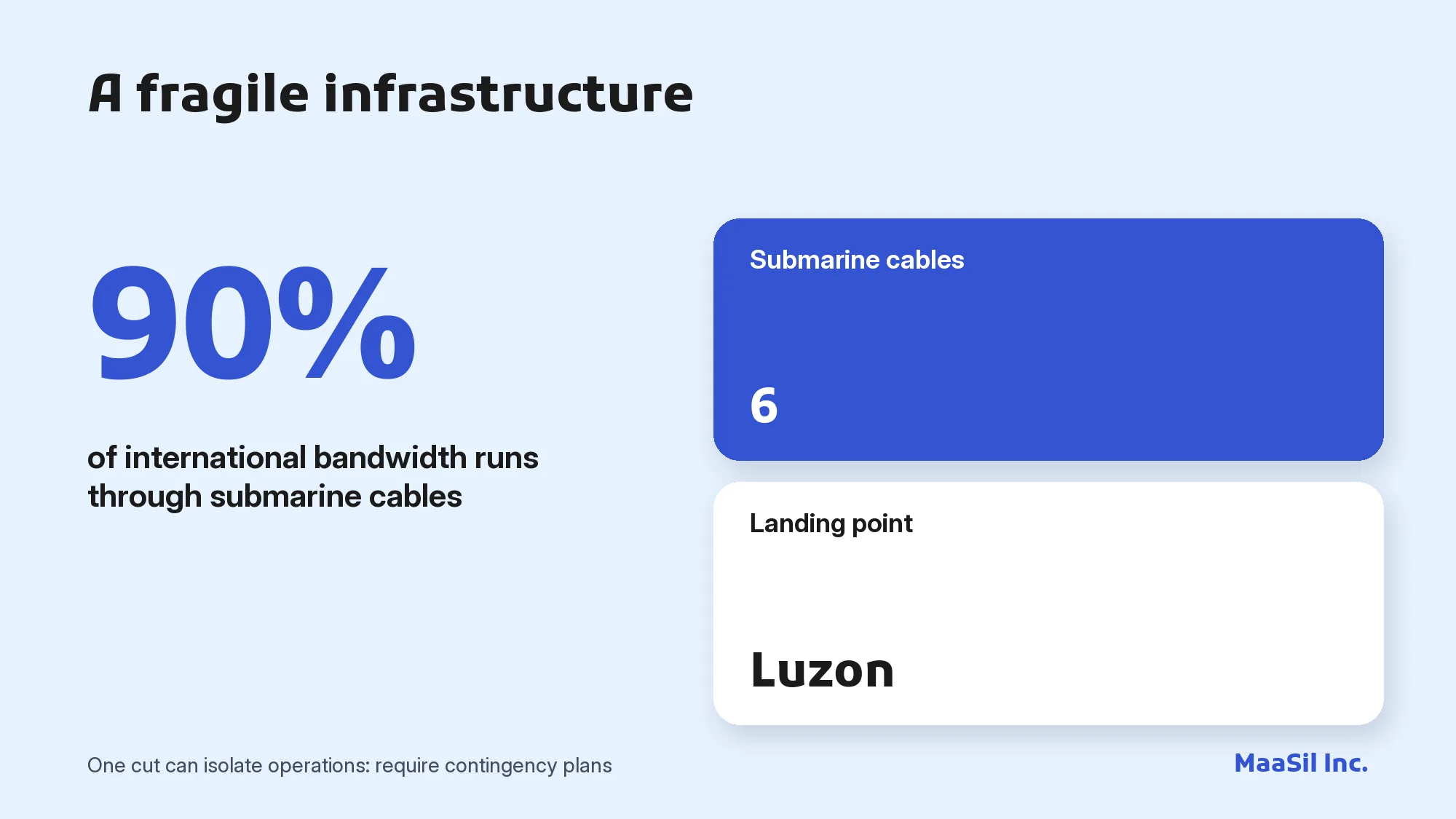
A concentrated infrastructure: continuity plans are essential.
Typhoon exposure requires redundant power infrastructure exceeding standard Tier-3 specifications. Philippines averages 20 typhoons annually (8-10 make landfall). Category 3+ storms disrupt commercial power grids for 12-72 hours. BPO infrastructure requirements exceed standard data center specs: N+1 power backup (generator capacity 125% of peak load not 100%), 72-hour diesel fuel reserves on-site (not 24-hour standard), UPS battery banks (15-minute runtime not 5-minute), solar panel arrays (daytime operations if prolonged grid failure plus fuel shortage). Cost impact: premium infrastructure adds $180-250/FTE annually versus $80-120 in low-risk geographies.
Geographic split strategy provides business continuity insurance. Structure: 70% primary capacity Manila (Makati center), 30% secondary capacity Cebu (different island, different cable landing, different power grid, different typhoon track). Normal operations: both sites run production (not hot standby). During Manila disruption: Cebu absorbs critical workload (month-end close priorities) whilst routine work pauses. Cost: 8-12% premium versus single-site (duplicate management, split technology licensing) but eliminates multi-day service gaps. Real example: 2022 Typhoon Odette hit Cebu, Manila unaffected—workload shifted north. 2023 monsoon flooding hit Manila, Cebu continued operations. Client experienced zero SLA breaches both events.
BPO Services Company Selection: Evaluating Provider Capability and Risk
Multi-tower capability claims mask domain heterogeneity. Large BPO (Concentrix, TaskUs, Alorica) markets "end-to-end services" spanning CX, F&A, IT, HR. Reality check: Concentrix heritage = customer service (20+ years, mature processes). Concentrix F&A capability = acquired smaller firm 2018 (incomplete integration, inconsistent quality). Client case study: hired Concentrix for both phone support plus accounting. Phone support SLAs: 96% achievement (strong legacy capability). Accounting SLAs: 79% achievement (weak newer domain). Blended reporting masked problem until client demanded tower-specific metrics revealing gap.
Small specialist BPO advantages in niche financial domains. 40-seat Manila provider specializing exclusively in SaaS revenue recognition (ASC 606 expertise) delivers superior outcomes versus 5,000-seat generalist handling everything. Specialist advantages: staff receive 200+ hours domain training (versus 40 hours generalist), management deeply understands narrow problem space (can spot edge cases), client gets senior attention (40-seat provider treats your 15 FTEs as 37% of business versus 0.3% at large firm). Trade-off: zero geographic redundancy (single site risk), thin management bench (if founder leaves, capability walks out door), financial fragility (one large client loss triggers collapse).
Proof-over-promises validation methodology prevents sales-reality gaps. Demand "Provide 3 references for similar work (SaaS financial services, ASC 606, similar transaction volume) with direct contact details (not cherry-picked testimonials)." Call references asking: "What was actual attrition rate (not what BPO quoted)?" "How long did transition really take versus planned?" "What hidden costs emerged?" Request live demo: "Show your team processing our actual invoice samples (anonymize) not generic sales demonstration." Site visit requirements: "Visit proposed delivery center seeing actual floor (not showcase area), interview line staff (not just managers), review real-time dashboards (not static PowerPoint reports)."
Complete FAQ: Philippine BPO Financial Services Decision Framework
Philippine BPOs are 'finance experts'—can they handle US tax nuances? Scope clarity: Philippine BPOs excel at bookkeeping (transaction coding, bank reconciliations) and reporting (GAAP-compliant journal entries, financial statement preparation following templates). NOT tax strategists—US tax code (IRC Section 199A qualified business income, 163j interest limitation, 174 R&D capitalization) requires US CPA. Philippine staff cannot sign US tax returns (state board regulations). Hybrid model works: Philippine BPO processes transactions, US CPA firm (or in-house US Controller) handles tax compliance, planning, and filing. Example: Chicago manufacturer uses Manila BPO ($1,200/FTE) for daily GL maintenance, US CPA firm ($8,500 annually) for tax returns—total $22,900 versus $65K fully-onshore staff.
What if BPO's junior staff misclassify revenue causing audit problems? Layered review mandate: contract requires two-tier QA—junior accountant enters transaction, senior CPA reviews before posting (not after). Cost impact: adds 12-15% labor cost ($1,365/FTE versus $1,200 without review) but catches 94% of errors pre-posting versus 67% post-posting correction. Client-side validation: deploy audit bots (MindBridge AI, BlackLine anomaly detection) scanning 100% of BPO entries daily flagging outliers. Example: SaaS client used BlackLine discovering 4% error rate (BPO claimed under 1%). Contract penalties enforced: $500 per material error plus remediation costs.
How do I verify BPO isn't using unlicensed software exposing me to audit? License audit clause: contract requires BPO provide proof of software licenses quarterly (screenshots showing license count, vendor invoice copies). Use client-owned licenses: provision BPO with your SAP/Oracle/NetSuite user seats (you control compliance, BPO can't markup 30-50%). Third-party audit: hire software compliance firm (Snow Software, Flexera) to remote-audit BPO's environment annually. Example: Manila BPO used "cracked" Sage 50 accounting software. Client's insurance company (cyber policy) required software audit discovering violation. BSA (Business Software Alliance) threatened client with lawsuit (vicarious liability for vendor's piracy). Client terminated BPO immediately, faced $40K legal settlement with software vendor.
Philippines is 12 hours ahead—will communication delays kill productivity? Structured overlap creates real-time windows: some Manila staff work 8pm-12am local (8am-12pm Boston) providing 4-hour synchronous collaboration period. Remaining 4 hours: staff work 8am-4pm Manila (8pm-12am Boston previous day, 12am-4am unattended). Cost: 10-15% shift differential for overlap period ($1,320-1,380/FTE versus $1,200 standard). Asynchronous infrastructure: replace email with Slack channels (threaded conversations maintain context), use Loom for video updates (2-minute video explains issue better than 400-word email), adopt "documentation-first" culture (decisions recorded in Confluence, not tribal knowledge).
How do I protect against submarine cable cuts disrupting month-end close? Geographic redundancy: split finance operations 70% Manila (Makati), 30% Cebu (Visayas island, different cable landing). Both sites run production daily (not hot-standby). During cable disruption: Cebu handles critical close activities whilst Manila does offline work (data entry, reconciliations that sync when connection restores). Cost: 8-12% premium ($1,305/FTE blended versus $1,200 single-site) but eliminates multi-day service gaps. Alternative: contractual SLA carve-out "Force majeure applies to submarine cable failures (confirmed by Philippine internet exchange), client receives pro-rated credit but no termination right."
Can I trust Philippine BPO's CPA credentials or are licenses fake? Verification methodology: Philippine PRC (Professional Regulation Commission) maintains public online registry at verification.prc.gov.ph. Request CPA license numbers from all senior BPO staff (Manager level and above). Verify each number showing: name matches, license status "active" not "expired/suspended," specialization if applicable. Red flag: BPO claims "CPA-equivalent" without license number (meaningless designation—either licensed or not). Contract language: "Minimum 60% of Client's team must hold active PRC-CPA license verified via PRC registry. BPO must provide updated verification screenshots quarterly." Penalty: "Each FTE below 60% threshold triggers $200/month penalty until remediated."
What happens if PEZA tax incentive expires mid-contract doubling my costs? Contract protection clause prevents surprises: "Provider pricing includes all taxes current and future (income tax, VAT, withholding, local business taxes). Provider absorbs any tax increases including but not limited to PEZA incentive expiration, corporate tax rate changes, new digital services taxes." If BPO resists (won't take tax risk): alternative structure "PEZA tax savings must be explicitly itemized in monthly invoicing showing (a) base labor/overhead cost, (b) PEZA tax credit applied, (c) net invoice total. Upon PEZA expiration or rate change, parties will renegotiate price increase with costs split 50% Client, 50% Provider." Benchmark validation: compare PEZA zone BPO quote versus non-PEZA BPO quote. If PEZA provider 20%+ cheaper, red flag that future tax increase not priced into model. If within 5%, BPO already assuming incentive loss (safe).
BSP Circular 765 mentions banks—I'm a tech company, does it affect me? Indirect exposure risk: if your Manila BPO also serves Philippine banks (common—most large BPOs have bank clients), your data sits on same infrastructure (same servers, same networks, same building). BSP audits BPO's overall facility not individual client siloes. BSP examiner reviewing bank client's data security discovers your client data on non-compliant servers (e.g., encryption at rest not enabled). BSP can order facility-wide remediation affecting all clients including you (service disruptions during fixes, forced infrastructure migrations). Due diligence question: ask BPO "Do you serve BSP-regulated entities (banks, EMI, payment processors)? If yes, provide copy of most recent BSP audit report showing findings." If BPO serves banks, demand "Dedicated infrastructure not shared with bank clients" OR accept BSP-level security controls (often exceeds ISO 27001—not necessarily bad, just expensive).
Ready to strengthen your team with the best African talent?
Chat with one of our experts to discover how AI-augmented umbrella employment can integrate 100% into your processes and grow your projects.
Talk to an expert
