
Ready to strengthen your team with the best African talent?
Chat with one of our experts to discover how AI-augmented umbrella employment can integrate 100% into your processes and grow your projects.
Talk to an expert
Outsourcing & BPO Strategy
Outsourcing Companies: The Decision Framework That Prevents 62% of Contract Failures
Your business needs external capacity. Internal hiring takes 87 days. Costs spiral. Outsourcing companies promise rapid deployment at 40-65% savings. But which providers deliver versus which create operational nightmares? This guide reveals the evaluation framework separating competent vendors from disasters.
What Are Outsourcing Companies and How They Transform Business Operations
Outsourcing companies provide external teams executing business functions—customer service, IT support, software development, accounting, recruitment, HR administration. Major providers operate globally: Philippines (BPO), India (IT), South Africa (customer service), Nigeria (software development), Egypt (multilingual support), Mauritius (compliance-sensitive work), Kenya (recruitment), Tunisia (French language services).
The core value proposition combines cost arbitrage, scalability, and access to specialized skills. A South African IT support analyst costs $18,400 annually versus $66,500 domestic (UK). However, true TCO includes hidden elements: infrastructure (VPN, security tools), management overhead, quality assurance, vendor margin, and transition costs. Advertised rates of $8-12/hour become $12.40-18.60/hour fully loaded.
According to OECD Global Outsourcing Survey 2023, 82% of mid-market and enterprise companies now outsource at least one function (up from 58% in 2017). The drivers: labor cost inflation domestically (+4.8% annually), talent scarcity in specialized roles, and demand for 24/7 operations without night shift premiums.
Yet 38% of outsourcing relationships fail within 24 months (Deloitte Outsourcing Survey 2023). Root causes: poor provider selection (rushed due diligence), misaligned expectations (unrealistic cost assumptions), and inadequate governance (no KPIs, vague contracts). A US manufacturing firm selected the lowest-bid Nigerian software vendor. The provider lacked enterprise experience. Deliverables missed deadlines by 6-9 weeks consistently. Contract terminated month 14, sunk cost $180K.
How to Evaluate IT Outsourcing Partner Capabilities Without Getting Burned
Provider evaluation separates competent vendors from disasters. Technical infrastructure verification comes first. Demand proof of dedicated leased lines (minimum 100Mbps symmetric, <80ms latency to your HQ). Public internet = security breach. Request datacenter tour recordings—legitimate providers eagerly show facilities (dual ISPs, generator runtime hours, physical security, acoustic dampening).

Dedicated lines, security, governance: check the evidence before signing.
Check endpoint security deployment. EDR agents should be pre-installed with USB lockdown. Ask: "What happens if an employee inserts a personal USB drive?" Correct answer: "Device gets flagged, security investigates." Wrong answer: "We trust our staff." Nigeria and Kenya require USB port lockdown—physical data theft remains common.
Examine their RACI matrix (Responsible, Accountable, Consulted, Informed). Who owns incident escalation? Where's the escalation matrix? If they hesitate, they lack operational rigor. Review their service tower model—do they separate functions (development, testing, deployment) or run generalist teams? Specialists outperform generalists 3:1 on complex projects.
Financial Stability Verification: Request audited financial statements (last 2 years). Check revenue growth trajectory, profitability, and cash reserves. Providers with negative cash flow risk sudden shutdown. One Kenyan BPO closed abruptly mid-contract (cash flow crisis). Client's customer service vanished overnight, 72-hour scramble to re-establish support.
Ask employee headcount trend. Rapid headcount declines signal talent exodus. One Egyptian software firm lost 40% of engineers in 6 months (competitor poaching). Project velocity collapsed. Client relationship damaged.
Retention Metrics Reveal Stability: Turnover above 25% annually signals trouble. Philippines BPOs average 30-35% (high but industry norm). South Africa 15-20% (better). Nigeria software 35-45% (concerning). Ask: "What's your 24-month retention rate for senior roles?" Below 70% means constant knowledge loss.
Request client references in your industry. A provider excelling at e-commerce helpdesk may fumble SaaS B2B support. Speak to three references, ask: "What surprised you negatively in month three?" Their answers expose hidden costs: shift differential pay (+40% for nights), certification renewals ($800/person/year), QA team allocation, error insurance.
Outsourcing Financial Services vs IT vs Customer Support: Function-Specific Criteria
Function | Critical Provider Capabilities | Deal-Breaker Gaps |
|---|---|---|
Financial Services | CPA-qualified staff, SOX/GAAP knowledge, error insurance ($2M+ coverage), audit trail infrastructure, multi-currency accounting software expertise | Self-taught bookkeepers, no error insurance, unfamiliarity with your accounting software (QuickBooks, Xero, NetSuite), no segregation of duties framework |
IT Support | ITIL/CompTIA certified staff, ITSM tool experience (ServiceNow, Jira Service Desk), 24/7 NOC capabilities, remote access tools, asset management integration | Consumer-grade internet (no backup ISP), no formal ticketing system, agents lack admin rights training, no change management process |
Customer Service | Omnichannel experience (phone, email, chat, social), industry vertical specialization, quality management system (5%+ interaction evaluation), speech analytics tools | Single-channel expertise only, no QA program, vague "we train on your process" without structured curriculum, unable to provide CSAT benchmarks from current clients |
Software Development | GitHub/GitLab experience, CI/CD pipeline knowledge, specific tech stack expertise (not "we know everything"), code review processes, test automation | Generalist claims ("full-stack everything"), no code samples/portfolio, unfamiliarity with your deployment environment, lack of staging infrastructure |
Recruitment | ATS integration experience (Greenhouse, Lever, Workable), background check partnerships, video interview platform proficiency, industry-specific sourcing channels | Manual processes (email-based workflows), no structured interview training, unfamiliarity with your country's employment law, cannot demonstrate previous placement metrics |
The Specialization Test: Ask: "What's your team composition for our function?" If they say "We'll assign people after contract signing," they lack depth. Quality providers have dedicated teams—"8 CPA-qualified accountants, 12 non-CPA bookkeepers" (financial services) or "24 ITIL-certified L1 agents, 8 L2 specialists, 2 L3 escalation engineers" (IT support).
Generic answers = red flag. One Nigerian BPO claimed "150+ software developers across all technologies." When pressed about React expertise specifically, they admitted "we have 3 React developers currently, but we'll hire more." This became a problem—project started with junior hires, months wasted on training.
Outsourcing Support Services: The Governance Framework That Prevents Failures
Sixty-two percent of outsourcing failures stem from inadequate governance, not provider capability (Deloitte analysis). Companies sign contracts then operate hands-off. Dysfunction compounds silently. Proper governance requires structured oversight.

Weekly reviews during the first six months: the governance that makes the difference.
Weekly Operational Reviews (First 6 Months):
KPI review: response times, resolution rates, quality scores, customer satisfaction, backlog trends
Escalation review: what broke through to Tier 2/3, root cause analysis
Knowledge gaps: what questions stumped the team, need documentation updates
Process improvements: what friction emerged, how to streamline
After six months, shift to bi-weekly if performance stabilizes. Never go beyond monthly reviews—drift accumulates quickly.
Monthly Business Reviews (Entire Relationship):
Strategic alignment: business priority changes requiring team retraining
Financial reconciliation: invoices match agreed rates, no surprise charges
Capacity planning: upcoming volume changes, seasonal spikes
Compliance updates: regulatory changes affecting procedures
Talent management: key person dependencies, succession planning
Quarterly Executive Sponsors: Client C-level and provider C-level discuss strategic relationship health, contract renewal outlook, expansion opportunities, major risk factors. This prevents operational teams hiding problems from leadership.
The Single Point of Contact Trap: Many contracts designate one internal person as sole provider interface. That person leaves. Knowledge evaporates. Offshore team paralyzed. Solution: Minimum two internal stakeholders with full context—primary and backup. Document all key decisions in shared wiki, not email silos.
Change Management Protocol: Any process change requires formal approval: proposed change documented, impact assessment (cost, timeline, risk), approval from designated authority, communication plan, rollback procedure. Prevents the "optimization backfire"—offshore team builds automation with bugs causing security breaches (happened with South African helpdesk resetting disabled accounts, re-enabling 47 terminated users).
HR Outsourcing Services Malaysia vs Africa vs Philippines: Geographic Provider Comparison
Location | Provider Strengths | Typical Functions | Cost Range (Loaded) | Key Limitations |
|---|---|---|---|---|
Malaysia | Multilingual (English, Mandarin, Malay), strong IT infrastructure, regional hub for Asia-Pacific | Shared services centers, finance/accounting, IT support for APAC | $9-15/hour | Higher costs than Philippines/Africa, cultural distance from Western clients |
Philippines | US cultural alignment, excellent English, 24hr timezone coverage for Americas, mature BPO industry | Customer service, technical support, back-office processing, creative services (graphics, content) | $6-11/hour | Accent-neutral agents now +35% premium, typhoon season disruptions (June-November), saturation driving wage inflation |
South Africa | Neutral English accent, strong financial services expertise, GAAP familiarity, stable infrastructure | Customer service (voice), accounting, recruitment, technical support | $10-17/hour | 15% annual salary inflation, power load-shedding (scheduled blackouts), limited US night shift availability |
Nigeria | Large talent pool (200M population), entrepreneurial culture, software development strength, low cost | Software development, data entry, email/chat support, content moderation | $8-14/hour | Power infrastructure gaps, accent bias from UK clients (18% request "someone I can understand"), internet reliability varies |
Kenya | Strong mobile/tech skills, excellent written English, recruitment specialization | Recruitment outsourcing, virtual assistants, chat support, data processing | $7-13/hour | British English idiom gaps (vs American), infrastructure quality varies outside Nairobi |
Egypt | Arabic/English bilingual, growing tech hubs, French-language capabilities (depending on education) | Software development, multilingual customer support, technical writing | $8-14/hour | ISP throttling during peak hours, bureaucratic business environment, geopolitical considerations for Israeli clients |
Mauritius | Strong IP protection, DPA compliance (EU adequacy status), financial services specialization | Compliance-sensitive work, accounting, financial analysis, legal process outsourcing | $12-19/hour | Smaller talent pool (1.3M population), higher costs (40% above Nigeria), limited scalability |
Tunisia | French/English bilingual, EU timezone alignment, strong engineering education | French-language customer support, software development for Francophone markets, technical support | $10-16/hour | French-speaking tech talent commands +30% premium, bureaucratic company registration |
Geographic Selection Framework:
For US Clients:
24/7 operations → Philippines (opposite timezone = natural coverage)
Cost optimization → Nigeria, Kenya (lowest rates)
Voice-heavy customer service → South Africa (accent)
Financial services → South Africa, Mauritius (compliance expertise)
For UK/EU Clients:
Customer service → South Africa, Nigeria, Kenya (timezone overlap + cost)
French language → Tunisia, Mauritius (Francophone talent)
Compliance-sensitive → Mauritius (DPA adequacy status)
Software development → Nigeria, Egypt (cost + quality balance)
For APAC Clients:
Regional hub operations → Malaysia (multilingual, infrastructure)
Cost optimization → Philippines (lower than Malaysia)
Arabic language needs → Egypt (bilingual talent)
IT Staff Outsourcing: The Hybrid Model vs Full Outsourcing Trade-Off
The 70/30 hybrid model balances cost and control. Seventy percent offshore execution, 30% internal strategic roles:

70% offshore execution, 30% strategic roles in-house.
Internal Team Owns:
Architecture and design decisions
Client relationship management (enterprise accounts, C-level interactions)
Compliance oversight (SOX, GDPR, HIPAA, industry-specific regulations)
Vendor management (managing the outsourcing company)
Strategic planning and roadmap
Offshore Team Owns:
Execution and implementation (build what's been designed)
BAU operations (business as usual, keep-the-lights-on work)
Volume work (ticket processing, data entry, repetitive tasks)
After-hours monitoring (follow-the-sun support)
Testing and quality assurance
This structure prevents the "knowledge hostage" scenario. A US fintech outsourced 100% of infrastructure management to Nigeria, then fired the entire internal IT team (cost cutting). When the BPO contract expired (pricing dispute), the firm had zero in-house capacity. Emergency re-hiring took five months, costing $340K in contractor rates plus system instability during transition.
The Retained Organization Concept: Even heavily outsourced functions need internal "intelligent customer" capability—someone who understands the work deeply enough to evaluate provider performance, catch errors, and manage escalations. A UK retailer outsourced all accounting to Mauritius. No internal finance staff remained except CFO. Small errors (wrong GL codes) compounded for months undetected. Annual audit discovered $280K in misclassified expenses. No one internal had expertise to catch it in real-time.
Rule of thumb: Maintain minimum 20-30% internal capacity for any outsourced function. This provides:
Knowledge continuity when provider relationship ends
Quality oversight capability
Escalation handling for edge cases
Strategic direction setting
Hybrid Team Members: One person splits time 50% onsite, 50% offshore hub. This "living bridge" translates context, catches cultural misunderstandings, and maintains knowledge flow. Bi-annual "reverse knowledge transfer" sessions force offshore teams to document everything—wiki entries, runbooks, architecture decision records, not just "how to deploy" but "why we built it this way."
Disadvantages of IT Outsourcing: The Tribal Knowledge Slack Trap
Ninety percent of troubleshooting knowledge lives in Slack threads, unsearchable after 90 days on free plans. Offshore teams aren't invited to critical channels. They see only formal documentation (often outdated). A complex system breaks. The offshore team follows runbooks—no resolution. Internal engineers fix it quickly via tribal knowledge ("Oh, you have to restart service B BEFORE service A, not documented anywhere"). The client blames offshore incompetence.
Root cause: Shadow IT knowledge never formalized. The "Eternal September" documentation rule solves this—anything resolved in chat gets wiki entry within 48 hours. Painful initially (slows internal team), essential for knowledge transfer.
The Communication Filtering Loss: Email loses 70% of nuance versus in-person conversation. Sarcasm, urgency, frustration—all flatten in text. A US client emailed Egyptian team: "Let's table this discussion until next week." The team shelved the project indefinitely. In American English, "table" means postpone briefly. In British English (which Egyptians learn), "table" means bring up for immediate discussion. Result: three-week project delay.
Solution: Loom Video Messages Screen recordings with voiceover preserve tone, show exactly what you mean. "Click here, then here, see the error?" becomes infinitely clearer than text description. Tool investment: $15/user/month. Time savings: 40% reduction in back-and-forth clarifications.
The Attrition Knowledge Gap: Philippines BPO averages 30-35% annual turnover. A customer service agent trained for six weeks leaves month eight. Replacement training costs $2,400. High-turnover environments require documentation obsession: record every training session, maintain decision trees for complex scenarios, create searchable knowledge bases with "why" not just "how."
Language Proficiency Reality: Self-reported "fluent English" often means functional, not fluent. Technical writing requires precision. "The server is having issues" (vague) versus "The server returns HTTP 503 errors under 1000+ concurrent connections" (actionable). Offshore teams need technical writing training, not just conversational English.
One Nigerian software team reported "API integration complete." Client tested—didn't work. Team meant "code written" not "tested and working." Different interpretation of "complete." Explicit definition frameworks prevent this: "Complete = code written + unit tests passing + integration tests passing + deployed to staging + client sign-off."
Recruitment Outsourcing Companies UK: The Cultural Interpretation Trap
UK firms outsourcing recruitment to Kenya or Nigeria face cultural interpretation gaps causing disasters. A London fintech briefed Kenyan recruiters: "We want proactive sourcing, take initiative." The recruiter called a candidate's current employer to verify employment—standard practice in Kenya. The employer discovered the job hunt. The candidate withdrew, threatened legal action. Contract terminated.
"Proactive" has different operational boundaries. In Kenya, reference checks during active recruitment = normal. In UK/US, contacting current employers pre-offer = blacklisted practice. Offshore teams need "negative instructions" (what NOT to do), not just positive goals.
Negative Instructions for Recruitment Outsourcing:
DON'T contact current employers for references (candidate consent required first, usually post-offer only)
DON'T share compensation ranges without client approval (market positioning sensitivity)
DON'T make hiring timeline promises to candidates without checking with client
DON'T send candidate profiles to multiple clients simultaneously (ethical breach)
The ATS Integration Failure: API tokens expire. Uganda and Kenya teams don't receive notifications. Data sync fails for weeks silently. Recruiters work from outdated candidate status—calling people already hired, missing new applicants. Monthly API health checks and renewal reminders prevent this.
Background Check Tool Gaps: Certn, Checkr, Sterling have geographic coverage limitations. Liberia and Sierra Leone criminal databases remain non-digitized. Recruiters assuming "system will flag issues" miss this. Manual processes required for certain countries—phone calls to courthouses, physical records checks.
Video Interview Bandwidth: HireVue, Spark Hire require 5Mbps upload. Malawi average upload = 2Mbps. Candidates experience frozen screens, audio dropouts, poor impression. Solution: Test candidate bandwidth before scheduling, offer phone interview alternative for low-bandwidth locations.
Advantages of Outsourcing Payroll Services: The Compliance Specialization Value
Payroll outsourcing delivers value beyond cost savings through compliance specialization. Domestic payroll managers handle one country's regulations. Mauritius or South African payroll BPOs handle 15-30 countries routinely—deeper expertise in multi-jurisdiction compliance.
A UK manufacturer expanding to Nigeria, Kenya, South Africa hired internal payroll manager. That person spent 8 months learning three countries' tax codes, statutory benefits, labor laws. Still made errors—Nigerian 13th month salary calculation wrong, Kenyan NHIF contributions miscalculated. Penalties totaled £18K.
Alternative: Mauritian payroll BPO charges $45/employee/month. Handles all three countries with established compliance frameworks. Includes tax filing, statutory reporting, benefits administration. Total cost $32,400/year for 60 African employees versus $68K internal payroll manager salary plus $18K penalties.
The Regulatory Update Burden: IRS changes 401(k) limits mid-year. HMRC adjusts National Insurance thresholds. These updates flow constantly. Internal payroll staff must monitor legislative changes across every operating country. BPO providers employ dedicated compliance teams tracking regulatory shifts—Ghana bookkeeper processing US payroll gets instant alerts when US payroll tax rates change.
Multi-Currency Complexity: Exchange rate API failures during weekend transactions (markets closed) cause posting delays. Manual interventions required. BPOs have established protocols: alternative exchange rate sources, manual override procedures, reconciliation frameworks. Internal teams improvise, creating errors.
However, payroll outsourcing creates dependency. Provider error? You're still liable to employees and tax authorities. One South African BPO miscalculated PAYE for 3 months. Client faced penalties plus angry employees (incorrect net pay). Mitigation: Monthly payroll audits spot-checking 10% of calculations independently.
Benefits of Business Process Outsourcing: The Scalability Without Hiring Friction
BPO providers deploy teams 85% faster than internal hiring. Domestic recruitment takes 47 days average (US Bureau of Labor Statistics): job posting, resume screening, interviews, background checks, offer negotiation, notice period, onboarding. BPO delivers trained teams in 14-21 days.
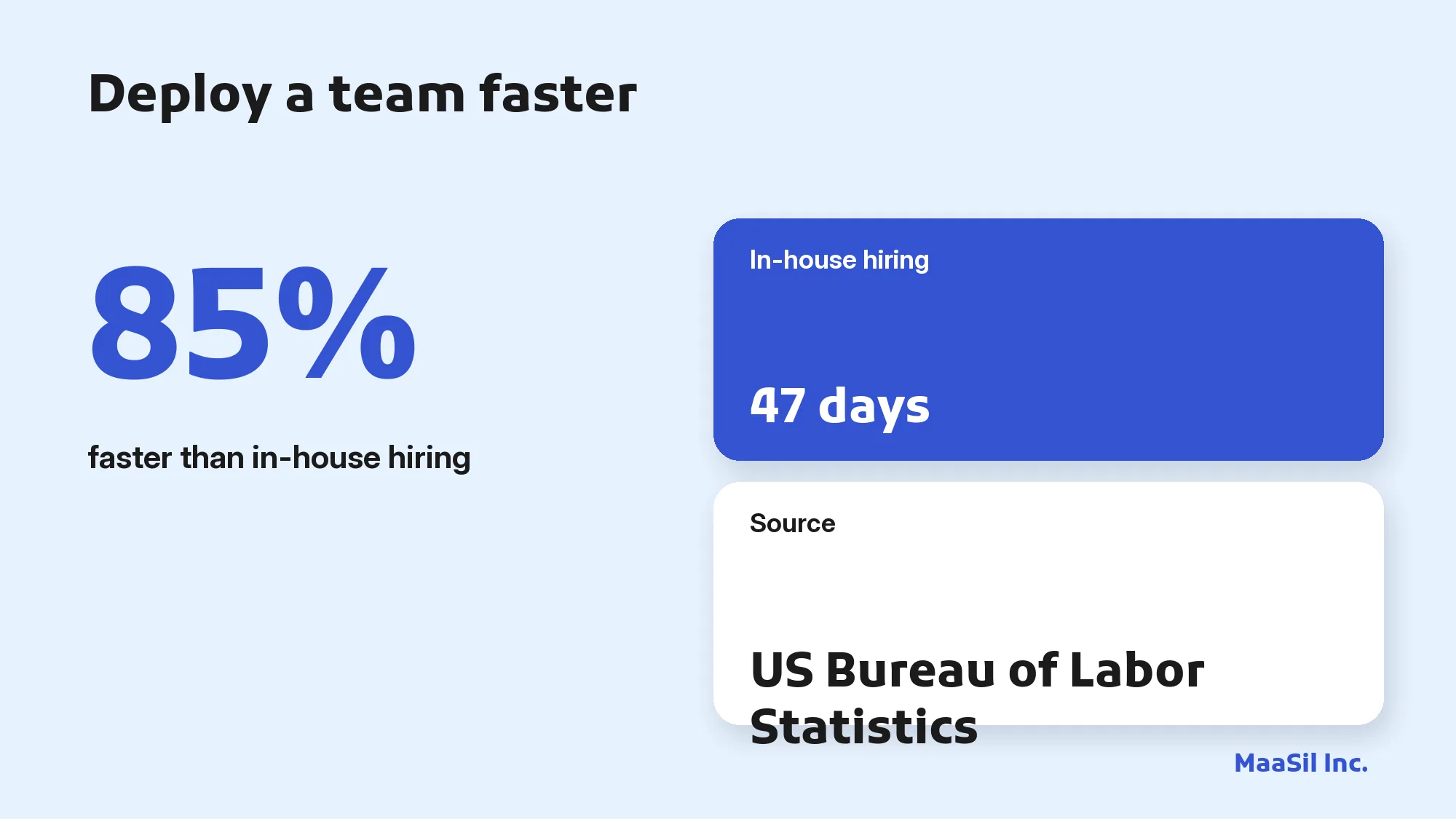
Deployment speed is an often underestimated BPO advantage.
A US e-commerce retailer needed 40 customer service agents for Black Friday (8 weeks away). Domestic hiring would miss deadline. Philippines BPO delivered trained team in 19 days: week 1 (recruitment from existing talent pool), week 2 (product training), week 3 (systems access and shadowing). Handled 63% volume increase successfully.
The scalability applies bidirectionally. Post-holiday, retailer reduced team from 90 to 50 agents (2-week notice to BPO). Domestic equivalent: 40 layoffs, severance packages ($120K estimated), unemployment insurance premium increases, low team morale. BPO model: contract flexibility without internal HR trauma.
Seasonal Demand Patterns:
Tax preparation firms: 300% volume increase January-April, then drop. BPOs scale teams accordingly.
Retail: Black Friday through Christmas surge. Predictable annual pattern.
Travel: Summer peak for Northern Hemisphere destinations.
Education: Application processing cycles for universities.
These patterns make internal staffing inefficient (overstaffed 60% of year or understaffed during peaks). BPO flexible capacity optimizes cost.
The Test-Before-Commit Value: Unsure if a new business function works? Outsource initially as pilot. A UK SaaS company considered 24/7 support but uncertain if customers would use night hours. Contracted South African BPO for 6-month trial. Night tickets = 8% of volume (lower than expected). Didn't justify full internal night shift team. BPO model allowed testing hypothesis without permanent hiring commitment.
Outsourcing Recruitment Services: The Quality vs Cost Balance
Recruitment outsourcing suits high-volume sourcing (50+ hires/year) but struggles with executive search or specialized roles. Kenyan recruiters cost $15K annually versus $68K domestic, handling 3x application volume through disciplined process adherence.
However, quality gaps emerge in edge cases. A German automotive firm outsourced embedded systems engineer recruitment to Egypt. Recruiters lacked technical depth to assess candidates. Submitted 40 profiles, only 6 met minimum qualifications (client engineering team filtered). Wasted review time.
The Feasibility Test: Can you create structured scorecard making assessment objective? If yes, outsource works. If no (requires intuitive "you know it when you see it" judgment), keep internal.
Perfect for Outsourcing:
High-volume hourly roles (retail, hospitality, call center)
Administrative positions (clear skill requirements)
Technical roles with objective tests (coding challenges for developers)
Early-stage screening (resume review, phone screens)
Dangerous to Outsource:
Executive search (C-level, VP-level—relationships and cultural fit critical)
Highly specialized technical roles (niche skill sets)
Culture-fit dependent positions (early-stage startup roles)
Employer brand building (requires deep company knowledge)
The RPO (Recruitment Process Outsourcing) Model: Full-function recruitment outsourcing where provider becomes your recruiting department. Handles sourcing, screening, interview coordination, offer management. Works for companies hiring 100+ people annually. Below that volume, cost per hire doesn't justify full RPO investment—use project-based recruiting instead (pay per placement).
Which processes should you outsource first? Let's review it in 30 minutes. Book a free audit →
Disadvantage of Outsourcing: The Compliance Retrofit Surprise
Regulatory changes mid-contract create unexpected costs. A Mauritius accounting team served EU client flawlessly for 18 months. Then US private equity firm acquired the client. New parent mandated SOX compliance audits. Auditors discovered offshore accountants had database delete permissions in ERP—SOX violation (segregation of duties breach).
Options: terminate outsourcing or re-architect permissions model. Remediation cost $45K. Initial contract lacked "regulatory change" clauses with cost-sharing provisions. Client absorbed full expense.
The Data Residency Shift: Nigeria proposed data localization legislation (2023) requiring customer data remain in-country. BPO contracts without jurisdiction clauses faced potential forced migration costs. Egypt restricts certain encryption software exports—developers couldn't use standard security libraries without government approval (6-week bureaucratic delay).
GDPR Misunderstanding: One UK client rejected Nigerian BPO: "Africa isn't GDPR compliant." Incorrect—GDPR applies to data controllers (the client), not processor location. Mauritius has EU adequacy status. However, perception persists. Requires client education.
Insurance Coverage Gaps: BPO E&O insurance typically caps at $1M—insufficient for major data breaches. Cyber liability policies exclude "failure to follow client procedures" (the most common loss cause). Clients need their own cyber insurance covering third-party vendor incidents. One US healthcare firm faced $2.4M breach fine after Philippines BPO laptop theft exposed patient records. BPO insurance paid $1M maximum. Client absorbed $1.4M.
Solution: Compliance Clauses:
Regulatory change notification: Provider must alert client within 10 days of relevant regulatory changes
Cost sharing: Major compliance retrofits (>$25K) trigger negotiation, not automatic client payment
Audit rights: Client can audit provider compliance quarterly
Insurance minimums: Specify E&O coverage ($5M+), cyber liability ($10M+), with client named as additional insured
Data breach protocol: Define notification timeline (<24 hours), forensic investigation requirements, customer communication responsibilities
Conclusion: The Provider Selection Framework That Works
Outsourcing companies deliver 40-65% cost savings when selected rigorously and governed properly. Success requires moving beyond price comparison to comprehensive evaluation: technical infrastructure verification (datacenter tours, endpoint security, network redundancy), financial stability checks (audited statements, cash reserves), retention metrics (24-month rates for senior roles), and client reference conversations exposing hidden costs.
Function-specific criteria matter. Financial services outsourcing demands CPA qualifications, error insurance, and SOX knowledge. Software development requires specific tech stack depth, not generalist claims. Customer service needs omnichannel experience, quality management systems, and speech analytics tools.
Geographic selection depends on client location and function type. Philippines optimizes for US 24/7 operations. South Africa suits UK/EU voice customer service. Nigeria and Kenya offer lowest costs for email/chat support and software development. Mauritius provides compliance-sensitive work capabilities.
The 70/30 hybrid model prevents knowledge hostage scenarios: 70% offshore execution, 30% internal strategic roles (architecture decisions, client relationships, compliance oversight, vendor management). Maintain minimum 20-30% internal capacity for any outsourced function as insurance.
Governance frameworks prevent 62% of failures: weekly operational reviews (first 6 months), monthly business reviews, quarterly executive sponsors, formal change management protocols. The "Eternal September" documentation rule—anything resolved in chat gets wiki entry within 48 hours—prevents tribal knowledge traps.
Hidden costs add 35-55% to advertised rates: payroll taxes, benefits, infrastructure, QA overhead, vendor margin, management time. Budget $12.40-18.60/hour fully loaded for roles advertised at $8-12/hour. Transition costs ($25K-40K per function) defer ROI to months 8-12.
Perfect candidates for outsourcing: high-volume repetitive work, clearly defined processes, measurable outputs (tickets, code commits, data entries), seasonal scaling needs. Dangerous candidates: strategic decision-making, client relationship ownership, highly specialized expertise, functions requiring deep tacit knowledge.
The question isn't whether to use outsourcing companies—it's whether you'll implement the evaluation and governance rigor separating successful partnerships from failed contracts.
Which processes should you outsource first? Let's review it in 30 minutes. Book a free audit →
Frequently Asked Questions About Outsourcing Companies
How do I verify an outsourcing company won't steal IP or customer data? Technical controls matter, not just contracts. Verify: DLP (Data Loss Prevention) blocking copy-paste and USB drives, VDI (Virtual Desktop Infrastructure) so no data touches offshore devices, watermarking with embedded user IDs tracing leaks, network segmentation limiting access to specific systems only. Request datacenter tour showing physical security (badge access, cameras, visitor logs). Check background verification protocols (criminal + credit history checks for all staff). NDAs are worthless without enforcement mechanisms—structure contracts under jurisdictions with IP protection (Singapore, UK, Mauritius). Departing internal employees pose higher theft risk than monitored offshore teams.
What's the true cost difference between advertised rates and reality? Advertised $8-12/hour becomes $12.40-18.60/hour fully loaded. Hidden costs: employer payroll taxes (20-25%), legally mandated benefits (13th month salary in Tunisia, housing allowances in Egypt), infrastructure (VPN circuits $15K/year, endpoint security tools $40/user/year), QA overhead ($2.40-4.80/agent/month), management time (internal project manager 20-30% capacity), vendor margin (15-25%), shift differentials (+40% for night coverage). Budget conservatively using loaded rates, not base. Transition costs ($25K-40K per function) plus 90-day ramp period delay ROI to months 8-12.
How do I prevent the "knowledge hostage" scenario if the relationship ends? Implement 70/30 hybrid model: 70% offshore execution, 30% internal strategic roles (architecture, compliance, vendor management, client relationships). Maintain minimum 20-30% internal capacity for any outsourced function. Bi-annual "reverse knowledge transfer" sessions force offshore teams to document everything in wiki: runbooks, architecture decision records, process flows, decision rationale (not just "how to deploy"). Hybrid team members split 50% onsite, 50% offshore creating "living bridge." Escrow arrangements hold critical documentation with third party. Never outsource 100% of a function then fire entire internal team—you've created dependency.
Which functions should never be outsourced versus perfect candidates? Perfect candidates: High-volume repetitive work (data entry, L1 helpdesk tickets), clearly defined processes with objective quality metrics, seasonal scaling needs (retail holiday surge), 24/7 coverage without night shift premiums, non-customer-facing back-office (AP/AR processing, payroll). Dangerous/Never outsource: Strategic decision-making (product roadmap, architecture design), C-level client relationships, crisis management requiring instant context, highly specialized roles with small talent pools, functions with heavy tacit knowledge ("you had to be there" context), regulatory submissions requiring deep company knowledge (FDA, SEC filings), employer brand development.
How do I structure contracts to prevent scope creep and surprise costs? Explicit service definitions with measurable SLAs: "respond to Tier 1 tickets within 2 business hours" not vague "timely support." Define business hours precisely (include timezones, holiday calendars, weekend policies). Specify included vs excluded work: "included = password resets, software installs, VPN troubleshooting; excluded = new system deployments, infrastructure upgrades, security incidents." Fixed monthly fee for defined volume bands (0-500 tickets, 501-1000 tickets) with per-ticket overage rates. Regulatory change clauses triggering cost renegotiation for compliance retrofits >$25K. Change management protocol requiring written approval for any scope additions. Monthly invoice reconciliation meetings catching drift early. Renewal clauses with 6-month notification preventing surprise pricing changes.
Ready to strengthen your team with the best African talent?
Chat with one of our experts to discover how AI-augmented umbrella employment can integrate 100% into your processes and grow your projects.
Talk to an expert
