
Prêt à renforcer votre équipe avec les meilleurs talents africains ?
Discutez avec l'un de nos experts pour découvrir comment le portage salarial augmenté à l'IA peut s'intégrer à 100 % à vos process et faire grandir vos projets.
Échangez avec un expert
Stratégie d'Externalisation & BPO
Avantages de l'externalisation des services comptables : une réduction des coûts de 67 % avec une précision de 99,4 %
Les équipes comptables internes coûtent entre 68 000 $ et 95 000 $ par ETP, alors que les taux d'erreur avoisinent les 3,2 %, ce qui crée un risque de conformité. L'externalisation des services comptables vers des prestataires basés aux Philippines, à l'Île Maurice ou en Afrique du Sud permet d'obtenir le même travail pour 18 000 $ à 34 000 $ par an avec une précision de 99,4 % (analyse comparative d'Everest Group). Mais perdrez-vous le contrôle financier ? Les équipes délocalisées comprendront-elles votre plan comptable ? Ce guide révèle quand l'externalisation de la comptabilité crée de la valeur et quand elle mène au désastre.
Quels sont les avantages de l'externalisation de la comptabilité au-delà des simples économies de coûts ?
L'externalisation de la tenue de livres et des services comptables transfère le traitement des transactions financières, le rapprochement et le reporting à des spécialistes externes. Les fonctions clés comprennent : le traitement des comptes fournisseurs, la gestion des comptes clients, le rapprochement bancaire, le traitement de la paie, la catégorisation des dépenses, la clôture mensuelle, la préparation des états financiers et la comptabilité multidevises. Les hubs géographiques sont : les Philippines (traitement des transactions à volume élevé), l'Île Maurice (activités sensibles à la conformité, adéquation avec l'UE), l'Afrique du Sud (expertise GAAP) et l'Égypte (capacités multilingues).

Précision, conformité, évolutivité : les bénéfices dépassent la seule baisse des coûts.
Les avantages quantifiables vont bien au-delà de l'arbitrage salarial :
1. Amélioration de la précision (gains de qualité mesurables) La tenue de livres interne affiche un taux de précision moyen de 96,8 % (enquête de l'American Payroll Association, entreprises de <500 employés). Les spécialistes de la comptabilité délocalisée atteignent en moyenne 99,4 % de précision (analyse comparative d'Everest Group, prestataires du premier quartile). Cet écart de 2,6 points de pourcentage est crucial à grande échelle.
Une entreprise traitant 200 transactions par mois avec une précision de 96,8 % :
Transactions annuelles : 2 400
Erreurs : 77 par an (2 400 × 3,2 %)
Temps de correction : 45 minutes en moyenne par erreur = 58 heures par an
Coût de la correction : 2 262 $ (58 heures × tarif mixte de 39 $/heure)
Risque d'audit : Un taux d'erreur plus élevé entraîne un contrôle d'audit accru
La même entreprise utilisant un prestataire délocalisé avec une précision de 99,4 % :
Erreurs : 14 par an (2 400 × 0,6 %)
Temps de correction : 11 heures par an
Coût : 429 $
Économies : 1 833 $ par an plus une réduction du risque d'audit
La cause fondamentale de l'avantage de précision de l'externalisation réside dans la spécialisation et la discipline des processus. Un comptable interne gère la comptabilité, l'administration des RH et la gestion de bureau (attention divisée). Le spécialiste comptable délocalisé traite exclusivement les transactions de 8 à 12 entreprises clientes, développant ainsi une reconnaissance des schémas récurrents. Des flux de travail basés sur des listes de contrôle, vérifiés par un réviseur d'assurance qualité avant la validation finale, permettent de détecter les erreurs avant leur enregistrement.
2. Spécialisation en matière de conformité (profondeur de l'expertise réglementaire) Les comptables internes gèrent les réglementations d'une seule entreprise. Les prestataires délocalisés gérant plus de 50 clients dans plusieurs juridictions développent une expertise plus approfondie que le personnel d'une seule entreprise.
Une startup technologique californienne (65 employés) a embauché un comptable interne pour 72 000 $ par an. Cette personne a passé 4 mois à apprendre les exigences spécifiques de la Californie : l'impact des pauses repas/repos sur les salaires, les règles de confidentialité de la PIPA affectant la paie, les ordonnances locales sur les congés de maladie variant selon les villes, les procédures d'indemnisation des accidents du travail de la WCAB et les règles de présence fiscale pour la taxe sur les ventes. Malgré cela, elle a commis des erreurs, classant de manière générique 43 000 $ de dépenses de R&D (qui auraient dû être admissibles au crédit d'impôt R&D de Californie), ce qui a fait perdre 9 800 $ de crédits d'impôt disponibles.
Alternative : Un BPO comptable à l'Île Maurice facture 21 $/heure (3 360 $ par mois pour 160 heures, soit 40 320 $ par an). Le personnel possède des qualifications équivalentes à celles d'un expert-comptable (ACCA, CGA) et gère la conformité californienne grâce à des cadres établis : suivi des crédits R&D, taxe sur les ventes multi-juridictionnelle, surveillance des ordonnances locales et précision de la classification des accidents du travail. Zéro erreur de codage, tous les crédits disponibles ont été obtenus.
La charge de la mise à jour réglementaire est transférée au prestataire. Si l'IRS modifie les règles d'amortissement en milieu d'année, l'équipe de conformité du BPO aux Philippines surveille les mises à jour législatives, ajuste immédiatement les procédures et forme le personnel délocalisé aux nouvelles exigences. Un comptable interne doit effectuer cette veille lui-même, au risque de passer à côté de mises à jour, ce qui peut coûter des milliers de dollars en pénalités ou en déductions perdues.
3. Évolutivité sans embauches successives Modèle comptable interne : Embaucher un comptable pour une capacité de 50 transactions/jour, un second lorsque le volume augmente, un contrôleur à partir de 1M$ de chiffre d'affaires, et un CFO à partir de 5M$. Chaque embauche équivaut à un coût fixe et à une période d'adaptation de 3 mois.
Modèle délocalisé : La capacité flexible s'adapte proportionnellement. Si le volume de transactions augmente de 40 % (pic saisonnier, acquisition, croissance), le prestataire alloue des heures supplémentaires, sans nouvelle embauche. Une entreprise SaaS est passée de 2,8M$ à 9,2M$ de chiffre d'affaires en 18 mois. En comptabilité interne, cela aurait nécessité l'ajout de 1,5 ETP en pleine croissance (plus de 108 000 $ en salaire, recrutement et formation). En externalisation, le volume est passé de 120 heures/mois à 285 heures/mois (de 2 520 $ à 5 985 $ par mois, au tarif de 21 $/heure). Aucun délai de recrutement, aucune période d'intégration et aucun engagement fixe en cas de ralentissement de la croissance.
4. Accélération de la clôture mensuelle Les équipes internes clôturent les comptes en 8 à 12 jours ouvrables en moyenne (enquête du Journal of Accountancy, PME). Les prestataires délocalisés dotés de procédures documentées clôturent en 4 à 6 jours ouvrables. Cette réduction des délais permet une visibilité financière plus rapide pour la prise de décision.
Une entreprise manufacturière (12M$ de chiffre d'affaires) clôturait ses comptes au jour 10 après la fin du mois (équipe interne). La direction recevait le compte de résultat au jour 12. Elle a découvert une perte de stock de 180 000 $ trop tard pour enquêter (la piste étant froide après 2 semaines). Elle est passée à un BPO comptable à l'Île Maurice qui clôture au jour 5. Les problèmes de fin de mois ont été identifiés lorsqu'ils étaient encore récents, permettant une réponse rapide. La perte de stock a été détectée au jour 7, l'enquête a identifié une faille dans le processus et celle-ci a été corrigée immédiatement. La perte annuelle de stock a été réduite de 34 %.
5. Assurance contre les erreurs / Protection financière Les prestataires délocalisés disposent d'une assurance E&O (Erreurs et Omissions), généralement avec une couverture de 2M$ à 5M$. S'ils calculent mal des taxes, entraînant des pénalités, leur assurance couvre les coûts de rectification. En cas d'erreurs comptables internes, l'entreprise assume l'entière responsabilité financière.
Le comptable interne d'un détaillant américain a mal calculé le lien fiscal pour la taxe sur les ventes (sans réaliser qu'un entrepôt temporaire créait une présence physique déclenchant ce lien). Cela a été découvert lors d'un audit. Arriérés d'impôts + pénalités : 87 000 $. Sans assurance, l'entreprise a payé la totalité.
Alternative délocalisée avec couverture E&O : Si la même erreur se produit, l'assurance du prestataire paie les pénalités (après une franchise classique de 5 000 $ à 10 000 $). L'exposition de l'entreprise est limitée, par rapport à une responsabilité totale.
Cependant, ces avantages nécessitent une mise en œuvre adéquate. Les transitions précipitées (passations de 30 jours) annulent les gains de précision. Les lacunes dans le transfert de connaissances provoquent des erreurs de codage. Des règles de plan comptable mal définies entraînent des erreurs de classification. Un calendrier de transition de 90 à 120 jours (30 jours de documentation + 30 jours d'observation + 30 jours en parallèle + 30 jours de support post-mise en service) permet de concrétiser ces avantages.
Quels processus externaliser en premier ? Faisons le point en 30 min. Réserver un audit gratuit →
Les avantages de l'externalisation informatique appliqués aux fonctions comptables : le parallèle avec l'intégration des systèmes
L'externalisation informatique offre des leçons applicables à l'externalisation comptable. Les deux nécessitent des intégrations de systèmes, des protocoles de sécurité, des plans de reprise après sinistre et une gestion des connaissances. Le parallèle opérationnel :
Structure de l'externalisation du support informatique :
Intégration du système de tickets (ServiceNow, Jira)
Base de connaissances pour les procédures de dépannage
Matrice d'escalade définissant le niveau 1, le niveau 2 et le niveau interne
Suivi des SLA (temps de réponse, temps de résolution, CSAT)
Gestion du changement pour toute modification de processus
Structure de l'externalisation comptable :
Intégration de logiciels comptables (QuickBooks, Xero, NetSuite, Sage Intacct)
Manuel de codage du grand livre documentant les règles de catégorisation
Voies d'escalade pour les transactions complexes par rapport au traitement de routine
Suivi des SLA (délai d'enregistrement, calendrier de rapprochement, livraison des rapports)
Approbation des changements pour les modifications du plan comptable ou les mises à jour de procédures
La matrice RACI (Responsable, Comptable/Décideur, Consulté, Informé) prévient 47 % des échecs :
Activité | Équipe délocalisée | Finance interne | Notes |
|---|---|---|---|
Saisie des factures fournisseurs | Responsable | Comptable/Décideur | L'équipe externe saisit, l'équipe interne approuve avant le paiement |
Rapprochement bancaire | Responsable | Informé | L'équipe externe rapproche, l'équipe interne est notifiée des écarts |
Catégorisation des dépenses | Responsable | Comptable/Décideur | L'équipe externe code selon le manuel GL, l'équipe interne effectue des contrôles ponctuels sur 10 % chaque mois |
Traitement de la paie | Responsable | Comptable/Décideur | L'équipe externe calcule, l'équipe interne approuve avant soumission |
Procédures de clôture mensuelle | Responsable | Comptable/Décideur | L'équipe externe exécute la liste de contrôle, l'équipe interne examine avant finalisation |
Préparation des états financiers | Responsable | Comptable/Décideur | L'équipe externe rédige, l'équipe interne examine et approuve |
Décisions relatives à la stratégie fiscale | Consulté | Responsable | L'équipe interne définit la stratégie, l'équipe externe fournit les données et analyses |
Réponse aux audits | Consulté | Responsable | L'équipe interne gère la relation avec l'auditeur, l'équipe externe fournit la documentation |
Modifications du plan comptable | Informé | Responsable | L'équipe interne décide des changements, l'équipe externe les applique après approbation |
Des limites RACI non définies provoquent des catastrophes. Si l'équipe délocalisée suppose que l'équipe interne a approuvé une écriture de journal, et que l'équipe interne suppose que l'équipe délocalisée en a vérifié l'exactitude, le résultat est une anomalie financière découverte lors de l'audit. Une documentation explicite évite cela.
Protocole de transfert de connaissances : L'externalisation comptable nécessite des guides de transition opérationnels, avec des documentations étape par étape comprenant des captures d'écran, des arbres de décision et la gestion des exceptions. De nombreuses entreprises fournissent une vue d'ensemble de haut niveau (« gérez simplement les factures ») en supposant que l'équipe délocalisée devinera les détails, ce qui génère des erreurs.
L'équipe comptable aux Philippines d'une entreprise a enregistré des licences de logiciels comme « Équipement informatique » (actif immobilisé, amorti) au lieu de « Abonnement logiciel » (charge d'exploitation, entièrement passée en charges). Mauvaise catégorie de grand livre, ce qui a faussé le compte de résultat de 34 000 $. Cause fondamentale : le manuel de codage du grand livre ne traitait pas explicitement des abonnements de logiciels. Une documentation complète évite cela : « Abonnements SaaS mensuels/annuels = 6800 (Frais de logiciels). Licences logicielles perpétuelles >5 000 $ = 1750 (Logiciels activés), amortissement sur 36 mois. »
Le parallèle en matière de sécurité est tout aussi important. L'externalisation informatique nécessite un VPN, une authentification double facteur (2FA) et une protection des points d'accès. L'externalisation comptable exige les mêmes contrôles : accès VPN aux systèmes comptables, authentification 2FA, accès bancaire en lecture seule (visualisation des transactions, impossibilité d'initier des paiements) et double autorisation pour les écritures de journal supérieures à 25 000 $.
Externalisation de la paie : la réalité d'un taux de précision de 99,4 %
L'externalisation de la paie apporte des améliorations mesurables de la qualité. Le traitement interne de la paie affiche un taux de précision moyen de 96,8 % (enquête de l'APA). Les spécialistes délocalisés de la paie atteignent en moyenne 99,4 % de précision (analyse comparative d'Everest Group). Cet écart de 2,6 % génère un volume d'erreurs important à grande échelle.
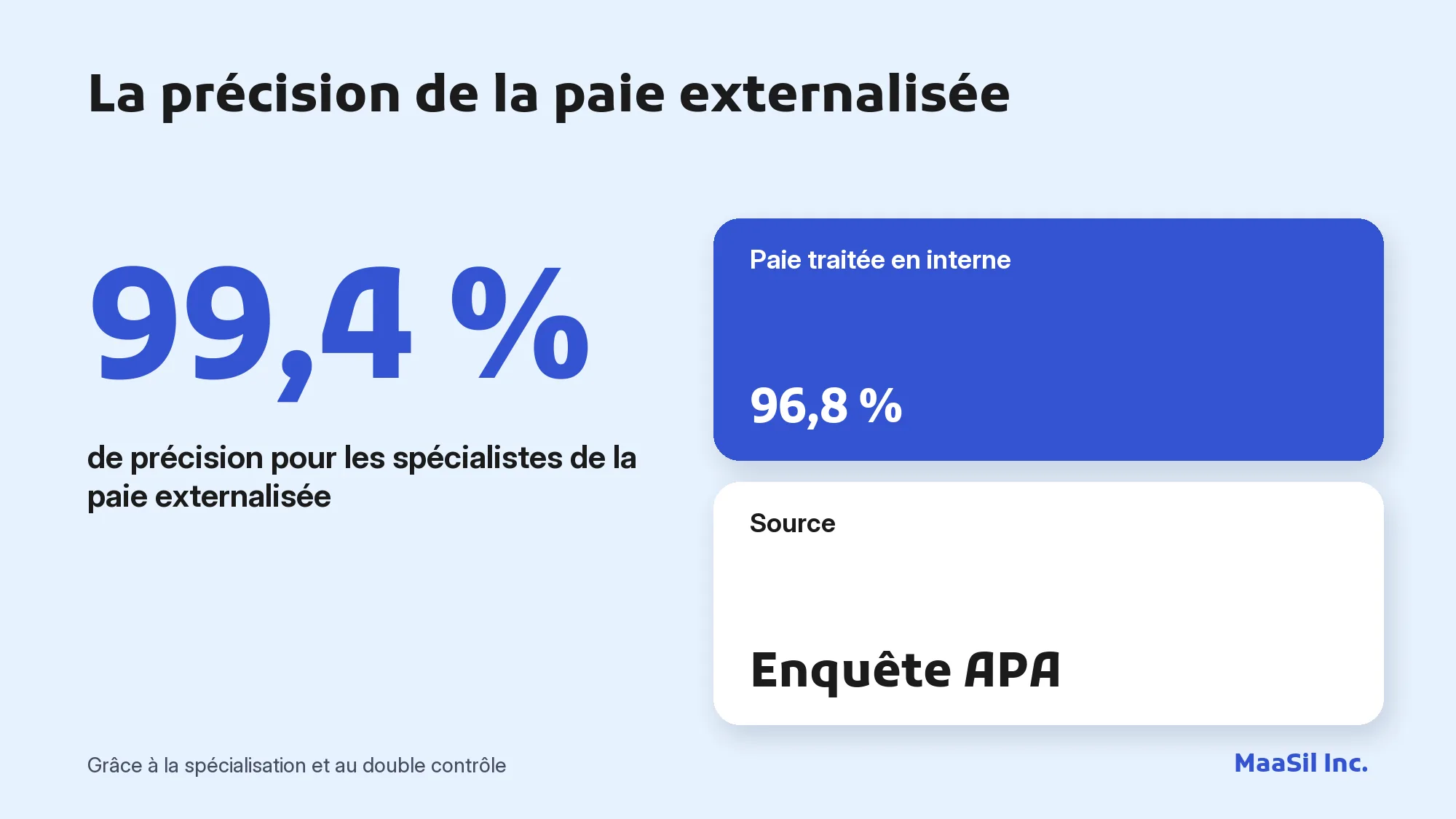
Spécialisation et double contrôle réduisent nettement les erreurs de paie.
Une entreprise de 200 salariés traitant une paie toutes les deux semaines (26 cycles par an) avec une précision de 96,8 % :
Transactions totales : 5 200 par an (200 salariés × 26 cycles)
Erreurs : 166 transactions (5 200 × 3,2 %)
Temps de correction : 45 minutes par erreur = 125 heures par an
Coût : 4 875 $ (125 heures × 39 $/heure)
Insatisfaction des employés : Les erreurs de paie sont l'une des 3 principales causes de plainte (enquête SHRM)
Risque réglementaire : Pénalités de l'IRS pour erreurs répétées
La même entreprise utilisant un BPO de paie aux Philippines/Maurice avec une précision de 99,4 % :
Erreurs : 31 transactions (5 200 × 0,6 %)
Temps de correction : 23 heures par an
Coût : 897 $
Économies : 3 978 $ par an
Satisfaction des employés : Améliorée (bulletins de paie fiables)
Conformité : Moins de risques de pénalités
Causes fondamentales de l'avantage de précision de l'externalisation :
1. Concentration sur la spécialisation Le gestionnaire de paie interne s'occupe de la paie + de l'administration des avantages sociaux + des mises à jour du SIRH + des rapports de conformité (attention divisée). Le spécialiste de la paie délocalisé traite uniquement la paie pour 15 à 20 entreprises clientes, développant une excellente reconnaissance des schémas. Il rencontre régulièrement tous les cas particuliers (embauches en cours de cycle, ajustements rétroactifs, saisies sur salaire, retenues multi-états, calculs de salaires supplémentaires, indemnités de maladie de tiers).
2. Flux de travail basé sur des listes de contrôle Les prestataires délocalisés de qualité utilisent des listes de contrôle standardisées et vérifiées avant soumission :
☐ Le numéro de sécurité sociale correspond au nom dans la base de données SSA (évite les erreurs d'identité)
☐ Le taux de salaire correspond à la lettre d'offre ou au formulaire de modification le plus récent
☐ Les codes de retenue fiscale correspondent au formulaire W-4 enregistré (fédéral + d'État le cas échéant)
☐ Les calculs cumulatifs depuis le début de l'année correspondent à la période de paie précédente
☐ Les comptes de dépôt direct sont validés (somme de contrôle du numéro de routage, format du numéro de compte)
☐ Déclaration des nouvelles embauches effectuée (exigence de l'État dans les 20 jours)
☐ Les calculs de saisie sur salaire sont vérifiés (pourcentage de l'ordonnance du tribunal, maximum autorisé par la CCPA)
Les gestionnaires internes travaillent souvent de mémoire (procédures non documentées), oubliant des étapes sous la pression du temps.
3. Processus de double examen Modèle délocalisé : Le gestionnaire saisit les données, le réviseur d'assurance qualité audite 100 % des entrées avant la soumission de la paie (deux paires d'yeux). Modèle interne : Un seul gestionnaire, aucun examen systématique jusqu'à la découverte d'erreurs après traitement.
4. Contrôles imposés par le système Les prestataires délocalisés configurent des validations système : « Le taux de salaire a changé de >20 % par rapport à la période précédente → signaler pour approbation du responsable » (permet de détecter les fautes de frappe comme 25,00 $/heure saisi au lieu de 250,00 $). « Le revenu brut depuis le début de l'année a diminué par rapport à la période précédente → alerte d'erreur » (impossible sauf annulation, nécessite une explication). Les systèmes internes manquent souvent de ces contrôles.
Avantage face à la complexité multi-états : Une entreprise axée sur le télétravail emploie du personnel dans 18 États américains. Chaque État a des règles uniques : salaire minimum, heures supplémentaires (quotidiennes vs hebdomadaires), calculs de retenues d'impôt sur le revenu de l'État, assurance invalidité (CA, NY, NJ, RI, HI), taxes locales (villes, comtés), taux d'assurance chômage, procédures de déclaration des nouvelles embauches et délai pour le dernier bulletin de paie en cas de licenciement.
Taille de l'équipe de paie interne requise : Au moins 2 ETP pour gérer la conformité dans 18 États (136 000 $ de salaires cumulés). BPO de paie aux Philippines/Maurice : Même couverture incluse dans le service de base (34 560 $/an pour 160 heures par mois). Économies : 101 440 $ par an.
Cependant, l'externalisation de la paie crée un risque de dépendance. Si le prestataire commet une erreur systématique sur plusieurs périodes, vous restez responsable vis-à-vis des employés et des autorités fiscales. Un BPO aux Philippines n'a pas mis à jour les barèmes de retenues du Kansas après une modification de la loi fiscale en milieu d'année. Des retenues insuffisantes ont été appliquées pendant 3 mois pour 12 employés du Kansas. Le client a dû faire face à 8 400 $ de pénalités en plus de problèmes de relations avec les employés (qui devaient des impôts en fin d'année). Atténuation : Des audits de paie mensuels vérifiant de manière indépendante 10 % des calculs par échantillonnage. Exemple : Calculer manuellement la paie brute et nette de 5 employés à l'aide des fiches de paie, comparer avec la sortie du système et enquêter sur les écarts.
Externalisation du support informatique : principes opérationnels appliqués à la comptabilité
Les principes opérationnels de l'externalisation du support informatique s'appliquent directement à l'externalisation comptable. Les deux fonctions partagent : le traitement des transactions, les niveaux d'escalade, la gestion des SLA, les bases de connaissances et l'assurance qualité.
Modèle de niveaux du support informatique :
Niveau 1 (70-80 % du volume) : Réinitialisation de mots de passe, installations de logiciels, dépannage de base → géré par l'équipe externe
Niveau 2 (15-25 % du volume) : Problèmes techniques complexes, configuration du système → spécialistes externes hybrides + équipe interne
Niveau 3 (3-5 % du volume) : Décisions d'architecture, incidents critiques → équipe interne uniquement
Modèle de niveaux de l'externalisation comptable :
Niveau 1 (75-85 % du volume) : Factures clients/fournisseurs de routine, rapprochement bancaire, codage des dépenses, saisie des données de paie → équipe externe
Niveau 2 (12-20 % du volume) : Transactions complexes (multidevises, intersociétés, transactions sur capitaux propres), écritures de journal de fin de mois, analyse des écarts → modèle hybride externe + interne
Niveau 3 (3-5 % du volume) : Stratégie fiscale, négociations d'audit, rapports au conseil d'administration, décisions de financement → équipe interne uniquement
La séparation des niveaux permet d'optimiser les coûts (l'équipe externe gère le travail à fort volume) tout en maintenant le contrôle (l'équipe interne gère le travail nécessitant une analyse subjective).
Parallèle avec le cadre SLA :
SLA du support informatique | SLA de l'externalisation comptable | Objectif |
|---|---|---|
Temps de première réponse <2 heures | Saisie des factures fournisseurs <24 heures après réception | Visibilité de la réactivité |
Temps de résolution <24 heures (Niveau 1) | Rapprochement bancaire <3 jours ouvrables après la fin du mois | Calendrier de réalisation |
Résolution au premier contact >75 % | Précision du codage des transactions >99 % | Mesure de la qualité |
Satisfaction client >85 % | Satisfaction des parties prenantes internes >85 % | Perception de la qualité de service |
Volume de tickets en attente en baisse d'un mois sur l'autre | Délai de paiement des fournisseurs en baisse, délai de recouvrement des créances clients en baisse | Santé opérationnelle |
Exigences de la base de connaissances : Le support informatique a besoin de documents de dépannage (« Outlook ne se connecte pas au serveur Exchange → vérifier les étapes 1-2-3 »). La comptabilité a besoin d'un manuel de codage du grand livre (« Frais de logiciels : SaaS mensuel = 6800, licences perpétuelles >5 000 $ = 1750 immobilisé »). Les deux évitent des escalades répétées pour les mêmes questions.
Programme d'assurance qualité : Le support informatique évalue 5 % des tickets chaque mois (problème correctement identifié ? Solution appropriée ? Communication claire ?). La comptabilité évalue 10 % des transactions chaque mois (enregistrées dans le bon compte de grand livre ? Documentation appropriée jointe ? Description claire ?). Les deux permettent de corriger les erreurs avant qu'elles ne s'accumulent.
La matrice d'escalade : Support informatique : Un agent peut réinitialiser des mots de passe (faible risque) mais doit faire remonter la désactivation de comptes réseau (implications de sécurité). Comptabilité : L'équipe peut coder des dépenses courantes (fournitures de bureau, déplacements) mais doit faire remonter les décisions relatives aux immobilisations >10 000 $ (implications d'amortissement), les transactions inhabituelles (règlements juridiques, extinction de dette) ou les transactions avec des parties liées (exigences de divulgation).
Des seuils d'escalade clairs évitent à la fois la sur-escalade (qui ralentit les opérations et fait perdre du temps à l'équipe interne) et la sous-escalade (où l'équipe externe prend des décisions inappropriées entraînant des erreurs).
Une entreprise manufacturière n'a pas défini de seuils d'escalade. L'équipe comptable externe a enregistré l'achat d'une machine de 85 000 $ comme charge d'exploitation (qui aurait dû être immobilisée). L'amortissement n'a pas été enregistré, le compte de résultat a surévalué les charges de 85 000 $ (ponctuel) et sous-évalué l'amortissement de 2 125 $/mois par la suite. L'actif de 85 000 $ manquait au bilan. L'audit a découvert cette anomalie. Coût de la correction : 12 000 $ (temps d'audit, états financiers retraités). Prévention : Règle d'escalade documentée : « Tout achat d'équipement >5 000 $ nécessite une approbation interne avant codage » (coût de 0 $, simple documentation).
Avantages de l'externalisation de la paie : la valeur de la conformité multi-juridictionnelle
L'externalisation de la paie auprès de spécialistes fournit une expertise géographique spécifique impossible à obtenir en interne à un coût comparable. La complexité :

Taux, seuils, règles locales : la paie multi-juridictionnelle exige des spécialistes.
Niveaux de conformité de la paie multi-états aux États-Unis :
Fédéral : FICA (Sécurité Sociale/Medicare), retenue d'impôt fédéral sur le revenu, chômage FUTA
État : Impôt sur le revenu de l'État (43 États), assurance chômage de l'État (taux variant de 0,5 % à 10 %), assurance invalidité de l'État (5 États : CA, NY, NJ, RI, HI), classifications d'accidents du travail
Local : Impôts sur le revenu municipaux (NYC, Philadelphie, autres), taxes de comté, ordonnances locales (congés de maladie payés, compléments de salaire minimum)
Une entreprise axée sur le télétravail avec des salariés dans 18 États fait face à 18 calculs différents de retenues d'impôt sur le revenu d'État, 18 taux d'assurance chômage (mis à jour trimestriellement), de multiples juridictions fiscales locales, des salaires minimums variables (du minimum fédéral de 7,25 $ à plus de 16,50 $ dans certaines villes), des règles d'heures supplémentaires différentes (la Californie exige des heures supplémentaires quotidiennes au-delà de 8 heures, la plupart des États au-delà de 40 heures par semaine) et des exigences uniques en matière de congés payés.
Capacité de paie interne requise : Pour gérer en interne la conformité dans 18 États : Au moins 2 ETP spécialistes de la paie (une seule personne ne pouvant maintenir ses connaissances dans toutes les juridictions). Coût : 136 000 $ de salaires cumulés + 26 000 $ d'avantages/taxes + 12 000 $ de logiciels/formation = 174 000 $ par an.
Alternative BPO de paie externe : Un prestataire aux Philippines ou à l'Île Maurice gérant plus de 50 clients américains dans tous les États dispose de cadres multi-juridictionnels établis :
Mises à jour automatisées des barèmes fiscaux (abonnement aux services fiscaux d'ADP, PayChex)
Moteurs de calcul de retenue spécifiques à chaque État
Base de données des juridictions fiscales locales (mise à jour trimestriellement au fur et à mesure de l'évolution des taux)
Suivi du salaire minimum par juridiction (fédérale, d'État, locale — le taux le plus élevé s'appliquant)
Moteur de règles d'heures supplémentaires (calcul quotidien vs hebdomadaire par État)
Règles d'accumulation des congés payés selon les ordonnances étatiques et locales
Coût : 21 $/heure, 160 heures par mois = 3 360 $/mois = 40 320 $ par an. Économies : 133 680 $ par an (réduction des coûts de 77 %) tout en maintenant une expertise de conformité équivalente ou supérieure.
Valeur concrète de la conformité : Une entreprise technologique de Seattle (85 employés répartis dans 9 États) utilisait un coordinateur de paie interne. Cette personne connaissait les règles de l'État de Washington (pas d'impôt sur le revenu d'État, congé familial payé) mais était moins familière avec les autres États. Erreurs sur 6 mois :
Salariés de l'Oregon : Oubli de retenir la taxe de transport de l'État (TriMet) dans la région métropolitaine de Portland. 2 800 $ d'arriérés d'impôts + pénalités.
Salariés de Californie : Mauvais calcul du taux de la SDI (assurance invalidité de l'État). 1 200 $ de pénalités.
Salariés de New York : Oubli de retenir l'impôt de résident de NYC pour 2 employés vivant dans la ville. 3 400 $ d'arriérés d'impôts + pénalités.
Coût total de conformité : 7 400 $. L'entreprise est passée à un BPO de paie à l'Île Maurice doté d'une expertise multi-états. Zéro erreur de conformité au cours des 18 mois suivants. Coût annuel du BPO (40 000 $) par rapport au coût interne précédent (82 000 $ salaire + avantages) = 35 000 $ d'économies nettes après prise en compte des coûts d'erreur évités de l'année 1.
Avantages de l'externalisation du recrutement vs avantages de l'externalisation comptable : facteurs de valeur spécifiques à chaque fonction
Différentes fonctions externalisées apportent des avantages par des mécanismes différents :
Facteurs de valeur de l'externalisation du recrutement :
Vitesse d'embauche : Déployer la recherche de candidats 85 % plus rapidement que de constituer une équipe de recrutement interne
Accès au marché : Exploiter des canaux de recherche spécialisés (recrutement sur GitHub pour les développeurs, conseils infirmiers pour la santé)
Gestion des volumes : S'adapter aux embauches saisonnières (période des fêtes dans le commerce de détail, période fiscale pour les cabinets comptables) sans effectif permanent
Structure des coûts : Coût variable par embauche par rapport aux salaires fixes des recruteurs
Facteurs de valeur de l'externalisation comptable :
Amélioration de la précision : 99,4 % vs 96,8 % grâce à la spécialisation et au double examen
Profondeur de conformité : Expertise multi-juridictionnelle (paie de 18 États, normes comptables internationales)
Accélération des fins de mois : Clôture des comptes en 4-6 jours vs 8-12 jours, permettant des décisions plus rapides
Protection financière : Couverture d'assurance E&O (2M$-5M$) par rapport à la responsabilité totale en interne
La différence des facteurs de valeur oriente les décisions fonction par fonction. Externalisez la comptabilité principalement pour des gains de précision et de conformité (les économies de coûts étant secondaires). Externalisez le recrutement principalement pour la rapidité et l'évolutivité (la qualité étant maintenue grâce à des fiches d'évaluation claires).
Cependant, les deux partagent des exigences communes de réussite :
Limites de portée claires (matrice RACI définissant les responsabilités externes vs internes)
Investissement dans le transfert de connaissances (transitions de 90 à 120 jours, pas de précipitation sur 30 jours)
Programmes d'assurance qualité (évaluation systématique, pas de présomption de qualité)
Cadres de gouvernance (revues opérationnelles hebdomadaires les 6 premiers mois, puis mensuelles)
Avantages de l'externalisation du marketing vs services financiers : différences de stratification des risques
L'externalisation du marketing et l'externalisation des services financiers comportent des profils de risque différents qui affectent la réalisation des avantages :
Externalisation du marketing (Risque commercial plus faible) :
Impact des erreurs d'exécution : La campagne est moins performante, le budget publicitaire est gaspillé, relance de la campagne
Exposition de données confidentielles : Minimale (les supports marketing sont pour la plupart publics)
Exigences de conformité : Légères (CAN-SPAM, consentement RGPD, utilisation des marques déposées)
Propriété de la relation : Peut rester interne (les ventes possèdent les relations clients, le marketing soutient)
Temps de rétablissement en cas d'échec : Rapide (changement d'agence, renouvellement rapide des créations)
Externalisation des services financiers (Risque commercial plus élevé) :
Impact des erreurs d'exécution : Anomalie financière, échec de l'audit, pénalités fiscales, violations des clauses restrictives de prêt
Exposition de données confidentielles : Élevée (comptes bancaires, rémunérations, contrats, performances financières)
Exigences de conformité : Lourdes (GAAP/IFRS, SOX, réglementations fiscales, exigences d'audit)
Propriété de la relation : Ne peut être déléguée (le CFO est responsable des rapports financiers et des relations avec les régulateurs)
Temps de rétablissement en cas d'échec : Lent (le retraitement des états financiers prend des mois, la résolution d'audit est complexe)
Les différences de profil de risque exigent une intensité de gouvernance différente :
Gouvernance de l'externalisation du marketing :
Revues mensuelles des créations
Analyse trimestrielle de la performance des campagnes
Alignement semestriel de la stratégie
Échecs = dépenses gaspillées, pas de menace existentielle
Gouvernance de l'externalisation des services financiers :
Examen hebdomadaire des transactions (les 6 premiers mois)
Vérification bi-hebdomadaire des rapprochements
Revue mensuelle de clôture avec explication des écarts
Audit de conformité trimestriel (vérification par échantillonnage de 10 %)
Échecs = exposition financière/juridique, menace existentielle possible
Par conséquent, les avantages de l'externalisation des services comptables nécessitent un investissement de gouvernance plus lourd que l'externalisation du marketing pour être réalisés en toute sécurité. Temps de gestion budgétaire : marketing 5 à 8 heures par mois, comptabilité 15 à 25 heures par mois (selon le volume et la complexité des transactions).
Quels processus externaliser en premier ? Faisons le point en 30 min. Réserver un audit gratuit →
Avantages de l'externalisation du service client vs comptabilité : l'écart des coûts d'erreur
Les erreurs d'externalisation du service client et les erreurs d'externalisation comptable ont des conséquences radicalement différentes :
Exemples d'erreurs de service client :
L'agent fournit les mauvaises étapes de dépannage → le client est frustré, rappelle (coût : temps de traitement d'appel supplémentaire de 8 $, impact modéré sur la satisfaction client)
L'agent rate une opportunité de vente incitative → perte de revenus de 50 $ à 200 $ (coût d'opportunité)
L'agent est impoli avec le client → plainte, risque de désabonnement (le départ d'un client à forte valeur coûte entre 2 000 $ et 50 000 $ en CLV)
Exemples d'erreurs comptables :
Mauvaise catégorisation d'une transaction de 100 000 $ → anomalie financière (constat d'audit, coûts de retraitement de 15 000 $ à 50 000 $)
Oubli de déclaration de la taxe sur les ventes → pénalités + intérêts (de 5 000 $ à 50 000 $ selon la durée et le montant)
Erreur de paie avec retenues d'impôt insuffisantes → pénalités IRS + insatisfaction des employés (de 500 $ à 5 000 $ par employé concerné)
Immobilisation d'une dépense qui aurait dû être une charge d'exploitation → violation d'une clause restrictive de prêt (ligne de crédit suspendue, crise de liquidité)
Le coût d'une erreur comptable est de 10 à 100 fois plus élevé. Une erreur de service client coûte généralement entre 8 $ et 2 000 $. Une erreur comptable peut coûter entre 5 000 $ et 500 000 $. Cela affecte le calcul du retour sur investissement pour les investissements de qualité :
Investissement de qualité dans le service client :
Programme d'assurance qualité évaluant 5 % des interactions : 2,40 $/agent/mois
Outils d'analyse de la parole : 45 $/agent/mois
Formation à la neutralisation de l'accent : 800 $/agent en paiement unique
→ Justifié par l'amélioration du CSAT et la réduction du taux de désabonnement
Investissement de qualité en comptabilité :
Processus de double examen (l'assurance qualité vérifie 100 % des transactions) : frais généraux de 4,50 $/heure
Supervision par un expert-comptable qualifié : 65 $/heure pour 10 % du temps de travail
Audits mensuels de précision : 1 200 $/mois
→ Justifié par l'évitement d'une seule pénalité fiscale de 25 000 $ ou d'un retraitement financier
Par conséquent, l'externalisation des services comptables devrait s'orienter vers des prestataires de qualité supérieure (plus chers) par rapport au service client, où des prestataires de milieu de gamme suffisent pour de nombreux cas d'utilisation. Il existe une solution pour réparer une erreur de service client (s'excuser, rembourser, réengager le client). Une erreur comptable peut être irréversible (rapport d'audit déjà émis, pénalités imposées, clause restrictive violée).
Avantages et inconvénients de l'externalisation comptable : les limites réelles
Les avantages dominent dans les scénarios correctement mis en œuvre, mais des limites existent :

Décalage horaire et perte de réponses immédiates : des limites à anticiper.
Limites nécessitant des mesures d'atténuation :
1. Perte de visibilité en temps réel Le comptable interne est assis à quelques mètres, les réponses aux questions sont immédiates. L'équipe délocalisée se trouve à 12 fuseaux horaires, les questions attendent le jour ouvrable suivant. Atténuation : Outils de communication asynchrones (explications vidéo Loom), documentation complète (manuel GL, directives de codage des transactions), réunions de synchronisation quotidiennes pendant la période de transition, puis hebdomadaires une fois le rythme stabilisé.
2. Écarts culturels et de communication L'équipe comptable philippine peut interpréter « urgent » différemment (communication indirecte culturelle). Le client américain dit « traitez cela quand vous le pouvez » (en pensant « aujourd'hui »), l'équipe externe comprend littéralement « dès que possible » (ce qui signifie « la semaine prochaine »). Atténuation : Marquage explicite des priorités (P1 = aujourd'hui, P2 = cette semaine, P3 = ce mois-ci), protocole d'escalade documenté, formation à la communication interculturelle dans les deux sens.
3. Lacunes de contexte sectoriel L'équipe délocalisée traite les transactions de manière mécanique, manquant de contexte commercial. Exemple : Une entreprise manufacturière enregistre la réparation d'une machine comme « Frais d'entretien » (charge d'exploitation). Cependant, cette réparation spécifique a prolongé la durée de vie utile et devrait être immobilisée (ajoutée au coût de l'actif, amortie). L'équipe externe ignorait l'historique de la machine. Atténuation : Directives de codage spécifiques au secteur (« Réparations maintenant la fonctionnalité actuelle = 6400 Réparations ; réparations prolongeant la durée de vie utile ou la capacité = 1600 Améliorations immobilisées »), règle d'escalade pour les transactions inhabituelles.
4. Limites de familiarité avec le système Votre fichier QuickBooks contient 15 ans de personnalisations, de sous-comptes, de suivi des classes et de rapports personnalisés. La nouvelle équipe externe ne comprend pas intuitivement cette structure (le collaborateur interne l'a assimilée par osmose au fil des ans). Atténuation : Documentation complète du système (plan comptable avec exemples d'utilisation, taxonomie des classes/départements, objectifs des rapports personnalisés), période d'observation de 6 semaines pendant la transition.
5. Distance relationnelle Le CFO connaît personnellement le comptable interne et lui fait confiance grâce aux années passées ensemble. L'équipe externe est constituée d'inconnus au départ, la confiance se bâtissant lentement. Atténuation : Appels vidéo pour établir une connexion personnelle, attribution d'une équipe stable (pas de rotation mensuelle du personnel), transparence sur les erreurs lorsqu'elles surviennent (renforce la crédibilité).
Les fonctions stratégiques ne peuvent pas être externalisées :
N'externalisez jamais la prise de décision ou les relations financières externes :
Stratégie fiscale (quand comptabiliser les revenus, quelles déductions réclamer, optimisation de la structure de l'entité) → nécessite la compréhension du contexte commercial et de la tolérance au risque
Gestion des audits (répondre aux questions des auditeurs, négocier les conclusions, expliquer les décisions commerciales) → demande une forte dimension relationnelle et dépend du contexte
Reporting financier au conseil d'administration (traduire les chiffres en récit stratégique) → nécessite une connaissance approfondie de l'entreprise et la gestion des parties prenantes
Relations bancaires (négociations de clauses restrictives, demandes de crédit, décisions de gestion de trésorerie) → basé sur la confiance et de nature relationnelle
Financement par actions (discussions sur la valorisation, gestion de la table de capitalisation, reporting aux investisseurs) → confidentiel, stratégique
Budgétisation et prévisions (dépend de la stratégie commerciale, des hypothèses du marché, des plans de croissance) → nécessite une proximité opérationnelle
Externalisez l'exécution transactionnelle, gardez la prise de décision stratégique et les relations externes en interne. Le modèle 75/25 fonctionne : 75 % du traitement des transactions à l'extérieur, 25 % du travail stratégique en interne.
Conclusion : le cadre décisionnel de l'externalisation comptable
Les avantages de l'externalisation des services comptables se concrétisent lorsque le volume des transactions et la complexité de la conformité justifient l'intervention de spécialistes. Avantages quantifiables : réduction des coûts de 52 à 67 % (un ETP interne coûtant entre 40 000 $ et 68 000 $ contre 18 000 $ à 34 000 $ pour un prestataire externe par an, charges comprises), amélioration de la précision de 2,6 % (99,4 % vs 96,8 %), accélération de la clôture mensuelle (4-6 jours vs 8-12 jours) et protection financière (assurance E&O couvrant les erreurs).
Candidats idéaux : Traitement des factures clients/fournisseurs (transactions à fort volume), rapprochement bancaire (mécanique avec des règles claires), traitement de la paie (particulièrement complexe avec plusieurs États), catégorisation des dépenses (manuel GL bien documenté), exécution de la clôture mensuelle (procédures de liste de contrôle documentées) et préparation des états financiers de base (bilan, compte de résultat, tableau des flux de trésorerie).
Risqué à externaliser : Décisions relatives à la stratégie fiscale, négociations d'audit, rapports au conseil d'administration, gestion des relations bancaires, financement par actions, budgétisation/prévisions et due diligence d'acquisition. Ces activités nécessitent un contexte commercial, du jugement et une gestion des relations externes impossibles à déléguer à un tiers.
Optimisation géographique : Philippines (coûts optimisés, volume élevé, 18-24 $/heure charges comprises), Île Maurice (sensibilité à la conformité, adéquation avec l'UE, qualifications équivalentes à un expert-comptable, 26-34 $/heure), Afrique du Sud (expertise GAAP, maîtrise de l'anglais, 24-32 $/heure), Égypte (multilingue arabe/français, 20-28 $/hour).
Exigences d'atténuation des risques : Transition de 90 à 120 jours (documentation + observation + parallèle + support post-mise en service), manuel complet de codage GL avec exemples, matrice RACI définissant les responsabilités externes vs internes, audits mensuels de précision (vérification d'un échantillon de 10 % des transactions), couverture d'assurance E&O de minimum 2M$ et plan de reprise après sinistre permettant un traitement d'urgence en interne si le prestataire fait défaut.
La question n'est pas de savoir si l'externalisation comptable apporte des avantages — les collaborations bien mises en œuvre améliorent quantitablement la précision, réduisent les coûts et accélèrent les processus. La question est de savoir si vous investirez dans une transition, une documentation et une gouvernance adéquates pour éviter que votre collaboration ne fasse partie des 35 % d'échecs constatés dans les 24 premiers mois.
Foire aux questions sur les avantages de l'externalisation des services comptables
Comment vérifier la qualité de la comptabilité délocalisée sans être moi-même expert-comptable ? Mettez en place des contrôles de qualité à plusieurs niveaux, même si vous n'avez pas d'expertise comptable : (1) Audits de précision mensuels — engagez un expert-comptable local pendant 4 heures par mois (600-800 $) pour examiner un échantillon aléatoire de 10 % des transactions, vérifier le codage GL et identifier les schémas récurrents, (2) Vérification des rapprochements — les rapprochements bancaires doivent présenter des écarts inexpliqués nuls ; si un « écart mystère de 500 $ » persiste mois après mois, il y a un problème de qualité, (3) Cohérence des états financiers — comparez les tendances d'un mois sur l'autre, enquêtez sur les variations inhabituelles (des dépenses qui doublent soudainement, des revenus qui chutent de 40 % — cela nécessite une explication), (4) Validation par un tiers — la préparation annuelle de la déclaration fiscale par un cabinet d'audit indépendant examine le travail externe et détecte les erreurs systématiques, (5) Vérification des références — parlez à 3 clients actuels du prestataire dans un secteur similaire, demandez-leur : « Quelles erreurs comptables avez-vous rencontrées ? À quelle vitesse ont-elles été corrigées ? » Vérifiez également les qualifications : des équivalences d'experts-comptables (ACCA, CGA, CA), et non des comptables autodidactes pour les travaux complexes.
Que se passe-t-il si le prestataire externe commet une erreur entraînant des pénalités fiscales — qui paie ? Cela dépend de la structure du contrat et du type d'erreur. Erreur du prestataire (mauvais calcul des charges sociales, retard de déclaration, traitement fiscal incorrect) — son assurance E&O doit couvrir les pénalités après franchise (généralement de 5 000 $ à 10 000 $). Vérifiez que le contrat inclut la clause suivante : « Le prestataire est responsable des erreurs résultant de son travail, y compris les pénalités et les intérêts. » Exigez également une couverture E&O minimale de 5M$ avec votre entreprise désignée comme co-assurée (pour pouvoir réclamer directement). Erreur causée par le client (vous avez fourni des informations incomplètes, omis de divulguer une transaction, modifié les faits en cours de processus) — vous êtes responsable, pas le prestataire. Erreur partagée (situation ambiguë, avis divergents sur le traitement approprié) — négociation, souvent avec partage des coûts. Prévention : Définissez des règles d'escalade exigeant du prestataire qu'il signale les traitements incertains avant de les traiter, plutôt que de faire des suppositions.
Comment éviter de perdre le contrôle financier lors de l'externalisation de la comptabilité ? Maintenez une surveillance stratégique grâce à un cadre de gouvernance : (1) Examen hebdomadaire des transactions les 6 premiers mois — contrôlez les décisions de codage, vérifiez que la documentation est jointe, répondez immédiatement aux questions pour renforcer les connaissances, (2) Revue mensuelle du reporting financier — examinez attentivement le compte de résultat, le bilan et le tableau des flux de trésorerie avec des explications sur les écarts (pourquoi les frais juridiques ont-ils augmenté de 60 % ?), (3) Analyse trimestrielle approfondie — examinez la balance âgée fournisseurs, la balance âgée clients et le grand livre pour les comptes principaux, enquêtez sur les anomalies, (4) Double autorisation — l'équipe externe ne peut pas passer d'écritures de journal >10 000 $ (ou tout autre seuil défini) sans votre accord, et les paiements >25 000 $ nécessitent votre autorisation explicite, (5) Contrôles d'accès au système — l'équipe externe dispose d'un accès en modification au grand livre, mais en lecture seule sur les comptes bancaires (impossible d'effectuer des virements), et ne peut pas supprimer de transactions (elle doit demander des écritures d'extourne). Ne donnez jamais un accès « administrateur complet » au départ — commencez de manière restrictive, puis étendez les accès au fur et à mesure que la confiance s'installe.
Quel est le délai réaliste entre la décision d'externaliser et l'apparition des premiers bénéfices ? Mois 1-2 : Sélection du prestataire — appel d'offres, démonstrations, vérification des références, négociation du contrat. Mois 3 : Planification de la transition — documentation des processus actuels, revue du plan comptable, configuration des accès système, présentation des équipes. Mois 4-5 : Transfert de compétences — l'équipe délocalisée observe vos processus, pose des questions, rédige la documentation, traite les transactions sous votre contrôle avant enregistrement. Mois 6 : Phase parallèle — l'équipe interne et l'équipe externe traitent les mêmes transactions de manière indépendante, comparent les résultats et identifient les écarts. Mois 7-8 : Transition opérationnelle — l'équipe externe assume la responsabilité principale, l'équipe interne effectue uniquement des vérifications ponctuelles, synchronisations quotidiennes au départ. Mois 9+ : Stabilisation — réduction de la surveillance à un rythme hebdomadaire, la précision doit atteindre l'objectif (>99 %). Concrétisation des avantages : Mois 10-12 — les économies de coûts apparaissent (vous ne payez plus de collaborateur interne à temps plein), la précision s'améliore de manière mesurable, les clôtures mensuelles s'accélèrent. Calendrier total : 9 à 12 mois avant de bénéficier pleinement des avantages. Les calendriers précipités (30 à 60 jours en mode « nous sommes prêts ! ») échouent — les lacunes de connaissances provoquent des erreurs qui annulent les bénéfices.
Dois-je externaliser la paie et la comptabilité ensemble ou séparément ? Ensemble (même prestataire) si : Le volume de transactions est faible (<100 salariés, <200 transactions mensuelles), vous préférez la simplicité d'un fournisseur unique, vous êtes sensible aux coûts (frais généraux partagés). Séparément (prestataires spécialisés) si : L'une des fonctions est très complexe (paie multi-états sur plus de 15 États, comptabilité impliquant des stocks/comptabilité analytique de fabrication), la qualité est non négociable (prêt à payer une prime de 15 à 25 % pour les meilleurs spécialistes de leur catégorie), vous disposez déjà d'une infrastructure de gestion des fournisseurs, ou le risque de conformité est élevé (société cotée SOX, secteur hautement réglementé). Exemple : Une entreprise manufacturière (300 salariés, 18 États, comptabilité des stocks complexe, conforme SOX) a fait appel à un spécialiste de la paie à l'Île Maurice (expertise multi-états, 42 000 $/an) et à un spécialiste comptable sud-africain distinct (expertise fabrication/GAAP, 38 000 $/an). Total 80 000 $/an contre 174 000 $ en interne (2 ETP). Des fournisseurs distincts ont ajouté des frais de gestion (2 points de contact contre 1) mais la qualité et l'expertise en conformité en valaient la peine. Une entreprise plus simple (services professionnels, 50 salariés, 3 États, comptabilité de trésorerie) utilise un seul BPO aux Philippines pour les deux (34 000 $/an au total).
Prêt à renforcer votre équipe avec les meilleurs talents africains ?
Discutez avec l'un de nos experts pour découvrir comment le portage salarial augmenté à l'IA peut s'intégrer à 100 % à vos process et faire grandir vos projets.
Échangez avec un expert
