
Prêt à renforcer votre équipe avec les meilleurs talents africains ?
Discutez avec l'un de nos experts pour découvrir comment le portage salarial augmenté à l'IA peut s'intégrer à 100 % à vos process et faire grandir vos projets.
Échangez avec un expert
Service Client & Call Center
Externalisation des clients de call center : comment migrer 4 500 interactions mensuelles sans perdre 18 % de ses clients
Votre équipe interne traite 150 appels quotidiens avec un DMT (durée moyenne de traitement) de 4,2 minutes et un taux de CSAT (satisfaction client) de 88 %. La direction exige une réduction des coûts de 70 % grâce à la délocalisation (outsourcing offshore). Six mois plus tard, le DMT est de 7,8 minutes, le CSAT est tombé à 71 % et le chiffre d'affaires du deuxième trimestre a diminué de 340 000 $ en raison de la perte de clients.
L'échec n'est pas dû aux capacités de l'offshore, mais à la gestion de la transition. Pour les clients de centres d'appels, l'externalisation nécessite une migration en quatre phases : l'extraction des connaissances des équipes internes, la sélection d'agents correspondant au profil démographique des clients, un fonctionnement parallèle validant la parité de qualité, et un suivi des SLA pour prévenir une dégradation progressive.
Ce guide couvre la feuille de route de transition que 68 % des entreprises omettent de suivre, la gestion du changement pour éviter le sabotage de l'équipe interne, et le cadre de SLA pour détecter la baisse de qualité avant que les clients ne s'en aperçoivent.
Quelles sont les 4 phases d'une migration réussie d'un centre d'appels vers l'externalisation ?
Les transitions précipitées détruisent les relations avec les clients. Des approches structurées minimisent les perturbations.

Une migration par étapes protège la qualité de service pendant la transition.
Phase 1 - Capture des connaissances (Semaines 1 à 4) :
Les agents internes possèdent des connaissances institutionnelles non documentées : résolutions de cas particuliers, tactiques de gestion des clients difficiles, spécificités des produits absentes des manuels de formation.
Méthodologie d'extraction :
Enregistrer 100 % des appels pendant 2 semaines (pas d'échantillonnage – les cas atypiques contiennent des informations précieuses)
Mener des entretiens structurés : « Racontez-moi votre appel le plus difficile le mois dernier »
Observer les meilleurs éléments : l'observateur documente la logique de décision, pas seulement les actions
Compiler une FAQ à partir des questions réelles des clients, et non de questions supposées
De plus, catégorisez les types d'interactions par complexité :
Niveau 1 (65 %) : Demandes de routine pouvant être traitées par script avec des arbres de décision
Niveau 2 (28 %) : Décisions nécessitant une connaissance du produit mais pas d'escalade
Niveau 3 (7 %) : Problèmes complexes nécessitant une expertise approfondie ou des exceptions aux règles
Erreur courante : Externaliser les trois niveaux simultanément. Le niveau 3 devrait rester en interne pendant 6 à 12 mois pendant que l'équipe offshore monte en compétences.
Livrables de documentation :
Guides pratiques (playbooks) pour les 20 principaux types d'interactions (étape par étape avec captures d'écran)
Matrice d'escalade (quand les agents transfèrent vs résolvent)
Profils de personnalité des clients (secteurs d'activité avec des attentes spécifiques – les cabinets d'avocats exigent un ton formel, les startups préfèrent un ton décontracté)
Solutions de contournement du système (le bug du CRM que tout le monde connaît mais que l'IT n'a pas encore résolu)
Phase 2 - Sélection du prestataire et contractualisation (Semaines 5 à 8) :
L'évaluation standard des fournisseurs (coût, certifications, installations) est nécessaire mais insuffisante. Les critères spécifiques au client comprennent :
Correspondance démographique des clients :
Clients américains âgés de 50 ans et plus : agents sud-africains (les données de tolérance aux accents montrent un taux d'acceptation de 91 %)
Clients e-commerce britanniques âgés de 18 à 35 ans : canaux privilégiant le texte avec du personnel basé au Kenya ou au Nigeria
Clients B2B grands comptes : Afrique du Sud/Maurice uniquement (les acheteurs de niveau C-suite ont un fort biais envers les accents)
Évaluation de l'alignement culturel :
Philosophie de résolution des conflits du prestataire (autonomisation vs respect strict du script)
Tactiques de réduction de l'attrition (les agents sont-ils payés au-dessus du marché pour assurer la fidélisation ?)
Investissement dans la formation (minimum de 4 semaines ou cours accéléré d'une semaine ?)
Validation de la compatibilité technologique :
Preuve de concept d'intégration CRM dans un environnement de test
Tests de charge avec le volume de pointe réel du client (et non une capacité théorique)
Exercice de reprise après sinistre avec l'IT du client observant le processus de basculement
De plus, les vérifications de références doivent poser des questions spécifiques :
« Qu'est-ce qui vous a surpris négativement au cours des mois 2 et 3 ? » (la lune de miel se termine, les vrais problèmes apparaissent)
« Montrez-moi vos données de performance SLA des 6 derniers mois » (les tendances révèlent la dégradation de la qualité)
« Comment ont-ils géré votre pire défaillance de service ? » (la réponse à la crise révèle la qualité du partenariat)
La négociation contractuelle doit aborder :
Soutien au transfert de connaissances : le prestataire affecte une équipe d'implémentation pendant 90 jours après le lancement, et n'abandonne pas le client après la première semaine
Incitations à la rétention de l'équipe interne : les agents nationaux reçoivent des primes pour former leurs homologues offshore (prévient le sabotage)
Paliers de performance : les SLA commencent à 80 % des références internes, puis augmentent mensuellement pour atteindre la parité au mois 4
Droits de résiliation : les manquements graves aux SLA permettent une sortie sans pénalité après une période de remédiation de 60 jours
Phase 3 - Fonctionnement parallèle (Semaines 9 à 16) :
Faire fonctionner les deux opérations simultanément coûte 40 % de plus à court terme, mais évite les catastrophes.
Stratégie de répartition du trafic :
Semaines 9-10 : 10 % vers l'offshore (sélectionner rigoureusement les types d'interactions les plus simples)
Semaines 11-12 : 25 % vers l'offshore (introduire une complexité modérée)
Semaines 13-14 : 50 % vers l'offshore (tester la gestion de la charge de pointe)
Semaines 15-16 : 80 % vers l'offshore (équipe interne en veille pour les escalades)
Suivi des indicateurs pendant la phase parallèle :
Indicateur | Référence interne | Cible Offshore | Seuil de décision |
|---|---|---|---|
DMT | 4,2 min | < 6,0 min | > 7 min = prolonger la formation |
Rer (Résolution au 1er contact) | 82 % | > 75 % | < 70 % = révision du processus |
CSAT | 88 % | > 82 % | < 78 % = arrêt de la montée en charge |
Taux de transfert | 8 % | < 15 % | > 20 % = problème d'autonomisation |
De plus, organisez des réunions quotidiennes (standups) :
Le superviseur offshore rapporte les défis de la veille
Le chef d'équipe interne propose du coaching sur les problèmes récurrents
Le chef de projet du client ajuste la répartition du trafic en fonction des performances
Constat fréquent : Un DMT offshore plus long n'est pas problématique si la résolution au premier contact (FCR) s'améliore. Consacrer 90 secondes de plus par appel pour éviter un rappel s'avère plus économique que des appels rapides générant de nouvelles sollicitations.
Phase 4 - Optimisation et transition de l'équipe interne (Semaines 17 à 24) :
Les agents internes font face à un avenir incertain – gérez cela maladroitement et ils saboteront la transition.
Stratégie de rétention pour les éléments performants :
Rôles de spécialistes de niveau 3 pour gérer les escalades que l'offshore ne peut pas résoudre
Postes d'assurance qualité pour contrôler les performances de l'offshore
Rôles de formation menant des sessions mensuelles de coaching pour l'offshore
Gestion de projet pour les initiatives futures
Cela permet de conserver les connaissances de l'entreprise tout en dimensionnant correctement l'équipe. Une équipe interne de 40 personnes devient un groupe de spécialistes de 8 personnes après l'externalisation.
Pour les autres agents internes :
Indemnités de départ : 2 semaines de salaire par année de service
Aide au reclassement : rédaction de CV, préparation aux entretiens, mise en relation avec des recruteurs
Notification anticipée : préavis de 90 jours permettant une recherche d'emploi proactive
Mal traiter les agents sur le départ génère des avis négatifs sur Glassdoor et des publications sur les réseaux sociaux qui nuisent à la réputation de la marque, ce qui coûte bien plus cher que les économies réalisées sur les indemnités de licenciement.
Cycle d'amélioration continue :
Revues hebdomadaires des performances de l'offshore pour identifier les tendances de dysfonctionnement
Mises à jour mensuelles des guides pratiques intégrant les nouveaux cas particuliers découverts
Visites trimestrielles sur site (le client visite le site offshore pour observer les opérations)
Appel d'offres biannuel (même sans changer de prestataire – un contrôle du marché garantit des tarifs compétitifs)
Comment empêcher les équipes internes de saboter les transitions d'externalisation de centres d'appels ?
Le sabotage dicté par la peur est un risque classique des projets d'externalisation.
Tactiques de sabotage :
Rétention d'informations : « C'est trop complexe à documenter, ils ne comprendront jamais »
Fourniture de données obsolètes : matériel de formation de 2019 au lieu des processus actuels
Sape de la confiance : « Les agents offshore vont détruire notre relation client »
Obstruction active : refus de participer aux appels de transfert de connaissances
Prévention par l'alignement des incitations :
Créez des primes de transition liées au succès de l'offshore :
Prime de 2 000 $ par agent interne si l'équipe offshore atteint 80 % de CSAT au mois 3
Prime de 1 500 $ si la résolution au premier contact (FCR) de l'offshore dépasse 75 % au mois 4
Prime de 1 000 $ pour chaque guide pratique documenté et produit
Coût total : 4 500 $ par agent interne. À comparer au coût d'une catastrophe : une transition d'externalisation ratée coûte 180 000 $ en honoraires de consultants, campagnes de reconquête des clients et retards dans les économies de coûts.
Programmes de reconnaissance :
Reconnaissance publique : e-mail du CEO remerciant l'équipe interne pour sa collaboration
Valorisation nominative : le « protocole d'escalade de Sarah » met à l'honneur les contributeurs
Évolution de carrière : les agents internes excellant dans le transfert de connaissances sont prioritaires pour les rôles de spécialistes
De plus, une communication transparente évite la propagation des rumeurs :
Annonce en semaine 1 : expliquer la justification économique (la réduction des coûts permettant d'investir dans la croissance)
Réunions d'information mensuelles (town halls) : partager l'avancement de la transition, répondre aux inquiétudes
Entretiens individuels : les managers rencontrent chaque agent pour discuter de son avenir spécifique
Répondre aux inquiétudes légitimes :
Peur de l'agent : « Je serai au chômage dans 6 mois. » Réponse : « Votre rôle évolue, il ne disparaît pas. Nous avons besoin de 8 spécialistes pour les escalades et la QA. Compte tenu de vos performances, vous êtes un excellent candidat. »
Peur de l'agent : « Les agents offshore vont ruiner notre réputation. » Réponse : « C'est précisément pour cela que nous avons besoin de votre expertise. Vous animerez des sessions mensuelles de coaching pour leur transmettre ce qui fait l'excellence de notre service. »
Peur de l'agent : « La direction ne valorise pas notre contribution. » Réponse : « Cette prime de transition de 4 500 $ démontre cette valeur. De plus, votre documentation servira de fondation au succès de l'offshore. »
Combien coûterait votre équipe support à Madagascar ? Estimer mon budget →
Quels SLA les clients de centres d'appels doivent-ils exiger dans les contrats d'externalisation ?
Des SLA flous ouvrent la voie à une dégradation de la qualité.
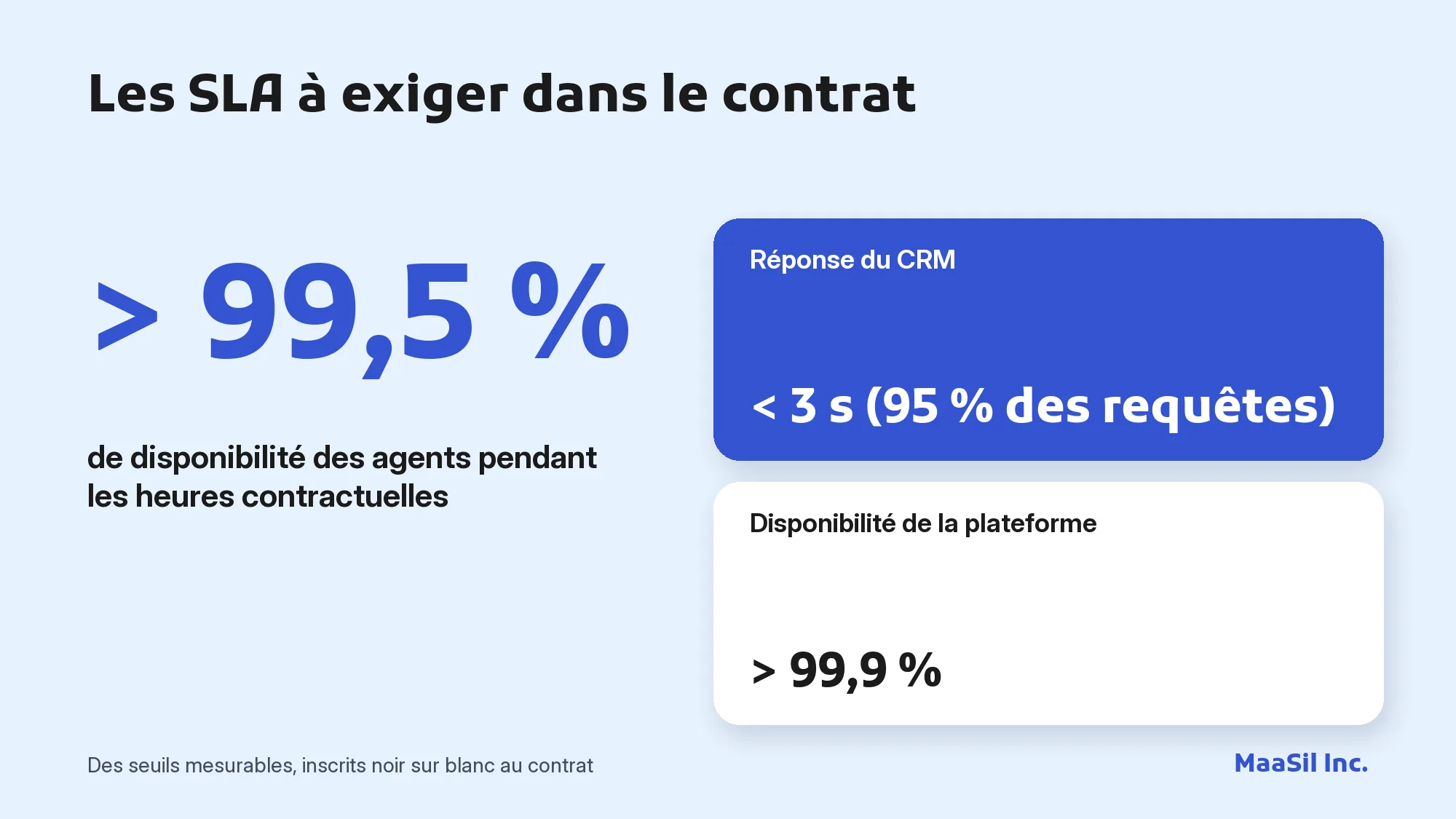
Des engagements chiffrés et mesurables protègent le client dès la signature.
Temps d'activité/disponibilité (opérationnel) :
Disponibilité des agents > 99,5 % pendant les heures contractuelles
Temps de réponse du système CRM < 3 secondes pour 95 % des requêtes
Temps de fonctionnement de la plateforme > 99,9 % (canaux voix, chat, e-mail)
Indicateurs de qualité (expérience client) :
Indicateur | Cible | Mesure | Pénalité |
|---|---|---|---|
CSAT | > 85 % | Sondage sur 20 % des interactions | < 80 % = réduction de 5 % des frais |
Rer (FCR) | > 80 % | Suivi des rappels à 7 jours | < 75 % = réduction de 10 % des frais |
DMT | < 6 min | Rapports automatisés de la plateforme | > 7,5 min = revue des performances |
Taux d'abandon | < 5 % | Appels déconnectés avant réponse | > 8 % = ajout de capacité requis |
Indicateurs de conformité (gestion des risques) :
PCI-DSS : zéro incident d'exposition des données de carte (faille = résiliation du contrat)
Protection des données : notification de faille en < 24h (retard = pénalité de 50 000 $)
Conservation des enregistrements : minimum de 60 jours (manquement = pénalité de 10 000 $)
De plus, les SLA doivent préciser la méthodologie de mesure :
CSAT : questionnaire envoyé dans l'heure suivant l'interaction à un échantillon aléatoire de 20 %, avec un taux de réponse minimum de 15 %
FCR : le client ne recontacte pas le service dans les 7 jours pour le même problème (e-mail/chat/appel, quel que soit le canal)
DMT : mesuré de la connexion de l'appel à sa déconnexion, y compris le temps d'attente et le travail post-appel
Exigences de reporting :
Tableau de bord quotidien : indicateurs en temps réel accessibles 24h/24, 7j/7
Rapport hebdomadaire : analyse des tendances avec identification des causes profondes des problèmes
Revue mensuelle d'activité : synthèse de direction avec initiatives d'amélioration
En outre, les droits d'audit :
Le client peut effectuer des visites d'installations inopinées chaque trimestre
Le client peut écouter des échantillons d'appels aléatoires sans pré-sélection du prestataire
Le client reçoit des exports de données brutes pour analyse indépendante
Ajustement des conséquences financières :
Niveaux de gravité des manquements aux SLA :
Mineur (CSAT 82-85 %) : réduction de 5 % des frais mensuels
Modéré (CSAT 78-82 %) : réduction de 10 % + plan d'actions correctives requis
Majeur (CSAT < 78 %) : réduction de 15 % + le client peut suspendre le trafic en attendant une amélioration
Critique (violation de données, fraude) : résiliation immédiate + responsabilité pour dommages et intérêts
Cependant, les pénalités seules ne favorisent pas l'amélioration. Des structures de bonus pour dépassement des SLA créent une motivation positive :
CSAT > 90 % : versement d'un bonus de 5 %
FCR > 85 % : bonus de 3 %
Excellence annuelle cumulée : bonus de 10 %
Comment surveiller la qualité de l'externalisation de votre centre d'appels sans faire de micro-management ?
Des cadres basés sur le principe « faire confiance mais vérifier » évitent la dégradation de la qualité.

Mesurer la qualité en continu, sans micro-management : la clé d'une externalisation réussie.
Outils de surveillance automatisés :
Les plateformes d'analyse de la parole (speech analytics comme CallMiner, Observe.AI) évaluent 100 % des interactions sur :
La conformité : mentions obligatoires, langage interdit
Le sentiment : niveau de frustration du client par analyse de l'intonation de la voix
Les compétences relationnelles : expressions d'empathie, indicateurs d'écoute active
L'efficacité : silences de plus de 8 secondes, mises en attente excessives
Cela coûte 18 $ par agent et par mois mais élimine les biais d'échantillonnage. Une QA traditionnelle examine 2 % des appels sélectionnés par les superviseurs – généralement les meilleurs appels de leurs meilleurs agents. L'IA examine tout, repérant les problèmes que les superviseurs manquent ou masquent.
Boucles de rétroaction des clients :
Sondages post-interaction capturant :
La note de satisfaction (échelle de 1 à 5)
Les motifs spécifiques d'insatisfaction (accent, temps d'attente, résolution, connaissances de l'agent)
La probabilité de recommandation (NPS)
Les commentaires libres (l'analyse textuelle identifie les thèmes récurrents)
Le timing du sondage compte : un envoi dans l'heure suivant l'interaction génère un taux de réponse de 78 %, contre 31 % pour un envoi le lendemain. De plus, offrez des incitations : une carte-cadeau Amazon de 5 $ pour avoir répondu augmente les réponses de 340 %.
Audit d'appels aléatoires :
L'équipe d'assurance qualité du client (qui peut être composée d'anciens agents internes dans des rôles de spécialistes) examine :
20 appels par agent et par mois (sélection aléatoire, non choisie par le superviseur)
Une grille d'évaluation alignée sur les normes internes
Des sessions de calibration : les équipes QA du client et du prestataire examinent conjointement des appels pour garantir l'homogénéité de la notation
Les conclusions alimentent les plans de coaching : un agent ayant de faibles scores reçoit une formation individuelle, et pas seulement des commentaires généraux.
Tableau de bord des indicateurs opérationnels :
Visibilité en temps réel sur :
La taille actuelle de la file d'attente (actualisation toutes les 30 secondes)
Le temps d'attente le plus long (indicateur de risque SLA)
La répartition du statut des agents (disponible, en ligne, pause, formation)
Le volume horaire par rapport aux prévisions (adéquation des capacités)
Des seuils d'alerte déclenchent des notifications :
File d'attente > 3 minutes : SMS au responsable des opérations du client
Taux d'abandon > 8 % : escalade vers le directeur du prestataire
Interruption du système > 5 minutes : appel automatique sur pont de conférence (IT client + IT prestataire)
Revues d'activité trimestrielles (QBR) :
Réunion de niveau exécutif couvrant :
Les tendances de performance SLA (sur 6 mois glissants)
Les thématiques des retours textuels des clients
L'évolution du coût par contact
La feuille de route technologique (mises à niveau de la plateforme, nouvelles fonctionnalités)
L'analyse comparative du marché (comment les performances se situent par rapport aux normes du secteur)
Résultats des QBR :
Initiatives d'amélioration à 90 jours avec responsables désignés et échéances
Décisions d'investissement (formation continue, mises à niveau technologiques)
Avenants au contrat (variations de volume, extensions de périmètre)
Conclusion : le plan d'action pour la transition d'externalisation de centre d'appels
Les clients de centres d'appels réussissent leur externalisation grâce à une migration en quatre phases : capture des connaissances des équipes internes sur 4 semaines en documentant les cas particuliers et la cartographie de la complexité des niveaux, sélection du prestataire validant la correspondance démographique des clients et la compatibilité technologique via des tests POC, fonctionnement parallèle augmentant le trafic de 10 % à 80 % sur 8 semaines tout en suivant quotidiennement les indicateurs, et optimisation en faisant évoluer les agents internes vers des rôles de spécialistes afin d'éviter le sabotage.
L'alignement des incitations empêche la rétention d'informations – les primes de transition de 4 500 $ liées aux indicateurs de succès offshore coûtent moins cher que les 180 000 $ de frais de rétablissement en cas d'échec. Une communication transparente lors des réunions mensuelles et des discussions individuelles sur les carrières apaise les craintes des agents concernant la sécurité de l'emploi et leur valeur patrimoniale.
Les SLA doivent préciser la méthodologie de mesure, pas seulement les objectifs : le CSAT mesuré par sondage dans l'heure suivant l'appel pour atteindre un taux de réponse de 15 %, le FCR suivi sur tous les canaux sur des périodes de 7 jours, le DMT incluant le temps d'attente et le travail post-appel, avec des conséquences financières calibrées selon des niveaux de gravité mineur/modéré/majeur/critique.
La surveillance de la qualité combine l'analyse de la parole évaluant 100 % des interactions pour la conformité et le sentiment, des sondages post-interaction capturant les motifs d'insatisfaction spécifiques avec analyse textuelle des commentaires ouverts, un audit d'appels aléatoires par les équipes QA du client examinant 20 appels par mois et par agent, et des tableaux de bord en temps réel avec des seuils d'alerte déclenchant des notifications par SMS lorsque les files d'attente dépassent 3 minutes.
Le cadre décisionnel : documentez la complexité des interactions de niveaux 1/2/3 en gardant le niveau 3 en interne au départ, sélectionnez des prestataires correspondant au profil démographique des clients grâce aux données de tolérance aux accents, négociez des contrats avec un support à l'implémentation de 90 jours et des paliers de performance augmentant mensuellement les cibles de SLA, effectuez des phases parallèles en prolongeant la formation lorsque les indicateurs offshore n'atteignent pas les seuils de décision, et conservez les éléments internes performants dans des rôles de spécialistes pour préserver les connaissances de l'entreprise. Les entreprises qui précipitent un basculement en une seule phase subissent une perte de clients de 18 % et une baisse de chiffre d'affaires de 340 000 $ ; celles qui investissent dans une transition structurée de 24 semaines obtiennent des réductions de coûts de 70 % sans détruire la qualité.
Prêt à renforcer votre équipe avec les meilleurs talents africains ?
Discutez avec l'un de nos experts pour découvrir comment le portage salarial augmenté à l'IA peut s'intégrer à 100 % à vos process et faire grandir vos projets.
Échangez avec un expert
