
Prêt à renforcer votre équipe avec les meilleurs talents africains ?
Discutez avec l'un de nos experts pour découvrir comment le portage salarial augmenté à l'IA peut s'intégrer à 100 % à vos process et faire grandir vos projets.
Échangez avec un expert
Service Client & Call Center
Spécialiste du support client : comment les équipes offshore offrent un CSM proactif pour 60 % de moins
Les spécialistes de l'assistance client internes (Customer Success Managers) coûtent entre 65 000 et 110 000 $ par an aux États-Unis ou dans l'UE. L'externalisation de ces rôles de spécialistes de l'assistance client réduit ce coût à une fourchette de 18 000 à 45 000 $, ce qui génère une économie de 60 à 65 %. Cependant, la plupart des entreprises confondent les CSM avec des agents de service client améliorés. Les spécialistes de l'assistance client ont besoin d'une gestion proactive des relations et d'un sens des affaires que la formation réactive aux tickets ne fournit pas. Ce guide révèle les lacunes en matière de formation, l'infrastructure de suivi de la santé des comptes et les différences de communication culturelle qui déterminent le succès ou l'échec.
Qu'est-ce qu'un spécialiste de l'assistance client et pourquoi ce n'est pas du service client
Le service client réagit aux tickets, résout les problèmes et clôture les dossiers. Les spécialistes de l'assistance client surveillent de manière proactive la santé des comptes, contactent les clients avant qu'ils ne rencontrent des problèmes et évitent le désabonnement grâce à la gestion des relations.

Plus qu'un service client : un suivi proactif de la santé de chaque compte.
Différence en pratique : Le service client attend les tickets, résout les problèmes, ferme les tickets — c'est tout. Les spécialistes de l'assistance client surveillent la santé des comptes, contactent les clients avant qu'ils ne rencontrent des difficultés et préviennent le désabonnement.
Défi offshore : Les agents formés à des modes de fonctionnement réactifs basés sur les tickets ont du mal à adopter une approche proactive. Le facteur culturel complique cela. Le contact proactif est perçu comme intrusif dans certaines cultures (au Ghana ou au Malawi, où les relations se construisent lentement). Les attentes occidentales en matière de B2B imposent des points réguliers mensuels avec le CSM comme pratique standard.
Lacune de formation : La plupart des formations offshore fournissent des scripts pour les demandes entrantes. L'assistance client requiert un sens des affaires, une reconnaissance des schémas (une baisse d'utilisation signale un risque de désabonnement) et des compétences en vente consultative.
Les solutions exigent de recruter un niveau au-dessus du service client classique (minimum 2-3 ans d'expérience en B2B), de former aux fondamentaux de la gestion de compte et pas seulement à la résolution de tickets, et de prévoir des périodes d'observation d'un mois aux côtés des CSM internes avant de prendre en charge des comptes.
Les descriptions de poste doivent clairement différencier l'assistance réactive de la gestion proactive de compte afin de garantir une sélection adéquate des candidats.
Infrastructure critique pour le suivi de la santé des comptes

Webcam 1080p obligatoire : les clients B2B attendent des appels vidéo.
Exigences en matière de matériel et de connexion
Matériel identique à celui du support client : double écran, casques de haute qualité. Les webcams deviennent obligatoires pour le support B2B car les clients s'attendent à des appels vidéo. Une qualité minimale de 1080p évite une apparence non professionnelle.
La qualité des appels vidéo nécessite un débit montant minimum de 10 Mbps pour une vidéo 1080p fluide. Le partage d'écran exige une faible latence pour les démonstrations guidées ; les décalages frustrent les clients lors des présentations.
Complexité de l'accès aux logiciels
Les spécialistes de l'assistance client ont besoin de données provenant de plusieurs systèmes : analyses de l'utilisation des produits (Mixpanel, Amplitude), historique des tickets d'assistance (Zendesk), données de facturation et de paiement (Stripe, Chargebee) et détails des contrats (Salesforce).
Chaque système nécessite un identifiant distinct, des autorisations spécifiques et un historique d'audit propre. Réalité de l'offshore : les demandes d'accès prennent 2 semaines pour obtenir l'approbation de la sécurité informatique pour chaque système. Le VPN requis pour certains systèmes ajoute de la latence. Le SSO (Single Sign-On) n'est souvent pas configuré pour les adresses IP offshore. Les agents passent 15 minutes par compte à rassembler les données de 4 systèmes différents.
Les stratégies d'atténuation comprennent des tableaux de bord unifiés (Gainsight, ChurnZero consolident les données), le pré-provisionnement des accès avant la date de début de l'agent plutôt que d'attendre, des intégrations d'API regroupant les données dans des vues uniques, et une configuration SSO spécifique pour l'offshore.
Par conséquent, la mise en place de l'infrastructure nécessite un minimum de 3 à 4 semaines avant que les spécialistes ne deviennent productifs. Précipiter cette étape crée des goulots d'étranglement dans l'accès aux données, ce qui détruit l'efficacité.
Pourquoi l'upselling proactif met mal à l'aise les agents d'Afrique de l'Est
Un client bénéficiant d'un abonnement mensuel à 500 $ présente une utilisation indiquant qu'une formule à 1 200 $ par mois lui conviendrait mieux. Le spécialiste doit recommander proactivement une mise à niveau.
L'agent d'Afrique de l'Est (Kenya, Ouganda, avec des normes de communication indirecte) pense : « Si je suggère de dépenser plus, ils vont croire que je ne m'intéresse qu'à l'argent. » Il ne dit rien, attend que le client demande. Résultat : le client atteint ses limites d'utilisation, s'agace et ignore qu'il existe des options de mise à niveau.
La culture d'entreprise occidentale considère les recommandations proactives comme une aide apportée aux clients, et non comme de la vente agressive. Les solutions consistent à recadrer la conversation : « Recommander une mise à niveau évite des désagréments au client, ce n'est pas une simple vente. » Des scripts peuvent aider : « J'ai remarqué que vous êtes à 90 % des limites de votre forfait. Pour éviter toute interruption de service, je vous recommande... »
Les indicateurs suivent les « opportunités d'expansion identifiées », en ciblant 15 à 20 % du portefeuille de clients par an. Supprimez les structures de commissions ; payez un salaire fixe et non une commission pour éliminer la perception d'une « pression commerciale ».
De plus, des exercices de jeux de rôle pendant la formation permettent de normaliser les conversations proactives. Les agents s'exercent aux recommandations de mise à niveau avec des retours d'expérience jusqu'à ce qu'ils se sentent à l'aise.
Comment le calcul du score de santé des comptes nécessite un accès aux données multi-systèmes
Le calcul du score de santé d'un compte nécessite des analyses d'utilisation du produit, le volume et le sentiment des tickets d'assistance, l'historique des paiements et les litiges de facturation, les dates de renouvellement des contrats et les niveaux d'engagement des parties prenantes.
Configuration traditionnelle : chaque source de données réside dans des systèmes distincts. Les agents compilent manuellement des rapports, consacrant 20 à 30 % de leur temps à la collecte de données plutôt qu'à l'interaction avec les clients.
Solution moderne : les plateformes de succès client (Gainsight à plus de 1 200 $/utilisateur/an, ChurnZero à plus de 800 $/utilisateur/an, Totango à plus de 600 $/utilisateur/an) agrègent les données automatiquement. Les coûts initiaux de la plateforme dépassent au départ les économies de salaire de l'offshore, mais les gains de productivité justifient l'investissement en l'espace de 6 à 9 mois.
Analyse coûts-avantages : un salaire de spécialiste offshore de 800 $ plus 100 $ de coût de plateforme totalise 900 $ par mois. Sans plateforme, le spécialiste gère 40 comptes. Avec la plateforme, il gère 65 comptes. Le coût réel par compte passe de 22,50 $ à 13,85 $, ce qui représente une amélioration de l'efficacité de 38 %.
Par conséquent, investissez dans des plateformes adaptées plutôt que dans des processus manuels si les portefeuilles de comptes dépassent 30 clients par spécialiste.
Ce qui se passe quand les clients posent des questions de stratégie commerciale
Le client demande : « Nous nous développons sur le marché européen, votre plateforme prendra-t-elle en charge la conformité au RGPD ? » Le spécialiste basé au Ghana ne sait pas en détail ce que le RGPD implique, quelles fonctionnalités du produit concernent la conformité, ou quel est le statut de certification de conformité de l'entreprise.
L'agent répond : « Laissez-moi vérifier auprès de mon responsable. » Perception du client : « Cette personne ne comprend pas nos besoins commerciaux. »
Cause profonde : la formation sur le produit se concentre sur l'utilisation des fonctionnalités, et non sur la raison pour laquelle les entreprises en ont besoin. La prévention nécessite une formation sectorielle (santé, fintech, etc.), des bases de conformité couvrant les concepts de RGPD, SOC2, HIPAA, des modules de contexte commercial lors de l'intégration, et un accès aux experts métier (SME) permettant aux spécialistes de solliciter les équipes produit pour les questions complexes.
De plus, des articles de base de connaissances traitant des questions courantes spécifiques à l'industrie offrent aux spécialistes des réponses prêtes à l'emploi. Dans les secteurs réglementés, les gestionnaires de comptes ont intérêt à comprendre les cadres réglementaires de leurs clients B2B.
Réalité des coûts d'un spécialiste de l'assistance client avec tous les facteurs
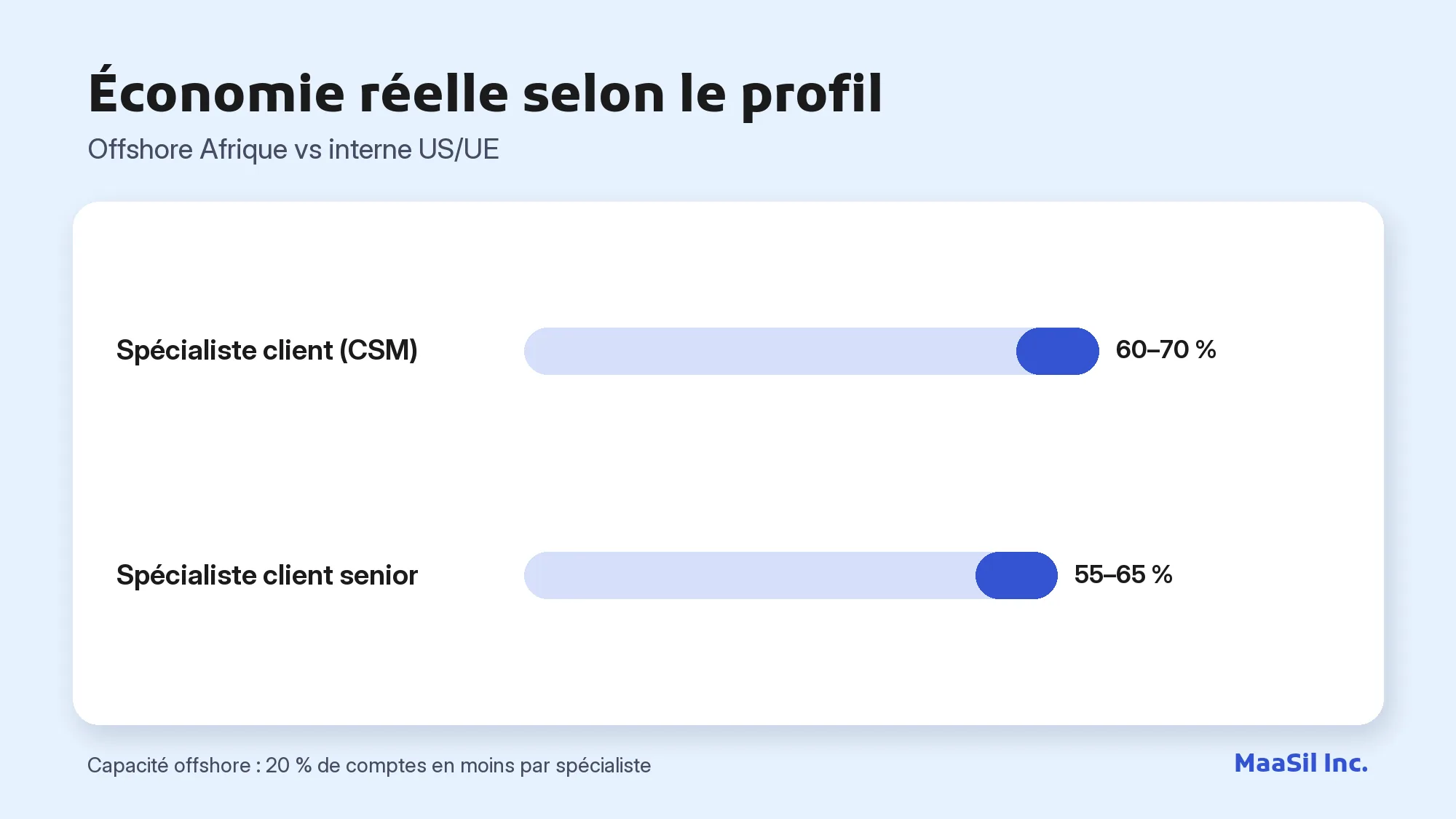
L'économie reste forte, même en ajustant la capacité de portefeuille offshore.
Rôle | Interne US/UE | Offshore Afrique | Économies effectives |
|---|---|---|---|
CSM/Spécialiste Client | 65K-85K$/an | 18K-30K$/an | 60-70% |
Spécialiste Client Senior | 85K-110K$/an | 30K-45K$/an | 55-65% |
La capacité de gestion du portefeuille de clients varie. SaaS standard à faible accompagnement (low-touch) : 1 spécialiste pour 50 à 80 comptes. B2B d'entreprise à fort accompagnement (high-touch) : 1 spécialiste pour 20 à 30 comptes.
Ajustement offshore : réduire de 20 % pour tenir compte de la surcharge de communication. Offshore low-touch : 40 à 65 comptes. Offshore high-touch : 15 à 25 comptes.
Par conséquent, calculez la taille totale de l'équipe sur la base de ratios de capacité ajustés. Un portefeuille de 200 comptes à faible accompagnement nécessite 3 à 4 spécialistes offshore contre 2,5 à 4 spécialistes en interne.
Combien coûterait votre équipe support à Madagascar ? Estimer mon budget →
Pourquoi les demandes de réunions en personne des clients tuent la rentabilité
Un client B2B s'attend à : « Rencontrons-nous autour d'un café pour discuter du renouvellement. » Le spécialiste offshore se trouve à l'Île Maurice, le client à Boston.
Les options imposent des choix impossibles. Refuser nuit à la relation. Envoyer le spécialiste aux États-Unis coûte 2 500 $ par voyage, effaçant ainsi 3 mois d'économies offshore. Assigner un membre de l'équipe interne aux réunions pose problème car il ne connaît pas l'historique du compte.
L'atténuation consiste à définir les attentes dès le départ : « Votre spécialiste est à distance, des appels vidéo sont disponibles. Réunions en personne avec le directeur de compte régional. » Les modèles hybrides font appel à des spécialistes offshore pour la gestion quotidienne et à des directeurs internes pour les QBR (revues d'activité trimestrielles). Les niveaux Premium attribuent des CSM internes aux comptes à forte valeur, tandis que les autres bénéficient d'un support offshore.
De plus, les clauses contractuelles lors du processus de vente clarifient les modèles de prestation de l'assistance. Les clients acceptant les conditions comprennent le modèle d'assistance à distance (remote-first) avant de démarrer.
Comment un décalage culturel dans le style de communication nuit aux relations
Un client d'une start-up technologique américaine (décontracté, au rythme rapide) envoie un message Slack : « yo, l'intégration est encore pétée 😤 » s'attendant à une réponse du type : « je m'en occupe, je vérifie les logs tout de suite ».
Un ton trop formel peut nuire à la relation : le style se travaille autant que le fond.
Un spécialiste offshore ayant reçu une formation classique en communication d'entreprise répond : « Cher Client, Nous vous remercions de nous avoir contactés. Je vais examiner cette question et vous tiendrai informé dans un délai de 24 heures. Cordialement, »
Perception du client : « Pourquoi cette personne est-elle si formelle et si lente ? » Cause profonde : la formation met l'accent sur le fait que la « communication professionnelle » se doit d'être formelle. Réalité : la culture du SaaS B2B est de plus en plus informelle.
L'atténuation nécessite une segmentation des clients pour faire correspondre le style de communication des spécialistes à la culture des clients, une formation à l'« effet miroir » où les agents reprennent les emojis et le langage décontracté lorsque les clients les utilisent, et des bibliothèques d'exemples montrant le spectre allant du très formel (grandes entreprises) au très décontracté (start-ups).
Par conséquent, l'intégration comprend une évaluation de la culture du client afin de garantir un alignement du style de communication dès le premier jour.
Comparatif : Quel support client fonctionne en offshore vs. en interne
Parfait pour l'offshore | Dangereux à externaliser |
|---|---|
Comptes SaaS à faible accompagnement (MRR 500-5K$) | Comptes d'entreprises clés (MRR >50K$) nécessitant des relations au niveau exécutif |
Support technique pour produits B2B | Rôles de conseil/consultation stratégique |
Intégration des nouveaux clients (processus standardisé) | Négociation de renouvellement de contrats (enjeux élevés) |
Formation sur les produits/webinaires | Gestion des plaintes escaladées provenant de la direction (C-level) |
Suivi d'utilisation/prise de contact proactive | Comptes spécifiques à un secteur (santé, juridique) exigeant une connaissance approfondie du domaine |
Rappels de renouvellement/tâches administratives | Comptes ayant un historique de besoins d'accompagnement élevés |
FAQ : Externalisation des spécialistes de l'assistance client
Les clients seront-ils mécontents de ne pas avoir de spécialistes de l'assistance locaux ?
Présentez-les comme un « spécialiste dédié » et non comme un « représentant offshore ». Les appels d'introduction vidéo humanisent et créent du lien. Des numéros de téléphone locaux (redirection VoIP vers les équipes offshore) maintiennent des points de contact familiers. La disponibilité pendant les heures de travail des clients grâce à des horaires décalés permet de gérer les fuseaux horaires. Les options de niveau Premium proposent des spécialistes internes pour les comptes à forte valeur.
Comment garantir une connaissance approfondie du produit pour les clients d'entreprise ?
Une intégration de six semaines (au lieu de deux) garantit une formation adéquate. Des programmes de certification sur les produits s'alignent sur les standards de l'équipe interne. Les spécialistes utilisent les produits au quotidien (l'utilisation interne favorise la familiarisation). Des analyses approfondies trimestrielles du produit avec les équipes d'ingénierie maintiennent les connaissances à jour. Les spécialistes assistent aux démonstrations clients en observant les appels de vente pour comprendre le contexte commercial.
Les barrières linguistiques et culturelles peuvent-elles nuire aux relations clients ?
Les critères d'embauche exigent un niveau d'anglais minimum B2 (échelle du Cadre européen commun de référence pour les langues - CECRL), de préférence C1. Les diplômes universitaires indiquent une exposition aux concepts commerciaux mondiaux. Une expérience préalable en B2B (et non dans le service client grand public B2C) garantit un parcours approprié. Des tests de fluidité culturelle présentent des scénarios commerciaux pour évaluer les réponses. Des périodes d'essai de 90 jours avec un suivi étroit permettent de détecter les problèmes rapidement.
Qu'est-ce qui empêche les spécialistes à distance de perdre des clients (churn) ?
Des protocoles de construction de relation structurent les points de contact : des bilans mensuels au minimum, des revues d'activité trimestrielles. Démarche proactive : « Nous avons vu que vous avez lancé une nouvelle fonctionnalité, voici comment notre plateforme peut vous accompagner. » Les attentions personnelles mémorisent les anniversaires des clients et les étapes importantes de l'entreprise grâce aux rappels du CRM. Les approches axées d'abord sur la vidéo créent des liens plus forts que le téléphone. Les réussites partagent la manière dont d'autres clients ont résolu des problèmes similaires.
Comment éviter que les spécialistes ne fassent trop de promesses ?
Des matrices d'autorité définissent ce que les spécialistes peuvent proposer de manière autonome ou ce qu'ils doivent remonter. Les processus d'approbation requièrent la validation d'un responsable pour les remises >10 %, les conditions personnalisées et les exceptions aux accords de niveau de service (SLA). Des scripts pour les demandes courantes indiquent : « Je peux vous proposer [dans les limites de mon autorité], pour [au-delà de mon autorité] laissez-moi confirmer avec mon chef d'équipe. » Des revues hebdomadaires où les responsables auditent les engagements clients permettent de détecter rapidement les promesses excessives.
L'externalisation des spécialistes de l'assistance client permet de réaliser 60 à 65 % d'économies lorsque les entreprises investissent dans une formation proactive, des plateformes de succès client et l'alignement des styles de communication. La formation réactive aux tickets échoue car les rôles de CSM exigent un sens des affaires et des compétences en gestion de la relation. De plus, le suivi de la santé des comptes nécessite des plateformes de données unifiées ; la compilation manuelle entre plusieurs systèmes fait perdre 20 à 30 % du temps des spécialistes. Une formation à la communication culturelle évite les décalages de formalité qui nuisent aux relations avec les clients des start-ups. Calculez les ajustements de capacité (réduction de 20 % pour l'offshore) et les coûts de plateforme avant la mise en œuvre, puis exécutez sur la base d'attentes réalistes de 60 % d'économies.
Prêt à renforcer votre équipe avec les meilleurs talents africains ?
Discutez avec l'un de nos experts pour découvrir comment le portage salarial augmenté à l'IA peut s'intégrer à 100 % à vos process et faire grandir vos projets.
Échangez avec un expert
