
Prêt à renforcer votre équipe avec les meilleurs talents africains ?
Discutez avec l'un de nos experts pour découvrir comment le portage salarial augmenté à l'IA peut s'intégrer à 100 % à vos process et faire grandir vos projets.
Échangez avec un expert
Service Client & Call Center
Entreprises d'externalisation du service client : comment économiser 65 % sans sacrifier la qualité
Les plaintes des clients concernant les temps d'attente s'accumulent. Votre équipe interne est noyée sous les arriérés de tickets. L'embauche d'agents supplémentaires à 42 000 $ chacun pèse sur les budgets. Les entreprises d'externalisation du service client promettent un soulagement à des tarifs offshore de 6 à 18 $ de l'heure. Mais la qualité va-t-elle s'effondrer ? Les accents vont-ils aliéner les clients ? Ce guide révèle quels prestataires de BPO tiennent leurs promesses et lesquels mènent à des catastrophes.
Qu'est-ce que l'externalisation du service client et pourquoi domine-t-elle le BPO ?
Les entreprises d'externalisation du service client se spécialisent dans la gestion des interactions avec les clients (téléphone, e-mail, chat, réseaux sociaux) pour le compte d'autres entreprises. Les principaux prestataires opèrent aux Philippines, en Afrique du Sud, au Nigeria, au Kenya, en Égypte et à l'Île Maurice. Ces entreprises de BPO (business process outsourcing ou externalisation des processus d'affaires) emploient des milliers d'agents formés dans des secteurs d'activité spécifiques.
L'argument commercial repose sur l'arbitrage des coûts. Un agent de service client aux Philippines coûte 8 400 $ par an tout compris, contre 54 600 $ au niveau national (États-Unis). Cependant, le coût total de possession (TCO) réel comprend des éléments cachés : les coûts de l'équipe d'assurance qualité (1 analyste qualité pour 15 agents), les outils d'analyse vocale (6 000 $/an pour 100 postes), l'infrastructure de téléphonie et les frais généraux de formation. Les tarifs de base annoncés de 4 $/heure passent à 6,80 $/heure avec les coûts indirects.
Selon l'enquête mondiale sur l'externalisation de Deloitte en 2023, 78 % des entreprises externalisent désormais au moins une fonction de service client (contre 52 % en 2018). La pandémie a accéléré l'adoption — le travail à distance a prouvé la viabilité opérationnelle du BPO.
Pourtant, 40 % des contrats d'externalisation échouent dans les deux ans. Cause profonde : l'illusion du « copier-coller ». Les entreprises copient des processus internes défaillants à l'étranger, en espérant des miracles. Un détaillant britannique a externalisé l'assistance par e-mail au Nigeria sans documenter son système d'escalade des priorités. L'équipe offshore a traité les tickets par ordre chronologique. Les plaintes des clients VIP sont restées en attente pendant 18 heures. Le contrat a été résilié après quatre mois.
Comment fonctionne réellement l'externalisation du service client derrière la technologie
Une externalisation réussie nécessite une infrastructure technique solide avant même que les agents ne répondent aux appels. La téléphonie VoIP exige une latence unidirectionnelle inférieure à 150 ms. L'Égypte et l'Afrique du Sud font face à des limitations de bande passante par les fournisseurs d'accès à Internet pendant les heures de pointe — des circuits MPLS dédiés ou un SD-WAN avec des politiques de QoS évitent les coupures. L'Internet public est source de catastrophes en matière de qualité.

VoIP : une latence unidirectionnelle inférieure à 150 ms est le premier prérequis.
Des casques anti-bruit (ANC > 30 dB) luttent contre la pollution sonore des plateaux de BPO en open space. Les installations aux Philippines et au Nigeria regroupent souvent plus de 200 agents dans une seule pièce. Sans une insonorisation adéquate, les clients entendent les conversations en arrière-plan. Une entreprise d'e-commerce américaine a reçu 23 % de plaintes concernant des « agents bruyants » avant de moderniser ses casques.
Les configurations d'accès au CRM créent des défaillances silencieuses. Soixante pour cent des clients accordent des autorisations incorrectes. Un accès en lecture seule alors que les agents doivent mettre à jour les dossiers clients entraîne la réouverture des tickets. Un accès complet en modification sans restriction de champ permet aux agents de supprimer accidentellement des historiques de commandes. Le juste milieu : un contrôle d'accès basé sur les rôles (RBAC) accordant des droits de modification uniquement sur des champs spécifiques (mises à jour de statut, notes, balises) tout en protégeant les données financières.
Le stockage des enregistrements soulève des questions de conformité. La loi sur la protection des données de Maurice exige un stockage sur des serveurs locaux — les enregistrements vocaux ne peuvent pas être hébergés dans une infrastructure cloud en dehors de sa juridiction. Une entreprise européenne a écopé d'une amende de 180 000 € pour non-respect du RGPD pour avoir stocké des appels de clients mauriciens sur des serveurs AWS en Irlande. Des exigences de localisation similaires sont en train d'émerger en Égypte.
Le piège de la mesure des SLA concerne 45 % des contrats. Un client britannique définit le SLA comme « répondre aux tickets dans les 4 heures ouvrables ». Il soumet un ticket le vendredi à 16h45 GMT. L'équipe nigériane commence le lundi à 8h00 WAT (7h00 GMT). Le tableau de bord du client indique 62 heures écoulées — violation du SLA. Le système de tickets a utilisé le temps absolu, et non les heures ouvrables. Une mise en œuvre correcte nécessite des calendriers professionnels partagés, des déclarations de fuseaux horaires explicites et des règles de pause automatique pendant les périodes de fermeture.
Externalisation des processus métiers (BPO) : Comparaison des coûts par zone géographique
Localisation | Tarif horaire de base | Coût réel chargé | Avantage clé | Faiblesse critique |
|---|---|---|---|---|
Philippines | 3,50-6,00 $ | 6,80-11,20 $ | Alignement culturel avec les États-Unis, couverture naturelle 24h/24 | Les agents sans accent représentent désormais une prime de +35 % (contre +10 % en 2019) |
Afrique du Sud | 6,00-10,00 $ | 10,40-16,80 $ | Accent neutre, excellent niveau d'anglais | Inflation salariale annuelle de 15 %, couverture limitée des équipes de nuit américaines |
Nigeria | 4,50-7,50 $ | 7,80-13,20 $ | Grand vivier de talents, culture entrepreneuriale | 18 % des clients britanniques demandent « quelqu'un que je peux comprendre » |
Kenya | 4,00-7,00 $ | 7,20-12,40 $ | Excellent anglais écrit, compétences en technologies mobiles | Écarts idiomatiques (différences entre anglais britannique et américain) |
Égypte | 4,00-6,50 $ | 7,00-11,40 $ | Bilingue arabe/anglais, pôles technologiques en pleine croissance | Problèmes de fiabilité du FAI pendant les heures de pointe |
Maurice | 7,00-11,00 $ | 12,20-18,40 $ | Conformité DPA (loi sur la protection des données), forte protection de la propriété intellectuelle | Coûts plus élevés (40 % de plus qu'au Nigeria), vivier de talents plus restreint |
Comparaison nationale (représentant du service client aux États-Unis) :
Salaire de base : 32 000 $
Charges sociales (7,65 %) : 2 448 $
Assurance maladie : 6 200 $
Cotisation retraite 401(k) (4 %) : 1 280 $
Équipement/logiciel : 1 800 $
Espace de bureau : 4 200 $
Recrutement/formation : 3 600 $ (amorti)
Frais généraux de gestion : 2 400 $
Total : 53 928 $ (26 $/heure)
Un agent aux Philippines à 6,80 $/heure tout compris = 74 % d'économies. Cependant, les coûts d'intégration retardent le retour sur investissement (ROI). La formation initiale (3-4 semaines), les problèmes de qualité pendant la phase de montée en charge (les agents fonctionnent à 60 % d'efficacité les 90 premiers jours) et le fonctionnement en parallèle (maintien de l'équipe interne pendant la transition) consomment entre 18 000 et 28 000 $. Les véritables économies se matérialisent entre le 6e et le 8e mois, pas immédiatement.
Combien coûterait votre équipe support à Madagascar ? Estimer mon budget →
Externalisation offshore : La réalité de la barrière de l'accent et les solutions techniques
La réalité de l'accent s'impose à chaque décision de BPO. Les indicateurs internes de six grands prestataires montrent que 18 % des clients britanniques demandent « quelqu'un que je peux comprendre » lorsqu'ils contactent des agents nigérians. Les entreprises ont trois options : les remplacer par des équipes sud-africaines (+35 % de coût), mettre en œuvre des stratégies d'atténuation, ou accepter l'attrition.
Solution 1 : Le modèle de canal hybride Les agents sud-africains gèrent les appels vocaux entrants. L'équipe nigériane gère les e-mails/chats/réseaux sociaux (l'anglais écrit élimine les problèmes d'accent). Cela préserve un avantage de coût de 48 % par rapport à un personnel entièrement sud-africain tout en maintenant la satisfaction des clients.
Un service d'abonnement britannique a mis cela en œuvre. Les appels vocaux (30 % du volume) ont été dirigés vers l'Afrique du Sud (CSAT de 91 %). Les e-mails/chats (70 % du volume) ont été dirigés vers le Nigeria (CSAT de 87 %). Coût global inférieur de 52 % au niveau national, CSAT moyen de 88 % (contre 89 % avec l'équipe interne précédente).
Solution 2 : Formation à la neutralisation de l'accent Des programmes de huit semaines réduisent de 60 % les plaintes liées à la compréhension. Les outils d'analyse de la parole (CallMiner, Observe.AI, Balto) identifient les véritables échecs de compréhension par rapport aux préjugés des clients. Un opérateur télécom britannique a découvert que 70 % des « plaintes concernant l'accent » provenaient de clients qui n'aimaient tout simplement pas la réponse — la communication n'était pas en cause.
La formation se concentre sur les phonèmes problématiques. Les Nigérians ont des difficultés avec les sons « th » (qui deviennent « d » ou « t »). « Think » devient « tink », « this » devient « dis ». Une pratique ciblée sur ces sons spécifiques améliore considérablement la clarté. Cependant, l'élimination complète de l'accent nécessite 12 à 18 mois de pratique continue.
Solution 3 : Analyse de la parole + Coaching Des outils en temps réel comme Balto affichent des suggestions de réponses pendant les appels. Si le système détecte qu'un client dit « Je ne vous comprends pas », il invite l'agent à ralentir de 20 % et à mieux articuler. L'analyse post-appel identifie les tendances. Le responsable examine les enregistrements avec l'agent et identifie les points d'amélioration spécifiques.
Cela coûte 45 $ par agent et par mois pour le logiciel, plus 2 heures par semaine de coaching par le responsable. Le retour sur investissement apparaît en 6 à 8 semaines grâce à la réduction des escalades et à l'amélioration du CSAT.
Qu'est-ce que l'externalisation des services d'ingénierie dans le contexte du support client ?
L'externalisation des services d'ingénierie au sein du support client désigne le support technique pour les produits logiciels, les plateformes SaaS ou le dépannage matériel. Cela diffère du service client général — les agents ont besoin d'une connaissance approfondie du produit et de compétences en résolution de problèmes techniques.
Les Philippines excellent dans ce domaine grâce à un système éducatif solide dans les matières STEM. Soixante-treize pour cent des agents de support technique en BPO possèdent une licence en informatique, en sciences informatiques ou en ingénierie (contre 45 % pour les rôles de service client général). Une entreprise de SaaS américaine a externalisé son support technique de niveau 2 à Manille. Les agents ont résolu 68 % des tickets sans escalade vers l'ingénierie (l'équipe interne atteignait 71 %) — un écart de qualité minimal pour une réduction des coûts de 62 %.
Cependant, la complexité du produit limite la faisabilité. Une entreprise allemande d'automatisation industrielle a tenté d'externaliser le support de programmation des API au Kenya. Les agents manquaient d'expérience pratique sur le terrain de la fabrication. Les clients demandaient « quel relais contrôle le verrouillage du convoyeur ? ». Les agents ne pouvaient pas visualiser le système. Le taux de résolution au premier appel est tombé à 31 % (équipe interne : 76 %). Contrat résilié après six mois.
Le test de faisabilité : Pouvez-vous créer une documentation permettant de résoudre les problèmes sans connaissances internes partagées uniquement à l'oral ? Si oui, l'offshore fonctionne. Si non (nécessite d'avoir été sur place), gardez l'équipe en interne. Les plateformes SaaS dotées d'une documentation d'architecture claire s'externalisent avec succès. Les systèmes industriels hérités avec 30 ans de personnalisations non documentées échouent à l'étranger.
Exemples d'externalisation informatique appliqués aux opérations de service client
L'externalisation du support informatique et l'externalisation du service client partagent des principes opérationnels similaires. Toutes deux nécessitent des systèmes de tickets (Zendesk, Freshdesk, ServiceNow), des bases de connaissances, des matrices d'escalade et un suivi des SLA. La principale différence : le support informatique gère les employés internes ; le service client gère les clients externes.
Modèle de réussite : Le modèle d'escalade par niveaux
Niveau 1 (Offshore) : Réinitialisation de mots de passe, suivi de commandes, réponses aux FAQ, traitement des retours, planification de rendez-vous (70 à 80 % du volume)
Niveau 2 (Hybride) : Dépannage technique, litiges de facturation, résolution de plaintes, modifications de compte (15 à 25 % du volume)
Niveau 3 (Interne) : Escalades vers la direction, questions juridiques, enquêtes sur les fraudes, rétablissement de service (3 à 5 % du volume)
Une entreprise de services financiers britannique a mis cela en œuvre. Le niveau 1 au Nigeria (8,20 $/heure chargé) gérait 76 % des contacts. Le niveau 2 était réparti entre le Nigeria (spécialistes techniques, 11,40 $/heure) et l'équipe interne. Le niveau 3 restait entièrement interne. Réduction globale des coûts : 58 % par rapport au modèle précédent entièrement interne. Le CSAT a d'abord chuté de 3 points (de 89 % à 86 %) mais est remonté à 88 % au sixième mois.
Modèle d'échec : Externalisation d'avant-vente complexe Un éditeur de logiciels B2B allemand a embauché un support d'avant-vente basé aux Philippines. Les prospects posaient des questions d'intégration complexes et spécifiques. Les agents offshore n'avaient ni accès au code source ni formation en ingénierie. « Votre API peut-elle gérer des mises à jour par lots pour 50 000 enregistrements avec validation de champs personnalisés ? » est devenu « Laissez-moi vérifier avec l'ingénierie » (délai de 48 heures). Trois contrats majeurs ont été perdus en raison de la lenteur des réponses techniques. L'avant-vente exige une connaissance approfondie du produit indisponible en externe.
Entreprises d'externalisation informatique vs Spécialistes du service client : Choix du prestataire
L'évaluation des prestataires diffère entre les entreprises d'externalisation informatique et les spécialistes du BPO de service client. Les entreprises informatiques mettent en avant les certifications techniques (ITIL, CompTIA, AWS). Les prestataires de service client mettent en valeur les scores CSAT, les processus de gestion de la qualité et l'expérience sectorielle spécifique.
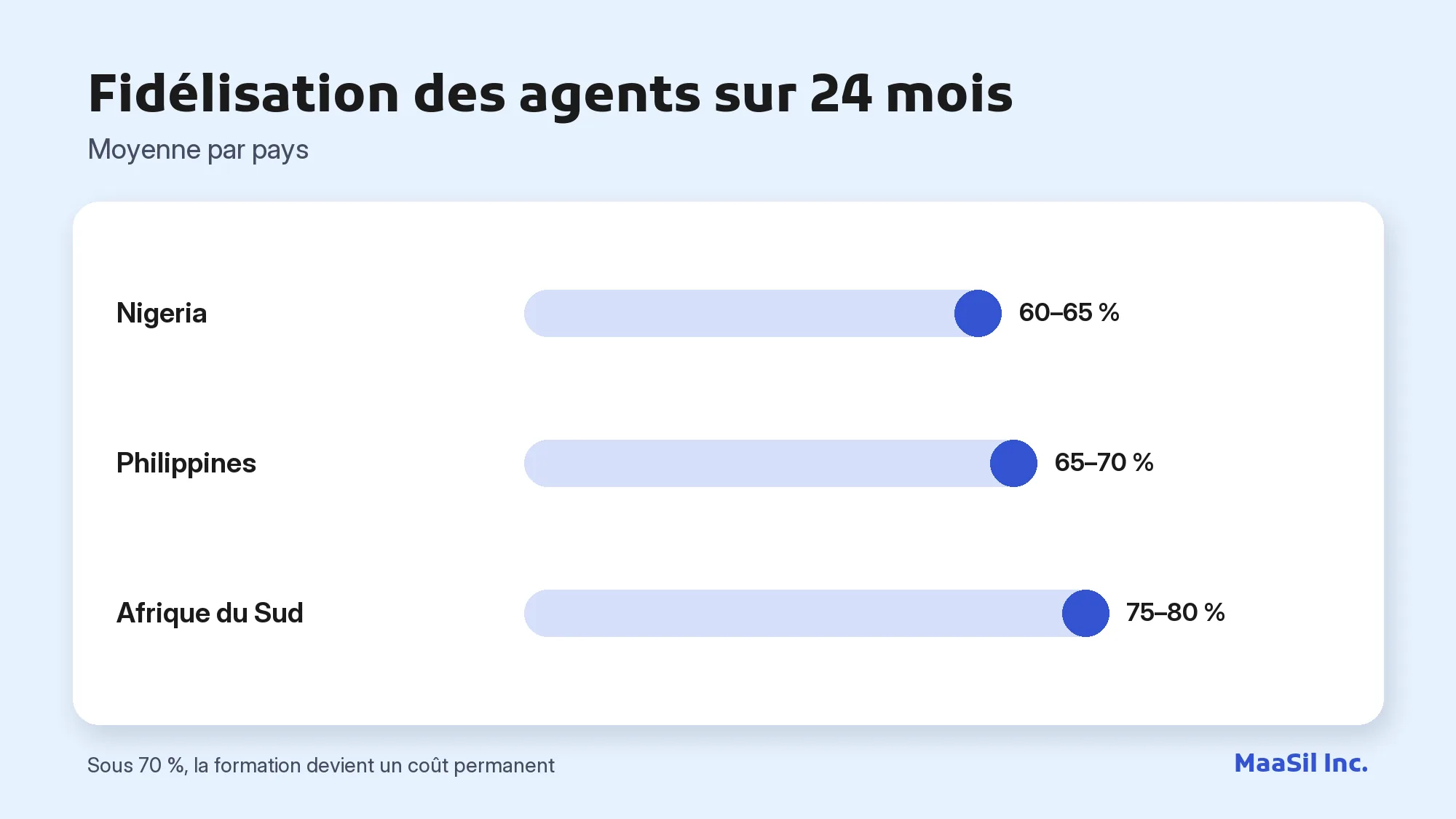
Demandez le taux de fidélisation sur 24 mois avant de choisir un prestataire.
Questions à poser aux prestataires de BPO de service client :
« Quel est votre taux de fidélisation des agents sur 24 mois ? » Un taux inférieur à 70 % est synonyme de coûts de formation continue constants. Les Philippines affichent une moyenne de 65-70 %, l'Afrique du Sud 75-80 %, le Nigeria 60-65 %. Un turnover élevé détruit les connaissances institutionnelles.
« Présentez votre grille d'évaluation de l'assurance qualité. » Une bonne assurance qualité évalue 5 à 10 % des interactions chaque mois selon plusieurs critères : accueil, écoute active, résolution de problèmes, respect des procédures, conclusion. Une évaluation unidimensionnelle de type « le problème a-t-il été résolu oui/non » passe à côté des nuances de qualité.
« Comment gérez-vous les plaintes liées aux préjugés sur l'accent ? » Les BPO de qualité ont des protocoles d'escalade : agents sud-africains d'« assistance accent » disponibles pour les rappels, outils d'analyse de la parole identifiant les réels problèmes de compréhension par rapport aux préjugés des clients, programmes de coaching des managers.
« Quel est votre processus de mise à jour de la base de connaissances ? » L'obsolescence des connaissances détruit la qualité du BPO. Changements de produits, mises à jour de politiques, nouvelles FAQ — si les agents travaillent avec des informations obsolètes, ils fournissent de mauvaises réponses. Meilleure pratique : revues hebdomadaires de la base de connaissances avec l'équipe produit du client, journaux de modifications pour suivre toutes les mises à jour, vérification par quiz de la lecture des mises à jour par les agents.
« Présentez-moi un cas récent de rétablissement de service après incident. » Comment ont-ils géré une erreur majeure ? Ont-ils assumé l'erreur ? Quelles améliorations de processus en ont découlé ? Les BPO qui rejettent la faute sur les clients pour des « exigences floues » doivent vous alerter.
Audit des infrastructures : Demandez une visite du centre de données (virtuelle acceptée). Vérifiez : double connexion FAI, générateur avec basculement automatique <5 secondes, capacité des onduleurs (UPS), sécurité physique, isolation acoustique. Les Philippines et le Nigeria disposent d'excellentes installations. Le Kenya et l'Égypte varient considérablement — certains sont de classe mondiale, d'autres sont des espaces de bureaux partagés avec une infrastructure minimale.
Leçons de l'externalisation du support informatique : Appliquer la précision des SLA au service client
L'externalisation du support informatique a été pionnière dans la rigueur de la mesure des SLA. Les BPO de service client utilisent souvent des indicateurs simplistes : « temps moyen de traitement inférieur à X minutes ». Cela incite les agents à expédier les appels des clients, ce qui nuit à la qualité.
Grille de SLA appropriée :
Indicateur | Objectif | Méthode de mesure | Pourquoi c'est important |
|---|---|---|---|
Temps de première réponse | <2 heures (e-mail), <30 sec (chat) | Horodatage de la création du ticket jusqu'au premier message de l'agent | Perception de la réactivité par le client |
Temps de résolution | <24 heures (Niveau 1), <72 heures (Niveau 2) | Heures ouvrables écoulées (pas en temps absolu) | Vitesse réelle de résolution des problèmes |
Satisfaction client (CSAT) | >85 % | Enquête post-interaction, échelle de 5 points | Indicateur direct de qualité |
Résolution au premier contact (FCR) | >75 % | Problème résolu lors d'une seule interaction sans escalade | Efficacité + expérience client |
Respect du planning | >95 % | Agent connecté pendant les plages horaires prévues | Fiabilité de la dotation en personnel |
Score de qualité | >90 % | Évaluation AQ de 5 à 10 % des interactions mensuelles | Contrôle complet de la qualité |
Le risque de manipulation des SLA : Les relations offshore matures sont confrontées à la manipulation des indicateurs. Les agents ferment rapidement les tickets en demandant « Est-ce résolu ? » sans réellement corriger les causes profondes. Les réouvertures de tickets comptent comme de nouveaux tickets, montrant un arriéré faussement bas. Luttez contre cela grâce à des audits de qualité : échantillonnez de manière aléatoire 10 % des tickets fermés chaque mois, vérifiez la résolution réelle par rapport au simple apaisement du client.
Autre tactique de manipulation : la sélection des tickets faciles. L'agent voit une file d'attente contenant un mélange de tickets simples (« suivre ma commande ») et complexes (« erreur de facturation datant d'il y a 3 mois »). Il choisit les plus simples, laissant les tickets complexes aux autres. Les indicateurs affichent un FCR élevé et un temps de traitement faible, mais l'arriéré de tickets difficiles s'accumule. Solution : attribution des tickets en mode « round-robin » (le système attribue automatiquement le ticket suivant, pas de choix possible).
Externalisation d'assistants virtuels vs Équipes de service client complètes
L'externalisation d'un assistant virtuel (VA) convient aux petites entreprises (<50 employés) ayant besoin d'un soutien à temps partiel. Un seul VA gère les e-mails, le chat, la planification des rendez-vous pour 8 à 12 $/heure. Pas d'investissement d'infrastructure, pas de frais généraux de gestion, horaires flexibles.
Cependant, les assistants virtuels ne disposent pas d'une infrastructure d'entreprise. Ils travaillent à domicile avec une connexion Internet grand public. Les pannes de courant, les défaillances des FAI et les interruptions familiales perturbent le service. Pas de supervision de l'assurance qualité — vous devez simplement espérer qu'ils soient performants. Une société de conseil américaine a embauché un assistant virtuel kenyan pour la planification des rendez-vous clients. La connexion Internet du VA a coupé lors d'un appel client crucial. Pas de solution de rechange, pas de basculement d'urgence. La relation client a été endommagée.
Les équipes complètes de service client fournissent une infrastructure d'entreprise : Internet redondant, générateurs, sécurité physique, suivi de l'assurance qualité, chefs d'équipe, parcours d'escalade. Le coût par agent augmente, mais la fiabilité et la qualité font un bond significatif. Le seuil de rupture : besoin de plus de 3 agents équivalents temps plein (ETP) = passez à un prestataire de BPO. 1-2 ETP = un assistant virtuel individuel peut suffire si vous acceptez une fiabilité moindre.
Externalisation des services de comptabilité + Service client : La synergie du back-office
Les entreprises regroupent souvent l'externalisation du service client avec des fonctions de back-office (comptabilité, saisie de données, administration des RH). Les prestataires de BPO au Kenya et à l'Île Maurice proposent des équipes hybrides — agents de service client pendant les heures de bureau, traitement de back-office en période creuse.
Une entreprise d'e-commerce britannique a externalisé les deux à l'Île Maurice. La même équipe de 12 personnes gérait les demandes des clients de 9h00 à 17h00 GMT, puis s'occupait de la saisie des commandes et de la comptabilité de 17h00 à 21h00 GMT. Le taux d'utilisation a atteint 80 % (contre 55 % pour le service client seul). Le coût par agent a chuté de 28 % grâce aux gains d'efficacité.
Cependant, des risques pour la qualité apparaissent. Les agents fatigués mentalement par 8 heures d'appels clients font des erreurs de saisie de données pendant le travail de back-office. Un agent a mal classé 47 000 £ de dépenses après une session de service client particulièrement stressante. Solution : séparer les équipes ou limiter le travail de back-office à 2-3 heures par jour avec des pauses obligatoires.
Intégration d'une entreprise d'externalisation du développement logiciel + Support client
Les entreprises d'externalisation de logiciels proposent de plus en plus un support client groupé pour les applications qu'elles développent. Les agences de développement égyptiennes et nigérianes proposent un support haut de gamme — les développeurs gèrent directement les escalades techniques de niveau 2/3. Cela élimine les lacunes de transfert de connaissances entre les équipes de développement et de support.
Une fintech américaine a développé une application de paiement mobile avec des développeurs égyptiens. Plutôt que de faire appel à un BPO de service client distinct, elle a maintenu le support au sein de l'équipe de développement. Le niveau 1 a été confié à un BPO philippin (questions simples sur l'utilisation). Le niveau 2+ a été escaladé directement aux développeurs égyptiens. Le temps de résolution des problèmes techniques complexes a chuté de 68 % parce que les développeurs comprenaient parfaitement le code source.
Compromis sur les coûts : les développeurs coûtent de 15 à 25 $/heure contre 6 à 11 $/heure pour les agents de service client. Cela n'est économique que pour les produits techniques où le niveau 2+ représente un volume important (>20 % des contacts). Pour le service client général (suivi des commandes, retours), une équipe de BPO distincte est plus logique d'un point de vue financier.
Les entreprises d'externalisation aux Philippines : L'avantage d'une couverture sur 24 heures
Les Philippines dominent l'externalisation du service client pour les entreprises américaines grâce à une parfaite concordance des fuseaux horaires. Manille a 12 à 13 heures d'avance sur l'heure de l'Est des États-Unis. Leurs horaires de 8h00 à 17h00 correspondent à 19h00-4h00 aux États-Unis. Cela crée une couverture naturelle de 24 heures sans majoration pour le travail de nuit.

Le décalage horaire des Philippines permet une couverture naturelle 24 h/24.
Un service de box par abonnement américain a mis en œuvre un support basé sur le modèle « follow-the-sun ». L'équipe interne (États-Unis) gérait la plage de 9h00 à 18h00 ET. L'équipe philippine couvrait la période de 18h00 à 9h00 ET. Les e-mails des clients recevaient une réponse en moins de 2 heures, quel que soit le moment de leur envoi. La mise en œuvre n'a coûté aucune prime d'équipe de nuit (les agents de nuit nationaux exigent une augmentation de salaire de 40 %).
Cependant, le support téléphonique en temps réel nécessite un chevauchement. S'il n'y a pas de réunion de passation de relais entre les équipes américaine et philippine, des éléments de contexte se perdent. Une équipe marque un ticket comme « en attente de réponse du client », l'équipe philippine ne sait pas pourquoi et envoie une demande en doublon. Cela génère de la frustration chez le client. Solution : une période de chevauchement d'une heure (l'équipe américaine reste tard de 18h00 à 19h00 ET, l'équipe philippine commence tôt de 7h00 à 8h00, heure de Manille) pour les discussions de transfert.
L'alignement culturel aide les Philippines à exceller avec les clients américains. L'exposition aux médias américains crée une familiarité avec les expressions idiomatiques, les fêtes et les références culturelles. Un agent comprend le concept du « Black Friday » sans explication. À l'inverse, au Kenya, un agent a demandé à un client américain « Qu'est-ce que Thanksgiving ? » lors d'un pic de support en novembre (un timing maladroit, bien que la question soit innocente).
Avantages de l'externalisation du service client : Au-delà des économies de coûts
Avantage 1 : Évolutivité sans les frictions de l'embauche L'embauche en interne prend en moyenne 47 jours (US Bureau of Labor Statistics). Les vérifications d'antécédents, les entretiens, les négociations d'offres et l'intégration prennent du temps. Les prestataires de BPO déploient des équipes formées en 14 à 21 jours. Un détaillant américain avait besoin de 25 agents supplémentaires pour la période des fêtes. L'embauche en interne n'aurait pas permis de respecter les délais. Le BPO philippin a livré les équipes en 18 jours, gérant une augmentation de volume de 53 %.
Avantage 2 : Opérations 24h/24 et 7j/7 aux tarifs standards Les équipes de nuit nationales coûtent 40 % de plus, sans compter le risque d'épuisement professionnel. Les BPO aux Philippines et en Afrique du Sud fonctionnent selon des horaires de jour standards locaux tout en couvrant les nuits aux États-Unis et en Europe. Pas de surcoût lié aux primes de nuit. Une entreprise SaaS britannique a ajouté un support 24h/24 et 7j/7 via une équipe de nuit sud-africaine (19h00-3h00 GMT = 9h00-17h00 en Afrique du Sud). Des agents aux tarifs standards, sans prime d'équipe de nuit.
Avantage 3 : Accès à des compétences spécialisées Trouver des agents bilingues dans son propre pays s'avère coûteux. Les locuteurs arabophones/anglophones en Égypte, francophones/anglophones en Tunisie, hispanophones/anglophones aux Philippines offrent une couverture linguistique impossible à obtenir localement à un coût raisonnable. Une compagnie d'assurance maladie américaine avait besoin d'un support en arabe pour ses clients de la région MENA. L'embauche de locuteurs arabophones aux États-Unis coûtait plus de 58 000 $. Un BPO égyptien a fourni des agents parlant couramment la langue pour 11 $/heure.
Avantage 4 : Concentrer l'équipe interne sur des tâches à forte valeur ajoutée L'offshore gère les demandes répétitives (suivi de commandes, réinitialisation de mots de passe, réponses aux FAQ). L'équipe interne se concentre sur les cas complexes (rétablissement de service, comptes VIP, escalades). Une entreprise de services financiers a transféré 72 % de son volume à l'étranger. L'équipe interne restante s'est orientée vers la gestion des relations et les projets stratégiques, ce qui a amélioré la satisfaction et la fidélisation des employés.
Cependant, ces avantages nécessitent une mise en œuvre appropriée. Les transitions précipitées annulent les économies. Une entreprise d'e-commerce américaine a exigé une transition en 21 jours. Au deuxième mois, l'arriéré de tickets a atteint 380 % de la base de référence. Six mois de temps de rétablissement ont été nécessaires. Les transitions réussies nécessitent entre 90 et 120 jours : 30 jours de documentation, 30 jours d'observation en binôme, 30 jours de fonctionnement en parallèle, et 30 jours de support post-lancement.
Inconvénients de l'externalisation du service client : Le piège des expressions culturelles
Problème : Maîtrise de la langue ≠ Fluidité culturelle
Un client britannique dit à un agent kenyan : « I need this sorted by end of play. » L'agent demande : « De quel jeu parlez-vous ? » « End of play » signifie « fin de la journée de travail » en anglais britannique — c'est une expression idiomatique. L'agent formé à l'anglais américain manque de vocabulaire professionnel britannique.
Des bases de données d'expressions régionales résolvent ce problème. Documentez des expressions comme « fortnight » (deux semaines), « on the back burner » (faible priorité), « ballpark figure » (estimation approximative), « touch base » (reprendre contact) avec des traductions en langage clair. Mettez-les à jour trimestriellement au fil de l'apparition de nouvelles expressions.
Problème : Interprétation littérale
Client américain (frustré) : « C'est la troisième fois que j'appelle pour ça ! » Agent nigérian : « En réalité, notre système indique qu'il s'agit de votre deuxième appel. » Techniquement correct, mais passe à côté du contexte émotionnel. Le client souhaite que sa frustration soit reconnue, pas qu'on corrige ses données.
La formation doit couvrir l'intelligence émotionnelle. « Je comprends que cela ait été frustrant. Permettez-moi de m'assurer que nous résolvons complètement ce problème cette fois-ci » reconnaît le sentiment avant de passer à la résolution du problème. De nombreux systèmes éducatifs africains privilégient la précision factuelle à la reconnaissance émotionnelle — une formation explicite à l'intelligence émotionnelle comble cette lacune.
Problème : Décalage des jours fériés
Un client américain appelle le 26 décembre (le lendemain de Noël, un jour ouvrable normal). Il tombe sur la messagerie vocale parce que le BPO philippin observe le 26 décembre comme étant le Boxing Day (un jour férié). Le client exprime sa colère sur les réseaux sociaux. Le contrat n'avait pas clarifié le calendrier des jours fériés.
Solution : Définissez explicitement les jours ouvrables. Utilisez le calendrier du client pour l'application des SLA. Le BPO peut observer ses propres jours fériés mais doit fournir une équipe minimale ou communiquer clairement les dates de fermeture aux clients.
Comment atténuer les risques liés à l'externalisation du service client : Le cadre de qualité
Contrôle 1 : Programme d'assurance qualité (non facultatif) Un minimum de 5 % des interactions doit être évalué mensuellement. Mélange d'une équipe AQ interne et de contrôles ponctuels côté client. La grille d'évaluation couvre :

Évaluer au moins 5 % des interactions chaque mois : le socle du contrôle qualité.
L'accueil (approprié, chaleureux)
L'écoute active (reformuler le problème du client)
La résolution de problèmes (solution correcte)
Le respect des procédures (suit les étapes établies)
La clarté de la communication (pas de jargon, confirmation de la bonne compréhension)
La conclusion (s'assure de la satisfaction, indique les étapes suivantes)
Une grille d'évaluation à dimension unique est trop superficielle. Un agent peut résoudre des problèmes (case cochée) tout en étant impoli (le CSAT en pâtit). Des grilles d'évaluation complètes permettent d'éviter cela.
Contrôle 2 : Sessions d'étalonnage Réunions mensuelles au cours desquelles les équipes d'AQ du client et du BPO écoutent les mêmes enregistrements d'appels et attribuent des notes de manière indépendante. Comparez les résultats. Si le client note l'interaction à 75 % et le BPO à 92 %, il y a un décalage. Discutez des différences jusqu'à ce qu'une cohérence d'évaluation apparaisse. Cela évite l'inflation des notes (le BPO évaluant de manière trop indulgente pour atteindre les objectifs).
Contrôle 3 : Boucles de rétroaction des clients Les enquêtes post-interaction (CSAT) sont essentielles, mais les taux de réponse se situent entre 3 et 8 %. Ne vous fiez pas uniquement aux enquêtes. Surveillez les mentions sur les réseaux sociaux, examinez les commentaires sur les sites d'avis et analysez les taux de contacts répétés (des clients qui appellent plusieurs fois indiquent que la première interaction a échoué). Un opérateur télécom a découvert que pour 40 % des tickets « résolus », les clients rappelaient dans les 48 heures — un indicateur de résolution biaisé.
Contrôle 4 : Analyse de la parole Des outils comme CallMiner, Observe.AI et Balto analysent 100 % des appels (et pas seulement un échantillon de 5 % pour l'assurance qualité). Signalez les mots-clés : « annuler », « concurrent », « frustré », « superviseur », « procès ». Identifiez les tendances. Si les mentions d'« annulation » augmentent de 40 % en une semaine, enquêtez immédiatement. L'assurance qualité manuelle détecte les problèmes individuels des agents ; l'analyse de la parole détecte les problèmes systémiques.
Contrôle 5 : Client mystère Des évaluations trimestrielles par client mystère testent la performance des agents à leur insu. Le client ou un tiers soumet des demandes d'assistance réalistes et évalue la qualité de l'interaction. Les résultats des clients mystères diffèrent souvent de l'assurance qualité habituelle (les agents se comportent différemment lorsqu'ils ne se savent pas surveillés). Un BPO a obtenu un score de 91 % lors de l'assurance qualité régulière, mais de 78 % lors des clients mystères — les agents donnaient des réponses types lors des interactions surveillées mais prenaient des raccourcis lorsqu'ils n'étaient pas supervisés.
Combien coûterait votre équipe support à Madagascar ? Estimer mon budget →
Conclusion : La décision stratégique d'externalisation du service client
Les entreprises d'externalisation du service client permettent de réaliser des économies de 50 à 65 % lorsqu'elles sont mises en œuvre avec une rigueur opérationnelle. Les BPO philippins offrent une parfaite adéquation des fuseaux horaires pour les entreprises américaines (6,80-11,20 $/heure chargé). L'Afrique du Sud fournit un anglais sans accent pour les marchés du Royaume-Uni et de l'UE (10,40-16,80 $/heure). Le Nigeria est optimal pour les canaux d'assistance écrits (7,80-13,20 $/heure).
Le succès nécessite une infrastructure adéquate (VoIP avec QoS, casques anti-bruit, intégration du CRM), une adaptation culturelle (bases de données d'expressions, formation à l'intelligence émotionnelle) et des contrôles de qualité (évaluation d'au moins 5 % des interactions, analyse de la parole, client mystère).
Le modèle de canal hybride préserve les économies tout en atténuant les problèmes d'accent : les agents sud-africains gèrent la voix, les équipes nigérianes gèrent les e-mails/chats. Cela permet d'obtenir une réduction des coûts de 48 % avec un impact minimal sur le CSAT.
Évitez de précipiter les transitions. Les transferts réussis nécessitent entre 90 et 120 jours : documentation, observation en binôme, fonctionnement en parallèle et support post-lancement. Réduire cette période à 30 jours provoque des crises d'arriérés de tickets qui nécessitent six mois de rétablissement.
Excellents candidats : support de niveau 1 (70 à 80 % du volume), interactions par e-mail/chat, besoins de couverture 24h/24 et 7j/7, mise à l'échelle saisonnière. Candidats à risque : avant-vente complexe, gestion des relations avec la direction, communications de crise nécessitant une connaissance approfondie de l'entreprise.
La question n'est pas de savoir s'il faut externaliser le service client, mais si vous mettrez en œuvre le cadre de qualité qui sépare les partenariats fructueux des résiliations de contrats.
Foire aux questions sur les entreprises d'externalisation du service client
Comment éviter un effondrement de la qualité lors de l'externalisation du service client ? Mettez en œuvre un programme d'assurance qualité complet évaluant 5 à 10 % des interactions mensuelles selon plusieurs dimensions : accueil, écoute active, résolution de problèmes, respect des procédures, clarté de la communication, conclusion. Organisez des sessions d'étalonnage mensuelles au cours desquelles les équipes d'AQ du client et du BPO notent des interactions identiques pour harmoniser les critères. Déployez l'analyse de la parole pour analyser 100 % des appels à la recherche de tendances de mots-clés. Réalisez des visites trimestrielles de clients mystères pour tester les performances non surveillées. La qualité nécessite un investissement — de 2,40 à 4,80 $ par agent et par mois pour les frais d'AQ — mais elle évite des scénarios de catastrophe avec des baisses de 71 % du CSAT.
L'accent des agents va-t-il poser problème avec des prestataires nigérians ou kenyans ? Oui — 18 % des clients britanniques demandent « quelqu'un que je peux comprendre » avec des agents nigérians. Mettez en œuvre un modèle de canal hybride : les agents sud-africains gèrent les appels vocaux (accent neutre), les équipes nigérianes gèrent les e-mails/chats (l'anglais écrit élimine l'accent). Cela permet de conserver un avantage de coût de 48 %. Alternativement, investissez dans une formation de 8 semaines sur la neutralisation de l'accent, ce qui réduit les plaintes de 60 %. Les outils d'analyse de la parole identifient les réels problèmes de compréhension (30 %) par rapport aux préjugés des clients (70 %). Ne présumez pas que les problèmes d'accent condamnent d'office l'externalisation — ils peuvent être résolus avec la bonne stratégie.
Comment les fuseaux horaires affectent-ils l'externalisation du service client ? Les Philippines offrent une adéquation parfaite des fuseaux horaires pour les entreprises américaines — leur plage de 8h00 à 17h00 correspond à 19h00-4h00 aux États-Unis — créant une couverture 24h/24 sans majoration pour le travail de nuit. L'Afrique du Sud a un décalage de 6 à 7 heures par rapport à l'heure de l'Est des États-Unis (1 à 3 heures d'avance sur le Royaume-Uni), ce qui limite la couverture nocturne des États-Unis mais s'avère parfait pour l'UE. Exigez un chevauchement d'au moins une heure entre les équipes internes et offshore pour les discussions de transfert de dossiers. Définissez les délais de SLA en utilisant les « heures ouvrables écoulées » et non le « temps absolu » — un ticket du vendredi à 16h45 nécessite une mise en pause automatique pendant le week-end pour éviter une fausse violation de SLA le lundi matin.
Quelle est la différence de coût réelle entre un service client interne et externe ? Un agent interne aux États-Unis : 53 928 $ tout compris (26 $/heure) comprenant le salaire, les avantages sociaux, les taxes, l'équipement, l'espace de bureau et les frais de gestion. Un agent aux Philippines : 14 280 $ tout compris (6,80 $/heure) comprenant le salaire de base, les charges indirectes, l'allocation de l'équipe AQ, les outils d'analyse vocale et l'infrastructure téléphonique. Économie réelle : 74 %. Cependant, les coûts d'intégration (de 18 000 à 28 000 $ pour la mise en place de l'équipe) et la période de montée en charge de 90 jours retardent le ROI jusqu'aux mois 6 à 8. Prévoyez votre budget avec prudence — les tarifs de base annoncés de 4 $/heure atteignent en réalité 6,80 à 11,20 $/heure.
Puis-je externaliser le service client sans perdre le contrôle de la relation client ? Oui, grâce à un modèle d'escalade par niveaux. Le niveau 1 (offshore) gère 70 à 80 % du volume : suivi des commandes, FAQ, dépannage simple. Le niveau 2 (spécialistes hybrides internes + offshore) gère 15 à 25 % : litiges de facturation, dépannage complexe. Le niveau 3 (interne uniquement) gère 3 à 5 % : escalades vers la direction, questions juridiques, rétablissement de service majeur. L'offshore traite les transactions ; l'interne conserve la maîtrise des relations. Une entreprise de services financiers britannique a obtenu une réduction de coûts de 58 % en conservant le contrôle des comptes clés en interne. L'erreur à éviter : externaliser 100 % des tâches, y compris les relations VIP — vous perdriez alors toute proximité avec vos clients.
Prêt à renforcer votre équipe avec les meilleurs talents africains ?
Discutez avec l'un de nos experts pour découvrir comment le portage salarial augmenté à l'IA peut s'intégrer à 100 % à vos process et faire grandir vos projets.
Échangez avec un expert
