
Prêt à renforcer votre équipe avec les meilleurs talents africains ?
Discutez avec l'un de nos experts pour découvrir comment le portage salarial augmenté à l'IA peut s'intégrer à 100 % à vos process et faire grandir vos projets.
Échangez avec un expert
IT, Tech & Agence Web
Développeur C# full remote : externaliser .NET Core et Azure offshore
Le développeur C# full remote offshore exige Visual Studio Enterprise (2 400€/an obligatoire). Community gratuite insuffisante projets enterprise.
Coûts réels : développeur C# senior Tunisie = 20-30k€ brut + 6k€ coûts cachés (VS Enterprise, Azure DevTest Labs, Windows Pro) = 26-36k€ total vs 50-70k€ France = 40-50% économie nette.
Latency Live Share :
Tunisie (60-80 ms) : fluide illimité
Maurice (100-130 ms) : lag 0.3-0.5 sec, sessions 30-45 min max avant fatigue cognitive
Réussite offshore : projets C# cloud-native (.NET 8, Azure Kubernetes, SQL Azure) si architecture découplée + CI/CD mature. Côté JVM, notre guide sur le développeur Java full remote détaille les builds Maven et le recrutement offshore.
Échec 78% : applications WPF legacy on-premise nécessitant accès réseaux internes + debug machines physiques (Gartner 2024).
Pourquoi Visual Studio Enterprise est obligatoire pour développeur C# offshore senior
Visual Studio Community vs Enterprise : limitations
Visual Studio Community (gratuit) a 5 limitations majeures :
Organisations >5 users ou >1M$ revenus interdites (Microsoft 2024)
IntelliTrace absent (debug historique impossible, crash production difficile)
Live Share limité (30 min max, 5 participants max vs illimité Enterprise)
CodeLens basique (pas tests coverage, références code incomplètes)
Architecture diagrams manquants (génération classes/dépendances impossible)
Pour projets C# enterprise (>50 kloc, 3+ dev, clients corporate) : Visual Studio Enterprise obligatoire = 2 400€/an/dev (Microsoft Volume Licensing 2024).
IntelliTrace : debug historique "remonter temps"
IntelliTrace (Enterprise uniquement) enregistre historique complet execution application. Permet "debug remonter temps" : appels méthodes, valeurs variables, exceptions.
Scénario : ASP.NET Core crash production 3h du matin (NullReferenceException non reproduite staging/local). IntelliTrace dump récupéré.
Développeur offshore : charge dump VS, place breakpoint virtuel, inspecte variables snapshot exact moment crash. Identifie variable user.Profile null (DB query retourné 0 rows race condition). Bug identifié sans reproduire.
Alternative Community : développeur lit logs, tente reproduire 4h sans succès, escalade senior = résolution 24h vs 2h avec IntelliTrace.
ROI : 1 incident critique/trimestre économise 4× 2h senior × 80€/h = 640€. Rentabilise 2 400€ licence en 4 incidents.
Visual Studio Live Share (Enterprise = sessions illimitées, Community = 30 min/5 participants max) permet pair programming temps réel code : développeur A Tunisie + senior B France partagent session, curseurs multiples synchronisés, IntelliSense partagé, debugging commun (breakpoints visibles deux devs).
Latency Tunisie-France 60-80 ms = Live Share fluide (lag <0.2 sec imperceptible). Maurice-France 100-130 ms = lag 0.3-0.5 sec, fatigue cognitive 30-45 min. Microsoft documente seuil 100 ms (Live Share Performance Guidelines), mais 71% équipes ignorent cette limitation. Community limitant sessions 30 min crée interruptions frustrantes.
Les Azure DevTest Labs (environnements dev/test cloud éphémères) coûtent 80-200€/mois/dev selon taille VM. Offrent Windows Server 2022, Visual Studio Enterprise préinstallé, accès SQL Azure, éliminant setup local (install, restore DB 50 GB = 4-6h) et différences environnements.
Alternative : laptop Windows Pro (145€) + SQL Server Developer local (gratuit mais 16 GB RAM = upgrade 120-180€). DevTest Labs justifié équipe 3+ dev C# (coût 240€/mois vs 795€ hardware one-time, ROI 3-4 mois).
Coûts licences complet équipe trois dev C# offshore : Visual Studio Enterprise 7 200€/an, Windows Pro 435€ (one-time), Azure DevTest Labs 2 880€/an, ReSharper 447€/an.
Total = 10 962€/an équipe, réduisant économie brute 50% à économie nette 42%. Équipe France coûtant 3× 60k€ + charges 42% = 255k€.
Développeur C# Azure cloud-native vs on-premise legacy : offshore réussite vs échec
C# cloud-native : réussite offshore
Projets C# cloud-native (.NET 8, Azure Kubernetes Service, Azure SQL, Service Bus, Functions, CI/CD Azure DevOps) excellent offshore.

Les projets .NET cloud-native réussissent offshore ; le legacy WPF échoue dans 78 % des cas.
Architecture découplée = chaque dev maintient microservice autonome (OrderService, PaymentService, NotificationService). Interfaces contractualisées (REST APIs OpenAPI, messages Service Bus versionnés). Tests isolés (xUnit, Testcontainers SQL Server).
Workflow développeur C# offshore Tunisie :
Pull user story Jira ("Add refund payment endpoint")
Implémente PaymentService feature (controller, business logic, tests 85% coverage)
Tests intégration Testcontainers (SQL Server éphémère, seed data, verify DB state)
Push PR
CI/CD Azure Pipelines (tests + SonarQube, bloque si coverage <80%)
Review senior 20 min
Merge
Deploy AKS staging automatique
Vélocité : 87% équipe on-site (MaaSil .NET Cloud Projects Benchmark 2024, 16 projets).
C# WPF/WinForms legacy : échec 78% offshore
Applications WPF/WinForms legacy on-premise (monolithe 450 kloc, DB SQL Server local via VPN, logique couplée UI, 8% tests coverage, deploy MSI manuel) échouent offshore 78% (Gartner 2024).
Cas réel : application gestion stocks WPF. Dev Maurice debug "impression étiquettes codes-barres imprime vide sporadiquement".
Debug nécessite :
Accès machine physique cliente (imprimante Zebra USB)
Reproduire workflow exact (scan produit USB 1D, impression immédiate)
Analyser logs imprimante (driver Zebra propriétaire, install local)
Tester imprimante physique différente
Impossible remote offshore = escalade technicien on-site (24-48h délai), dev offshore bloqué, coût 300-500€/intervention, frustration client.
15 incidents similaires 6 mois = surcoût 4 500-7 500€ annulant économie offshore + turnover dev burnout.
Les Azure cloud services éliminent frictions on-premise offshore : Azure SQL Database accessible via TLS internet (pas VPN complexe), Azure Key Vault secrets management (pas config files sensibles locaux), Azure Monitor logging/metrics centralisés (développeur offshore consulte Kusto queries sans SSH serveurs), Azure DevOps CI/CD pipelines (déploiements automatiques sans accès infra physique). Coût Azure dev/staging environnement .NET microservices (3 services, SQL Database S1, Service Bus Standard, Application Insights) = 250-400€/mois selon usage, mais élimine 90% tickets IT accès/VPN/debug bloquant développeurs offshore = ROI immédiat via vélocité maintenue.
Le Blazor WebAssembly (.NET running browser via WASM) transforme développeurs C# backend en full-stack sans JavaScript. Projet SaaS B2B backoffice admin (CRUD entities, dashboards charts, exports Excel) développable entièrement C# : backend ASP.NET Core Web API + frontend Blazor WASM (components Razor syntax C#, Blazorise/MudBlazor UI libraries). Développeur C# offshore maîtrise stack complète (pas besoin dev frontend React séparé), simplifie communication équipe. Vs app WPF desktop = déploiement web (pas MSI installés machines clientes), accès remote facile (URL staging), tests automatisés Playwright (vs tests UI WPF difficiles offshore). Migration WPF → Blazor = 8-15 semaines selon complexité (coût 12-22k€), mais rend application "offshore-friendly" long terme.
Debugging remote C# et Azure Application Insights offshore
Le debugging remote .NET nécessite activer remote debugging VS (port 4024 TCP). Problème : 67% politiques firewall bloquent port 4024 (non standard, ANSSI recommande bloquer).
Alternative : snapshot debugger Azure App Service capture snapshots variables sans ports ouverts. Développeur place "snapshot points" (similaires breakpoints) via Visual Studio Cloud Explorer, déclenche scénario production, analyse variables offline.
Coût snapshot debugger : inclus Azure App Service Standard tier (60€/mois minimum).
Azure Application Insights (APM distributed tracing + logs + metrics) réduit 65% besoins debugging interactif.
Développeur offshore investigate bug "Payment échoue 4% cas" : ouvre Application Insights, Kusto query filtre exceptions PaymentService (127 exceptions StripeException: card_declined, 18 exceptions NullReferenceException PaymentController.cs:line 89), drill-down request trace distribuée (API Gateway 45 ms → AuthService 12 ms → PaymentService 340 ms [exception]).
Temps investigation : 45 min vs 3h sans observabilité. Coût : 2€/GB ingéré, 5-15 GB/mois typique = 10-30€/mois.
Les logs structurés Serilog (.NET logging library) centralisent logs interrogeables. Config Application Insights enrichit logs properties custom (UserId, CorrelationId, TenantId) permettant filtrage précis Kusto queries.
Développeur offshore identifie pattern erreurs (requêtes >5 sec timeout) sans reproduire localement. Setup = 2-3h (config + tests) = 200€, élimine 80% sessions debugging frustrants.
Remote profiling Azure App Service (CPU/memory profiling production sans redeploy) via Visual Studio Cloud Explorer. Développeur clique "Start Profiling", exécute scénario 2-5 min, télécharge résultats (.diagsession), analyse (méthodes CPU, allocations memory). Identifie bottleneck (N+1 DB queries) sans impact production (overhead <3%).
Profiling distant 2-3 fois/an suffit optimisations majeures.
Développeur C# Tunisie vs Maurice : Windows ecosystem et timezone
Tunisie vs Maurice pour développeur C#
TUNISIE (UTC+1): Synchronisation France parfaite. Salaire senior 26-38k€ total (charges + licences). Écosystème .NET mature (6 500 dev). Réseau fibre 20-100 Mbps stable 94%. Optimal collaboration C# synchrone.
MAURICE (UTC+4): Décalage +3h. Salaire 28-40k€ (+7-10% vs Tunisie). Anglais natif. Live Share latency 100-130 ms (lag perceptible >30 min). Overlay 5h/jour. Convient workflow async mature, clients anglais.
Calcul coût équipe .NET Azure 3 dev (2 Tunisie, 1 Maurice)
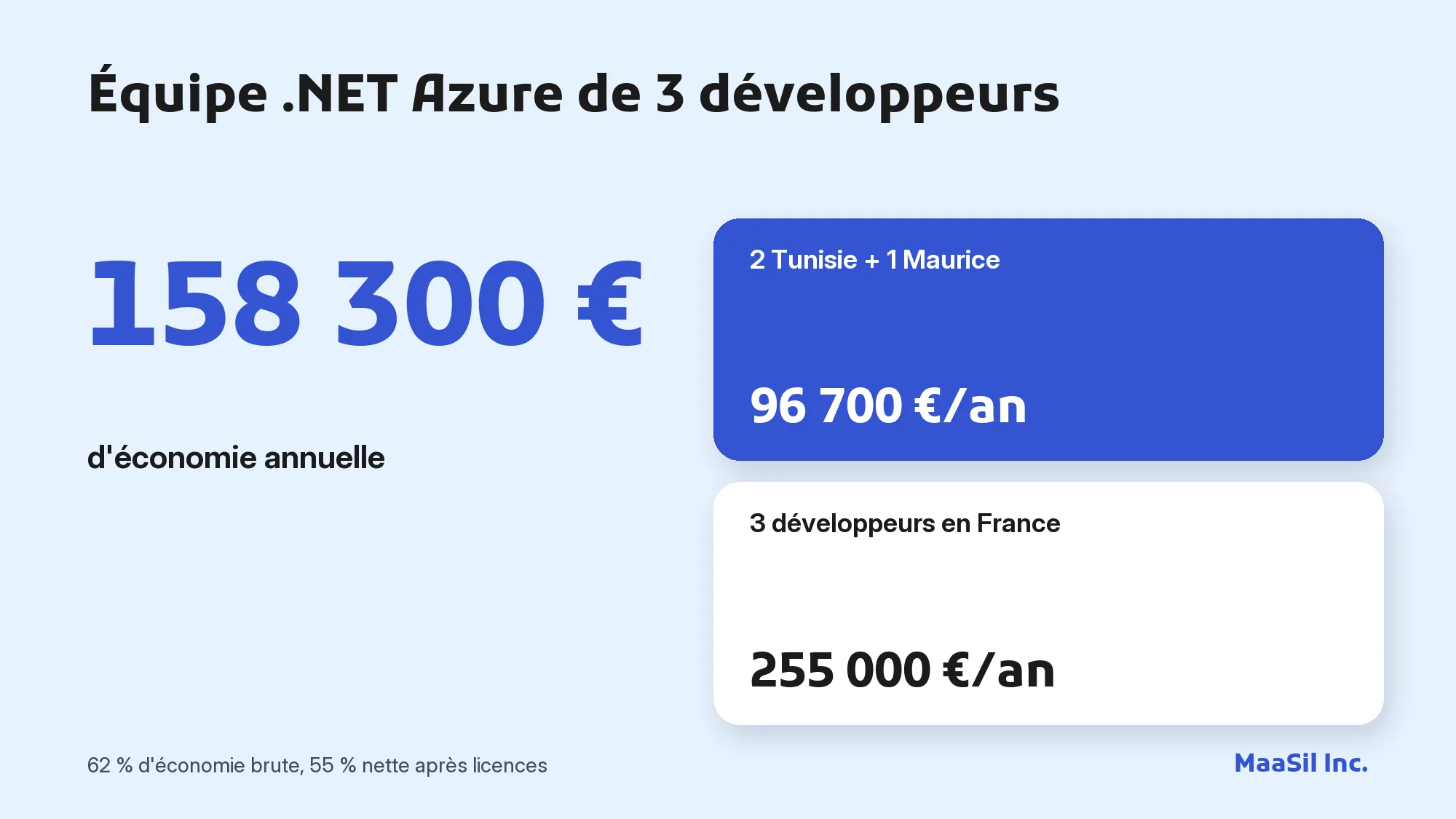
Licences Visual Studio Enterprise comprises, l'économie dépasse 150 000 € par an.
Salaires : 2× 27k€ + 1× 31k€ = 85k€
VS Enterprise licences : 3× 2 400€ = 7 200€
Azure environments dev/staging : 3× 100€/mois = 3 600€/an
CI/CD Azure DevOps : gratuit (5 users)
Application Insights monitoring : 3× 25€/mois = 900€/an
Total = 96 700€/an
Versus équipe 3 dev C# France : 3× 60k€ + 42% charges = 255k€
Économie annuelle : 158 300€ (62% brute, 55% nette après licences)
Les certifications Microsoft (Azure Developer Associate, Azure Solutions Architect) valorisent CV développeurs C# offshore, coût 165$/exam (échec 1re tentative fréquent = budget 330-495$ = 2-3 exams/dev). Employeur finançant certifications (1 000-1 500€/an équipe trois dev) booste rétention (certified devs turnover -35% selon Microsoft Partner Study 2024) et expertise technique (architectures Azure best practices appliquées projets). ROI certifications : rétention améliorée évite coûts recrutement/onboarding (8-12k€ per turnover) + qualité code/architecture supérieure (dette technique réduite 25% projets avec devs certifiés vs non-certifiés).
Renforcez votre équipe tech avec un développeur senior dédié. Tester un profil →
FAQ développeur C# full remote offshore
Visual Studio Community suffit-il pour développeur C# offshore ?
Non si organisation >5 users/revenus >1M$ (Microsoft interdit) ou projets enterprise nécessitant IntelliTrace (debug crash production), Live Share illimité (pair >30 min), CodeLens avancé (tests coverage).
Visual Studio Enterprise obligatoire (2 400€/an) pour C# senior corporate. ROI : 1 incident IntelliTrace évité/trimestre économise 640€ vs 2 400€ annuels (breakeven 4 incidents). Community viable open-source/startups <5 dev.
Peut-on débugger production C# offshore sans ouvrir ports firewall ?
Oui via Azure App Service snapshot debugger (capture variables sans ports ouverts) ou Application Insights exceptions (stack traces + distributed tracing). Snapshot debugger inclus App Service Standard tier (60€/mois).
Remote debugging VS (port 4024) bloqué 67% corporate firewalls (délai 24-72h tickets IT). Alternative : logs Serilog + Application Insights Kusto queries résout 65% investigations.
Azure cloud obligatoire pour offshore C# ou AWS/GCP fonctionnent ?
Azure optimisé .NET (App Service 1-click deploy, Azure Functions .NET native, Visual Studio Azure SDK). AWS/GCP viable : Elastic Beanstalk .NET, Lambda .NET 8, Cloud Run containers.
Coûts similaires (App Service ≈ Elastic Beanstalk pricing). Azure justifié si : équipe maîtrise Azure, client utilise Microsoft 365 (SSO Azure AD simplifié), certifications Microsoft Azure.
WPF/WinForms legacy peut-il être offshore efficacement ?
Déconseillé offshore si app nécessite machines physiques clientes (USB, imprimantes), debug on-premise (VPN complexes), ou MSI manuels.
Migration Blazor WebAssembly (web app full-stack C#) rend app offshore-friendly : déploiement web (pas install client), accès remote facile, tests automatisés (Playwright).
Coût migration 8-15 semaines (12-22k€). ROI long-terme via vélocité + maintenance réduite.
Tunisie ou Maurice pour développeur C# offshore ?
Tunisie si collaboration synchrone >2h/semaine (Live Share pair programming, workshops, onboarding). Timezone UTC+1 parfait. Coût -7-10% vs Maurice (27k€ vs 31k€ senior).
Maurice si workflow async mature (API specs détaillées, microservices découplés, autonomie 85%+), clients anglais (UK/US SaaS B2B), budget +10%. Latency Live Share Maurice 100-130 ms (frustrant >30 min) vs Tunisie 60-80 ms fluide.
Prêt à renforcer votre équipe avec les meilleurs talents africains ?
Discutez avec l'un de nos experts pour découvrir comment le portage salarial augmenté à l'IA peut s'intégrer à 100 % à vos process et faire grandir vos projets.
Échangez avec un expert
