
Prêt à renforcer votre équipe avec les meilleurs talents africains ?
Discutez avec l'un de nos experts pour découvrir comment le portage salarial augmenté à l'IA peut s'intégrer à 100 % à vos process et faire grandir vos projets.
Échangez avec un expert
Service Client & Call Center
Hire Customer Support Offshore : Le Guide Complet pour Réduire vos Coûts de 60 % sans Compromis sur la Qualité
Votre équipe support croule sous plus de 500 tickets par jour. Les délais de réponse explosent, tandis que les scores de satisfaction chutent à 78 %. Recruter en France coûte 45 000 € par an et par agent.
Pourtant, 73 % des clients ne détectent pas la localisation offshore lorsque la maîtrise du français est maintenue, selon Salesforce 2023. Recruter un support client offshore devient ainsi une option stratégique. Vous devez toutefois éviter les pièges techniques et culturels qui ont fait échouer 40 % des projets mal préparés.
Qu'est-ce qu'un support client offshore haute performance ?
Un support client offshore haute performance repose sur trois piliers non négociables.

Double écran, 8 Go de RAM et un upload stable : le socle d'un support haute performance.
D'abord, l'infrastructure technique :
Casque à réduction de bruit DSP pour supprimer le bruit du centre offshore
8 Go de RAM minimum pour faire tourner le CRM, la base de connaissances et 15 onglets de navigateur
Double écran, car un écran unique entraîne une baisse de productivité de 40 % selon Zendesk
Ensuite, une connectivité critique :
5 Mbps d'upload garantis pour un partage d'écran fluide
Ping inférieur à 150 ms pour la VoIP, au-delà duquel les coupures deviennent perceptibles
Fibre redondante avec une solution de secours 4G opérationnelle
Enfin, la pile logicielle :
Zendesk Suite à 49-99 € par agent et par mois
Grammarly Business à 12,50 € par mois pour une orthographe française irréprochable
Loom à 10 € par mois, dont les vidéos explicatives réduisent de 30 % les tickets récurrents
Un onduleur de 1 500 VA reste obligatoire à Madagascar ou en Tunisie. Dans ces régions, les coupures de courant font souvent abandonner les tickets en cours.
Le support client offshore diffère radicalement de la simple sous-traitance transactionnelle. Il exige des agents Bac +5 formés pendant 80 heures à la culture de votre produit. Les agents doivent détenir au minimum une certification C1 en français via le TCF. Ils doivent faire preuve de sensibilité aux subtilités culturelles françaises, comme le vouvoiement et la gestion des conflits à la française.
Les licences logicielles représentent 250 € par agent et par mois de coûts cachés. Les prestataires les omettent souvent de leurs devis. Par ailleurs, le turnover structurel offshore atteint 30 à 40 % par an, contre 15 % en France. Cela impose une documentation obsessionnelle.
Chaque processus filmé via Loom ramène l'onboarding à 2 semaines au lieu de 6. Cet investissement documentaire est vite rentabilisé avec des taux de turnover élevés.
Support client France vs offshore : comparatif du coût total réel
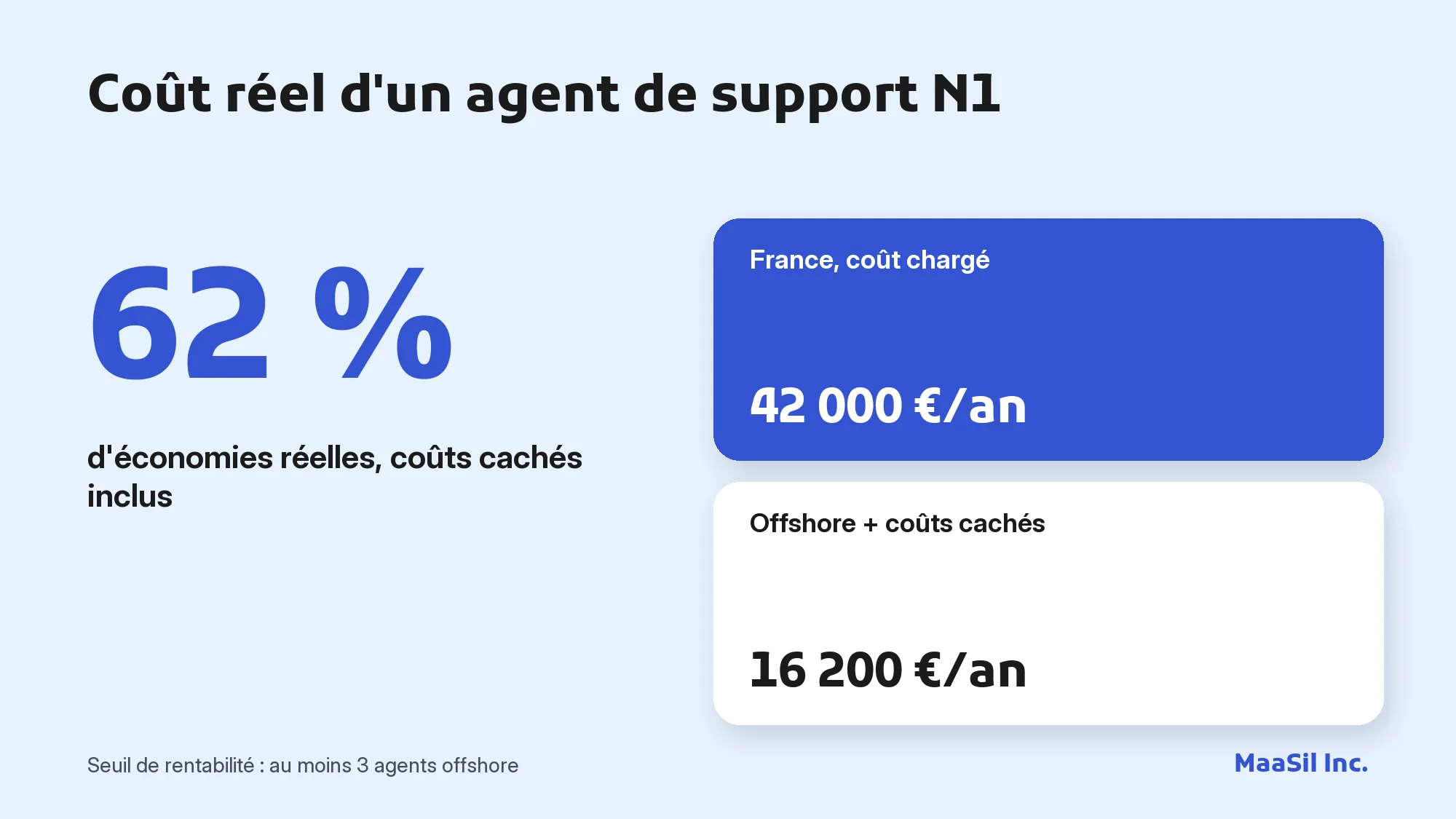
Même avec les licences, la supervision et la redondance, les économies atteignent encore 62 %.
Poste | France (€/mois) | Tunisie/Madagascar (€/mois) | Coûts cachés | Économies nettes |
|---|---|---|---|---|
Agent N1 | 2 800-3 500 | 600-900 | +250 (licences, 0,2 ETP de supervision FR) | 55-65 % |
Superviseur | 4 500-5 500 | 1 200-1 600 | +400 (monitoring, reporting) | 60 % |
Infrastructure/agent | 150 | 80 | +50 (redondance électrique) | 13 % |
Formation initiale | 1 500 | 2 000 | +500 (formateur FR déployé) | -66 % (surcoût) |
Pile de sécurité RGPD | 80 | 180 | DLP, MFA, VPN dédié | -125 % |
Véritable seuil de rentabilité : minimum 3 agents offshore.
En dessous de ce seuil, les coûts fixes annulent les économies salariales. Ces coûts fixes comprennent l'infrastructure, 0,2 ETP de supervision française et les outils de monitoring. Un agent de support N1 français coûte 42 000 € par an, charges comprises. Comparez avec 13 200 € en offshore, plus 3 000 € de coûts cachés, soit 16 200 € au total. Cela représente 62 % d'économies.
Cependant, un turnover offshore de 35 % implique un coût de remplacement de 2 000 € par départ. Ce montant couvre le recrutement et la formation. Si un agent ne reste que 8 mois, les économies tombent à 48 %.
C'est pourquoi les prestataires performants paient 15 % au-dessus du marché local. Cette stratégie ramène le turnover à 25 % et restaure la rentabilité.
Le vrai coût de l'offshore comprend des postes sous-estimés : Zendesk Suite à 99 €/agent pour les fonctionnalités avancées (macros, suivi des SLA), Klaus.com à 49 €/agent pour le scoring de la qualité des conversations, l'assurance cyber du prestataire (2 M€ minimum exigés contractuellement). En Tunisie, un agent qualifié demande désormais 800-900 €/mois en 2024 (inflation locale de +18 % depuis 2021), contre 600 € à Madagascar, où la stabilité d'Internet reste aléatoire (coupures de 2 à 3 h par semaine fréquentes à Antananarivo).
Combien coûterait votre équipe support à Madagascar ? Estimer mon budget →
Pourquoi 67 % des supports offshore échouent : l'erreur du script
Le secteur répète une fausse bonne idée : « Le support client s'externalise facilement car il est scriptable. » En réalité, les scripts tuent le CSAT dès que le client s'écarte du parcours standard. Exemple concret : un client français en colère utilise l'expression « C'est le pompon ! », l'agent philippin formé aux scripts ne comprend pas le véritable niveau d'urgence, manque l'escalade nécessaire et génère un avis Google à 1 étoile. Selon Gartner 2023, 67 % de l'insatisfaction client provient de réponses offshore perçues comme « robotiques ».
La latence multi-outils aggrave cette perception. Un agent jongle entre Salesforce (CRM), Zendesk (helpdesk), Notion (base produit), Slack (messagerie interne) et RingCentral (téléphonie). La latence cumulée atteint 2 à 4 secondes entre le clic du client et l'affichage des informations chez l'agent. Le client perçoit un « silence gênant » et en conclut à l'incompétence. Une étude de Dimension Data mesure +35 % d'AHT (Average Handle Time, durée moyenne de traitement) en offshore par rapport à l'onshore, uniquement à cause de cette friction technique. La solution passe par une intégration API via Zapier ou Make (synchronisation automatique du contexte client) et un screen pop automatique (fiche client affichée AVANT le décrochage via CTI), pour 2 à 3 jours de développement + 150 €/mois d'outils, mais avec un ROI en 6 semaines si le volume dépasse 500 tickets/mois.
Ce qui fonctionne réellement : une formation continue de 4 h/semaine sur les cas limites (hors scripts), l'autonomisation des agents avec une autorisation de remboursement jusqu'à 50 € sans escalade, des tests trimestriels sur des scénarios déviants (client en état d'ébriété, furieux, manipulateur). Des agents francophones Bac +5, formés pendant 40 h à la culture d'entreprise française (références culturelles, gestion des conflits à la française), atteignent 87 % de CSAT contre 73 % pour des profils juniors guidés par des scripts.
Comment éviter les pièges culturels dans le support client offshore
Un cas réel illustre ce risque majeur : le support d'un produit alimentaire bio externalisé de la France vers Madagascar. Un client demande si un produit convient à un « régime cétogène », l'agent répond « Oui, sans gluten » (confusion entre cétogène et sans gluten). Le client diabétique commande, rencontre un problème de santé et menace d'engager des poursuites. L'analyse révèle un contexte culturel manquant : les régimes occidentaux « tendance » (keto, paléo, flexitarien) restent inconnus dans les pays émergents. Google Traduction échoue sur les nuances (« sans sucre ajouté » ≠ « faible indice glycémique »). Les scripts ne couvrent pas le vocabulaire nutritionnel avancé.
L'atténuation exige donc une base de connaissances visuelle (tableaux comparatifs de régimes avec photos), une règle d'escalade stricte (tout terme nutritionnel inconnu = transfert immédiat vers le superviseur FR) et une formation mensuelle d'1 h sur les tendances sociétales françaises (nouveaux régimes, mouvements de consommateurs). Les prestataires offshore performants recrutent désormais des profils ayant vécu en France ou suivi des cursus francophones (Agence universitaire de la Francophonie), ce qui garantit une sensibilité culturelle authentique.
Par ailleurs, les expressions idiomatiques françaises posent problème : « Ça me prend la tête », « C'est le pompon », « Ça me saoule » nécessitent un glossaire dédié, mis à jour chaque trimestre. Les agents doivent maîtriser l'échelle d'urgence implicite française : un « petit souci » peut masquer une vraie colère (euphémisme culturel), tandis qu'un « GROS PROBLÈME !!! » en majuscules, avec plusieurs signes de ponctuation, signale une urgence absolue nécessitant une escalade immédiate.
Quels cas échouent systématiquement en support client offshore
Le support technique SaaS complexe nécessitant du débogage représente un cas d'échec systématique. Scénario typique : un client signale « J'obtiens une erreur 502 après avoir intégré votre webhook à notre CRM Pipedrive sur mesure. » L'agent offshore de niveau 1, formé à la FAQ standard mais sans aucune compétence technique serveur, le fait attendre 20 minutes, puis le transfère finalement à un développeur en Europe, ce qui génère une frustration maximale. L'écart de compétences techniques est insurmontable : déboguer une API exige des compétences backend (analyse de logs serveur, Postman, cURL). Transformer un agent de support en semi-développeur multiplierait son salaire par 2,5 et annulerait toutes les économies. De plus, le turnover détruit le ROI : 3 mois de formation, agent parti après 8 mois (moyenne du secteur).
La seule configuration viable : un tri automatisé intelligent où l'IA détecte les mots-clés techniques (« webhook », « API », « erreur 5xx ») et oriente directement vers l'équipe UE sans passer par l'offshore. Le support offshore se limite alors aux comptes utilisateurs, à la facturation et aux questions d'usage basique du produit. Il faut accepter que l'offshore couvre au maximum 65 à 70 % du volume de tickets, le reste nécessitant obligatoirement un traitement onshore. Les clients VIP et les grands comptes exigent aussi un support onshore : attentes premium, relation de long terme, subtilités culturelles françaises impossibles à scripter.
Autres cas dangereux : la gestion de crise de relations publiques (client mécontent devenu viral sur Twitter/LinkedIn, risque de bad buzz nécessitant une sensibilité FR cruciale), la vente consultative complexe (ACV > 10 k€, cycle long, négociation subtile), le conseil juridique RGPD (interprétation réglementaire française évolutive avec responsabilité juridique), le support d'urgence critique 24h/24 et 7j/7 si l'indisponibilité coûte > 10 k€/heure (énergie, santé, finance de marché). Règle empirique : offshore acceptable si 60 %+ du volume est scriptable ET si l'erreur d'un agent ne bloque pas l'activité. Onshore obligatoire en cas d'impact immédiat sur le chiffre d'affaires OU de forte complexité décisionnelle.
Quels risques RGPD avec un support client offshore et comment les maîtriser
Le support client accède à des données sensibles : e-mails, adresses, historiques d'achat, moyens de paiement des clients. Une capture d'écran de ticket = exfiltration possible de données personnelles. L'amende RGPD peut atteindre 4 % du chiffre d'affaires annuel mondial. Sous-risque critique : un prestataire multi-clients gérant 8 clients différents sur le même site crée un risque de contamination (l'agent A accède accidentellement à la base de données du client B).
La pile de sécurité obligatoire comprend : un DLP (Data Loss Prevention) comme Teramind ou ActivTrak bloquant le copier-coller hors CRM, l'USB et les captures d'écran (coût de 35 €/agent/mois), un VPN dédié par client avec segmentation réseau VLAN stricte, une MFA (authentification à 2 facteurs) systématique pour l'accès aux outils, des journaux d'audit conservés 3 ans (preuve de conformité CNIL) et un contrat DPA (Data Processing Agreement) avec une clause de pénalité de 100 k€ minimum. Les certifications ISO 27001 (sécurité de l'information) et SOC 2 Type II (si clients américains) du prestataire sont non négociables. Les postes de travail offshore doivent être sans USB/Bluetooth, avec des écrans filtrés antireflet, dans une architecture réseau zero-trust.
Le vrai coût de la sécurité atteint +180 €/agent/mois, ce qui réduit de 20 à 25 % les économies de l'offshore. Ce surcoût reste toutefois inférieur au risque : une violation RGPD coûte en moyenne 4,35 M$ (IBM Security 2023), sans compter les dommages de réputation. La localisation des données doit rester exclusivement dans l'UE (aucun transit hors d'Europe en cas de RGPD strict). Les serveurs Zendesk doivent être configurés sur le data center de Francfort ou de Dublin, jamais aux États-Unis ni en Asie. Un audit surprise par un cabinet indépendant (Deloitte, PwC) deux fois par an vérifie la conformité réelle par rapport à la conformité contractuelle. Enfin, l'assurance cyber du prestataire doit couvrir au minimum 2 M€ de responsabilité civile cyber.
Comment garantir la qualité du support client offshore : indicateurs et outils
Le risque de dérive invisible de la qualité s'installe progressivement : l'agent répond vite (l'AHT baisse = KPI au vert côté prestataire), mais la résolution reste incomplète (le client doit recontacter = le FCR s'effondre). Le CSAT chute sur 3 à 6 mois avant le déclenchement de l'alerte. L'atténuation technique passe par un suivi pondéré du FCR : un ticket « résolu » n'est validé que si le client ne le rouvre pas sous 72 h. Un audit qualité hebdomadaire sur 10 % de tickets tirés au hasard, réévalués par le manager FR, détecte les dérives précoces. Des pénalités contractuelles envers le prestataire (si CSAT < 85 % ou FCR < 70 % → 15 % de réduction de facturation) alignent les intérêts.
Les outils de monitoring en temps réel comprennent Klaus.com (49 €/agent/mois) pour le scoring de la qualité des conversations avec analyse sémantique par IA, MaestroQA pour l'audit IQA (Internal Quality Assurance) automatisé qui détecte les réponses hors sujet, et Zendesk QA intégré qui mesure le respect des macros approuvées. Le SLA (Service Level Agreement) doit être contractuellement précis : réponse < 2 h entre 8 h et 20 h (heure FR), < 8 h en heures creuses, résolution < 24 h pour les tickets standard, < 4 h pour les prioritaires. Un tableau de bord en temps réel (Geckoboard, Databox) expose le CSAT, le FCR, l'AHT et le taux d'escalade pour détecter les anomalies.
La formation continue représente l'investissement clé : 4 h/semaine sur les cas limites (hors scripts), dont 1 h par mois sur les tendances sociétales françaises. Des tests trimestriels sur des scénarios déviants (client manipulateur, furieux, situations ambiguës) valident l'autonomie décisionnelle. Un plan de carrière visible (Agent → Senior → Team Lead en 18 mois) réduit le turnover de 40 %. Une prime de fidélisation de 500 € après 12 mois améliore la rétention de 35 % selon Everest Group. Une équipe mixte (50 % de juniors, 30 % de confirmés, 20 % de seniors) absorbe les départs de juniors grâce aux formateurs seniors internes.
Processus pas à pas pour recruter un support client offshore
Étape 1 - POC réduit (mois 1-2) : Recrutez 1 agent test, formation de 3 semaines sur une base de connaissances solide (Notion/Confluence avec plus de 200 cas documentés, captures d'écran, vidéos Loom), puis 1 mois de test réel avec 20 % du trafic de tickets. Mesurez le CSAT, le FCR et l'AHT par rapport à l'équipe onshore. GO/NOGO basé sur un écart < 10 % sur ces indicateurs. Coût : 2 400 € de formation + 1 200 € de salaire = 3 600 €, soit 1,2 mois du coût d'un agent FR.

Commencez par un pilote avec un seul agent sur 20 % des tickets avant de passer à l'échelle.
Étape 2 - Infrastructure (mois 2) : Déployez la pile technique complète : Zendesk Suite configuré avec des macros validées, intégration API Zapier pour la synchronisation du contexte client, screen pop CTI, double écran + casque à réduction de bruit DSP + onduleur 1 500 VA, VPN dédié avec MFA, DLP activé (Teramind). Formez l'agent à la pile : 40 h de pratique supervisée. Coût de l'infrastructure : 1 800 €/agent en one-shot + 430 €/mois récurrents (licences + sécurité).
Étape 3 - Montée en charge progressive (mois 3-6) : Recrutez 2 agents supplémentaires (seuil de rentabilité de 3 agents atteint), répartissez le trafic 50 % offshore / 50 % onshore au mois 3, puis 70/30 si les indicateurs sont bons. Mettez en place 0,2 ETP de supervision FR (1 jour/semaine) : audit qualité de 10 % des tickets, 4 h/semaine de formation continue, mises à jour de la base de connaissances. Installez les outils de monitoring (Klaus, MaestroQA). Contractualisez le SLA avec pénalités.
Étape 4 - Optimisation et sécurisation (mois 6-12) : Audit de sécurité par un cabinet indépendant, contractualisation du DPA avec une clause de pénalité de 100 k€, souscription d'une assurance cyber de 2 M€. Déployez un chatbot IA (Intercom, Drift) couvrant 60 % des questions simples hors horaires, ce qui réduit la charge offshore. Mettez en place le plan de carrière (Senior à M+12, Team Lead à M+18) et la prime de fidélisation de 500 €. Testez une géographie redondante : 70 % Tunisie, 30 % Madagascar (atténuation des grèves/crises). La part offshore atteint 75 % du volume de tickets, 25 % en onshore (VIP, technique complexe, urgences).
FAQ Hire Customer Support
Mes clients détecteront-ils que c'est de l'offshore ? Non, si le français est de niveau C1+ et l'empathie maîtrisée. Une étude Salesforce 2023 montre que 73 % des clients ne parviennent pas à identifier la localisation de l'agent. Interdisez les mentions géographiques (« Je suis à Tunis »), privilégiez « Je travaille pour [VotreMarque] ». Formez 40 h à la culture d'entreprise française et testez via un test A/B sur 20 % du trafic offshore pendant 3 mois.
Le décalage horaire Tunisie/Madagascar pose-t-il problème ? Non, le décalage est de 0 à 2 h avec la France. L'équipe offshore couvre 8 h-20 h heure FR (80 % des tickets), complétée par une mini-équipe FR sur les pics de 8 h-10 h et 18 h-20 h. Un chatbot IA (Intercom) résout 60 % des questions simples hors horaires. Adaptez le SLA : « Réponse < 2 h de 8 h à 20 h, < 8 h en heures creuses. »
Comment gérer un turnover offshore de 35 % ? Payez 15 % au-dessus du marché local (le turnover tombe à 25 %), créez un plan de carrière visible (Team Lead à M+18), versez une prime de fidélisation de 500 € à 12 mois. Documentez chaque processus de façon obsessionnelle en vidéo Loom : l'onboarding est ramené à 2 semaines. Une équipe mixte de 50 % de juniors / 50 % de confirmés + seniors absorbe les départs.
Quel volume minimum pour rentabiliser l'offshore ? Minimum 3 agents pour amortir les coûts fixes (infrastructure, 0,2 ETP de supervision FR, monitoring). En dessous, les 60 % d'économies salariales sont annulés. Avec 3 agents, économies nettes = (3 500 € - 1 150 €) × 3 = 7 050 €/mois - 1 200 € de coûts fixes = 5 850 €/mois, soit 70 k€/an.
Quels types de support ne PAS externaliser ? Le support technique complexe nécessitant du débogage (API, serveurs), la gestion de crise de relations publiques (bad buzz Twitter/LinkedIn), les clients VIP/grands comptes (relation de long terme), le conseil juridique RGPD (responsabilité juridique), la vente consultative > 10 k€ d'ACV, les urgences critiques si l'indisponibilité coûte > 10 k€/h. L'offshore couvre au maximum 65 à 70 % du volume de tickets, le reste nécessite de l'onshore.
Conclusion
Recruter un support client offshore génère 55 à 65 % d'économies nettes si trois conditions sont réunies : un seuil minimum de 3 agents, une infrastructure technique robuste (double écran, fibre redondante, pile de sécurité RGPD à 180 €/agent/mois) et un turnover maîtrisé sous 25 % grâce à un salaire supérieur de 15 % au marché et à un plan de carrière visible. Les 67 % d'échecs proviennent d'un excès de scripts robotiques et d'une sous-estimation des coûts cachés (+250 €/agent/mois de licences + supervision). Le POC d'1 agent pendant 3 semaines (3 600 €) valide la faisabilité avant la montée en charge. Les cas dangereux (support technique complexe, VIP, crise de relations publiques) restent en onshore, l'offshore couvrant 70 % du volume transactionnel. La rentabilité apparaît dès le 4e mois si les indicateurs CSAT > 85 %, FCR > 70 % et AHT < +20 % par rapport à l'onshore sont respectés contractuellement, avec pénalités.
Prêt à renforcer votre équipe avec les meilleurs talents africains ?
Discutez avec l'un de nos experts pour découvrir comment le portage salarial augmenté à l'IA peut s'intégrer à 100 % à vos process et faire grandir vos projets.
Échangez avec un expert
