
Prêt à renforcer votre équipe avec les meilleurs talents africains ?
Discutez avec l'un de nos experts pour découvrir comment le portage salarial augmenté à l'IA peut s'intégrer à 100 % à vos process et faire grandir vos projets.
Échangez avec un expert
Stratégie d'Externalisation & BPO
Services d'externalisation RH aux Philippines : la réduction des coûts de 68 % sans catastrophe de conformité
Votre équipe RH croule sous l'administration des avantages sociaux, le traitement de la paie et la coordination des recrutements. Les coûts de personnel interne s'élèvent à plus de 68 000 $ par an. Les services d'externalisation RH aux Philippines promettent le même travail pour 9 à 15 $ de l'heure. Mais des lacunes en matière de conformité créeront-elles une responsabilité juridique ? Les différences culturelles provoqueront-elles des désastres dans les relations avec les employés ? Ce guide révèle quand l'externalisation RH aux Philippines apporte de la valeur et quand elle crée un risque catastrophique.
Qu'est-ce que l'externalisation des services RH et pourquoi les Philippines dominent ce marché
L'externalisation des services RH consiste à transférer les fonctions des ressources humaines à des prestataires externes : traitement de la paie, administration des avantages sociaux, coordination du recrutement, formalités d'intégration, gestion des données SIRH, tenue des dossiers du personnel, coordination de la formation. Les entreprises de BPO aux Philippines se spécialisent dans ces opérations RH de back-office, employant des milliers de spécialistes RH formés à la conformité multi-pays.
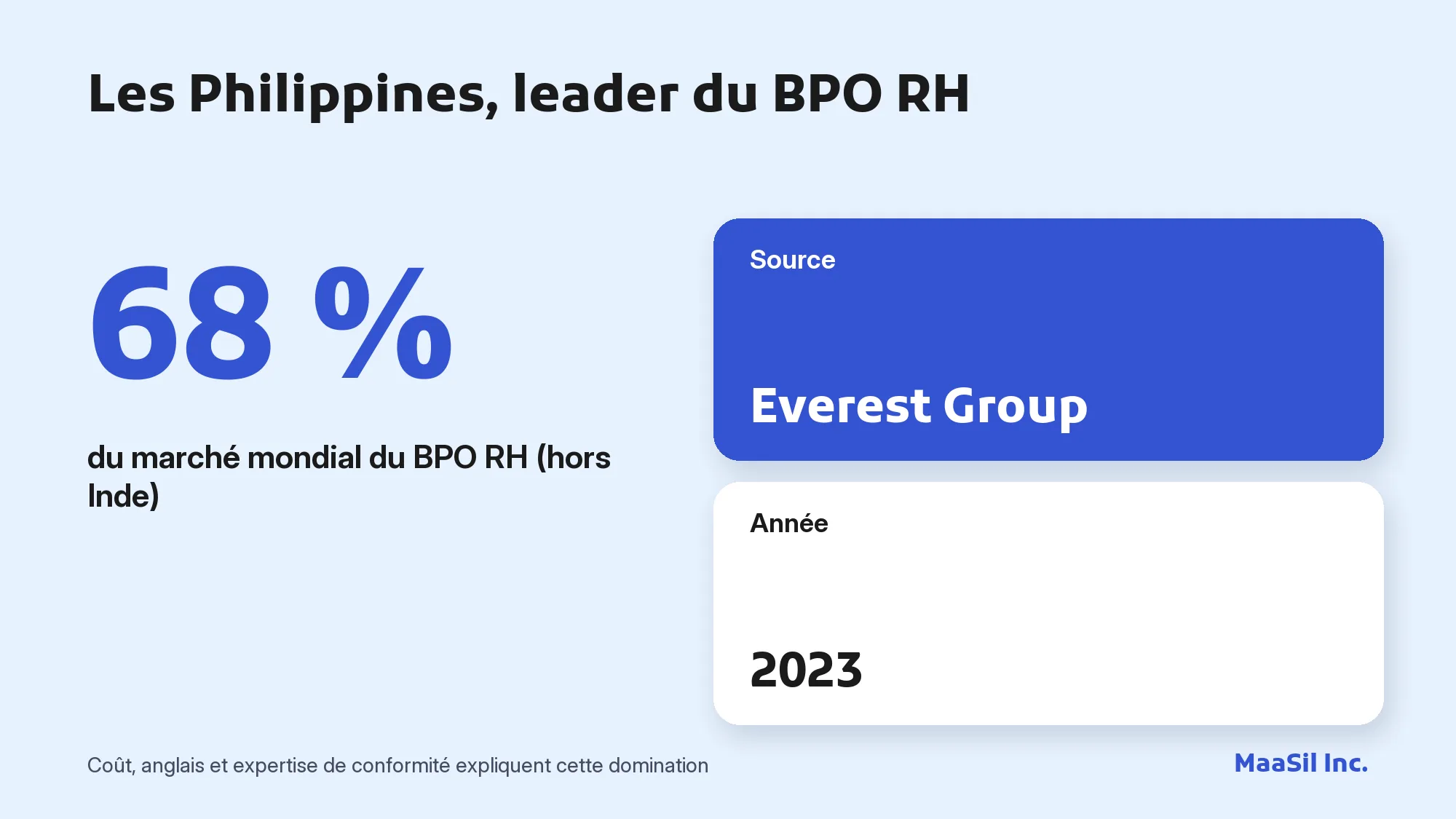
Coût, maîtrise de l'anglais et expertise de conformité expliquent cette domination.
Les Philippines ont capturé 68 % des parts du marché mondial du BPO RH (hors Inde) selon l'analyse 2023 de l'Everest Group. Trois facteurs expliquent cette domination : l'avantage de coût (9 à 15 $/heure tout compris contre 28 à 42 $/heure en interne aux États-Unis), la maîtrise de l'anglais (taux de maîtrise de 92 %, le plus élevé d'Asie du Sud-Est selon l'EF English Proficiency Index) et l'alignement culturel avec les pratiques commerciales occidentales (l'héritage du système éducatif colonial américain ayant créé une familiarité avec les concepts RH américains).
Cependant, le coût total de possession (TCO) réel comprend des éléments cachés au-delà des salaires de base. Les charges sociales (cotisations SSS, PhilHealth et Pag-IBIG aux Philippines = 12,5 % du salaire), l'infrastructure (licences de logiciels SIRH, systèmes de gestion de documents sécurisés), l'assurance qualité (frais d'audit de conformité) et la coordination de la gestion ajoutent 35 à 50 % aux tarifs annoncés. Un spécialiste RH philippin à 11 $/heure coûte en réalité entre 15,40 et 16,50 $/heure tout compris.
L'analyse de rentabilité se renforce pour les travaux transactionnels à haut volume. Une entreprise américaine de 500 employés génère environ 150 heures par mois de pur travail transactionnel RH : saisie des données de paie, traitement des inscriptions aux avantages sociaux, formalités administratives pour les nouvelles recrues, documentation de fin de contrat, mises à jour du suivi des congés payés. Un généraliste RH interne (salaire de 68 000 $) consacre 35 % de son temps à ces transactions contre 65 % à un travail stratégique (relations avec les employés, gestion de la performance, initiatives culturelles).
Modèle BPO aux Philippines : l'équipe offshore gère 100 % du travail transactionnel (2 310 $/mois = 150 heures × 15,40 $), le partenaire commercial RH interne se concentre à 100 % sur le travail stratégique. Économies de coûts : 19 690 $ par an contre la part de 23 800 $ du salaire du généraliste consacrée au traitement des transactions. De plus, la personne en interne est désormais entièrement affectée à des activités à forte valeur ajoutée.
Pourtant, 35 % des relations d'externalisation RH échouent dans les 24 mois (Deloitte Outsourcing Survey 2023). Causes profondes : lacunes de conformité (l'équipe offshore ne connaît pas le droit du travail du pays du client), malentendus culturels (le style de communication indirect des Philippins se heurte aux attentes de directivité américaines) et dérive des objectifs (frontières mal définies entre RH transactionnelles et stratégiques créant des conflits).
Comment fonctionne réellement l'externalisation RH aux Philippines dans les coulisses des opérations
Une externalisation RH réussie nécessite une infrastructure technique avant que le traitement ne commence. L'intégration du SIRH (Workday, BambooHR, ADP, Paylocity) via des connexions API permet une synchronisation des données en temps réel. La saisie manuelle des données génère des erreurs — une seule faute de frappe dans le numéro de compte bancaire d'un employé = échec de la paie.

VPN, double authentification et connexions redondantes sécurisent l'accès aux données RH.
Des systèmes de gestion de documents sécurisés (SharePoint, Google Workspace, Box) avec des autorisations granulaires protègent les données sensibles. Le contrôle d'accès basé sur les rôles (RBAC) accorde aux coordinateurs RH offshore des droits de visualisation/modification sur des champs spécifiques (titre de poste, département, soldes de congés) tout en limitant l'accès aux données de rémunération et aux évaluations de performance. Quarante-deux pour cent des entreprises accordent des autorisations excessives au départ, pour découvrir des mois plus tard que le personnel offshore pouvait consulter la rémunération des dirigeants.
Des tunnels VPN avec authentification à deux facteurs sécurisent l'accès au réseau. Les Philippines subissent fréquemment des typhons (saison de juin à novembre) provoquant des pannes d'électricité et d'internet. Des connexions ISP redondantes et un groupe électrogène de secours (commutation automatique <5 secondes) évitent les retards de traitement. La paie d'un détaillant américain a échoué parce que le BPO philippin a manqué d'électricité pendant la phase finale de traitement (vendredi 15h00 à Manille = vendredi 2h00, heure de l'Est des États-Unis, date limite de paie). Pas de groupe électrogène de secours, pas de plan de secours. Les employés ont reçu leurs fiches de paie avec trois jours de retard. Un désastre pour le moral.
La coordination des fuseaux horaires détermine l'efficacité opérationnelle. Les Philippines ont 12 à 13 heures d'avance sur l'heure de l'Est des États-Unis (8h00 à Manille = 19h00 la veille aux États-Unis). Cela permet une couverture naturelle de 24 heures — l'équipe philippine traite les demandes pendant la nuit pendant que les États-Unis dorment. Cependant, les demandes urgentes en temps réel en pâtissent. Une demande de "traitement d'un chèque de paie de fin de contrat d'urgence aujourd'hui" soumise à 10h00 heure de l'Est = 23h00 à Manille (équipe hors ligne). Traitement le jour ouvrable suivant = retard de 36 heures.
La définition du SLA devient cruciale. "Traiter la paie sous 3 jours ouvrables" peut signifier différentes choses. L'équipe philippine compte ses jours ouvrables (du lundi au vendredi, heure de Manille). Le client américain compte les jours ouvrables américains. Si la demande arrive le vendredi à 16h00 heure de l'Est (samedi 5h00 à Manille), le chronomètre commence-t-il le vendredi aux États-Unis ou le lundi à Manille ? Une spécification explicite du fuseau horaire évite les litiges.
Avantages de l'externalisation des ressources humaines : Au-delà du coût, la spécialisation de la conformité
Les économies de coûts motivent les décisions initiales, mais la spécialisation de la conformité apporte une valeur continue. Les généralistes RH internes gèrent les réglementations d'un seul pays. Les BPO RH philippins qui gèrent plus de 50 clients américains dans 15 États développent une expertise du droit du travail américain plus approfondie que le personnel RH d'une seule entreprise.
Une startup technologique californienne (45 employés) a embauché un coordinateur RH interne à 68 000 $. Cette personne a passé 5 mois à apprendre la conformité spécifique à la Californie : règles sur les pauses repas/repos, exigences de confidentialité PIPA, congés CFRA, ordonnances locales sur les congés de maladie (San Francisco diffère de Los Angeles), procédures d'indemnisation des accidents du travail du WCAB. Elle a tout de même commis des erreurs — classant à tort 8 employés comme exemptés (ils auraient dû être non exemptés selon les décrets salariaux de Californie). Un audit de l'inspection du travail a entraîné une amende de 87 000 $ d'arriérés de salaire plus des pénalités.
Alternative : Le BPO RH aux Philippines facture 18 $/heure (2 880 $/mois pour 160 heures, 34 560 $/an). Il gère la conformité en Californie via des cadres établis : listes de contrôle de classification des exemptés (test des fonctions + test de base de salaire vérifiés pour chaque rôle), suivi automatisé des pauses repas intégré au système de pointage, calculs de congés CFRA/FMLA avec les modèles d'avis requis, protocoles de déclaration des accidents du travail. Zéro erreur de classification.
La charge de la mise à jour réglementaire est transférée au prestataire. Le projet de loi californien AB-1003 modifie les exigences de Cal-WARN en milieu d'année. L'équipe de conformité du BPO philippin surveille les changements législatifs, met à jour les procédures immédiatement et forme le personnel offshore aux nouvelles exigences. Le coordinateur RH interne doit effectuer une veille autonome — facile de rater des mises à jour s'il n'est pas abonné à des services d'alerte spécialisés (2 400 $/an pour un suivi complet du droit du travail).
La complexité multi-États amplifie la valeur. Une entreprise en télétravail complet emploie des personnes dans 22 États américains. Chaque État a ses propres spécificités : salaire minimum (varie de 7,25 à 16,50 $), règles sur les heures supplémentaires (certaines quotidiennes, d'autres hebdomadaires), exigences en matière de pauses repas/repos (la Californie les impose, d'autres non), lois sur les congés (maladie, familiaux, médicaux), exigences de fréquence de paie (les options hebdomadaires, bihebdomadaires, bimensuelles diffèrent selon l'État), délai de versement de la dernière paie en cas de licenciement.
Taille de l'équipe RH interne requise : Minimum 2 ETP pour gérer la conformité dans 22 États (136 000 $ au total). BPO aux Philippines : Même couverture dans le cadre des services de base (34 560 $/an pour 160 heures de coordination mensuelle). Économies : 101 440 $ par an.
Cependant, les RH stratégiques ne peuvent pas être externalisées. Les enquêtes sur les relations avec les employés, le coaching en gestion de la performance, le développement de la culture, la gestion du changement, le développement du leadership, la stratégie de rémunération — ces aspects nécessitent une connaissance approfondie du contexte de l'entreprise et des relations de confiance impossibles à obtenir de l'extérieur. Le modèle hybride 70/30 fonctionne : 70 % des RH transactionnelles en offshore, 30 % des RH stratégiques en interne.
Quels processus externaliser en premier ? Faisons le point en 30 min. Réserver un audit gratuit →
Externalisation informatique en Indonésie vs Services RH aux Philippines : Optimisation géographique spécifique aux fonctions
Les Philippines dominent l'externalisation RH précisément en raison de leurs avantages pertinents dans ce domaine. L'Indonésie excelle dans l'externalisation informatique (solide bassin de talents en programmation Java, coût 15 % inférieur à celui des Philippines) mais manque d'infrastructures de BPO RH. La différence de vivier de talents :
Caractéristiques des talents BPO RH aux Philippines :
73 % possèdent un diplôme universitaire en gestion des RH, en psychologie ou en administration des affaires (contre 45 % en Indonésie)
Forte familiarité avec les logiciels RH américains : ADP, Workday, BambooHR, Paylocity (la plupart des programmes de formation les intègrent)
La maîtrise de l'anglais permet de lire des documents complexes sur le droit du travail américain
La culture du service client (antécédents fréquents dans le secteur de l'hôtellerie) convient aux exigences d'empathie du rôle de coordinateur RH
Caractéristiques des talents d'externalisation informatique en Indonésie :
68 % détiennent un diplôme en informatique ou en ingénierie
Solides compétences techniques (Java, Python, infrastructure cloud)
Niveau d'anglais inférieur (62 % selon l'index EF contre 92 % pour les Philippines) — suffisant pour la documentation technique, insuffisant pour la communication RH face aux employés
Avantage de coût : 7 à 13 $/heure chargé contre 9 à 15 $/heure pour les Philippines
La spécialisation géographique découle de la composition du vivier de talents et de la maturité des infrastructures. Les Philippines ont plus de 30 ans de développement dans le secteur du BPO RH. Le secteur du BPO en Indonésie se concentre sur les services informatiques et le travail créatif (animation, conception graphique), et non sur les opérations RH.
Avantages de l'externalisation des services de paie : La réalité du taux d'erreur
L'externalisation de la paie apporte des améliorations mesurables de la qualité au-delà du coût. Les BPO RH philippins affichent un taux d'exactitude de la paie moyen de 99,4 % (données de référence d'Everest Group). Le traitement interne de la paie atteint en moyenne 96,8 % d'exactitude (enquête de l'APA auprès d'entreprises américaines de <500 employés). L'écart de 2,6 % représente un volume d'erreurs important.
Une entreprise de 200 employés traitant la paie toutes les deux semaines (26 cycles par an) avec une exactitude de 96,8 % :
Nombre total de transactions de paie : 5 200 par an (200 employés × 26 cycles)
Erreurs : 166 transactions (5 200 × 3,2 %)
Temps de correction : 45 minutes en moyenne par erreur = 125 heures par an
Coût du temps de correction : 4 875 $ (125 heures × 39 $/heure, taux mixte)
Insatisfaction des employés : Les erreurs de paie sont l'un des trois principaux facteurs de plainte des employés (enquête de la SHRM)
La même entreprise utilisant un BPO aux Philippines avec une exactitude de 99,4 % :
Erreurs : 31 transactions (5 200 × 0,6 %)
Temps de correction : 23 heures par an
Coût : 897 $
Économies : 3 978 $ par an, en plus de l'amélioration du moral
Cause profonde de la plus grande exactitude à l'étranger : La spécialisation et la discipline des processus. Le gestionnaire de paie interne gère la paie, les avantages sociaux, l'administration du SIRH et les rapports de conformité (attention dispersée). Le spécialiste de la paie philippin traite uniquement la paie de 15 à 20 entreprises clientes, développant ainsi une forte capacité de détection des anomalies. Les flux de travail basés sur des listes de contrôle (vérifiées par un réviseur QA avant soumission) interceptent les erreurs avant le traitement.
La valeur de l'assurance contre les erreurs apporte une protection supplémentaire. Les BPO philippins disposent d'une assurance responsabilité civile professionnelle (couverture typique de plus de 5 millions de dollars). S'ils commettent une erreur de calcul de la paie entraînant un sous-paiement d'impôt pour l'employé (pénalité de l'IRS pour l'employé), l'assurance du BPO couvre les coûts de correction. En cas d'erreurs de paie internes, l'entreprise assume l'entière responsabilité.
Cependant, l'externalisation de la paie crée un risque de dépendance. Le prestataire commet une erreur systématique affectant plusieurs périodes de paie ? Vous restez responsable devant les employés et les autorités fiscales. Un BPO philippin a mal calculé les retenues à la source à Porto Rico pendant 4 mois (les barèmes fiscaux n'avaient pas été mis à jour après un changement de loi). Le client a dû faire face à 73 000 $ de pénalités en plus d'un désastre dans les relations avec les employés (le salaire net incorrect a causé des difficultés financières). Mesure d'atténuation : Des audits mensuels de la paie vérifiant de manière indépendante 10 % des calculs sous forme de contrôles ponctuels.
Avantages de l'externalisation des RH : La scalabilité pour les entreprises en croissance
L'externalisation RH permet de se développer sans les coûts d'embauche par paliers. Modèle RH interne : Embauche d'un généraliste à 50 employés, d'un second à 125 employés, puis de rôles spécialisés (recruteur, administrateur des avantages sociaux) à partir de plus de 200 employés. Chaque embauche = coût fixe + 3 mois de période d'adaptation.

Se développer sans recruter un nouveau profil RH à chaque palier de croissance.
Modèle BPO : Une capacité flexible qui évolue proportionnellement. Ajouter 20 employés = +20 heures de traitement mensuel, pas une nouvelle embauche. Une startup SaaS est passée de 65 à 180 employés en 14 mois. RH internes : Auraient nécessité d'ajouter 1,5 ETP à mi-parcours (plus de 102 000 $ en salaire, coûts de recrutement, temps de formation, espace de bureau). BPO aux Philippines : A augmenté les heures de service de 80/mois à 210/mois (augmentation du coût mensuel de 1 232 $ à 3 234 $). Aucun retard de recrutement, aucune période d'intégration, aucun engagement de coût fixe si la croissance ralentit.
La flexibilité saisonnière profite aux secteurs ayant des embauches cycliques. Le commerce de détail ajoute 200 employés temporaires d'octobre à décembre (saison des fêtes). Les RH internes se noient sous les formalités d'intégration. Le BPO aux Philippines passe d'un volume de base de 120 heures/mois à 340 heures/mois d'octobre à décembre, puis revient au volume de base en janvier. Le client ne paie que pour les heures utilisées.
L'intégration post-fusion/acquisition crée des pics temporaires d'activité RH. L'entreprise acquise compte 85 employés qui doivent être intégrés dans le SIRH de la société mère, inscrits aux avantages sociaux et convertis au système de paie. L'équipe RH interne manque de bande passante (déjà à pleine capacité avec les effectifs actuels). Le BPO philippin déploie une équipe d'intégration dédiée pour un projet de 6 semaines, puis revient à un soutien d'activité courante. Coût : Basé sur le projet plutôt que sur des effectifs permanents.
Cependant, la croissance crée des défis de transfert de connaissances. L'équipe philippine a été formée pour une entreprise de 65 employés (processus plus simples). À 180 employés, la complexité augmente : Plusieurs départements, bureaux, classifications d'employés, niveaux de régimes d'avantages sociaux, politiques de congés, hiérarchies d'approbation. L'équipe offshore a besoin d'une formation continue à mesure que l'entreprise évolue. De nombreux BPO partent du principe "former une fois et c'est fini" — c'est faux. Prévoyez des sessions trimestrielles de révision des processus pour informer l'équipe offshore des changements organisationnels.
Entreprises d'externalisation au Nigeria vs aux Philippines pour les fonctions RH : L'écart d'expertise en conformité
Le Nigeria offre un coût inférieur de 15 à 25 % à celui des Philippines pour le travail de BPO général (7 à 13 $/heure contre 9 à 15 $/heure). Cependant, l'externalisation RH en particulier révèle des lacunes en matière d'expertise de conformité qui annulent les avantages de coût.
Points forts du BPO RH aux Philippines :
Plus de 15 ans de gestion de la conformité paie/RH aux États-Unis (courbe d'apprentissage mature)
Réseaux de partenariat avec des prestataires de paie américains (ADP, Paychex) pour les déclarations fiscales
Familiarité avec les avantages sociaux américains (401(k), HSA, FSA, COBRA)
Programmes de formation axés sur le droit du travail américain (FLSA, FMLA, ADA, Title VII)
Faiblesses du BPO RH au Nigeria :
Exposition limitée à la conformité américaine (la plupart des clients au Royaume-Uni/UE, cadre réglementaire différent)
Le droit du travail britannique diffère considérablement : indemnités de licenciement légales, dispense de préavis rémunérée, transferts TUPE, documents P45/P60 — rien de tout cela n'existe aux États-Unis
Les concepts d'avantages sociaux diffèrent : le Nigeria dispose d'un régime national d'assurance maladie (gouvernemental), et non de la complexité de l'assurance maladie parrainée par l'employeur
Méconnaissance du traitement de la paie : les retenues à la source multi-juridictionnelles aux États-Unis (fédérales, étatiques, locales) sont nettement plus complexes que le système PAYE à niveau unique du Nigeria
Une entreprise britannique utilise avec succès un BPO RH nigérian pour sa paie au Royaume-Uni (environnement réglementaire familier, économies de coûts de 52 %). La filiale américaine de cette même entreprise a tenté d'utiliser le même prestataire — ce fut un désastre. L'équipe nigériane n'a pas compris : la classification exempté vs non exempté (qui a causé des infractions sur les heures supplémentaires), les retenues multi-États (envoi de formulaires fiscaux erronés), les limites de contribution 401(k) (traitement de reports excédentaires), les droits de continuation COBRA (omission d'envoyer les avis requis).
Le coût des manquements à la conformité a dépassé les économies réalisées. 180 000 $ en arriérés de salaires, pénalités et frais juridiques contre 45 000 $ que l'entreprise aurait économisés en utilisant un BPO aux Philippines doté d'une expertise en conformité américaine.
Leçon de spécialisation géographique : Faites correspondre l'expertise de conformité du prestataire à votre juridiction réglementaire. Philippines = optimal pour l'externalisation RH américaine. Nigeria = optimal pour les RH britanniques/africaines. Égypte/Tunisie = optimal pour les marchés francophones/arabophones. N'optimisez pas uniquement sur le coût — les erreurs de conformité coûtent exponentiellement plus cher que les différences de tarif.
Avantages de l'externalisation des services informatiques appliqués aux opérations RH : Le parallèle avec l'intégration des systèmes
L'externalisation informatique enseigne des leçons applicables à l'externalisation RH. Les deux fonctions nécessitent des intégrations de systèmes, des protocoles de sécurité, des plans de reprise d'activité et une gestion des connaissances. Le parallèle :
Externalisation du support informatique :
Intégration avec le système de tickets (ServiceNow, Jira)
Accès VPN avec 2FA
Base de données de gestion des actifs
Base de connaissances pour le dépannage
Matrice d'escalade vers les équipes internes
Externalisation des RH :
Intégration avec le SIRH (Workday, BambooHR)
Accès sécurisé aux documents avec RBAC
Gestion de la base de données des employés
Documentation des politiques/procédures
Voies d'escalade pour les cas complexes
La matrice RACI (Réalisateur, Approbateur, Consulté, Informé) clarifie les limites :
Activité | Équipe Offshore | RH Internes | Notes |
|---|---|---|---|
Saisie des données de paie | Réalisateur | Approbateur | L'équipe offshore saisit, l'équipe interne approuve avant soumission |
Traitement de l'adhésion aux avantages sociaux | Réalisateur | Informé | L'équipe offshore traite les formalités, l'équipe interne est notifiée de la finalisation |
Formalités d'intégration des nouvelles recrues | Réalisateur | Approbateur | L'équipe offshore prépare les documents, l'équipe interne garantit la conformité |
Traitement des départs/licenciements | Consulté | Réalisateur | L'équipe interne est propriétaire de la décision/communication, l'offshore gère les papiers |
Administration des congés (FMLA) | Réalisateur | Approbateur | L'équipe offshore suit les dates/papiers, l'équipe interne approuve les cas complexes |
Enquêtes sur les relations avec les employés | Informé | Réalisateur | L'équipe interne mène les enquêtes, l'offshore est mis à jour pour archivage |
Décisions de rémunération | Non impliqué | Réalisateur | Fonction exclusivement interne |
Évaluations de performance | Consulté (admin) | Réalisateur | L'équipe interne gère le processus, l'offshore s'occupe de la logistique du système |
Quarante-sept pour cent des échecs d'externalisation RH proviennent de limites RACI non définies. L'équipe offshore suppose que l'équipe interne a approuvé une action (l'équipe interne pensant que l'offshore avait vérifié). Résultat : Infraction à la conformité ou crise dans les relations avec les employés. Une documentation RACI explicite permet d'éviter cela.
Le protocole de transfert de connaissances est essentiel. L'externalisation informatique utilise des "guides opérationnels de transition" — une documentation pas-à-pas de chaque processus avec captures d'écran, arbres de décision et gestion des exceptions. L'externalisation RH nécessite la même rigueur. Le processus "Comment intégrer une nouvelle recrue" doit être documenté de manière très précise : Quels formulaires dans quel ordre, où les archiver électroniquement, qui reçoit des copies, qu'est-ce qui déclenche la vérification des antécédents, calendrier d'E-Verify, procédures de conformité I-9, dates limites d'adhésion aux avantages sociaux.
De nombreuses entreprises fournissent une vue d'ensemble de haut niveau ("gérez simplement les nouvelles recrues") en pensant que l'équipe offshore résoudra les détails. Cela génère des erreurs. L'équipe RH aux Philippines d'une entreprise a envoyé des formulaires d'inscription aux avantages sociaux à des nouvelles recrues avant leur date d'éligibilité (période d'attente de 30 jours). Les employés se sont inscrits, ont engagé des frais médicaux la deuxième semaine, et les demandes de remboursement ont été refusées (car non éligibles). Risque juridique accru et insatisfaction des employés. Cause profonde : La documentation du processus ne précisait pas explicitement le calendrier d'éligibilité.
Services d'externalisation du recrutement informatique : La valeur d'une sous-fonction spécialisée
L'externalisation du recrutement fait partie de l'externalisation RH mais nécessite une évaluation distincte. Les BPO philippins proposant des services de recrutement excellent dans les fonctions de coordination (publication d'offres, tri des CV, planification des entretiens, vérification des références post-offre) mais ont des difficultés avec le recrutement technique spécialisé.
Un éditeur de logiciels américain a externalisé son rôle de recruteur technique aux Philippines. Le recruteur n'était pas en mesure d'évaluer : "L'expérience React de ce candidat correspond-elle à un réel travail de production ou simplement à un niveau de tutoriel ?" Il a soumis 60 profils, seuls 9 répondaient aux qualifications minimales. L'équipe d'ingénieurs a perdu 18 heures à examiner des candidats non qualifiés. Coût du temps des ingénieurs (85 $/heure en moyenne) = 1 530 $ gaspillés.
Le test de faisabilité : Pouvez-vous créer une grille d'évaluation objective rendant l'analyse mécanique ? Si oui, l'externalisation fonctionne. Si non (nécessite un jugement technique), gardez la fonction en interne.
Adapté à l'externalisation du recrutement aux Philippines :
Rôles horaires à fort volume (commerce de détail, hôtellerie, service client)
Postes administratifs (exigences de diplômes claires : "licence + 3 ans d'expérience administrative")
Rôles techniques de niveau débutant avec des tests objectifs (défis de codage évalués automatiquement)
Tâches de coordination (planification, vérification des références, préparation des lettres d'offre)
À conserver en interne ou confier à des cabinets spécialisés :
Rôles techniques seniors (ingénierie, science des données) nécessitant un jugement d'évaluation des compétences
Recrutement de cadres supérieurs (C-level, VP — où les relations et les nuances sont critiques)
Nicheadresses spécialisées (ingénieurs en systèmes embarqués, développeurs Haskell — bassins de talents restreints)
Postes dépendants de l'adéquation culturelle (premières embauches de startups où l'alignement des valeurs importe plus que les diplômes)
Le modèle hybride fonctionne bien : l'équipe philippine source et trie (haut du tunnel), le recruteur interne ou le responsable du recrutement fait passer les entretiens aux finalistes (étape nécessitant beaucoup de jugement). Une entreprise de fintech a mis en place ce modèle — le BPO philippin a fourni 15 candidats triés par besoin d'ingénieur senior, le recruteur interne a fait passer des entretiens aux 5 meilleurs, et le responsable du recrutement aux 2 meilleurs. Le délai de recrutement est passé de 87 à 52 jours. Le coût par embauche a chuté de 41 % (sourcing philippin à 18 $/heure contre un recruteur interne à 56 $/heure tout compris).
Externalisation des services de comptabilité fournisseurs + RH : L'opportunité d'intégration finance-RH
Les entreprises regroupent souvent l'externalisation RH avec les fonctions de back-office financier. Les BPO aux Philippines proposent des équipes intégrées gérant les deux : le spécialiste RH traite la paie, puis la transmet au spécialiste de la comptabilité fournisseurs (AP) qui paie les obligations liées à la paie (dépôts de taxes, paiements aux assureurs d'avantages sociaux, versements de saisies sur salaires). Cette intégration réduit les frictions de transfert.
Auparavant, un fabricant américain de 300 employés procédait ainsi : les RH internes traitaient les données de paie → envoyaient un résumé par e-mail à la comptabilité → la comptabilité le saisissait dans le système AP → la comptabilité planifiait les paiements. Implication de trois personnes, 4,5 heures écoulées, transferts par e-mail créant des problèmes de contrôle des versions ("As-tu utilisé le fichier révisé ou le fichier original ?").
Modèle de BPO intégré aux Philippines : Un seul membre de l'équipe traite les données de paie directement dans le système comptable, planifie les paiements et effectue le rapprochement bancaire. Implication de deux personnes (le processeur offshore + l'approbateur interne), 2,1 heures écoulées, aucune friction de transfert. Le taux d'erreur a chuté de 68 % (plus de problèmes de contrôle des versions d'e-mails).
Cependant, la séparation des tâches requiert une attention particulière. La conformité SOX interdit à la même personne de saisir des comptes fournisseurs ET d'approuver des paiements. L'équipe philippine doit avoir : une personne A qui saisit les dettes de paie, et une personne B qui approuve les paiements, jamais le même individu. Certains BPO utilisent un modèle généraliste (une personne fait tout) — acceptable pour les entreprises non cotées, inacceptable pour les organisations soumises à la loi SOX.
L'intégration du plan comptable crée une dépendance technique. L'équipe philippine doit comprendre votre structure de comptabilité générale pour imputer correctement les charges de personnel : quels codes de département, quels centres de coûts, quelles catégories de dépenses. Fournissez une documentation complète de comptabilité générale avec des exemples : "Saisir les salaires de base du département Ingénierie comme suit : Débit 6100.300 / Crédit 2100 (Salaires à payer)." Ne partez pas du principe que le comptable offshore devinera votre système — des guides de codification explicites évitent les erreurs de classification.
Avantages de l'externalisation offshore pour les RH : La fenêtre de traitement de 24 heures
Le fuseau horaire des Philippines (12 à 13 heures d'avance sur l'Est des États-Unis) permet un traitement nocturne. La date limite de paie est le vendredi à midi heure de l'Est ? Soumettez les données le jeudi à 18h00 heure de l'Est (vendredi 7h00 à Manille). L'équipe philippine traite le dossier pendant la nuit (heure américaine) et livre la paie finalisée le vendredi à 8h00 heure de l'Est. Six heures avant la date limite, une marge de sécurité pour les corrections.
Traitement interne : Données de paie soumises le jeudi à 18h00 heure de l'Est, traitées par l'équipe interne le vendredi matin (même fuseau horaire), finalisées le vendredi à 11h30 heure de l'Est. Trente minutes avant la date limite, aucune marge d'erreur.
L'avantage du traitement nocturne s'étend au-delà de la paie : inscriptions aux avantages sociaux, mises à jour du SIRH, formalités d'intégration, traitement des fins de contrat — tout est finalisé pendant que les États-Unis dorment. Une entreprise en télétravail complet embauche quelqu'un pour un début le lundi, et soumet les documents le vendredi après-midi (trop tard pour que les RH internes les traitent). L'équipe philippine les traite pendant la nuit, la nouvelle recrue reçoit son e-mail de bienvenue le samedi matin avec ses identifiants, prête pour démarrer le lundi. Une expérience fluide.
Cependant, les demandes urgentes le jour même en pâtissent. Une demande de "chèque de paie d'urgence hors cycle aujourd'hui" soumise à 10h00 heure de l'Est = 23h00 à Manille (équipe hors ligne). Jour ouvrable suivant = retard de 24 à 36 heures. Solution : Définir un SLA "traitement d'urgence" avec des tarifs majorés. Travail standard = traitement nocturne inclus. Urgence le jour même = réponse sous 2 heures, coût +50 % du taux horaire. Les clients l'utilisent avec parcimonie, le BPO adapte ses effectifs en conséquence.
Le décalage des calendriers de jours fériés crée des interruptions de traitement. Les Philippines observent 18 à 20 jours fériés nationaux par an (y compris des jours fériés régionaux). Certains ne correspondent pas aux jours fériés américains. Une entreprise américaine soumet le traitement de la paie le vendredi (semaine de Thanksgiving aux États-Unis, jour ouvrable normal aux Philippines) en s'attendant à une livraison le lundi. Mais le lundi = jour férié aux Philippines (Jour de Bonifacio). Traitement reporté au mardi. Des calendriers de jours fériés explicites dans le SLA évitent les surprises.
Leçons de l'externalisation informatique offshore : Cadres de réduction des risques pour les fonctions RH
L'externalisation informatique a développé des cadres de réduction des risques applicables aux RH. Le parallèle avec la reprise d'activité après sinistre :
Exigences de reprise d'activité de l'externalisation informatique :
Prestataire de secours identifié (si le partenaire offshore principal défaille, le partenaire secondaire est prêt à être déployé)
Escrow de données (documentation des systèmes critiques conservée par un tiers)
Procédures de retour en arrière documentées (comment réintégrer la fonction en interne si nécessaire)
Exigences de reprise d'activité de l'externalisation RH :
Capacité de traitement de paie de secours (si le BPO philippin défaille le vendredi, pouvez-vous gérer la paie en interne le lundi ?)
Sauvegardes des données des employés indépendantes du BPO (exports hebdomadaires du SIRH vers votre espace de stockage contrôlé)
Personne en interne formée aux fondamentaux de la paie (pas une experte, mais capable d'exécuter un traitement d'urgence)
Une entreprise de santé américaine s'appuyait à 100 % sur un BPO philippin pour la paie — zéro compétence interne. Le BPO a subi une attaque au rançongiciel le jeudi précédant la date limite de paie du vendredi. Systèmes hors ligne pendant 5 jours. L'entreprise n'a pas pu traiter la paie — personne en interne ne savait comment faire. Employés non payés, catastrophe pour le moral, plaintes déposées pour non-paiement de salaires.
Coût de l'impréparation : 47 000 $ (le prestataire de service de paie d'urgence a facturé 3 fois ses tarifs normaux pour une mise en œuvre express + pénalités de l'inspection du travail de l'État pour paiement tardif). Coût de prévention : Former une personne en interne aux bases de la paie (coût annuel de 8 000 $ pour 5 heures/mois de maintien des connaissances), maintenir des procédures d'urgence documentées (0 $, juste du temps de documentation).
Le risque de perte de connaissances reflète celui de l'externalisation informatique. Lorsque l'équipe interne cesse de gérer la paie pendant 3 ans, elle perd cette compétence. Si la relation avec le BPO philippin prend fin (différend sur les prix, acquisition, autre) — vous ne pouvez pas effectuer une transition fluide ailleurs. Période de transition = chaos opérationnel.
Solution : Maintien des compétences en mode hybride. Une personne des RH internes suit l'équipe philippine de manière trimestrielle (4 heures/trimestre à observer le processus de paie, poser des questions, mettre à jour la documentation). Un investissement de temps minimal (16 heures par an) maintient suffisamment de connaissances pour assurer les transitions ou gérer les urgences.
Quels processus externaliser en premier ? Faisons le point en 30 min. Réserver un audit gratuit →
Inconvénients de l'externalisation RH : La frontière des relations avec les employés
Les fonctions RH stratégiques ne peuvent pas être externalisées en raison des exigences de confiance. Les employés ne confieront pas de problèmes sensibles à un tiers offshore. Les limites :

Le jugement et la discrétion restent en interne ; l'offshore traite le mécanique.
Ne jamais externaliser :
Enquêtes sur les relations avec les employés (harcèlement, discrimination, conflits au travail)
Décisions de licenciement et communications associées
Coaching en gestion de la performance
Situations de congés sensibles (violence domestique, aménagements pour santé mentale)
Négociations syndicales ou relations sociales
Gestion du changement organisationnel
Coaching de dirigeants
Stratégie de rémunération et analyse de marché
Peuvent être externalisés (composants transactionnels) :
Documentation d'enquête (l'offshore crée la structure du dossier, la chronologie, la liste des témoins après que l'interne a terminé l'enquête)
Traitement des formalités de licenciement (l'offshore gère les avis COBRA, le calcul de la dernière paie, l'administration de l'arrêt des avantages sociaux après que l'interne a mené l'entretien de licenciement)
Administration du système d'évaluation de la performance (l'offshore configure les cycles d'évaluation, envoie les rappels, compile les formulaires remplis)
Logistique de l'administration des congés (l'offshore suit les dates FMLA, envoie les avis requis, coordonne avec la paie — l'interne approuve les cas complexes)
Le fossé de communication culturelle accentue ce point. Le style de communication philippin met l'accent sur l'indirection et la préservation de l'harmonie (éviter la confrontation). La culture d'entreprise américaine valorise la franchise. Ce décalage crée des problèmes :
Scénario : Un employé américain demande au coordinateur RH philippin : "Puis-je obtenir une avance sur ma paie ? J'ai une dépense d'urgence." Le coordinateur répond : "Laissez-moi vérifier la politique et je reviens vers vous" (pour gagner du temps et consulter les RH internes). L'employé interprète cela comme "probablement oui, juste une vérification de procédure." Politique RH interne : Aucune avance sur salaire, jamais. Le coordinateur doit annoncer la mauvaise nouvelle — l'employé se sent trompé.
Meilleure approche : Les RH internes gèrent toute demande nécessitant du jugement ou de la discrétion. L'offshore gère uniquement le traitement mécanique avec des règles de décision claires par oui/non. "Suis-je éligible au 401(k) ?" = mécanique (vérification de l'ancienneté et des heures travaillées par rapport à la politique d'éligibilité). "Puis-je faire un retrait pour motif impérieux de mon 401(k) ?" = nécessite un jugement (consulter les RH internes ou orienter l'employé vers un contact interne).
Conclusion : Le cadre stratégique de l'externalisation RH aux Philippines
Les services d'externalisation RH aux Philippines permettent de réaliser 55 à 68 % d'économies sur les fonctions RH transactionnelles lorsque les limites sont clairement définies. Structure des coûts : les tarifs annoncés de 9 à 15 $/heure deviennent de 12 à 18 $/heure tout compris (y compris les charges sociales, l'infrastructure, l'assurance qualité et la coordination de gestion). Une charge de travail transactionnelle RH mensuelle de 150 heures coûte entre 1 800 et 2 700 $ offshore, contre 5 100 à 6 300 $ en interne (coût total d'un coordinateur RH américain).
La valeur dépasse le simple aspect financier pour englober la spécialisation en conformité. Les BPO philippins qui gèrent plus de 50 clients américains développent une expertise du droit du travail américain plus approfondie que les généralistes RH d'une seule entreprise. Le suivi des mises à jour réglementaires, les cadres de conformité multi-États et l'assurance responsabilité civile professionnelle (couverture de plus de 5 millions de dollars) offrent une protection supérieure aux capacités internes.
Les candidats idéaux pour l'externalisation : Traitement de la paie, administration des avantages sociaux (inscription, modifications, COBRA), gestion des données SIRH, formalités d'intégration des nouvelles recrues, logistique documentaire de fin de contrat, suivi des congés payés, réponses aux vérifications d'emploi, coordination logistique des formations. Ces fonctions partagent les mêmes caractéristiques : volume élevé, procédures clairement définies, résultats mesurables, faible marge de discrétion.
Dangereux à externaliser : Enquêtes sur les relations avec les employés, décisions de licenciement, coaching de performance, négociations syndicales, aménagements de postes sensibles, conception organisationnelle, stratégie de rémunération, développement de la culture. Ces éléments nécessitent des relations de confiance, un jugement contextuel et une gestion d'informations confidentielles impossibles à assurer à l'extérieur.
Le modèle hybride 70/30 optimise : 70 % de RH transactionnelles offshore (efficacité des coûts), 30 % de RH stratégiques internes (gestion des relations, résolution de problèmes complexes, supervision de la conformité, gouvernance des prestataires). Conservez au moins un partenaire commercial RH en interne, quelle que soit la taille de l'entreprise — cette personne possède les relations avec les employés et gère les prestataires.
La réduction des risques exige : des matrices RACI explicites définissant les droits de décision offshore vs internes, des audits mensuels d'exactitude de la paie (contrôle ponctuel de 10 % des calculs), des sessions trimestrielles de révision des processus informant l'équipe offshore des changements organisationnels, des plans de reprise d'activité incluant des capacités internes de traitement d'urgence et des calendriers de jours fériés synchronisés pour éviter les interruptions de traitement.
L'avantage du fuseau horaire (12 à 13 heures d'avance sur les États-Unis) permet un traitement nocturne — soumettez le vendredi soir, recevez les livrables le samedi matin. Cependant, les demandes urgentes le jour même nécessitent des tarifs de traitement d'urgence majorés et des attentes clairement définies.
La question n'est pas de savoir s'il faut utiliser l'externalisation RH aux Philippines, mais si vous mettrez en œuvre la discipline des limites séparant les gains d'efficacité transactionnels de la préservation des relations stratégiques.
Foire aux questions sur les services d'externalisation RH aux Philippines
Quelles fonctions RH doivent absolument rester internes et lesquelles peuvent être externalisées en toute sécurité ? À conserver en interne : Enquêtes sur les relations avec les employés, décisions/communications de licenciement, coaching de performance, cas de congés sensibles (violence domestique, santé mentale), négociations syndicales, stratégie de rémunération, gestion du changement organisationnel, développement de la culture. Ces aspects exigent des relations de confiance et un jugement contextuel impossibles à obtenir en externe. Sûr à externaliser : Saisie/traitement des données de paie, administration des inscriptions aux avantages sociaux, gestion des données SIRH, traitement des formalités d'intégration des nouvelles recrues, vérifications d'emploi, suivi des congés payés, logistique de formation, formalités de départ (après l'entretien de licenciement mené en interne). Règle : Travail transactionnel mécanique = externalisation ; travail relationnel nécessitant du jugement = interne.
Comment éviter les erreurs de paie lors de l'externalisation aux Philippines ? Mettez en place des contrôles qualité à plusieurs niveaux : (1) Le processeur philippin saisit les données avec une vérification par liste de contrôle (le numéro de sécurité sociale correspond au nom, le taux de salaire correspond à la lettre d'offre, les codes de retenue fiscale sont corrects selon le formulaire W-4), (2) Le réviseur QA philippin audite 100 % des saisies avant soumission (deuxième regard), (3) L'approbateur interne contrôle ponctuellement 10 % des calculs de paie chaque mois (vérification indépendante), (4) Un audit post-traitement examine trimestriellement les erreurs systématiques (les calculs d'heures supplémentaires sont-ils systématiquement exacts pour tous les employés ?). Les BPO philippins atteignent une exactitude moyenne de 99,4 % avec ces contrôles contre 96,8 % d'exactitude en interne (référence APA). Vérifiez également la couverture de l'assurance responsabilité civile professionnelle (5 millions de dollars minimum) afin que le prestataire soit financièrement responsable de ses erreurs.
Que se passe-t-il si l'équipe philippine ne comprend pas le droit du travail américain ? Sélectionnez des BPO disposant d'une expertise éprouvée en conformité américaine — demandez : "Combien de clients basés aux États-Unis avez-vous ? Pour quels États traitez-vous actuellement la paie ? Quelle formation votre personnel reçoit-il sur la FLSA, la FMLA, l'ADA ?" Les prestataires de qualité disposent d'équipes de conformité qui surveillent les changements réglementaires, de programmes de fomatation couvrant les bases du droit du travail américain et de partenariats avec des gestionnaires de paie américains (ADP, Paychex) pour l'expertise fiscale. Vérifiez les connaissances spécifiques : "Comment déterminez-vous la classification exempté vs non exempté ?" S'ils ne peuvent pas expliquer le test des fonctions + le test de base salariale + les exemptions sectorielles, ils manquent d'expertise. Des points réguliers mensuels sur la conformité par votre conseil juridique/RH auprès de l'équipe offshore évitent les écarts de connaissances sur les politiques spécifiques à l'entreprise.
Comment les fuseaux horaires affectent-ils les besoins de traitement RH urgents ? Les Philippines ont 12 à 13 heures d'avance sur l'heure de l'Est des États-Unis. Flux de travail standard : Soumettez les demandes de traitement avant 18h00 heure de l'Est des États-Unis, l'équipe traite le dossier pendant la nuit (leur journée de travail) et livre avant 8h00 heure de l'Est le lendemain. Cela fonctionne bien pour les activités planifiées (cycles de paie réguliers, intégrations planifiées). Les besoins urgents le jour même en pâtissent — une demande soumise à 10h00 heure de l'Est = 23h00 à Manille (équipe hors ligne). Définissez un SLA de traitement d'urgence avec tarification majorée : Traitement nocturne standard inclus dans les tarifs de base, traitement d'urgence le jour même (réponse sous 2 heures) coûte une majoration de +50 % du tarif horaire. À utiliser avec parcimonie pour les urgences réelles (licenciement non planifié nécessitant un chèque de paie final immédiat). Coordonnez également les calendriers de jours fériés — les Philippines observent 18 à 20 jours fériés nationaux, certains diffèrent des jours fériés américains, ce qui crée des retards de traitement s'ils ne sont pas anticipés.
Comment conserver les compétences en interne pour ne pas être otage du prestataire BPO ? Mettez en œuvre un maintien des compétences en mode hybride : (1) Une personne des RH internes suit l'équipe philippine de manière trimestrielle (4 heures/trimestre à observer les processus et mettre à jour la documentation), (2) Un "transfert de connaissances inversé" semestriel où l'équipe offshore documente tous les processus en détail (guides pas-à-pas avec captures d'écran), (3) Maintenez des procédures d'urgence documentées permettant un traitement de paie interne de secours en cas de défaillance du prestataire, (4) Stockez les sauvegardes des données des employés de manière indépendante (exports hebdomadaires du SIRH vers votre espace de stockage contrôlé), (5) Conservez au moins un partenaire commercial RH interne quelle que soit la taille de l'entreprise — cette personne ne traite pas les transactions mais maintient suffisamment de connaissances pour évaluer la qualité du prestataire et assurer les transitions. Investissement : 20 à 30 heures par an évitent la perte de compétences. N'externalisez jamais à 100 % en éliminant toutes les compétences RH internes — vous créeriez une dépendance sans stratégie de sortie.
Prêt à renforcer votre équipe avec les meilleurs talents africains ?
Discutez avec l'un de nos experts pour découvrir comment le portage salarial augmenté à l'IA peut s'intégrer à 100 % à vos process et faire grandir vos projets.
Échangez avec un expert
