
Prêt à renforcer votre équipe avec les meilleurs talents africains ?
Discutez avec l'un de nos experts pour découvrir comment le portage salarial augmenté à l'IA peut s'intégrer à 100 % à vos process et faire grandir vos projets.
Échangez avec un expert
IT, Tech & Agence Web
Services d'AQ externalisés : pourquoi moins de testeurs seniors valent mieux que plus de juniors
Les ingénieurs QA en interne coûtent entre 5 500 $ et 10 000 $ par mois aux États-Unis ou dans l'UE. Les services de QA externalisés réduisent ce coût à une fourchette de 1 600 $ à 3 600 $, offrant ainsi 60 à 70 % d'économies. Cependant, les entreprises commettent une erreur critique : embaucher plus de testeurs moins chers plutôt que moins de testeurs expérimentés. Ce guide révèle pourquoi 1 ingénieur QA senior trouve 15 bugs par jour alors que 3 testeurs juniors n'en trouvent que 6 uniques, en plus des exigences d'infrastructure dont les coûts de licence dépassent souvent les économies de salaire.
Qu'est-ce que l'externalisation de la QA et pourquoi plus de testeurs ne signifie pas de meilleurs tests
Les services de QA externalisés délèguent les tests de logiciels — tests manuels, automatisation des tests, validation d'API, tests de performance — à des équipes offshore en Afrique du Sud, au Kenya, à Maurice ou au Nigeria. Les entreprises voient des coûts par testeur peu élevés et supposent que l'embauche de trois juniors l'emporte sur celle d'un senior.
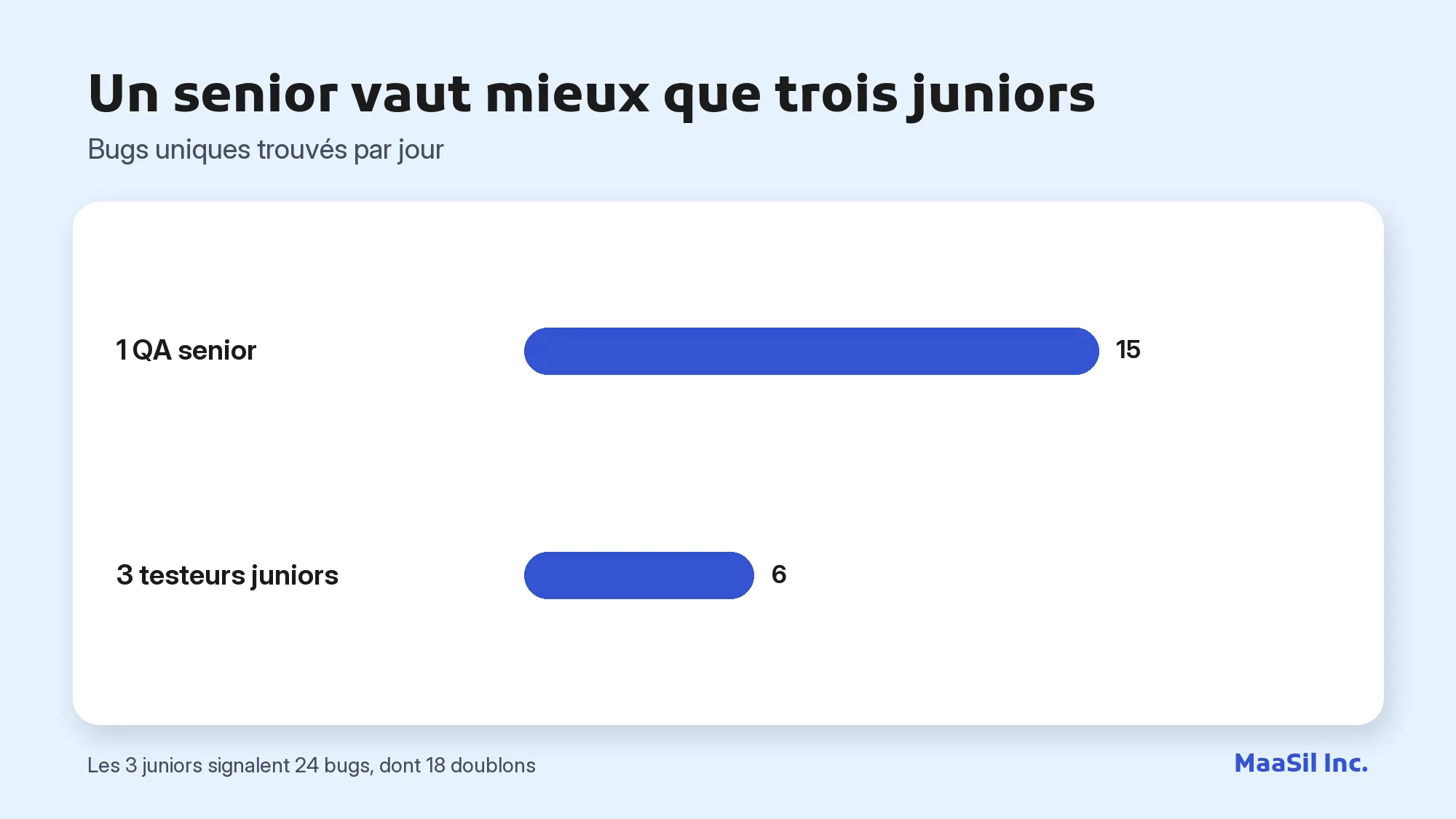
Plus de testeurs ne veut pas dire de meilleurs tests : l'expérience fait la différence.
Les mathématiques prouvent le contraire. Un ingénieur QA senior doté d'une pensée orientée cas limites trouve 15 bugs par jour en sachant où les systèmes flanchent. Trois testeurs juniors trouvent chacun 8 bugs par jour, soit un total de 24, mais 18 sont des doublons. Résultat net : 6 bugs uniques par jour pour les juniors contre 15 pour les seniors.
La comparaison des coûts montre le piège. Un QA offshore senior en Afrique du Sud coûte 2 500 $ par mois. Trois QA offshore juniors au Kenya coûtent 600 $ par mois chacun, soit un total de 1 800 $. Cela semble moins cher jusqu'à ce que la qualité des bugs entre en ligne de compte. Les testeurs juniors génèrent plus de rapports "pas un bug", faisant perdre du temps de développement pour le tri. Par conséquent, le coût effectif par bug valide trouvé rend les seniors plus économiques.
La vérité à contre-courant : embauchez la moitié de l'effectif QA que vous pensez avoir besoin, mais payez le double du salaire pour obtenir des ingénieurs expérimentés. En pratique, l'expertise spécialisée surpasse souvent la quantité généraliste dans les domaines techniques.
Infrastructure critique dont les coûts de licence dépassent les économies de salaire
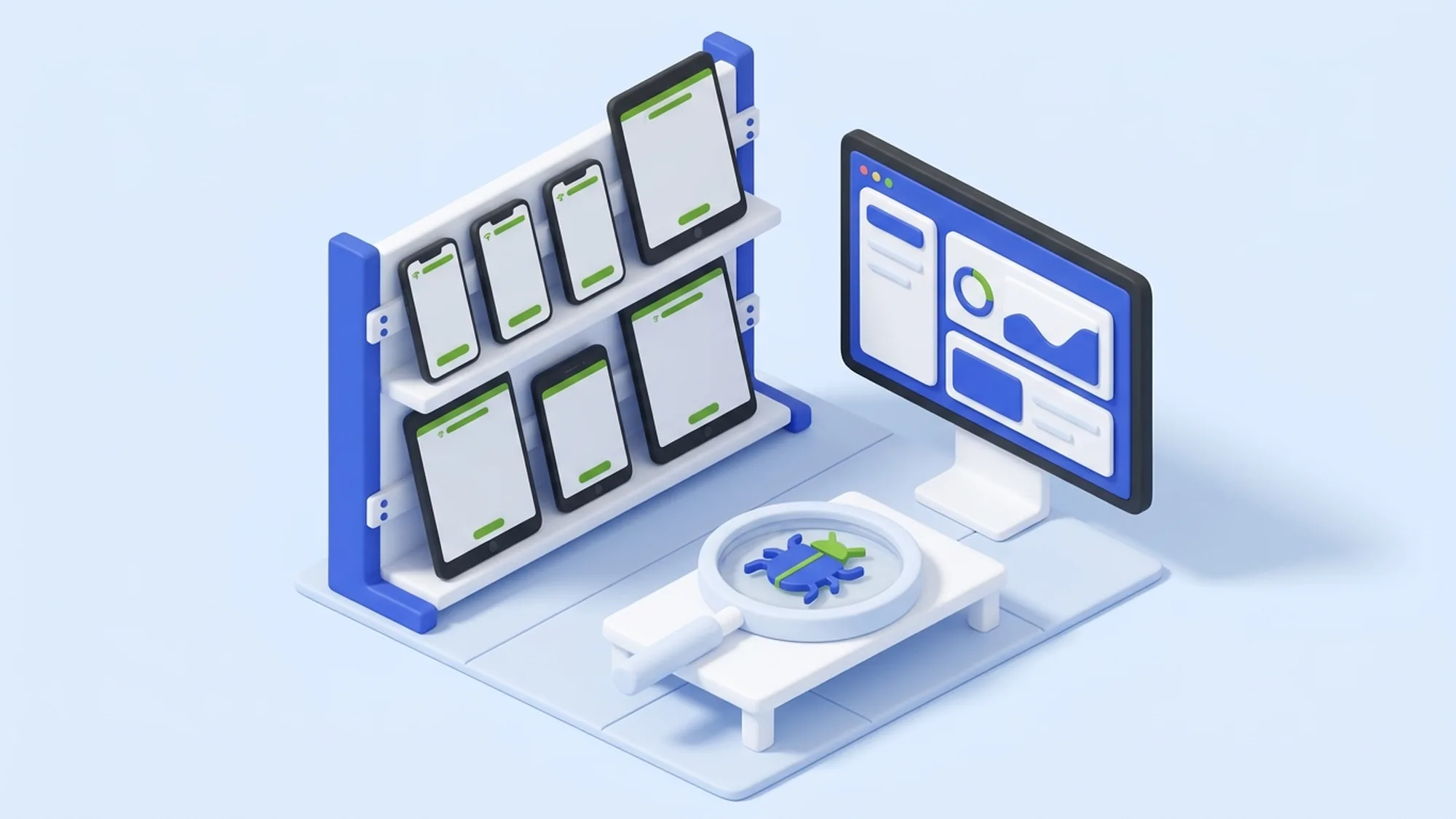
Appareils réels, écrans haute résolution, licences : l'infrastructure QA a un coût.
Le matériel déterminant la qualité des tests
Des moniteurs haute résolution (minimum 2560×1440) permettent une validation de l'interface utilisateur au pixel près. Des résolutions inférieures manquent des incohérences de conception. Les laboratoires d'appareils avec de vrais appareils iOS et Android capturent 30 % des bugs que les émulateurs manquent. Les tests multi-navigateurs nécessitent à la fois des machines Windows et Mac car les bugs Safari n'apparaissent que sur de véritables systèmes macOS.
Un minimum de 32 Go de RAM prend en charge les frameworks d'automatisation des tests exécutant une grille Selenium avec exécution parallèle. Une RAM insuffisante impose des tests séquentiels, multipliant les temps de cycle de test par 5 à 10.
Les licences logicielles qui détruisent les hypothèses budgétaires
BrowserStack facture 312 $ par utilisateur et par mois pour les tests en direct et automatisés. Sauce Labs coûte 349 $ par utilisateur et par mois. Les tests de performance LoadRunner coûtent entre 5 000 $ et 15 000 $ par an et par licence.
Par conséquent, une équipe QA de trois personnes engendre à elle seule 936 $ à 1 047 $ par mois de coûts BrowserStack/Sauce Labs. Ajoutez les outils de gestion de tests (TestRail, Zephyr, qTest à 50-80 $ par utilisateur), les frameworks d'automatisation (hébergement commercial de grille Selenium), les plateformes de test d'API (Postman Team à 49 $/utilisateur) et les outils de performance (JMeter cloud à 200 $+).
Coûts logiciels totaux : 1 200 $ à 1 800 $ par mois et par ingénieur QA. Lorsque les salaires de la QA offshore tournent autour de 1 200 $ à 2 000 $ par mois, les licences approchent ou dépassent les coûts de main-d'œuvre. Les entreprises qui s'attendaient à 70 % d'économies découvrent 50 % d'économies réelles après les dépenses d'outillage.
De plus, les plateformes de gestion des tests, les systèmes de suivi des bugs (Jira, Azure DevOps) et les outils d'intégration CI/CD ajoutent 100 $ à 200 $ supplémentaires par utilisateur et par mois. Réalité cachée : les économies de coûts des services de QA externalisés proviennent de la main-d'œuvre, pas des outils.
Aspects économiques du laboratoire d'appareils
Les tests mobiles nécessitent des appareils physiques. iOS nécessite un iPhone 12, 13, 14, 15 (quatre appareils à 800 $ chacun, soit 3 200 $). Android nécessite un Samsung Galaxy S21/S22/S23, un Pixel 6/7/8, un OnePlus (sept appareils à 600 $ chacun, soit 4 200 $). Investissement total pour le laboratoire d'appareils : 7 400 $ en une fois plus 2 000 $ de remplacements annuels.
Alternative : tests cloud via BrowserStack à 312 $ par mois multipliés par la taille de l'équipe. Pour une équipe de trois personnes sur deux ans, les tests cloud coûtent 22 464 $ contre 11 400 $ pour les laboratoires d'appareils physiques. Cependant, les laboratoires physiques introduisent une charge de gestion des appareils.
Les facteurs de décision comprennent la taille de l'équipe (les grandes équipes favorisent le cloud), la fréquence des tests (les tests quotidiens favorisent le physique) et les exigences de sécurité (certains clients interdisent les tests cloud pour les applications propriétaires).
Renforcez votre équipe tech avec un développeur senior dédié. Tester un profil →
Pourquoi l'accès à l'environnement de test avec des géo-restrictions tue la productivité
Scénario réel : une équipe QA basée en Ouganda teste une application fintech américaine dotée d'un système de prévention de la fraude bloquant les adresses IP non américaines. La solution de contournement utilise un VPN vers des terminaux américains, mais ajoute 180 ms de latence, empêchant ainsi des tests de performance SLA précis.
Alternative : autoriser les adresses IP du bureau ougandais dans les environnements de staging. Nouveau problème : les audits de sécurité signalent "Pourquoi des adresses IP ougandaises accèdent-elles à des données financières ?" Cela crée une surcharge administrative pour la conformité.
Problème plus profond : données de test contenant des PII (informations personnellement identifiables). Les données semblables à la production nécessaires pour des tests réalistes contiennent de vrais noms de clients, des numéros de sécurité sociale et des numéros de carte. L'accès de la QA offshore crée des violations du RGPD et de PCI-DSS.
L'atténuation nécessite un masquage des données et une génération de données synthétiques ajoutant 40 à 60 heures de configuration. Les environnements de staging dédiés nécessitent des configurations géo-sensibles. Un VPN avec tunneling divisé envoie le trafic de l'application via le VPN tandis que les outils de test se connectent directement. La documentation expliquant pourquoi les adresses IP offshore sont autorisées crée des pistes d'audit qui satisfont les responsables de la conformité.
Selon les directives de l'ICO britannique sur les transferts de données internationaux, tout transfert restreint doit être couvert par une décision d'adéquation, des garanties appropriées ou une dérogation.
Comment l'inflation de la gravité des bugs fait perdre du temps aux développeurs
Un testeur QA nigérian issu d'une culture perfectionniste trouve un texte de bouton indiquant "Signup" au lieu de "Sign Up" (incohérence d'espacement). Il le signale comme étant de gravité CRITIQUE, arguant : "Le client me paie pour trouver tous les défauts, ceci est un défaut, cela doit être important."
L'équipe de développement voit 12 bugs CRITIQUES dans Jira. Réalité : 1 bug réellement critique (le traitement des paiements échoue), 11 problèmes cosmétiques. L'équipe de développement perd confiance : "La QA offshore ne comprend pas les priorités."
La cause profonde combine une volonté culturelle d'impressionner et un manque de contexte commercial. Les agents ne comprennent pas l'impact sur les revenus par rapport à l'impact cosmétique ou les blocages de version par rapport aux correctifs post-version.
Les solutions nécessitent une formation sur la gravité des bugs avec des exemples d'impact commercial. Les modèles spécifient : "Critique équivaut à une perte de revenus ou à une corruption de données, Majeur équivaut à une fonctionnalité inutilisable, Mineur équivaut à un problème cosmétique ou d'expérience utilisateur (UX)." Des cycles de révision où les responsables QA auditent les classifications de gravité pendant les trois premiers mois permettent des ajustements accompagnés d'explications pour les corrections.
Les métriques suivent les rétrogradations de gravité ; celles-ci devraient diminuer avec le temps à mesure que le calibrage s'améliore. Par conséquent, investissez du temps de formation dès le départ pour éviter de perdre continuellement du temps de développement.
Que se passe-t-il lorsque la QA trouve des bugs que les développeurs ne peuvent pas reproduire
La QA offshore à Maurice signale "Le paiement échoue sur Safari". L'équipe de développement de San Francisco effectue le test et constate que tout fonctionne correctement. S'ensuivent dix allers-retours : "Échoue toujours" contre "Impossible de reproduire".
La cause profonde est découverte : la QA teste sur Safari 16.4 (dernière version pour macOS Monterey) tandis que les développeurs testent sur Safari 17.2 (macOS Sonoma). Le bug n'existe que dans Safari 16.x. Les machines de la QA offshore n'ont pas été mises à niveau vers Sonoma en raison d'une politique informatique exigeant des mises à jour trimestrielles.
Temps perdu : 6 heures de temps de développement sur 2 jours. Les stratégies de prévention comprennent une documentation de matrice d'environnement spécifiant la version de l'OS, la version du navigateur et le modèle de l'appareil dans chaque rapport de bug. Les captures d'écran combinées aux fichiers HAR (journaux réseau) deviennent obligatoires pour les bugs d'interface utilisateur. Des enregistrements d'écran (Loom, CloudApp) capturent les étapes de reproduction.
Les clouds d'appareils partagés, où la QA offshore utilise des appareils BrowserStack ou Sauce Labs identiques à ceux des développeurs, éliminent les décalages d'environnement. De plus, des instantanés d'environnement de test standardisés garantissent la cohérence.
La réalité des coûts des services de QA externalisés avec tous les frais cachés
Rôle | En interne US/UE | Offshore Afrique | Coûts des outils | Coût total offshore |
|---|---|---|---|---|
QA manuelle | 5 500 $ | 600-900 $ | 150 $ | 750-1 050 $ |
QA automatisée | 8 000 $ | 1 200-2 000 $ | 400 $ | 1 600-2 400 $ |
Responsable QA | 10 000 $ | 2 000-3 000 $ | 600 $ | 2 600-3 600 $ |
Les coûts cachés de fragmentation des appareils pour les tests mobiles comprennent les appareils iOS (3 200 $ pour quatre modèles) et les appareils Android (4 200 $ pour sept modèles). Total : 7 400 $ d'investissement initial plus 2 000 $ de remplacements annuels.
L'alternative des tests cloud (BrowserStack à 312 $ par mois) multipliée par la taille de l'équipe crée des dépenses récurrentes. Une équipe de trois personnes sur deux ans : 22 464 $ dans le cloud contre 11 400 $ pour des laboratoires physiques.
Pourquoi l'enfermement propriétaire dans un framework d'automatisation détruit le ROI
La QA offshore conçoit un framework Selenium en Python avec des attentes codées en dur, sans modèle d'objet de page (POM) et avec des sélecteurs fragiles. Cela fonctionne initialement, mais chaque modification de l'interface utilisateur brise 40 % des tests. Seul l'auteur d'origine comprend le framework. Celui-ci s'en va après 8 mois. La nouvelle équipe de QA ne peut pas le maintenir, ce qui conduit à l'abandon du framework.
Résultat : 15 000 $ d'investissement en automatisation perdus. La prévention nécessite des exigences de revue de code pour l'automatisation (pas seulement pour le code de dev), l'approbation de l'architecture du framework avant sa construction, une documentation obligatoire (README, diagramme d'architecture) et un transfert de compétences par de la programmation en binôme pendant deux semaines avant le départ de l'auteur d'origine.
Par conséquent, traitez l'automatisation des tests comme du code de production nécessitant les mêmes normes de qualité, processus de révision et rigueur de documentation.
Comment le décalage horaire double les cycles de correction de bugs
L'équipe de développement déploie une version à 17h00 heure américaine (1h00 du matin heure du Kenya). La QA effectue les tests le lendemain matin à 8h00 au Kenya (minuit aux États-Unis). Elle trouve un bug critique et le signale à 9h00 au Kenya (1h00 du matin aux États-Unis). L'équipe de développement voit le rapport de bug à 9h00 aux États-Unis (17h00 au Kenya, en fin de journée). Elle corrige le bug à 15h00 aux États-Unis (23h00 au Kenya quand la QA est hors ligne). Le bug reste non testé pendant 16 heures.

Un décalage horaire mal géré peut doubler les cycles de correction de bugs.
Résultat : un cycle de 2 jours pour une correction de bug qui devrait prendre 4 heures. Les stratégies d'atténuation comprennent un chevauchement des équipes QA (minimum 4 heures avec l'équipe de développement), des protocoles de hotfix où les bugs critiques reçoivent des notifications Slack immédiates (le développeur vérifie même après les heures de travail) et des tests asynchrones où les développeurs incluent des vidéos de reproduction ainsi que des tests unitaires prouvant les correctifs.
Acceptez des cycles plus lents pour les bugs non critiques plutôt que de payer des primes d'équipe de nuit pour des problèmes mineurs. Selon l'OIT, la fatigue liée à des horaires excessifs peut accroître les accidents et les blessures, et réduire la productivité et la qualité.
Comparaison : quels tests fonctionnent en offshore par rapport à l'interne
Parfait pour l'offshore | Dangereux à externaliser |
|---|---|
Tests de régression (répétitifs, bien documentés) | Tests exploratoires de toutes nouvelles fonctionnalités (nécessitent une intuition produit) |
Tests d'API (attentes claires en matière d'entrées/sorties) | Tests d'UX/ergonomie (différences culturelles dans la conception "intuitive") |
Tests de compatibilité des applications mobiles (fragmentation des appareils) | Tests d'accessibilité (la conformité WCAG nécessite un contexte culturel) |
Tests de charge/performance (scripteurs, mesurables) | Tests de pénétration de sécurité (risques juridiques/de conformité si offshore) |
Développement de l'automatisation des tests (exigences claires) | Tests d'acceptation utilisateur (nécessitent la perspective/l'empathie du client) |
Tests multi-navigateurs (validation mécanique) | Tests de fonctionnalités avec conformité régionale (nuances du RGPD, CCPA) |
FAQ : mise en œuvre des services de QA externalisés
Comment éviter que la QA offshore ne manque des bugs critiques ?
Mettez en œuvre des modèles hybrides où la QA offshore gère 80 % des tests tandis que la QA en interne effectue la validation de la version finale. Exigez une couverture de code supérieure à 85 % avant la validation par l'équipe offshore. La surveillance de la production capture les bugs en production, remonte jusqu'aux lacunes des tests et ajuste les cas de test. Des clauses de pénalité appliquent des crédits de service lorsque des bugs critiques qui auraient dû être détectés atteignent la production.
Qu'est-ce qui empêche la QA offshore de signaler des centaines de bugs insignifiants ?
Des workflows d'examen des bugs où les responsables QA trient tous les bugs avant de les assigner aux développeurs filtrent le bruit. Une formation sur la gravité via des sessions de calibrage trimestrielles avec les équipes de développement harmonise la compréhension. Des indicateurs mesurent les taux de rejet de bugs (le développeur marque "pas un bug") en ciblant moins de 5 %. Des boucles de rétroaction expliquent aux testeurs pourquoi les bugs ont été rejetés, améliorant ainsi les futurs rapports.
Comment s'assurer que la qualité de l'automatisation ne se dégrade pas ?
Les documents de conception du framework d'automatisation doivent être approuvés avant le début du codage. Les revues de pull requests pour le code de test appliquent la même rigueur que pour le code produit. Des métriques d'instabilité (flakiness) signalent les tests qui échouent/réussissent de manière incohérente afin d'être corrigés. Le suivi des coûts de maintenance déclenche des refactorisations du framework lorsque la maintenance des tests dépasse 20 % du temps d'automatisation.
La QA offshore peut-elle accéder à la production en toute sécurité ?
Un environnement de staging semblable à la production reproduit l'infrastructure de production (cher mais nécessaire). Des outils de données synthétiques (Faker, Mockaroo) génèrent des données de test réalistes. Un accès en lecture seule à la production permet à la QA d'interroger les bases de données de production pour analyse sans modification. Les données masquées brouillent les PII tout en préservant les relations entre les données pour la validité des tests.
Qu'est-ce qui prévient les lacunes de communication dans les rapports de bugs ?
Des modèles de rapports de bugs imposent une structure : étapes pour reproduire, résultats attendus par rapport aux résultats réels, détails de l'environnement, évaluation de la gravité, captures d'écran. Des exigences vidéo obligent à inclure des vidéos de reproduction pour tous les bugs de l'interface utilisateur. La "Définition de Terminé" pour les bugs signifie que les développeurs doivent pouvoir les reproduire uniquement à partir des rapports. Des revues hebdomadaires de bugs, où la QA présente les trois bugs les plus complexes aux équipes de développement, génèrent des retours sur la qualité des rapports.
Les services de QA externalisés offrent 60 à 70 % d'économies lorsque les entreprises embauchent des ingénieurs expérimentés plutôt que de maximiser les effectifs. Les coûts de licence des outils de test correspondent souvent aux salaires offshore, réduisant ainsi les économies attendues. De plus, la qualité du framework d'automatisation détermine le ROI ; des frameworks médiocres gaspillent des investissements de plus de 15 000 $. Le calibrage de la gravité des bugs, la standardisation de l'environnement et la planification du chevauchement des fuseaux horaires séparent l'externalisation de la QA réussie des expériences ratées. Calculez le coût total, y compris les laboratoires d'appareils ou les abonnements aux tests cloud, puis procédez à la mise en œuvre sur la base d'économies réalistes de 60 % après déduction des frais d'outillage.
Prêt à renforcer votre équipe avec les meilleurs talents africains ?
Discutez avec l'un de nos experts pour découvrir comment le portage salarial augmenté à l'IA peut s'intégrer à 100 % à vos process et faire grandir vos projets.
Échangez avec un expert
