
Prêt à renforcer votre équipe avec les meilleurs talents africains ?
Discutez avec l'un de nos experts pour découvrir comment le portage salarial augmenté à l'IA peut s'intégrer à 100 % à vos process et faire grandir vos projets.
Échangez avec un expert
Stratégie d'Externalisation & BPO
Société de services d'externalisation : le cadre d'évaluation permettant d'éviter des échecs à 340 000 $
Le choix d'une entreprise de services d'externalisation détermine la réussite ou le désastre. Les prestataires de qualité offrent des économies de coûts de 48 à 63 % avec une perturbation minimale. Un mauvais choix engendre un chaos opérationnel, des violations de conformité et des résiliations de contrats coûtant entre 180K $ et 450K $ en dépenses perdues et en efforts de récupération. Ce guide dévoile le cadre de diligence raisonnable qui sépare les partenaires compétents des catastrophes.
Qu'est-ce qu'un fournisseur de services d'externalisation et comment la sélection influence-t-elle les résultats
Une entreprise de services d'externalisation fournit des équipes externes exécutant des fonctions opérationnelles dans plusieurs catégories : BPO (business process outsourcing) pour le service client et le back-office, services informatiques pour l'assistance et le développement, services financiers pour la comptabilité et la paie, services RH pour le recrutement et l'administration, et services créatifs pour le contenu et le design. Concentrations géographiques : Philippines et Inde (BPO/IT), Afrique du Sud et Nigeria (support multilingue), Égypte et Tunisie (compétences en arabe/français), Kenya et Maurice (services spécialisés).
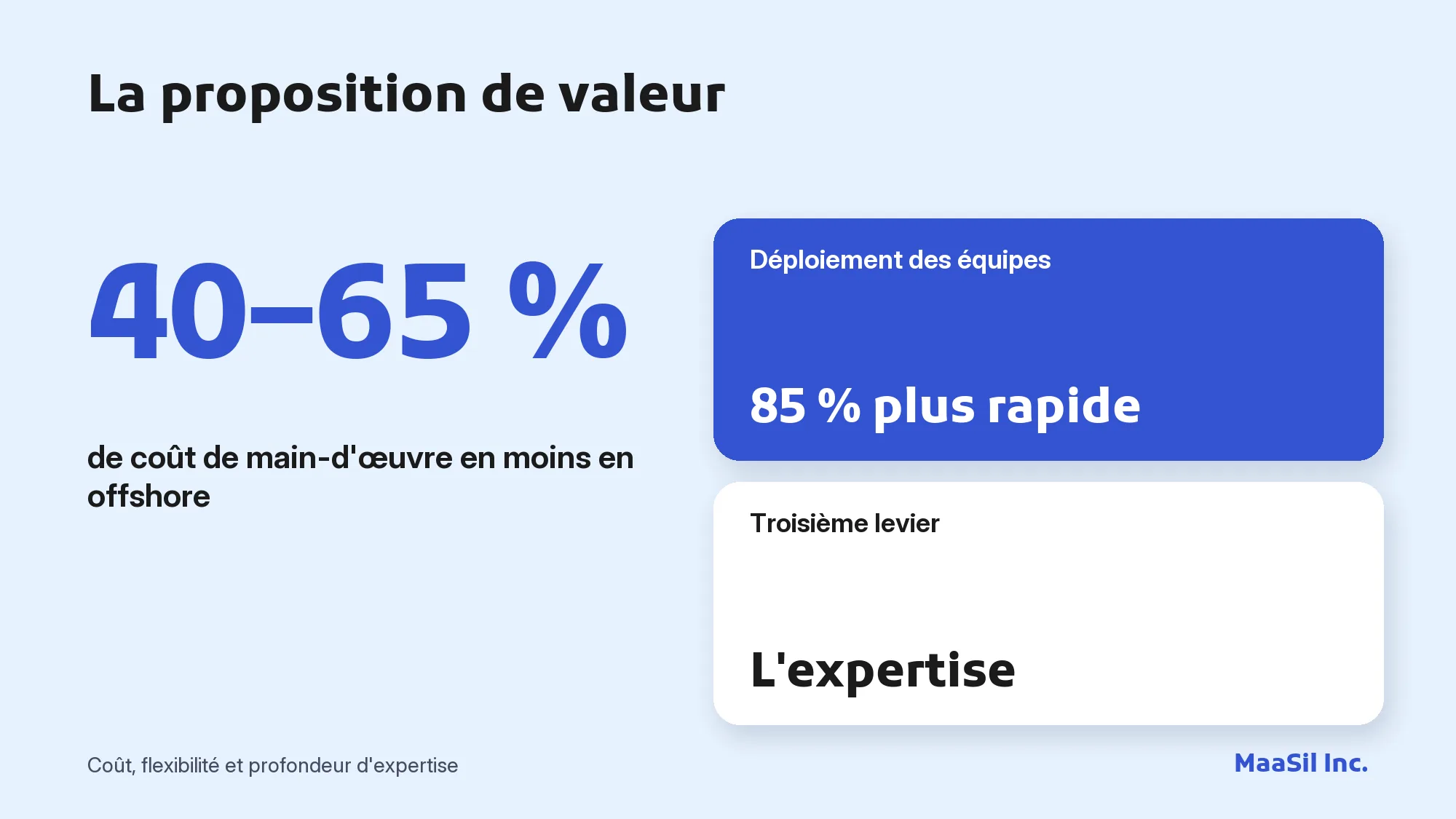
Arbitrage des coûts, flexibilité et expertise : les trois piliers de la proposition de valeur.
La proposition de valeur fondamentale combine trois éléments : l'arbitrage des coûts (main-d'œuvre offshore de 40 à 65 % moins chère), la flexibilité (déploiement des équipes 85 % plus rapide que l'embauche interne) et la profondeur de l'expertise (les prestataires spécialisés développent des capacités qui dépassent le personnel interne généraliste). Une entreprise de service client aux Philippines traite plus de 500K tickets d'assistance par mois pour plus de 30 clients, développant une reconnaissance de schémas impossible à obtenir pour les équipes internes d'une seule entreprise.
Cependant, la sélection du prestataire détermine si ces avantages théoriques se concrétisent. Une étude d'Everest Group analysant plus de 500 relations d'externalisation a révélé que 38 % d'entre elles échouent dans les 24 mois. Causes profondes : Une mauvaise évaluation des prestataires (12 % des échecs – sélection précipitée, diligence raisonnable insuffisante), des attentes mal alignées (19 % – hypothèses de coûts irréalistes, portée mal définie), une gouvernance inadéquate (31 % – absence d'indicateurs clés de performance, contrats fragiles, surveillance insuffisante) et l'incompatibilité culturelle (15 % – frictions de communication, différences de style de travail).
L'impact financier d'une mauvaise sélection s'accumule. Un fabricant américain a sélectionné une entreprise d'externalisation de logiciels nigériane la moins-disante (coût du projet de 45K $ contre 72K $ pour l'offre suivante la plus basse). Le prestataire manquait d'expérience avec les entreprises de grande envergure. Les livrables ont systématiquement manqué les délais de 6 à 9 semaines. Les problèmes de qualité ont nécessité de nombreuses retouches. Le contrat a été résilié au 14e mois. Coût total perdu : 180K $ (paiements initiaux + temps de l'équipe interne pour gérer les dysfonctionnements + coûts des prestataires d'urgence pour terminer le projet). Alternative : Dépenser 27K $ de plus initialement pour un prestataire expérimenté aurait permis de mener le projet à bien.
Comment évaluer les plus grandes entreprises d'externalisation informatique par rapport aux agences spécialisées
La taille du prestataire impose des compromis. Les grandes entreprises d'externalisation informatique (plus de 5000 employés) offrent de la profondeur et de la redondance. Les petites agences (50 à 200 employés) offrent de la flexibilité et une attention au niveau des associés. Aucun modèle n'est intrinsèquement supérieur ; adaptez-le à vos besoins.

Profondeur et redondance d'un côté, flexibilité et attention de l'autre.
Avantages des grands prestataires :
Profondeur de l'effectif : Si un employé s'en va, un remplaçant est immédiatement disponible dans le vivier de talents interne
Redondance géographique : Opérations dans plusieurs pays, possibilité de transférer la charge de travail si un site est confronté à une crise
Stabilité financière : Sociétés cotées en bourse ou soutenues par des fonds de capital-investissement, risque de fermeture plus faible
Infrastructure de conformité : Certifications SOX, RGPD, ISO établies
Méthodologies : Cadres de transition éprouvés, systèmes de gestion de la qualité, rapports de performance
Investissements technologiques : Outils d'entreprise pour la sécurité, la surveillance et l'analyse
Inconvénients des grands prestataires :
Bureaucratie : Les demandes de changement nécessitent des approbations à plusieurs niveaux, réactivité lente
Approches standardisées : Rigidité du type « c'est ainsi que nous faisons pour tout le monde », personnalisation minimale
Rotation de l'équipe de compte : Votre contact change fréquemment (promotions internes, transferts)
Prime de prix : La taxe de marque ajoute 15 à 25 % par rapport aux concurrents plus petits
Perdu dans le portefeuille : Les petits clients (<500K $ de dépenses annuelles) reçoivent l'attention de profils juniors
Avantages des agences spécialisées :
Flexibilité : Flux de travail personnalisés, adaptations rapides aux besoins changeants
Attention des dirigeants : Les fondateurs/dirigeants seniors sont personnellement engagés
Ajustement culturel : Plus facile à aligner avec votre style de travail spécifique
Efficacité des coûts : 15 à 30 % moins cher que les grandes entreprises pour des rôles équivalents
Profondeur de spécialisation : Expertise ciblée (par exemple, « nous ne faisons que du développement React » contre « nous faisons tout »)
Inconvénients des agences spécialisées :
Risque lié aux personnes clés : Si le fondateur part ou qu'un expert unique démissionne, la compétence disparaît
Contraintes de capacité : Impossible de se développer rapidement, limité à la taille actuelle de l'équipe
Concentration géographique : Un seul site = vulnérabilité aux perturbations locales (électricité, internet, troubles civils)
Fragilité financière : Réserves de trésorerie limitées, risque de fermeture plus élevé pendant les ralentissements économiques
Lacunes de conformité : Peuvent manquer de certifications formelles (ISO, SOC 2)
Cadre de sélection :
Votre situation | Choisir un grand prestataire | Choisir une agence spécialisée |
|---|---|---|
Dépenses annuelles >500K $ | ✓ Les économies d'échelle justifient les frais généraux | △ Négocier fermement sur la flexibilité |
Opérations critiques 24h/24 et 7j/7 | ✓ Redondance et profondeur essentielles | ✗ Risque de point de défaillance unique |
Secteur hautement réglementé (finance, santé) | ✓ Infrastructure de conformité requise | △ Uniquement s'il est spécialisé dans votre secteur vertical |
Exigences en évolution rapide | △ La bureaucratie sera frustrante | ✓ L'agilité est précieuse |
Compétence de niche spécialisée | △ L'approche généraliste limite la profondeur | ✓ Expertise approfondie essentielle |
Projet pilote / test d'externalisation | △ Les tailles d'engagement minimales peuvent être trop importantes | ✓ Points d'entrée flexibles |
Une fintech américaine (Série B, 180 employés) a testé une grande entreprise de services informatiques indienne pour le développement d'applications. Engagement minimum : 300K $/an, 6 développeurs affectés. Le projet nécessitait en réalité 2 à 3 développeurs. L'entreprise a été contrainte d'absorber une capacité sous-utilisée. Elle est passée à une agence nigériane (45 développeurs au total), avec un dimensionnement d'équipe flexible (2 développeurs pour commencer, 5 en période de pointe, retour à 3 pour la maintenance), coût annuel de 175K $. Une bien meilleure adéquation.
BPO informatique vs spécialistes fonctionnels : Associer le prestataire au besoin
Les entreprises d'externalisation des processus métier (BPO) outsourcing companies offrent de la largeur — elles gèrent plusieurs fonctions (service client, saisie de données, comptabilité back-office, administration RH). Les spécialistes fonctionnels se concentrent sur la profondeur — uniquement le développement de logiciels ou uniquement le recrutement ou uniquement la comptabilité. Le compromis :
Modèle BPO Généraliste :
Un seul fournisseur pour plusieurs fonctions (gestion des fournisseurs plus simple)
Coûts d'infrastructure partagés (VPN, outils de sécurité amortis)
Flexibilité de formation croisée (les agents peuvent passer d'une fonction à l'autre pendant les fluctuations de volume)
Mais : Risque de touche-à-tout, manque de spécialisation approfondie
Modèle de Spécialiste Fonctionnel :
La meilleure expertise de sa catégorie pour une fonction spécifique
Formation ciblée et optimisation des processus
Connaissances spécifiques au secteur (par exemple, spécialistes du cycle de revenus de la santé)
Mais : Plusieurs relations fournisseurs à gérer, duplication des coûts d'infrastructure
Cadre de décision :
Utiliser un BPO Généraliste si :
Externalisation de plus de 3 fonctions (service client + comptabilité + administration RH)
Les fonctions ne sont pas spécialisées (travail transactionnel, expertise minimale requise)
Priorité à la consolidation des fournisseurs (réduire les frais généraux de gestion)
Les contraintes budgétaires favorisent l'optimisation des coûts par rapport à l'optimisation de la qualité
Utiliser un Spécialiste Fonctionnel si :
Fonction unique ou 2 fonctions liées (par exemple, développement de logiciels + assurance qualité)
L'expertise du domaine est essentielle (par exemple, paie avec conformité américaine multi-états, support technique pour un produit SaaS complexe)
La qualité n'est pas négociable (prêt à payer une prime de 20 à 30 % pour le meilleur de sa catégorie)
Vous disposez déjà d'une infrastructure de gestion des fournisseurs
Exemple : Une entreprise d'e-commerce britannique a externalisé le service client, le traitement des commandes et la comptabilité à un seul BPO aux Philippines. La qualité du service client était bonne (88 % de CSAT). La qualité de la comptabilité était médiocre (expertise QuickBooks superficielle, erreurs de codage du grand livre mensuelles). Répartition de l'accord : Conservation du service client auprès du BPO, transfert de la comptabilité à un spécialiste comptable à l'île Maurice. La qualité de la comptabilité s'est considérablement améliorée. La légère augmentation des frais généraux de gestion (désormais 2 fournisseurs au lieu d'un) a été compensée par la réduction des erreurs.
Avantages de l'externalisation du marketing digital vs opérations de base : Stratification des risques
Toutes les fonctions ne comportent pas le même niveau de risque d'externalisation. Stratifiez selon le caractère critique pour l'activité :
Fonctions à faible risque (idéales pour l'externalisation) :
Saisie et traitement des données
Service client de niveau 1 (réponses aux FAQ, suivi des commandes)
Traitement des transactions comptables (clients, fournisseurs)
Administration des RH (saisie des données de paie, documents relatifs aux avantages sociaux)
Modération de contenu
Services de transcription
Surveillance des réseaux sociaux
Fonctions à risque moyen (à externaliser avec une gouvernance forte) :
Développement de logiciels (création de fonctionnalités, pas l'architecture de base)
Service client de niveau 2 (dépannage technique)
Exécution du marketing digital (gestion des publicités, mise en œuvre du référencement naturel)
Coordination du recrutement (recherche de candidats, sélection)
Rapports financiers (processus de clôture mensuelle)
Fonctions à haut risque (à externaliser uniquement avec une extrême prudence) :
Décisions relatives à l'architecture du produit de base
Gestion de la relation client au niveau exécutif
Stratégie et analyse financières
Enquêtes RH et relations avec les employés
Prise de décision juridique et de conformité
Gestion de crise et relations publiques
La stratification des risques détermine l'intensité de la gouvernance. Risque faible : Des points de contrôle mensuels suffisent. Risque moyen : Revues hebdomadaires, indicateurs clés de performance explicites, audits de qualité. Risque élevé : Coordination quotidienne, équipes hybrides colocalisées, jamais 100 % externe.
L'externalisation du marketing digital se situe dans la catégorie des risques moyens. Une entreprise égyptienne de services marketing peut exécuter : la gestion de Google Ads, la configuration de campagnes Facebook, la mise en œuvre technique du référencement naturel, la publication sur le calendrier de contenu, le déploiement de campagnes d'e-mailing. Cependant, la stratégie doit rester interne : positionnement de la marque, architecture des messages, direction créative des campagnes, allocation du budget entre les canaux.
Une entreprise B2B SaaS a externalisé « tout le marketing » à une agence philippine. L'agence a optimisé les clics et les formulaires remplis (ses indicateurs clés de performance). Elle a généré 500 prospects par mois. L'équipe commerciale s'est plainte : les prospects étaient de mauvaise qualité, 90 % ne correspondaient pas au profil client idéal (ICP), faisant perdre du temps aux commerciaux. Cause profonde : L'agence manquait de contexte stratégique concernant le profil client idéal. La stratégie a été ramenée en interne (quels segments cibler, message pour chacun), tout en conservant l'exécution offshore. Le volume de prospects est tombé à 180 par mois, mais le taux de qualification a grimpé à 68 % (contre 8 % auparavant). La contribution au pipeline a augmenté de 3,4 fois.
Quels processus externaliser en premier ? Faisons le point en 30 min. Réserver un audit gratuit →
Externalisation des services aux entreprises : L'analyse de la réalité des coûts cachés
Les tarifs annoncés induisent en erreur. Une entreprise de services d'externalisation aux Philippines propose « 9 $ de l'heure pour les agents du service client ». Le coût total réel chargé atteint 13,80 $ à 15,60 $ de l'heure. Les composantes du coût additionnel :
Contributions obligatoires de l'employeur philippin :
SSS (sécurité sociale) : 13 % du salaire (part patronale 9,5 %, part salariale 4,5 % mais l'employeur paie initialement les deux)
PhilHealth (assurance maladie) : 4 % du salaire
Pag-IBIG (fonds de logement) : 2 % du salaire
13e mois de salaire : Bonus de fin d'année obligatoire (provision mensuelle de 8,33 %)
Total : 21,33 % du salaire de base
Infrastructures et outils :
Système de téléphonie VoIP avec QoS : 180 $/agent/an
Licences de logiciels CRM/de billetterie : 600 $/agent/an
VPN et outils de sécurité : 240 $/agent/an
Poste de travail et périphériques (amortis) : 350 $/agent/an
Allocation d'espace de bureau : 780 $/agent/an
Total : 2150 $/agent/an = 1,03 $/heure
Assurance qualité et management :
Analyste AQ (évalue 5 % des interactions) : 0,60 $/heure d'agent productif
Supervision par le chef d'équipe (ratio 1:15) : 0,90 $/heure d'agent
Total : 1,50 $/heure
Marge du fournisseur :
Bénéfice du prestataire et frais généraux : marge de 18 à 25 %
Sur une base de 9 $ = 1,80 $ à 2,25 $/heure
Coût total réel chargé :
Base : 9,00 $/heure
Charges patronales (21,33 %) : 1,92 $/heure
Infrastructure : 1,03 $/heure
AQ/Management : 1,50 $/heure
Marge du fournisseur : 2,25 $/heure
Total : 15,70 $/heure
Comparez au tarif annoncé de 9 $/heure = augmentation de 74 % par rapport au tarif annoncé. Il ne s'agit pas d'une tromperie du prestataire — ce sont des coûts réels. Mais les clients qui établissent leur budget sur la base des tarifs annoncés font face à des manques à gagner inattendus.
Comparaison nationale (représentant du service client aux États-Unis) :
Salaire de base : 32 000 $ (15,38 $/heure)
Charges sociales : 2448 $ (7,65 %)
Assurance maladie : 6200 $
Abondement 401(k) : 1280 $
Congés payés et jours fériés (12 %) : 3840 $
Équipement/logiciel : 1800 $
Espace de bureau : 4200 $
Recrutement/formation (amortis) : 3600 $
Frais généraux de management : 2400 $
Total : 57 768 $ (27,77 $/heure)
Coût total chargé aux Philippines (15,70 $/heure) par rapport au coût total chargé aux États-Unis (27,77 $/heure) = 43 % d'économies. Cela reste important, mais on est loin des « 70 % d'économies ! » revendiqués par le marketing sur la base d'une comparaison des seuls tarifs de base.
Budgétisez de manière prudente en utilisant des tarifs chargés. Demandez au prestataire une ventilation montrant toutes les composantes des coûts. Les contrats doivent spécifier : « Tarif horaire de 15,70 $ tout compris, pas de frais d'infrastructure supplémentaires, assurance qualité incluse, management inclus. » Cela évite une facturation surprise pour la « récupération d'infrastructure » ou les « services d'assurance qualité » après quelques mois d'engagement.
Quels processus externaliser en premier ? Faisons le point en 30 min. Réserver un audit gratuit →
Sélection d'un prestataire d'externalisation informatique : L'audit de l'infrastructure technique
Les capacités techniques déterminent la réussite opérationnelle. Exigez des preuves d'infrastructure :

Bande passante, latence, groupe électrogène : l'audit se fait sur place, pas sur plaquette.
Réseau et connectivité :
Connexions ISP doubles auprès de fournisseurs différents (redondance)
Bande passante symétrique minimale de 100 Mbps par tranche de 25 agents/développeurs
Ligne louée dédiée vers votre siège (circuit MPLS) pour l'accès aux systèmes de base, et non l'internet public
Latence <80 ms vers votre centre de données principal (testée par ping lors de la visite sur site)
SD-WAN avec politiques de QoS donnant la priorité à la voix/vidéo sur le trafic général
Électricité et environnement :
Générateur diesel avec basculement automatique <5 secondes (les coupures de courant sont fréquentes au Nigeria, au Kenya, en Égypte)
Capacité de l'onduleur (UPS) : minimum 30 minutes à pleine charge (comble le vide pendant le démarrage du générateur)
Carburant du générateur : capacité d'autonomie de 72 heures (évite l'arrêt lors de pannes prolongées)
CVC : Systèmes de refroidissement redondants (l'équipement tombe en panne si la température de la pièce dépasse 28 °C)
Sécurité physique :
Systèmes d'accès par badge avec enregistrement des entrées/sorties
Personnel de sécurité 24h/24 et 7j/7
Couverture de vidéosurveillance (conservation minimale de 30 jours)
Système de gestion des visiteurs (badges pour les invités, obligation d'accompagnement)
Application de la politique du bureau propre (documents verrouillés chaque soir)
Sécurité des terminaux :
Agents EDR (Endpoint Detection Response) sur tous les postes de travail
Verrouillage des ports USB (les contrôles physiques des supports empêchent le vol de données — crucial au Nigeria/Kenya)
Chiffrement complet du disque
Capacité d'effacement à distance (si l'appareil est perdu/volé)
Gestion des correctifs (mises à jour du système d'exploitation et des applications déployées dans les 7 jours suivant leur publication)
Contrôles d'accès :
MFA (authentification multifacteur) pour tout accès au système
VPN requis pour tout accès à internet (pas de navigation directe sur l'internet public)
Gestion des accès privilégiés pour les comptes d'administrateur
Enregistrement des sessions pour les environnements réglementés (PCI, HIPAA)
Demander des preuves :
Enregistrement de la visite du centre de données (même si vous ne pouvez pas vous déplacer physiquement, ils doivent montrer les installations)
Résultats récents des tests de reprise après sinistre (basculement réussi vers les systèmes de sauvegarde)
Rapports de tests d'intrusion (audit de sécurité externe au cours des 12 derniers mois)
Certification SOC 2 Type II ou ISO 27001 (normes de sécurité de l'information)
Une entreprise de santé américaine a fait l'impasse sur l'audit d'infrastructure. Elle a sélectionné un prestataire nigérian uniquement sur la base du coût et d'un portefeuille de CV. Elle a découvert après 4 mois : une seule connexion ISP (pannes fréquentes), pas de générateur (équipe hors ligne pendant les coupures de courant 3 à 5 heures par semaine), ports USB non restreints (risque de vol de données sous HIPAA). Obligée de résilier, de faire la transition vers un prestataire conforme, 9 semaines de perturbation, 240K $ de coûts imprévus.
Externalisation du développement informatique : Le cadre de qualité du code et de protection de la propriété intellectuelle
La sélection d'une entreprise d'externalisation de logiciels nécessite une vérification de la qualité du code et une protection de la propriété intellectuelle allant au-delà des critères généraux du BPO.
Évaluation de la qualité du code :
Demandez un portefeuille GitHub (vrai code de production issu de projets précédents, pas des exemples de tutoriels)
Évaluez : l'organisation du code, les pratiques de commentaires, la couverture des tests, la qualité de la documentation
Entretien technique : Problème d'architecture sur tableau blanc (peuvent-ils concevoir des solutions évolutives ?)
Revue de code : Donnez un échantillon de votre base de code, demandez-leur d'identifier les problèmes et de suggérer des améliorations
Vérification des références : Parlez à 3 clients logiciels précédents, demandez : « Avez-vous rencontré de la dette technique ? Quelle était la qualité du code ? »
Signaux d'alarme :
Impossible de montrer du code de production (« confidentialité des clients » — les prestataires légitimes ont des études de cas avec autorisation)
Les échantillons de code sont d'une qualité digne d'un tutoriel (applications CRUD simples, pas de logique complexe)
Pas de culture de test (demandez « Quel est votre pourcentage de couverture de test ? » S'ils ne le suivent pas, c'est un signal d'alarme)
Résistance aux revues de code (les prestataires de qualité se prêtent volontiers à l'évaluation technique)
Exigences de protection de la propriété intellectuelle :
Contrat de travail sur commande (Work-for-hire) : Toute la propriété du code vous est transférée immédiatement dès sa création (pas à la fin du projet, mais dès la création)
Pas de réutilisation du code : Le prestataire ne peut pas réutiliser votre code pour d'autres clients (même des fonctions utilitaires génériques)
Clause de non-concurrence pour l'équipe : Les développeurs travaillant sur votre projet ne peuvent pas travailler simultanément sur des projets de concurrents directs
Séquestre du code source (Escrow) : Le code et la documentation sont conservés par un tiers neutre (si le prestataire ferme, vous accédez à la source)
Vérification des antécédents : Vérifications pénales et financières pour tous les développeurs (des difficultés financières augmentent le risque de vol de propriété intellectuelle)
Accord de non-divulgation (NDA) contraignant : Accord de non-divulgation spécifiant la juridiction d'application (Singapour, Royaume-Uni, Delaware États-Unis — pays disposant d'un droit de la propriété intellectuelle solide), clause de dommages-intérêts forfaitaires
Contrôles techniques de la propriété intellectuelle :
Les développeurs travaillent sur des bureaux virtuels (VDI), le code ne touche jamais les appareils locaux
Répertoire Git hébergé sur votre infrastructure ou votre cloud contrôlé (GitHub Enterprise), pas sur les systèmes du prestataire
Validations de code (commits) signées avec des identités de développeur vérifiées (empêche de masquer qui a écrit quoi)
Règles de protection des branches nécessitant une revue par les pairs avant la fusion
Analyse automatisée des secrets empêchant les mots de passe/clés API codés en dur
Une fintech a été victime d'un vol de propriété intellectuelle : un développeur égyptien a copié le code d'un algorithme de trading sur une clé USB (ports non restreints), a quitté le prestataire et a lancé un produit concurrent. Le client a intenté un procès — et a découvert que le jugement était inapplicable (le contrat ne spécifiait pas la juridiction, les tribunaux égyptiens ne donnant pas la priorité à la propriété intellectuelle). Perte de 2,8M $ investis dans le développement de l'algorithme. Prévention : Verrouillage USB (coût de 0 $, paramétrage de configuration) + clause de juridiction applicable.
Externalisation du centre d'assistance informatique : La précision des SLA qui empêche le contournement des règles
L'externalisation du support informatique dépend entièrement de la conception des SLA. Des SLA mal définis incitent au contournement — le prestataire optimise les métriques au détriment de la qualité du service.

Mesurez la résolution réelle, pas seulement le délai de première réponse.
Exemple de mauvais SLA (facile à contourner) :
« Répondre aux tickets dans un délai de 4 heures ouvrables »
« Résoudre 85 % des tickets dans un délai de 24 heures »
Comment les prestataires contournent cela :
L'agent répond « J'examine le problème » à 3h 59m (respecte le SLA de réponse sans apporter d'aide réelle)
L'agent clôture le ticket en demandant « Est-ce résolu ? » sans corriger la cause profonde (le client répond « Je suppose ? », ce qui compte comme une résolution et respecte le SLA de 24h)
Sélection opportuniste : Les agents traitent en priorité les tickets simples (résolutions rapides) et évitent les tickets complexes (qui dégradent les métriques)
Cadre de SLA approprié :
Métrique | Définition | Cible | Méthode de mesure | Pourquoi c'est important |
|---|---|---|---|---|
Délai de première réponse | Temps écoulé entre la création du ticket et le premier message de fond de l'agent (pas de réponse automatique) | <2 heures (heures ouvrables uniquement) | Horodatage du système, l'AQ vérifie que les réponses sont substantielles et pas seulement « j'examine le problème » | Perception de la réactivité par le client |
Délai de résolution | Heures ouvrables écoulées entre la création du ticket et la résolution vérifiée | <24 heures (Niveau 1), <72 heures (Niveau 2) | Heures ouvrables uniquement (pause en dehors des heures définies), le client doit confirmer la résolution sinon le ticket est rouvert | Vitesse réelle de résolution des problèmes |
Résolution au premier contact (FCR) | Pourcentage de tickets résolus lors de l'interaction initiale, sans escalade ni suivi nécessaire | >75 % | Audit : Échantillon aléatoire de 50 tickets « résolus » par mois, vérification de l'absence de réouverture sous 7 jours | Efficacité + expérience client |
Satisfaction client (CSAT) | Score de l'enquête post-interaction | >85 % (moyenne de 4,25/5) | Enquête automatisée envoyée 24 heures après la clôture, taux de réponse minimum de 30 % requis | Indicateur direct de qualité |
Tendance du backlog | Tickets ouverts depuis >72 heures | En baisse d'un mois sur l'autre ou <5 % du volume total | Instantané hebdomadaire, suivi de la tendance et non du nombre absolu | Alerte précoce sur les problèmes de capacité/qualité |
Score de qualité | Évaluation multidimensionnelle | >90 % | L'équipe d'AQ évalue 5 % des interactions chaque mois à l'aide d'une grille d'évaluation (accueil, écoute active, résolution de problèmes, respect des politiques, clarté de la communication, conclusion) | Contrôle complet de la qualité |
Contrôles anti-contournement :
Les réouvertures pénalisent la FCR : Si un ticket est rouvert dans les 7 jours, la « résolution » d'origine était fausse — les métriques sont ajustées rétroactivement
Distribution équitable (Round-robin) : Le système attribue automatiquement le ticket suivant, les agents ne peuvent pas choisir les tickets faciles
Les audits d'AQ vérifient la substance de la réponse : La réponse « j'examine le problème » ne compte pas comme une « première réponse », sauf si elle comprend : Un résumé du problème, les prochaines étapes de dépannage, un calendrier d'exécution prévu
Confirmation du client requise : L'agent marque le ticket comme résolu, le système envoie automatiquement un message « Veuillez confirmer que le problème est résolu » au client, le ticket n'étant considéré comme résolu qu'après confirmation du client ou 48 heures de silence
Pénalités pour vieillissement du backlog : Les tickets de >7 jours comptent double dans les métriques (incite à traiter les anciens tickets, pas seulement les nouveaux qui sont faciles)
Une entreprise de SaaS britannique a découvert des pratiques de contournement 6 mois après le début d'un contrat d'externalisation informatique. Le prestataire sud-africain affichait 92 % de FCR et 89 % de CSAT. Pourtant, les plaintes des clients augmentaient. L'enquête a révélé : Les agents pressaient les clients pour raccrocher afin de respecter les objectifs de temps de traitement, les problèmes n'étaient pas réellement résolus et les clients rappelaient (ce qui comptait comme de nouveaux tickets, pas des réouvertures). Après avoir remanié les SLA avec des contrôles anti-contournement, la FCR est tombée à un niveau réaliste de 68 %, mais la satisfaction réelle des clients s'est améliorée car les problèmes étaient véritablement résolus.
Externalisation des services financiers : La vérification de l'expertise en conformité
L'externalisation des services financiers — comptabilité, tenue de livres, paie, clients/fournisseurs, rapports financiers — comporte un risque réglementaire. L'expertise du prestataire en matière de conformité doit correspondre à votre juridiction.
Cadre de vérification :
Pour les clients américains (comptabilité basée sur les normes GAAP) :
Qualifications du personnel : Quel pourcentage de l'équipe comptable détient un titre d'expert-comptable américain (CPA) ou équivalent (ACCA, CGA) ? Minimum 40 % de profils qualifiés pour la comptabilité complexe. La tenue de livres (clients/fournisseurs) peut être confiée à des profils non certifiés CPA.
Test de connaissances des normes GAAP : Soumettez ce scénario : « Le client reçoit un contrat SaaS annuel de 120K $ payé d'avance. Comment comptabilisez-vous les revenus ? » Réponse correcte : Passif de produits constatés d'avance, constatation mensuelle au prorata (10K $/mois sur 12 mois). S'ils répondent « comptabiliser 120K $ immédiatement », ils ne comprennent pas la comptabilité d'exercice.
Conformité multi-états : Si vous opérez dans plusieurs États, demandez : « Comment gérez-vous la détermination du lien de dépendance (nexus) pour la taxe sur les ventes ? Comment suivez-vous les taxes sur la paie spécifiques à chaque État ? » Les prestataires sophistiqués disposent de cadres de travail. Les prestataires moins solides répondent « nous suivons vos instructions » (vous ne devriez pas avoir à leur dire comment faire — c'est leur expertise).
Expertise logicielle : Ont-ils de l'expérience avec votre système comptable (QuickBooks, Xero, NetSuite, Sage Intacct) ? Demandez des exemples concrets de clients utilisant le même logiciel. Les spécificités des systèmes comptent — QuickBooks Desktop se comporte différemment de QuickBooks Online, le comptable doit en connaître les nuances.
Pour les clients britanniques (normes FRS 102 ou IFRS) :
Qualifications : ACCA, CIMA ou ACA (qualifications comptables reconnues au Royaume-Uni)
Connaissances fiscales britanniques : Demandez : « Comment calculez-vous l'assurance nationale de l'employeur (National Insurance) pour un employé de catégorie A ? » Ils doivent connaître le taux de 13,8 % et le seuil secondaire de 9 100 £ (2024).
Expérience de la TVA : « Expliquez le mécanisme d'autoliquidation pour les services B2B d'un fournisseur de l'UE. » Permet de tester la compréhension de la TVA britannique post-Brexit.
Inscription automatique aux retraites : Comment gèrent-ils les exclusions, les réinscriptions, les calculs de cotisations ?
Signaux d'alarme :
Le prestataire prétend « nous gérons tous les pays » — il est impossible d'avoir une expertise approfondie partout, ce qui suggère des connaissances superficielles
Impossible de nommer des réglementations spécifiques (demande « Quelles réglementations voulez-vous que nous suivions ? » — ils devraient le savoir)
Pas de comptables qualifiés dans le personnel (des teneurs de livres autodidactes conviennent pour des tâches de base, mais sont insuffisants pour les rapports financiers)
Pas d'assurance contre les erreurs / de police E&O (ou couverture <2M $ — insuffisant pour l'exposition aux données financières)
Exigences en matière d'assurance :
E&O (Errors & Omissions) : Couverture minimale de 5M $ (protège si le prestataire commet une erreur causant une perte financière)
Responsabilité cyber : Minimum 10M $ (protège en cas de violation de données)
Votre entreprise désignée comme assuré supplémentaire (afin que vous puissiez faire une réclamation directe, et pas seulement le prestataire)
Couverture subséquente (la police d'assurance se poursuit 2 ans après la fin de la relation — couvre les erreurs latentes découvertes plus tard)
Un fabricant américain a externalisé sa comptabilité à un BPO au Kenya. Aucun personnel qualifié CPA. Les comptables ont classé à tort 280K $ de dépenses d'investissement en dépenses d'exploitation (qui auraient dû être activées et amorties, et non entièrement passées en charges). Cela a faussé les états financiers utilisés pour le respect des clauses restrictives bancaires. La banque a exigé le remboursement du prêt pour défaut de paiement. Un audit a découvert l'erreur. Coût de la correction : 45K $ (reconstitution des états financiers, reprise de l'audit) + dégradation de la relation avec la banque. Assurance E&O du prestataire : maximum 1M $. Le fabricant a dû absorber les 45K $ non couverts.
Conclusion : Le cadre de décision pour la sélection d'un prestataire
La sélection d'une entreprise d'externalisation de services détermine si vous réalisez de 48 à 63 % d'économies de coûts tout en améliorant vos opérations, ou si vous faites face à des échecs de l'ordre de 180K $ à 450K $. Une évaluation rigoureuse selon six dimensions permet de distinguer les prestataires de qualité :
1. Infrastructure technique : Double connexion ISP, générateur de secours, sécurité des terminaux, reprise après sinistre — à vérifier par des visites de centres de données et des rapports de tests d'intrusion.
2. Stabilité financière : États financiers audités, tendances de croissance des revenus, réserves de trésorerie — pour éliminer le risque de fermeture.
3. Expertise en conformité : Qualifications (CPA, ITIL, certifications du secteur), tests de connaissances spécifiques à la juridiction, couverture d'assurance (E&O de plus de 5M $, cyber de plus de 10M $) — pour prévenir les violations réglementaires.
4. Gestion de la qualité : Cadres d'assurance qualité (évaluation de plus de 5 % des interactions), analyse vocale, client mystère, sessions d'étalonnage — pour maintenir la performance.
5. Compatibilité culturelle : Alignement du style de communication, chevauchement des heures de travail (minimum 4 heures par jour), réactivité face aux escalades — pour réduire les frictions.
6. Conditions commerciales : Transparence des prix chargés (et non des tarifs de base annoncés), contrôles de SLA anti-contournement, clauses de changement réglementaire, protocoles en cas de violation de données — pour protéger vos intérêts.
Compromis liés à la taille du prestataire : Les grandes entreprises (plus de 5000 employés) offrent de la profondeur et de la redondance, mais s'accompagnent de bureaucratie et de tarifs élevés. Les agences spécialisées (50 à 200 employés) offrent de la flexibilité et de l'attention, mais présentent un risque lié aux personnes clés et des contraintes de capacité. Adaptez votre choix à vos besoins — une grande structure pour les activités critiques avec des dépenses supérieures à 500K $, une agence spécialisée pour des compétences pointues ou des projets pilotes.
Spécialiste fonctionnel vs BPO généraliste : Les spécialistes apportent la meilleure expertise de leur catégorie pour des fonctions précises (développement de logiciels, paie, recrutement). Les généralistes proposent une large gamme de services sur plusieurs fonctions (service client + back-office + administration RH). Choisissez des spécialistes lorsque la qualité n'est pas négociable, et des généralistes pour consolider les fournisseurs et optimiser les coûts.
La stratification des risques détermine l'intensité de la gouvernance. Fonctions à faible risque (saisie de données, support de niveau 1) : Points de contrôle mensuels. Risque moyen (développement, support de niveau 2, exécution du marketing digital) : Revues hebdomadaires, indicateurs clés de performance explicites. Risque élevé (stratégie, conformité, relations de niveau exécutif) : À conserver en interne ou externalisation extrêmement limitée avec coordination quotidienne.
Les coûts cachés ajoutent 35 à 55 % aux tarifs annoncés : taxes patronales, infrastructures, AQ, management, marge du fournisseur. Aux Philippines, un tarif de base de 9 $/heure se transforme en 13,80 $ à 15,60 $/heure une fois chargé. Budgétisez de manière prudente, exigez des ventilations de tarifs tout compris.
La question n'est pas de savoir s'il faut faire appel à une entreprise de services d'externalisation — mais si vous mettrez en œuvre la rigueur d'évaluation nécessaire pour éviter de faire partie des 38 % de relations qui échouent dans les 24 mois.
Foire aux questions sur les entreprises de services d'externalisation
Comment puis-je vérifier que les références clients d'un prestataire sont authentiques et non préparées ? Demandez 5 références (prévoyez d'en contacter au moins 3). Demandez un mélange de profils : 1 client de longue date (plus de 3 ans), 1 client récent (moins de 6 mois — ce qui révélera l'expérience d'intégration), 1 entreprise de taille similaire à la vôtre. C'est un signal d'alarme si le prestataire ne propose que de très grandes marques (Fortune 500) — cela peut ne pas refléter l'expérience que reçoivent les plus petits clients. Pendant les appels de référence, posez des questions hors script : « Qu'est-ce qui vous a surpris négativement au cours du 3e mois ? » (révèle les problèmes cachés), « Si vous deviez les choisir à nouveau aujourd'hui, que négocieriez-vous différemment ? » (expose les points faibles du contrat), « Avez-vous connu une défaillance majeure du service ? Comment l'ont-ils gérée ? » (teste la réaction aux crises). Recherchez le contact de référence sur LinkedIn — vérifiez qu'il y travaille réellement et regardez son poste (les références de niveau opérationnel sont plus honnêtes que celles des dirigeants). Recherchez également le nom de l'entreprise du prestataire sur Google avec les mots « procès » ou « plaintes » — les litiges publics révèlent des schémas récurrents.
Quelle est la différence de coût réelle entre les tarifs annoncés et les prix totaux chargés ? Les tarifs de base annoncés sont sous-estimés de 35 à 55 %. Aux Philippines, un tarif de base de 9 $/heure devient 13,80 $ à 15,60 $/hour avec : les charges sociales patronales (21,33 % = 1,92 $), l'infrastructure et les outils (1,03 $/heure pour la VoIP, le CRM, la sécurité, l'espace de bureau), les frais généraux d'AQ et de management (1,50 $/heure pour les chefs d'équipe et les analystes qualité), et la marge du fournisseur (18 à 25 % = 1,80 $ à 2,25 $/heure). Demandez toujours une ventilation des tarifs chargés affichant TOUTES les composantes. Le contrat doit spécifier un tarif « tout compris » pour éviter une facturation surprise pour des « frais de récupération d'infrastructure » ou des « services d'AQ » quelques mois plus tard. Cela représente tout de même 43 à 48 % d'économies par rapport aux coûts nationaux chargés (15,70 $ offshore contre 27,77 $ aux États-Unis), mais pas les « 70 % d'économies ! » vantés par le marketing sur la base d'une comparaison des seuls tarifs de base.
Comment puis-je empêcher le prestataire de réutiliser ma propriété intellectuelle ou mon code pour d'autres clients ? Combinez contrôles techniques et accords juridiques : (1) Une clause de travail sur commande (Work-for-hire) transférant la propriété lors de la création du code et non à la fin du projet, (2) Un séquestre de code source (Escrow) confiant le code à un tiers neutre, (3) Des bureaux virtuels (VDI) pour que le code ne touche jamais les appareils locaux que les développeurs pourraient copier, (4) Le verrouillage des ports USB empêchant le vol physique de données (crucial au Nigeria/Kenya où la copie sur clé USB est courante), (5) Un répertoire Git sur votre propre infrastructure contrôlée et non sur celle du prestataire, (6) Des filigranes de code intégrant des identifiants pour tracer les fuites, (7) Des vérifications d'antécédents pour tous les développeurs (les difficultés financières augmentent le risque de vol de propriété intellectuelle), (8) Une clause de juridiction applicable (Singapour, Royaume-Uni, Delaware États-Unis — droit de la propriété intellectuelle fort) avec des dommages-intérêts forfaitaires en cas de violation. Les accords de non-divulgation seuls sont inutiles — les contrôles techniques empêchent la copie, et les clauses de juridiction permettent l'application de la loi en cas de violation.
Dois-je choisir un grand prestataire établi ou une agence spécialisée plus petite ? Cela dépend de votre situation. Choisissez un grand prestataire (plus de 5000 employés) si : Vos dépenses annuelles sont supérieures à 500K $ (économies d'échelle), vos opérations critiques fonctionnent 24h/24 et 7j/7 et nécessitent de la redondance, vous évoluez dans un secteur hautement réglementé exigeant une infrastructure de conformité (SOX, HIPAA, PCI), ou vos besoins à long terme sont stables. Choisissez une agence spécialisée (50 à 200 employés) si : Vous avez besoin de compétences de niche très pointues (ils se concentrent sur un domaine précis plutôt qu'une approche généraliste), vos exigences évoluent rapidement et nécessitent de l'agilité, vous lancez un projet pilote pour tester l'externalisation (points d'entrée flexibles), vous avez des contraintes budgétaires (15 à 30 % moins cher que les grandes entreprises), ou vous souhaitez bénéficier de l'attention des fondateurs et dirigeants seniors. Les grands prestataires offrent de la profondeur et de la stabilité, mais s'accompagnent de bureaucratie et de tarifs élevés. Les agences spécialisées offrent de la flexibilité et des coûts avantageux, mais présentent un risque lié aux personnes clés et des contraintes de capacité.
Comment puis-je rédiger des SLA qui empêchent les prestataires de contourner les métriques tout en fournissant un service médiocre ? Mettez en place des contrôles anti-contournement : (1) Les réouvertures pénalisent la résolution au premier contact (FCR) — si un ticket est rouvert sous 7 jours, la « résolution » initiale était fausse, et les métriques sont ajustées de manière rétroactive, (2) Distribution de tickets équitable (Round-robin) — le système attribue automatiquement les tickets, empêchant les agents de choisir les demandes faciles pour gonfler leurs métriques, (3) Les audits d'AQ vérifient la substance de la réponse — la mention « j'examine le problème » ne compte pas comme une « première réponse » si elle ne contient pas un résumé du problème, les étapes de dépannage et un calendrier, (4) Confirmation du client requise — l'agent marque le ticket comme résolu, mais cela ne compte pas dans les métriques tant que le client n'a pas confirmé ou après 48 heures de silence, (5) Pénalités pour vieillissement du backlog — les tickets ouverts depuis plus de 7 jours comptent double, ce qui incite à résoudre les anciens problèmes plutôt qu'à traiter uniquement les nouveaux qui sont faciles, (6) Évaluation multidimensionnelle de la qualité — pas seulement un indicateur « résolu oui/non », mais une grille d'évaluation mensuelle sur 5 % des interactions portant sur l'accueil, l'écoute active, la résolution et la clarté. Effectuez également des audits mensuels de métriques sur un échantillon aléatoire de tickets clôturés pour vérifier qu'ils ont été réellement résolus.
Prêt à renforcer votre équipe avec les meilleurs talents africains ?
Discutez avec l'un de nos experts pour découvrir comment le portage salarial augmenté à l'IA peut s'intégrer à 100 % à vos process et faire grandir vos projets.
Échangez avec un expert
