
Prêt à renforcer votre équipe avec les meilleurs talents africains ?
Discutez avec l'un de nos experts pour découvrir comment le portage salarial augmenté à l'IA peut s'intégrer à 100 % à vos process et faire grandir vos projets.
Échangez avec un expert
Assistanat Virtuel & Administratif
Service Client Assistant Virtuel : Un Talent de Niveau Master à 450-950 $ Mensuels pour une Excellence Après-Vente
Les modèles de service client par assistant virtuel offrent un support après-vente grâce à des professionnels à distance diplômés d'un master pour 450 à 950 $ par mois, contre 3 200 à 4 500 $ pour des agents internes en Europe ou aux États-Unis. Cependant, 60 % des déploiements échouent en raison d'hypothèses erronées sur l'infrastructure : la qualité de la VoIP, la coordination des fuseaux horaires et les lacunes dans le transfert des connaissances détruisent la qualité du service avant même que les économies de coûts ne se matérialisent.
Qu'est-ce que le service client par assistant virtuel pour les fonctions après-vente ?
Le service client par assistant virtuel désigne des professionnels travaillant à distance qui gèrent le traitement des garanties, la gestion des retours, le dépannage des produits et les activités de fidélisation de la clientèle depuis leur domicile ou des espaces de cotravail. Contrairement aux centres d'appels dotés d'une infrastructure centralisée, les modèles virtuels répartissent les exigences technologiques entre les différents agents, créant ainsi des risques de qualité variable en ce qui concerne la connectivité Internet, le contrôle du bruit dans l'espace de travail et la standardisation des équipements.
Les applications après-vente exigent des compétences plus élevées que l'assistance virtuelle générale. L'arbitrage des demandes de garantie requiert une connaissance approfondie des produits afin d'éviter les validations non autorisées, l'escalade des défauts nécessite une logique de diagnostic permettant de distinguer les bogues de micrologiciel des erreurs d'utilisation, et la conformité réglementaire pour le traitement des données RGPD protège contre une amende potentielle de 20 millions d'euros, calculée comme 4 % du chiffre d'affaires mondial conformément aux dispositions de l'article 83 selon les directives de l'autorité britannique de protection des données (ICO).
Les assistants virtuels de niveau master diplômés de l'Université d'études professionnelles du Ghana et de l'Université de technologie de Maurice apportent une rigueur analytique pour l'analyse des causes profondes des défauts, une précision linguistique pour la documentation et une sensibilisation à la conformité qui font défaut aux diplômés de l'enseignement secondaire local. Par conséquent, les taux d'erreur du premier mois chutent de 40 % (recrues insuffisamment formées) à 12 % avec des talents diplômés, selon les recherches de la Business Process Outsourcing Association of South Africa.
Combien coûte le service client par assistant virtuel ?
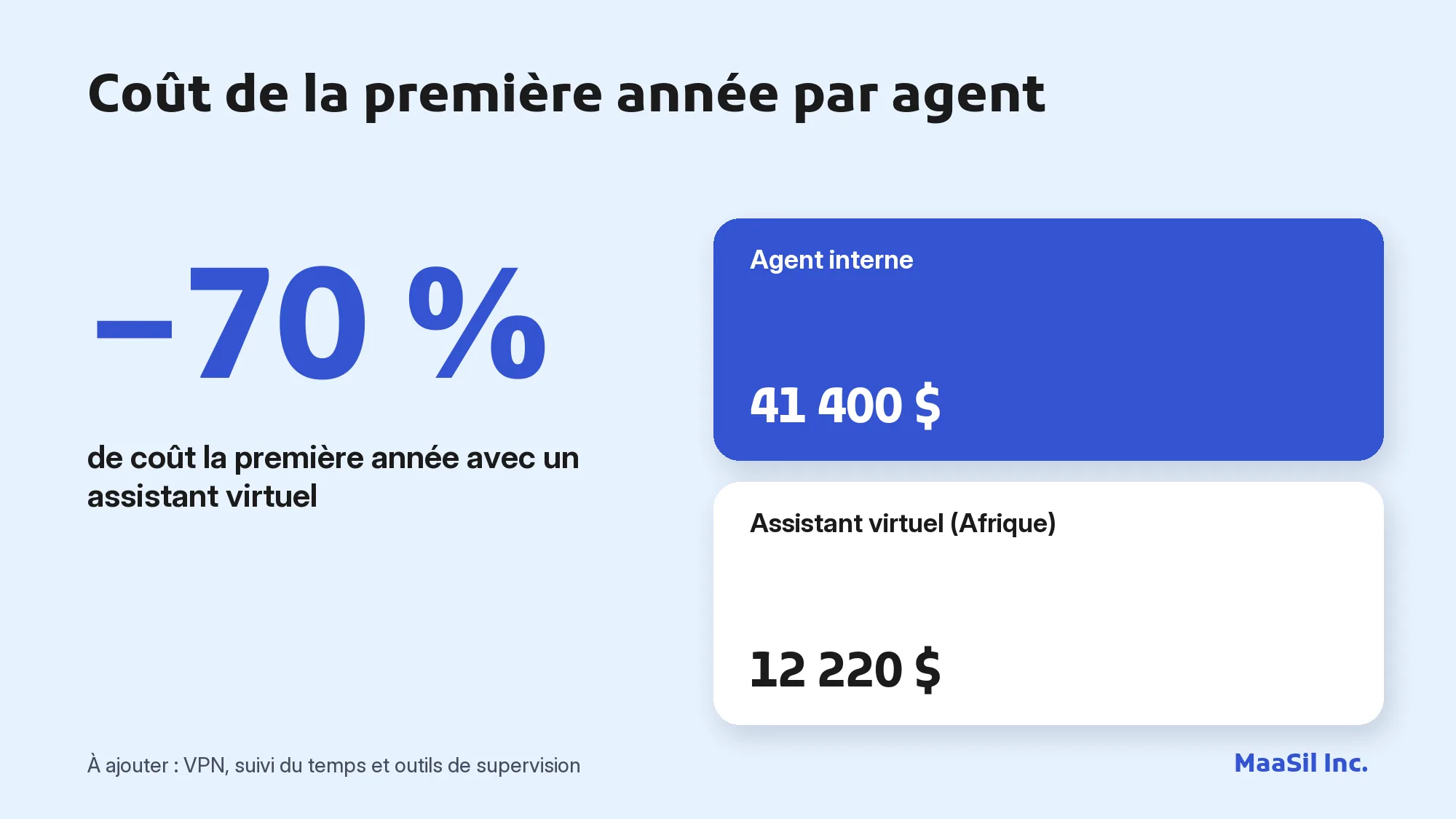
Salaire, équipement et licences compris, l'économie atteint 70 % la première année.
Catégorie de dépenses | Agent interne | Assistant virtuel (Afrique) | Variables de coût |
|---|---|---|---|
Salaire mensuel | 3 200-4 500 $ | 450-950 $ | +35 % de prime pour le bilinguisme français à Maurice |
Fourniture d'équipement | 800 $ (unique) | 220 $ (unique) | Ordinateur portable, casque, moniteur (réduit si propriété de l'agent) |
Licences logicielles | 85 $/mois | 85 $/mois | Tarification identique pour Zendesk, CRM |
Allocation Internet | Inclus dans le salaire | 45 $/mois | La fiabilité de la connexion à domicile varie |
Frais de supervision | Interne | 180 $/mois pour 10 agents | Ratio d'analystes AQ |
Coûts totaux de la première année : agent interne = 41 400 $ (salaire + équipement + licences), assistant virtuel = 12 220 $ (réduction de 70 %). Toutefois, les dépenses cachées comprennent l'infrastructure VPN (25 $/agent/mois), les logiciels de suivi du temps (8 $/agent/mois) et les outils de surveillance de la productivité (12 $/agent/mois) garantissant la responsabilisation du travail à domicile.
La fluctuation des devises crée des risques et des opportunités. La dépréciation du rand sud-africain (30 % par rapport au dollar américain entre 2020 et 2023) a réduit les coûts effectifs de 23 %, mais un renforcement soudain augmente proportionnellement les dépenses libellées en dollars. Par conséquent, les contrats libellés en devise locale avec des taux de conversion trimestriels en dollars stabilisent la budgétisation face à la volatilité des taux au comptant.
Les coûts liés à la rotation du personnel doublent les économies théoriques. La rétention moyenne des assistants virtuels est de six mois contre 14 mois pour les agents travaillant sur site en raison de facteurs d'isolement. Les investissements dans le recrutement et la formation (400 $ par agent) se répètent deux fois par an, de sorte qu'un coût annuel de rotation du personnel de 800 $ doit être pris en compte dans le calcul du coût total de possession. Les déploiements basés à Maurice affichent une rétention supérieure de 19 % grâce à des rencontres vidéo mensuelles en équipe qui luttent contre l'isolement lié au travail à distance.
Besoin d'un(e) assistant(e) francophone dédié(e), sans gestion RH ? Rencontrer un profil →
Pourquoi le service client par assistant virtuel échoue-t-il sans normes d'infrastructure ?
La qualité de la VoIP détermine la perception du client bien plus que la politesse de l'agent. Les connexions Internet à domicile d'une moyenne de 10 Mbps en téléchargement suffisent pour les appels vidéo, mais un débit montant de 1 à 2 Mbps crée des coupures de voix lors de connexions VoIP simultanées. Des pics de latence supérieurs à 150 ms provoquent des chevauchements de conversation, tandis qu'une gigue dépassant 30 ms produit une distorsion de voix robotique ; les connexions kenyanes à Nairobi offrent une bonne fiabilité, mais les zones rurales subissent des dégradations.

Débit montant, casque antibruit, secours 4G : sans normes d'infrastructure, la qualité s'effondre.
Les casques antibruit deviennent obligatoires, et non facultatifs. Le bruit ambiant de la maison (enfants, circulation, animaux domestiques) détecté dans 34 % des environnements domestiques non contrôlés nuit à l'image de professionnalisme. Les casques dotés d'une réduction active du bruit d'au moins -25 dB coûtent 85 $, contre 15 $ pour les modèles de base, mais l'élimination du chaos sonore ambiant justifie l'investissement : les plaintes des clients mentionnant un « environnement non professionnel » chutent de 18 % à moins de 3 %.
L'alimentation de secours prévient les défaillances du travail à domicile en Afrique. Le Ghana et le Nigeria connaissent de fréquentes pannes d'électricité d'une durée de 4 à 8 heures, tandis que le délestage en Afrique du Sud suit les calendriers publiés par Eskom. Les assistants virtuels ont besoin de stations d'énergie portatives (Jackery 500Wh = 450 $) offrant six heures d'autonomie pour leur ordinateur portable, et des points d'accès mobiles 4G (25 $/mois de données) permettent de basculer sur Internet en cas de panne d'électricité sur la fibre optique à domicile.
Le double écran reste essentiel malgré les contraintes du bureau à domicile. L'accès simultané au système de tickets et à la base de connaissances réduit le temps de traitement moyen de 34 secondes par interaction ; multiplié par 200 appels quotidiens, les configurations à un seul écran font perdre 113 minutes par mois. Par conséquent, les allocations d'équipement doivent imposer un deuxième écran de 24 pouces (140 $) plutôt que d'autoriser des configurations uniquement sur ordinateur portable qui réduisent la productivité de 23 %.
L'ergonomie de l'espace de travail influe sur la durabilité à long terme. Les assistants virtuels qui travaillent sur des tables de cuisine développent des troubles musculosquelettiques qui entraînent une rotation annuelle de 15 % du personnel selon les recherches sur la santé au travail de l'Organisation internationale du Travail. Les allocations pour une chaise ergonomique (180 $) et un bureau réglable (220 $) réduisent le taux de départ de 12 % ; de plus, la vérification contractuelle de l'espace de travail par photo lors de l'intégration garantit le respect des normes professionnelles en matière d'environnement de travail.
Quels sont les cas d'utilisation parfaits du service client par assistant virtuel par rapport aux échecs ?
Les applications parfaites incluent le support de niveau 1 par e-mail et par messagerie instantanée, où les variables de qualité de la voix n'ont pas d'impact sur l'expérience client. Les demandes d'état de commande, les réinitialisations de mot de passe et les mises à jour de compte s'effectuent avec succès via des canaux écrits. Le traitement des retours d'e-commerce avec des flux de travail RMA standardisés tire parti de la flexibilité des assistants virtuels : des augmentations saisonnières d'effectifs de 30 % sont déployées en sept jours, contre 14 jours pour le recrutement sur site.
Les scénarios à risque impliquent un support vocal à volume élevé nécessitant une qualité VoIP constante sur des dizaines d'agents simultanés. L'infrastructure des centres d'appels avec Internet dédié, alimentation de secours et isolation acoustique offre une fiabilité que les bureaux à domicile ne peuvent pas égaler ; par conséquent, les opérations après-vente à forte composante vocale affichent une satisfaction client supérieure de 28 % avec les modèles sur site, d'après les données de Zendesk Benchmark.
Le support des marques de luxe risque de nuire à la perception de prestige lorsque les clients détectent un environnement de bureau à domicile. Les incidents liés aux bruits de fond ou les problèmes de qualité Internet déclenchent des perceptions d'une « externalisation bon marché » qui nuisent à l'image de marque : les segments de clientèle à forte valeur (>50 000 $ de valeur à vie) affichent une rétention supérieure de 18 % avec des agents basés sur site, selon les recherches du Journal of Service Management.
Le support technique B2B complexe nécessitant un dépannage par partage d'écran dépasse les capacités d'un assistant virtuel sans sécurité VPN et bande passante adéquate. Les transferts de fichiers volumineux (journaux de diagnostic, sauvegardes système) sur des connexions résidentielles échouent en raison des limites de débit montant de 2 Mbps, tandis que la fibre symétrique de 50 Mbps sur site permet une collaboration fluide. De plus, l'accès aux systèmes internes couverts par des accords de confidentialité (NDA) requiert une sécurité de réseau d'entreprise indisponible dans les configurations de bureau à domicile.
Les secteurs réglementés sont confrontés à des barrières de conformité pour le déploiement d'assistants virtuels. Les données de santé (PHI) et les données financières (PII) nécessitent des accords de partenariat HIPAA et une certification PCI-DSS de niveau 1 impossibles à obtenir dans des environnements domestiques non contrôlés. La loi sud-africaine POPIA autorise le traitement virtuel sous réserve de contrôles techniques spécifiques (stockage chiffré, accès surveillé), mais les réglementations américaines imposent des opérations sur site pour la plupart des applications de services financiers.
Comment structurer les équipes de service client par assistant virtuel ?
La coordination des équipes s'étend sur plusieurs fuseaux horaires en s'appuyant sur des modèles de suivi du soleil. L'île Maurice (GMT+4) couvre les heures du matin en Europe, l'équipe d'Afrique de l'Ouest (GMT+0 à GMT+1) gère les pics de l'après-midi, et des fenêtres de chevauchement d'équipes de deux heures permettent des transferts de dossiers évitant la fatigue de ré-explication pour le client. Des modèles de notes de dossier obligatoires spécifiant « prochaine action requise de l'agent » réduisent les délais de changement de contexte de 40 %.

Le modèle « follow the sun » répartit la couverture entre plusieurs fuseaux horaires.
Des réunions quotidiennes en vidéo luttent contre l'isolement du travail à distance qui favorise la rotation du personnel. Des synchronisations d'équipe de quinze minutes au début du service renforcent la camaraderie et font remonter les problèmes bloquants avant qu'ils n'affectent le client. Les déploiements à Maurice signalent une rétention supérieure de 19 % grâce à des interactions sociales structurées par rapport à une coordination uniquement par e-mail ; de plus, des activités d'équipe virtuelles mensuelles (jeux en ligne, spectacles de talents) renforcent la cohésion culturelle.
Le contrôle de la qualité exige de la transparence en matière d'enregistrement d'écran et de saisie de touches. Des outils comme Time Doctor (12 $/agent/mois) capturent des captures d'écran périodiques et des niveaux d'activité, tandis qu'ActivTrak (9 $/agent/mois) fournit des analyses de productivité sans surveillance constante invasive. Le consentement de l'agent et la conformité en matière de protection des données en vertu des dispositions de l'article 88 du RGPD sur la surveillance de l'emploi exigent des accords écrits spécifiant la portée de la surveillance et les limites de conservation des données.
Une autorité échelonnée évite les goulots d'étranglement de l'escalade au sein des équipes distribuées. Les assistants virtuels disposant d'une autorisation de remboursement instantané de 50 à 100 $ résolvent 68 % des cas sans intervention d'un superviseur, tandis que les modèles sans autorité créent des retards de huit heures entre les équipes. La disponibilité des superviseurs via des canaux Slack dédiés permet une consultation en temps réel pour les cas marginaux : des accords de niveau de service (SLA) de réponse en 15 minutes évitent l'abandon du client pendant les temps d'attente.
L'optimisation de l'accès à la base de connaissances répond aux contraintes de bande passante. Les plateformes basées sur le cloud (Confluence, Notion) permettent la mise en cache hors ligne des articles, évitant ainsi les retards de chargement en temps réel lors des interactions avec les clients. Le formatage Markdown réduit la taille des pages de 60 % par rapport aux interfaces gourmandes en HTML ; de plus, les index de recherche locale améliorent les temps de réponse aux requêtes, passant de trois secondes à moins de 500 ms sur les connexions à faible bande passante.
Comment mettre en œuvre avec succès un service client par assistant virtuel ?
Étape 1 : Standardisation de l'équipement (semaine 1). Imposer des spécifications minimales : processeur Intel i5, 8 Go de RAM, casque antibruit, double écran, chaise ergonomique. Fournir des allocations d'équipement (850 $) ou expédier des kits standardisés garantissant l'uniformité. Vérifier les vitesses de connexion Internet à domicile (minimum 10 Mbps en descente, 2 Mbps en montée) via l'intégration de l'API Speedtest pendant le processus de candidature ; les zones urbaines du Kenya sont éligibles, les candidats ruraux requièrent des rôles basés sur site.
Étape 2 : Sécurisation et attribution des accès (semaines 1-2). Déployer des concentrateurs VPN (Cisco AnyConnect, Palo Alto GlobalProtect) chiffrant l'ensemble du trafic. Configurer l'authentification multifacteur pour l'accès au CRM et au système de tickets conformément aux normes ISO 27001. Établir des politiques de chiffrement des appareils exigeant BitLocker ou FileVault pour prévenir le vol de données sur les ordinateurs portables volés. La conformité à la loi sud-africaine POPIA exige des contrats de traitement de données spécifiant les obligations de l'assistant virtuel en vertu du règlement 3.
Étape 3 : Formation et certification (semaines 2-5). Offrir une intégration de quatre semaines : deux semaines de connaissances produits avec un seuil de réussite de certification de 80 %, deux semaines de compétences en communication, y compris la neutralisation de l'accent et les techniques de désescalade. Suivre virtuellement des agents internes par partage d'écran pendant 10 jours avant le déploiement en autonomie. Les déploiements au Ghana bénéficient de partenariats universitaires permettant des modules de formation pré-emploi qui réduisent le temps de montée en compétences de 40 %.
Étape 4 : Validation du projet pilote (semaines 6-9). Déployer cinq assistants virtuels gérant 15 % du volume sous réserve d'un examen d'assurance qualité (AQ) quotidien. Collecter les données de satisfaction client (CSAT) pour les comparer à la référence interne, avec des scores cibles à moins de cinq points de pourcentage d'écart. Surveiller les indicateurs de qualité de la VoIP (latence, gigue, perte de paquets) via les tableaux de bord analytiques de RingCentral. Identifier les lacunes de la base de connaissances grâce aux retours des agents et mettre à jour la documentation avant le lancement complet.
Étape 5 : Croissance avec contrôles de qualité (semaine 10+). S'étendre par tranches de cinq agents en maintenant des ratios de 10 agents pour 1 analyste AQ. Mettre en œuvre une analyse de sentiment par IA (Zendesk Answer Bot) signalant les interactions négatives nécessitant l'examen immédiat d'un superviseur. Réaliser des visites mystères mensuelles pour valider les performances ; de plus, des audits trimestriels des bureaux à domicile permettent de vérifier les normes de l'espace de travail et la conformité en matière de sécurité. Examiner les schémas de rotation du personnel en ajustant les stratégies de rémunération et d'engagement lorsque le taux de départ dépasse 15 % par an.
Comparaison : Service client en français via des assistants virtuels
Le service client en langue française par le biais d'assistants virtuels s'appuie sur les viviers de talents bilingues de l'île Maurice et du Sénégal. Les compétences en français à Maurice découlent de l'héritage colonial et du système éducatif qui offrent une fluidité native, tandis que le Sénégal propose des dialectes de français d'Afrique de l'Ouest desservant les marchés francophones. Cependant, les agents mauriciens exigent des primes salariales de 35 % (750 à 1 200 $ par mois) par rapport aux rôles uniquement anglophones en raison d'une offre limitée.
Les nuances du marché du français canadien posent un défi aux locuteurs de français africains. Les différences de vocabulaire québécois (par ex. « courriel » vs « e-mail », « magasiner » vs « faire du shopping ») nécessitent des modules de formation spécifiques pour éviter les formulations maladroites. Par conséquent, des réviseurs qualité basés à Montréal doivent valider l'exactitude des scripts avant le déploiement ; des processus de localisation de deux semaines rallongent les délais de mise en œuvre, mais évitent de dérouter le client avec l'usage du français métropolitain.
Les marchés européens francophones affichent une meilleure acceptation des assistants virtuels. Les clients français tolèrent mieux les accents mauriciens que les marchés anglophones n'acceptent l'anglais africain, selon les recherches sur les facteurs culturels publiées par le European Journal of Marketing. De plus, les coûts de main-d'œuvre français (3 800 à 5 200 $ par mois) créent des opportunités d'arbitrage plus importantes que les marchés anglophones, de sorte qu'une réduction des coûts de 68 % justifie des compromis mineurs sur la perception de l'accent.
Les exigences multilingues suisses (français, allemand, italien) dépassent les capacités d'un assistant virtuel sur un marché unique. Les opérations basées à Zurich nécessitent des équipes de polyglottes sur site avec changement de langue instantané ; les modèles d'assistants virtuels peinent avec le changement de contexte linguistique en temps réel, ce qui réduit la productivité de 35 %. Par conséquent, la couverture du marché suisse requiert des approches hybrides : des assistants virtuels mauriciens uniquement francophones pour le niveau 1, et des polyglottes basés dans des locaux en Suisse pour les escalades de niveau 2.
FAQ : Service client par assistant virtuel pour l'après-vente
Les assistants virtuels peuvent-ils gérer efficacement les appels vocaux ? Oui, moyennant des exigences strictes en matière d'infrastructure. Des casques antibruit, un débit montant minimum de 2 Mbps et une connexion Internet 4G de secours permettent d'obtenir une qualité VoIP équivalente à celle des opérations sur site. Cependant, les éléments incontrôlables de l'environnement domestique (bruits de chantier, interruptions familiales) génèrent 12 % de plaintes en plus sur la qualité des appels par rapport aux installations contrôlées selon les données de Zendesk. Par conséquent, un support basé principalement sur l'e-mail et le chat avec une couverture vocale limitée optimise les forces de l'assistant virtuel tout en minimisant l'exposition à ses faiblesses.
Comment surveiller la productivité des assistants virtuels sans microgestion ? Les indicateurs basés sur les résultats évitent la sensation d'une surveillance constante. Suivez les tickets résolus par heure (cible de 8 à 12 cas de niveau 1), les scores CSAT (à maintenir au-dessus de 85 %) et les taux de résolution au premier contact (supérieurs à 70 %). Les logiciels de suivi du temps (Time Doctor, ActivTrak) offrent une visibilité sur l'activité grâce à des captures d'écran périodiques et à l'utilisation des applications sans surveillance constante. De plus, les réunions vidéo quotidiennes permettent d'identifier les points de blocage avant tout impact sur la productivité ; une gestion basée sur la confiance avec des indicateurs clés de performance clairs surpasse la surveillance invasive, réduisant le taux de rotation du personnel de 22 %.
Que se passe-t-il lorsque la connexion Internet d'un assistant virtuel tombe en panne pendant une interaction avec un client ? Les points d'accès mobiles 4G de secours (allocation de données de 25 $/mois) permettent un basculement automatique en moins de 30 secondes. Les plateformes de routage d'appels (RingCentral, Five9) détectent la déconnexion de l'agent et replacent les clients dans la file d'attente vers des agents disponibles, évitant ainsi les abandons d'appels. Les protocoles post-panne exigent que les agents documentent la cause de l'incident et le calendrier de résolution ; des schémas récurrents indiquant l'insuffisance de l'infrastructure déclenchent des exigences de mise à niveau de l'équipement ou une transition vers un rôle sur site.
Combien de temps les assistants virtuels restent-ils dans des rôles après-vente ? La rétention moyenne est de six mois, contre 14 mois sur site, en raison de l'isolement lié au travail à distance et des écarts de perception quant au développement de carrière. Les stratégies d'atténuation comprennent des rencontres virtuelles mensuelles, des parcours d'évolution clairs (assistant virtuel senior, chef d'équipe) et des rencontres annuelles en personne avec un budget de 800 $ par agent. Les déploiements à Maurice affichent une rétention supérieure de 19 % grâce à des programmes d'engagement structurés par rapport à des approches de gestion transactionnelle qui traitent les assistants virtuels comme des ressources interchangeables.
Les assistants virtuels peuvent-ils accéder de manière sécurisée à des données clients confidentielles ? Oui, grâce à des contrôles par niveaux. Le chiffrement VPN, l'authentification multifacteur et l'accès au CRM basé sur les rôles limitent l'exposition des données. L'enregistrement d'écran avec masquage des données de paiement conformes aux normes PCI permet un contrôle qualité sans compromettre la sécurité. Le chiffrement des appareils (BitLocker, FileVault) empêche le vol de données sur les ordinateurs portables volés. Toutefois, les secteurs réglementés (données de santé PHI, données financières PII) font face à des restrictions spécifiques à chaque juridiction ; la loi sud-africaine POPIA autorise le traitement virtuel sous contrôles techniques, alors que l'HIPAA américaine exige généralement des opérations sur site avec des contrôles de sécurité physique indisponibles dans les bureaux à domicile.
Prêt à renforcer votre équipe avec les meilleurs talents africains ?
Discutez avec l'un de nos experts pour découvrir comment le portage salarial augmenté à l'IA peut s'intégrer à 100 % à vos process et faire grandir vos projets.
Échangez avec un expert
