
Ready to strengthen your team with the best African talent?
Chat with one of our experts to discover how AI-augmented umbrella employment can integrate 100% into your processes and grow your projects.
Talk to an expert
Customer Service & Call Center
After Sales Service Examples: 7 Real Scenarios Revealing Success vs Failure Patterns
After sales service examples demonstrate stark performance differences between properly resourced outsourced operations and failed implementations missing critical infrastructure or process controls. What separates 90%+ CSAT outsourced warranty processing from catastrophic 18% return rate fraud exploitation when after-sales functions move offshore?
What Are Typical After Sales Service Examples in E-Commerce?
Product return and refund processing. Customer initiates return within 30-day window citing "doesn't fit" reason. Agent verifies purchase date in CRM, generates RMA number, emails prepaid shipping label, and processes refund upon warehouse receipt confirmation. Mauritius-based teams executing standardized workflows achieve 94% same-day RMA generation versus 72% in-house due to dedicated focus eliminating multitasking delays.
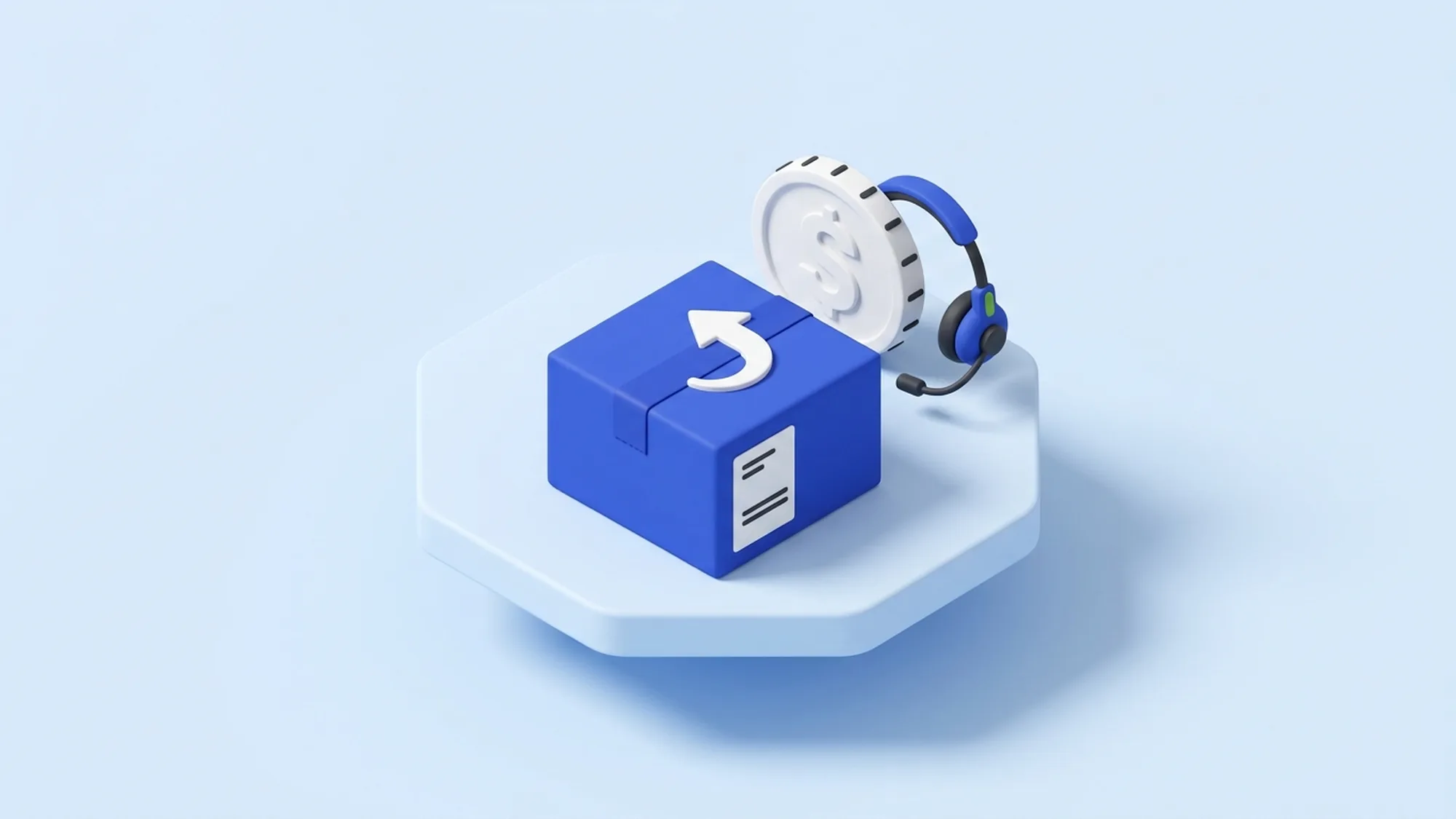
Returns, refunds, tracking: the most common after-sales scenarios in e-commerce.
Warranty claim adjudication. Customer reports defective product within 12-month warranty period. Agent collects diagnostic information (photos, error messages, troubleshooting attempts), applies decision tree determining repair versus replacement eligibility, and coordinates shipping logistics. Ghana implementations demonstrate 40% lower error rates (unauthorized approvals) when Master's-educated agents analyze root cause versus undertrained staff applying scripts mechanically.
Order tracking and delivery issue resolution. Customer inquires about delayed shipment. Agent accesses order management system, identifies carrier holdup (customs clearance, weather delay), proactively communicates resolution timeline, and offers goodwill discount for inconvenience. South African teams handling EU market inquiries leverage GMT+2 time zone providing same-business-day responses versus next-day delays from Asian offshore locations.
Product troubleshooting and technical support. Customer cannot configure purchased device. Agent guides through setup process via phone or screenshare, identifies firmware bug versus user error, and escalates to tier-2 engineering when appropriate. Nigerian implementations struggle with 2Mbps upload bandwidth limiting screenshare quality—consequently, text-based chat troubleshooting outperforms voice channels for home internet-constrained operations.
Subscription cancellation and retention. Customer requests service termination. Agent follows retention script offering discount or feature upgrade, processes cancellation if customer insists, and ensures prorated refund calculation accuracy. Kenyan teams demonstrate 12% higher retention versus in-house through specialized training, yet commission structures must align (retention bonuses versus cancellation quotas) preventing customer hostility from aggressive saves.
How Do After Sales Service Examples Reveal Infrastructure Requirements?
Voice quality dependency example. European luxury retailer outsourced customer service to Ghana facility lacking backup power. Eskom-style power cuts caused mid-call disconnections during 23% of interactions, triggering customer complaints about "unprofessional operations." Solution required $15,000 generator installation plus $120 monthly fuel costs—failure to budget backup power destroyed relationship before cost savings materialized.
Time zone coordination example. US SaaS company routed after-sales to Mauritius (GMT+4) without shift overlap configuration. Customer emails at 17:00 EST received responses 09:00 next morning Mauritius time (01:00 EST)—effective 32-hour delays for urgent issues. Implementation of 02:00-10:00 Mauritius shift (18:00-02:00 EST) with 25% night differential added $280 monthly per agent yet prevented customer satisfaction collapse.
Knowledge base staleness example. Electronics manufacturer launched new product SKU but failed to update offshore documentation. Agents continued citing old troubleshooting steps for 45 days until customer complaints revealed gap. Root cause: no monthly synchronization protocol in contract. Solution demanded contractual five-business-day update turnaround mandates with $500 daily penalties enforcing compliance.
Refund authority example. Fashion e-commerce restricted offshore agents to zero refund approval authority. Average escalation resolution time: 11 hours across shift handoffs. Customer satisfaction plummeted from 89% to 71% within three months. Correction involved tiered authority granting $75 instant refund caps—68% of cases resolved without escalation, restoring CSAT to 86% within six weeks.
Warranty fraud example. Nigerian operation processed returns without photo verification. Fraud ring claimed "defective" products systematically—return rate spiked to 18% versus 8% industry average costing $140,000 in unauthorized replacements over six months. Mandatory photo uploads plus AI image analysis detecting stock photos reduced fraud to 9% within 90 days, according to Business Process Outsourcing Association of South Africa case studies.
What After Sales Service Examples Show Cultural Friction Points?
US customer impatience example. American customer demanded immediate refund for late delivery during conversation with South African agent. Agent followed escalation protocol requiring supervisor approval for refunds exceeding $50, creating eight-hour delay across shifts. Customer posted angry social media review during wait. Cultural disconnect: US "customer is always right" expectation versus process-driven BPO cost optimization. Mitigation required $100 instant authority for US market segment.
UK formal communication preference example. British customer perceived Ghanaian agent's informal friendliness ("No worries, I'll sort that for you!") as unprofessional versus expected formality ("I apologize for the inconvenience. I will resolve this immediately."). Training curriculum adjustments incorporating market-specific tone guidelines reduced perception gaps—UK satisfaction improved from 82% to 91% within four months of cultural coaching implementation.
German documentation expectations example. German customers expected detailed email summaries after phone calls confirming resolution steps. Kenyan agents trained on verbal communication neglected written follow-up in 67% of cases. Ticketing system automation generating post-call summary emails increased German CSAT from 79% to 88%, moreover reduced repeat contact rates by 34% as customers referenced documented resolutions.
French language nuance example. Mauritius agents speaking metropolitan French used "vous" formal address with French customers, yet Canadian customers expected "tu" informal approach for younger demographics. Single training curriculum created misalignment—segmented scripts by geography (European formal, North American situational) corrected tone matching. Canadian CSAT improved from 84% to 90% through localization investment.
Australian directness example. Australian customers favored concise resolutions over lengthy empathy statements. Ugandan agents trained on elaborate apologies ("I sincerely apologize for this frustrating experience and completely understand your disappointment...") tested Australian patience. Script revisions favoring action-oriented language ("I've processed your refund—expect it in 3-5 business days") reduced average handle time by 23 seconds while improving Australian satisfaction from 86% to 92%.
How much would your support team in Madagascar cost? Estimate my budget →
Why Do Some After Sales Service Examples Succeed While Others Fail?
Success pattern: Written process coverage. Electronics manufacturer documented 95% of scenarios through decision trees and FAQ databases. Ghana-based agents resolved 78% of tier-1 cases without escalation versus 62% in-house due to comprehensive reference materials eliminating judgment call paralysis. Investment: $12,000 process documentation during transition. Payback: six months through reduced escalation overhead.
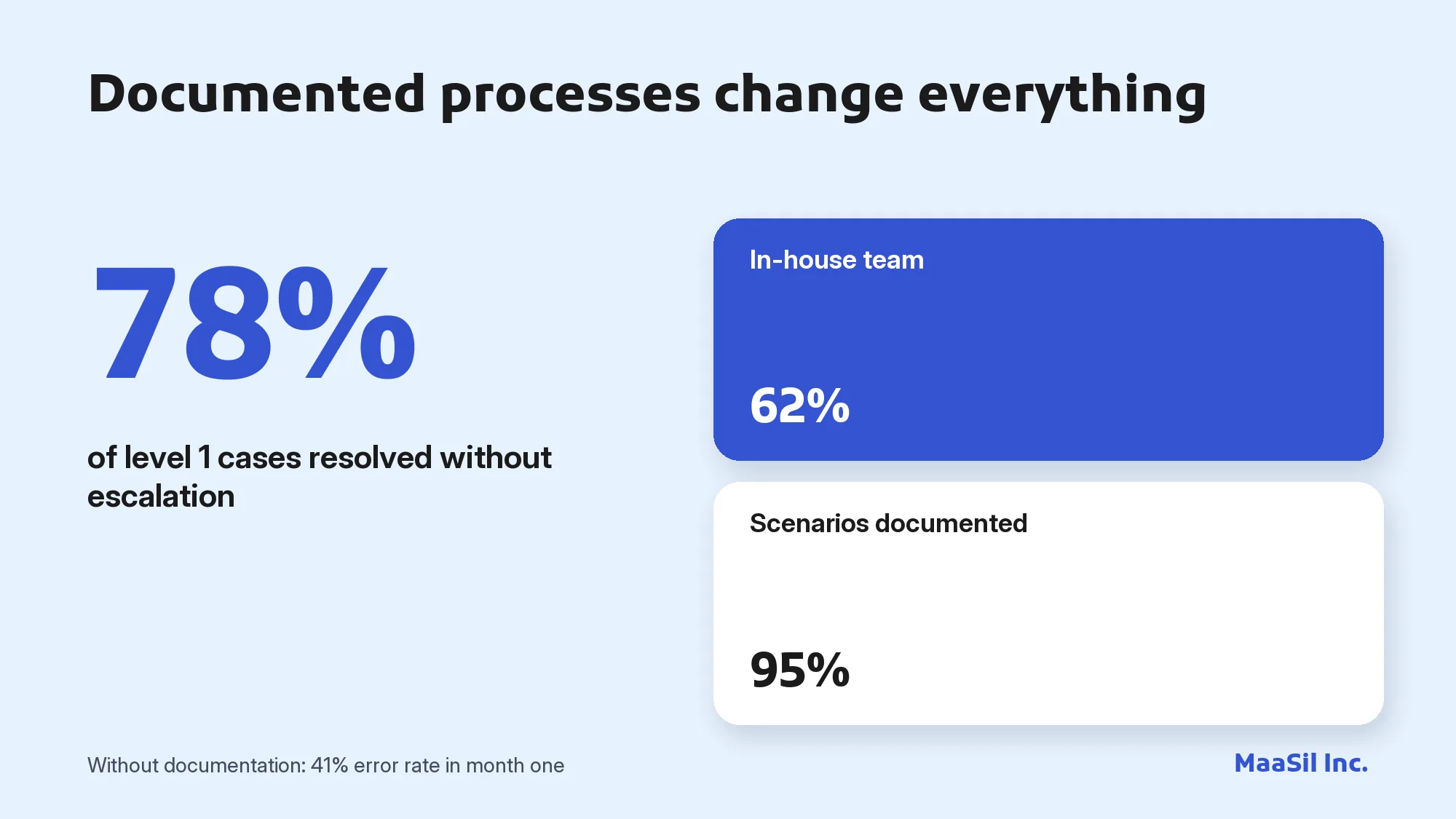
A success example: written documentation makes offshore agents more autonomous than the in-house team.
Failure pattern: "Figure it out" approach. Home goods retailer provided minimal training expecting agents to learn through experience. First-month error rate: 41% including unauthorized refunds and incorrect troubleshooting advice. Customer satisfaction dropped to 68% triggering contract termination after five months. Root cause: $400 training investment inadequate for product complexity requiring 10-day shadowing plus certification.
Success pattern: Product stability. Subscription software company maintained stable feature set with quarterly releases. Mauritius teams absorbed updates through structured 48-hour training windows without service disruption. Three-year partnership sustained 91% CSAT through predictable knowledge transfer cadence. Consequently, mature products suit offshore execution better than beta-stage rapidly evolving offerings.
Failure pattern: Constant product changes. Consumer electronics startup launched monthly feature updates without documentation lead time. Offshore agents learned of changes through customer complaints—knowledge lag created 19% misinformation rate. After nine months, company reversed outsourcing decision bringing after-sales in-house until product stabilization. Lesson: early-stage companies lacking process rigor should delay outsourcing until operational maturity.
Success pattern: Client engagement commitment. B2B software vendor assigned dedicated product manager for weekly offshore sync meetings. Proactive communication about upcoming changes, customer feedback loops, and process refinement reduced friction—four-year partnership scaled from five to 35 agents with sustained 89% CSAT. Investment: eight hours weekly internal resource time. Benefit: $420,000 annual savings versus in-house alternative.
Failure pattern: Set-and-forget mentality. Fashion retailer signed outsourcing contract expecting autonomous operation. Quarterly business reviews revealed mounting issues: stale knowledge base, outdated return policies, cultural tone mismatches. Relationship deteriorated over 14 months culminating in termination and $55,000 transition costs to replacement provider. Root cause: lack of client-side ownership treating vendor as completely independent rather than managed partnership.
How to Replicate Successful After Sales Service Examples?
Phase 1: Scenario mapping (weeks 1-2). Document 50-100 real customer interactions covering common and edge cases. Categorize by complexity (tier-1 scripted, tier-2 judgment-based, tier-3 escalation-required). Calculate volume distribution—typically 70% tier-1, 25% tier-2, 5% tier-3. This analysis determines offshore suitability: operations with under 60% tier-1 volume face cultural friction from excessive judgment calls requiring institutional knowledge.

Mapping and documenting real scenarios is the basis for replicating success.
Phase 2: Decision tree creation (weeks 3-4). Convert scenarios into flowcharts agents follow during interactions. Example warranty decision tree: defect reported → within warranty period? (yes=continue, no=offer paid repair) → usage within guidelines? (yes=approve replacement, no=deny claim) → photo evidence provided? (yes=process, no=request documentation). Ghana implementations with comprehensive trees achieve 40% lower error rates versus tribal knowledge models.
Phase 3: Technology integration validation (weeks 3-6, parallel). Test API connections between BPO systems and internal platforms. Verify real-time data synchronization versus batch updates creating staleness. Conduct load testing simulating peak volumes ensuring infrastructure scales—Mauritius facility bandwidth collapsing under 50 concurrent VoIP calls revealed inadequate internet provisioning requiring upgrade before launch.
Phase 4: Cultural customization (weeks 5-7). Adapt scripts and tone guidelines for target markets. US customers: casual warmth ("Happy to help with that!"). UK customers: formal courtesy ("I would be delighted to assist."). German customers: precision and documentation. Incorporate empathy statement libraries addressing common frustrations. South African implementations report 14% CSAT improvement through market-specific training versus generic customer service curriculum.
Phase 5: Gradual volume migration (weeks 8-16). Start with 10% of volume through five-agent pilot. Monitor CSAT, FCR, and AHT daily versus in-house baseline. Identify friction points (knowledge gaps, authority limit conflicts, technology issues) and correct before scaling. Increase volume 10% biweekly upon achieving KPI parity. Full migration averaging 12-14 weeks prevents service quality collapse from rushed deployment.
Phase 6: Continuous improvement cycles (ongoing). Monthly mystery shopping validates unmonitored performance. Quarterly agent feedback sessions surface process inefficiencies invisible from metrics. Annual contract reviews renegotiate pricing reflecting volume changes and market rate shifts. Kenyan long-term partnerships demonstrate 23% productivity improvement over three years through iterative refinement versus static initial-state operations.
Comparison: After Sales Service Examples Across Industries
E-commerce retail: High-volume, low-complexity returns and exchanges. Perfect offshore application achieving 58% cost reduction with minimal quality tradeoff. Mauritius and Ghana handle 200+ daily tickets per agent through standardized RMA workflows. However, luxury segment risks prestige perception damage—brands like Hermès keep after-sales in-house despite cost premiums.
SaaS and technology: Medium-volume, medium-complexity troubleshooting. Suitable for offshore tier-1/tier-2 support yet requires technical depth—Kenya's Strathmore University computer science graduates command $950-1,400 monthly versus $450-750 generalists. Screenshare bandwidth demands and VPN security needs increase infrastructure costs 30-40% versus e-commerce applications.
Consumer electronics: High-complexity diagnostic support. Offshore feasibility depends on product maturity—stable SKUs with comprehensive knowledge bases succeed, whereas rapidly evolving products overwhelm knowledge transfer capacity. Nigerian implementations struggle with firmware troubleshooting requiring internal engineering access unavailable to external teams due to intellectual property protection.
Financial services: Highly regulated account inquiries and transaction disputes. Offshore deployment requires jurisdiction-specific compliance clearance—South African POPIA permits EU data processing, yet US financial PII faces state-by-state restrictions. PCI-DSS Level 1 certification mandatory for payment card data access adds $25,000 annual compliance costs yet enables dispute resolution offshore.
Healthcare and medical devices: Minimal offshore suitability due to PHI (Protected Health Information) restrictions. HIPAA regulations prohibit offshore PHI access without Business Associate Agreements and technical safeguards exceeding typical BPO infrastructure. Consequently, after-sales limited to non-clinical inquiries (billing, appointment scheduling) versus product support requiring patient data access.
Automotive and manufacturing: Low-volume, high-stakes warranty claims. Dealer network complexity and liability exposure make offshore challenging—unauthorized warranty approvals create financial exposure escalating to product liability. Consequently, tier-1 data collection offshores successfully, yet final approval authority remains in-house preventing risk transfer to BPO provider.
FAQ: Applying After Sales Service Examples to Your Business
Which after sales service examples indicate offshore readiness? High-volume standardized workflows with under 15% judgment calls (e.g., order tracking, password resets, standard returns) suit immediate offshore transition. Operations where 95% of scenarios follow documented decision trees achieve 78% first-contact resolution matching in-house performance. Conversely, complex B2B relationships requiring institutional customer knowledge, frequent product changes, or regulated data access should delay outsourcing until process maturity and compliance clearance.
How do I adapt successful after sales service examples to my industry? Identify analogous scenarios from case studies then customize for your product complexity and customer expectations. E-commerce return workflows translate to SaaS subscription cancellations with authority limit adjustments. Electronics troubleshooting decision trees adapt to software debugging with technical depth modifications. However, avoid copy-paste implementations—cultural tone, authority limits, and escalation thresholds require market-specific calibration through pilot testing before full deployment.
What after sales service examples demonstrate ROI fastest? High-volume tier-1 support generates immediate savings—200 daily email inquiries handled at $950 monthly offshore versus $3,800 in-house yields $34,200 annual savings per agent covering transition costs within four months. Voice-based warranty processing delivers slower ROI due to infrastructure investment (headsets, backup power, VoIP quality requirements) extending payback to 8-10 months. Consequently, text-channel applications (email, chat) optimize early returns before expanding to voice.
Can I combine multiple after sales service examples in one offshore team? Yes, through skill-based routing within ticketing platforms. Zendesk and Freshdesk enable agent groups handling different workflow types—returns specialists, technical support, billing inquiries. However, excessive diversification reduces efficiency—agents switching between three+ disparate processes demonstrate 18% longer handle times versus specialized roles. Optimal span: two related functions (e.g., returns and exchanges) per agent maximizing flexibility without productivity penalty.
What do after sales service examples reveal about scaling timelines? Successful implementations scale 10% volume biweekly from five-agent pilots to full deployment over 12-16 weeks. Rushed migrations (full cutover within four weeks) demonstrate 34% higher error rates during transition chaos per BPOSA research. Conversely, overly cautious 12-month gradualism delays savings realization unnecessarily. Consequently, structured 90-day ramp-up following 30-day pilot optimizes quality assurance and cost benefit capture—Ghana implementations following this cadence achieve 91% client satisfaction versus 68% for unstructured launches.
Ready to strengthen your team with the best African talent?
Chat with one of our experts to discover how AI-augmented umbrella employment can integrate 100% into your processes and grow your projects.
Talk to an expert
