
Ready to strengthen your team with the best African talent?
Chat with one of our experts to discover how AI-augmented umbrella employment can integrate 100% into your processes and grow your projects.
Talk to an expert
Customer Service & Call Center
Call Center Clients Outsourcing: How to Migrate 4,500 Monthly Interactions Without Losing 18% of Customers
Your internal team handles 150 daily calls with 4.2-minute AHT and 88% CSAT scores. Leadership demands 70% cost reduction through offshore outsourcing. Six months later, AHT is 7.8 minutes, CSAT dropped to 71%, and Q2 revenue declined $340,000 from customer churn.
The failure isn't offshore capability—it's transition management. Call center clients outsourcing requires four-phase migration: knowledge extraction from internal teams, agent selection matching customer demographics, parallel operation validating quality parity, and SLA monitoring preventing gradual degradation.
This guide covers the transition roadmap 68% of companies skip, change management preventing internal team sabotage, and the SLA framework catching quality decline before customers notice.
What Are the 4 Phases of Successful Call Center Client Migration to Outsourcing?
Rushed transitions destroy customer relationships. Structured approaches minimize disruption.

A phased migration protects service quality throughout the transition.
Phase 1 - Knowledge capture (Weeks 1-4):
Internal agents possess undocumented institutional knowledge: edge case resolutions, difficult customer handling tactics, product quirks absent from training materials.
Extraction methodology:
Record 100% of calls for 2 weeks (not sampling—outliers contain valuable edge cases)
Conduct structured interviews: "Walk me through your most difficult call last month"
Shadow top performers: Observer documents decision logic, not just actions
Compile FAQ from actual customer questions, not assumed questions
Moreover, categorize interaction types by complexity:
Tier-1 (65%): Routine inquiries scriptable with decision trees
Tier-2 (28%): Judgment calls requiring product knowledge but no escalation
Tier-3 (7%): Complex issues needing deep expertise or policy exceptions
Common mistake: Outsourcing all three tiers simultaneously. Tier-3 should remain internal for 6-12 months while offshore team builds capability.
Documentation deliverables:
Playbooks for top 20 interaction types (step-by-step with screenshots)
Escalation matrix (when agents transfer vs resolve)
Customer personality profiles (industries with specific expectations—legal firms demand formal tone, startups prefer casual)
System workarounds (the CRM bug everyone knows about but IT hasn't fixed)
Phase 2 - Provider selection and contracting (Weeks 5-8):
Standard vendor evaluation (cost, certifications, facilities) is necessary but insufficient. Client-specific criteria include:
Customer demographic matching:
US customers aged 50+: South African agents (accent tolerance data shows 91% acceptance)
UK ecommerce customers aged 18-35: Text-preferred channels staffed from Kenya/Nigeria
B2B enterprise customers: South Africa/Mauritius only (C-suite buyers have strong accent bias)
Cultural alignment assessment:
Provider's conflict resolution philosophy (empowerment vs strict script adherence)
Attrition reduction tactics (are agents paid above-market to ensure retention?)
Training investment (4-week minimum or 1-week crash course?)
Technology compatibility validation:
CRM integration proof-of-concept in test environment
Load testing with client's actual peak volume (not theoretical capacity)
Disaster recovery drill with client IT observing failover process
Additionally, reference checks must ask specific questions:
"What surprised you negatively in months 2-3?" (honeymoon period ends, real issues emerge)
"Show me your SLA performance data for last 6 months" (trends reveal quality degradation)
"How did they handle your worst service failure?" (crisis response reveals partnership quality)
Contract negotiation must address:
Knowledge transfer support: Provider assigns implementation team for 90 days post-launch, not abandoning client after week 1
Internal team retention incentives: Domestic agents receive bonuses for training offshore counterparts (prevents sabotage)
Performance ratchets: SLAs start at 80% of internal benchmarks, increase monthly to parity by month 4
Termination rights: Material SLA breaches allow exit without penalty after 60-day cure period
Phase 3 - Parallel operation (Weeks 9-16):
Running both operations simultaneously costs 40% more short-term but prevents disaster.
Traffic allocation strategy:
Week 9-10: 10% to offshore (cherry-pick simplest interaction types)
Week 11-12: 25% to offshore (introduce moderate complexity)
Week 13-14: 50% to offshore (test peak load handling)
Week 15-16: 80% to offshore (internal team on standby for escalations)
Metric tracking during parallel run:
Metric | Internal Baseline | Offshore Target | Decision Threshold |
|---|---|---|---|
AHT | 4.2 min | <6.0 min | >7 min = extend training |
FCR | 82% | >75% | <70% = process review |
CSAT | 88% | >82% | <78% = halt ramp |
Transfer rate | 8% | <15% | >20% = empowerment issue |
Moreover, conduct daily standups:
Offshore supervisor reports previous day's challenges
Internal team lead provides coaching on recurring issues
Client project manager adjusts traffic allocation based on performance
Common discovery: Offshore AHT is longer but not problematic if FCR improves. An extra 90 seconds per call preventing callbacks delivers better economics than fast calls generating repeats.
Phase 4 - Optimization and internal team transition (Weeks 17-24):
Internal agents face uncertain futures—handle this poorly and they sabotage the transition.
Retention strategy for high performers:
Tier-3 specialist roles handling escalations offshore can't resolve
Quality assurance positions monitoring offshore performance
Training roles conducting monthly offshore coaching sessions
Project management for future initiatives
This retains institutional knowledge while sizing team appropriately. A 40-person internal team becomes 8-person specialist group post-outsourcing.
For remaining internal agents:
Severance packages: 2 weeks pay per year of service
Job placement assistance: Resume writing, interview prep, recruiter connections
Early notification: 90-day advance notice enabling proactive job search
Treating departing agents poorly creates glassdoor reviews and social media posts damaging brand reputation worth more than severance cost savings.
Continuous improvement cycle:
Weekly offshore performance reviews identifying trending issues
Monthly playbook updates incorporating new edge cases discovered
Quarterly onsite visits (client visits offshore facility observing operations)
Biannual RFP process (even if not switching vendors—market check ensures competitive pricing)
How Do You Prevent Internal Teams From Sabotaging Call Center Outsourcing Transitions?
Fear-driven sabotage is a classic risk in outsourcing projects.
Sabotage tactics:
Withholding knowledge: "That's too complex to document, they'll never understand"
Providing outdated information: Training materials from 2019, not current processes
Undermining confidence: "Offshore agents will destroy our customer relationships"
Active obstruction: Refusing to participate in knowledge transfer calls
Prevention through incentive alignment:
Create transition bonuses tied to offshore success:
$2,000 bonus per internal agent if offshore team achieves 80% CSAT by month 3
$1,500 bonus if offshore FCR exceeds 75% by month 4
$1,000 bonus for every documented playbook contributed
Total cost: $4,500 per internal agent. Compare to disaster cost: Failed outsourcing transition costs $180,000 in consultant fees, customer winback campaigns, and delayed cost savings.
Recognition programs:
Public acknowledgment: CEO email thanking internal team for partnership
Legacy naming: "Sarah's escalation protocol" honors contributors
Career advancement: Internal agents who excel at knowledge transfer get first consideration for specialist roles
Moreover, transparent communication prevents rumor spread:
Week 1 announcement: Explain business rationale (cost reduction enabling growth investment)
Monthly town halls: Share transition progress, address concerns
Individual meetings: Managers meet each agent discussing their specific future
Addressing legitimate concerns:
Agent fear: "I'll be unemployed in 6 months" Response: "Your role changes, not disappears. We need 8 specialists for escalations and QA. Based on performance, you're a top candidate."
Agent fear: "Offshore agents will ruin our reputation" Response: "That's why we need your expertise. You'll conduct monthly coaching calls teaching them what makes our service excellent."
Agent fear: "Leadership doesn't value our contribution" Response: "This $4,500 transition bonus demonstrates that value. Additionally, your documentation becomes the foundation for offshore success."
How much would your support team in Madagascar cost? Estimate my budget →
What SLAs Should Call Center Clients Demand in Outsourcing Contracts?
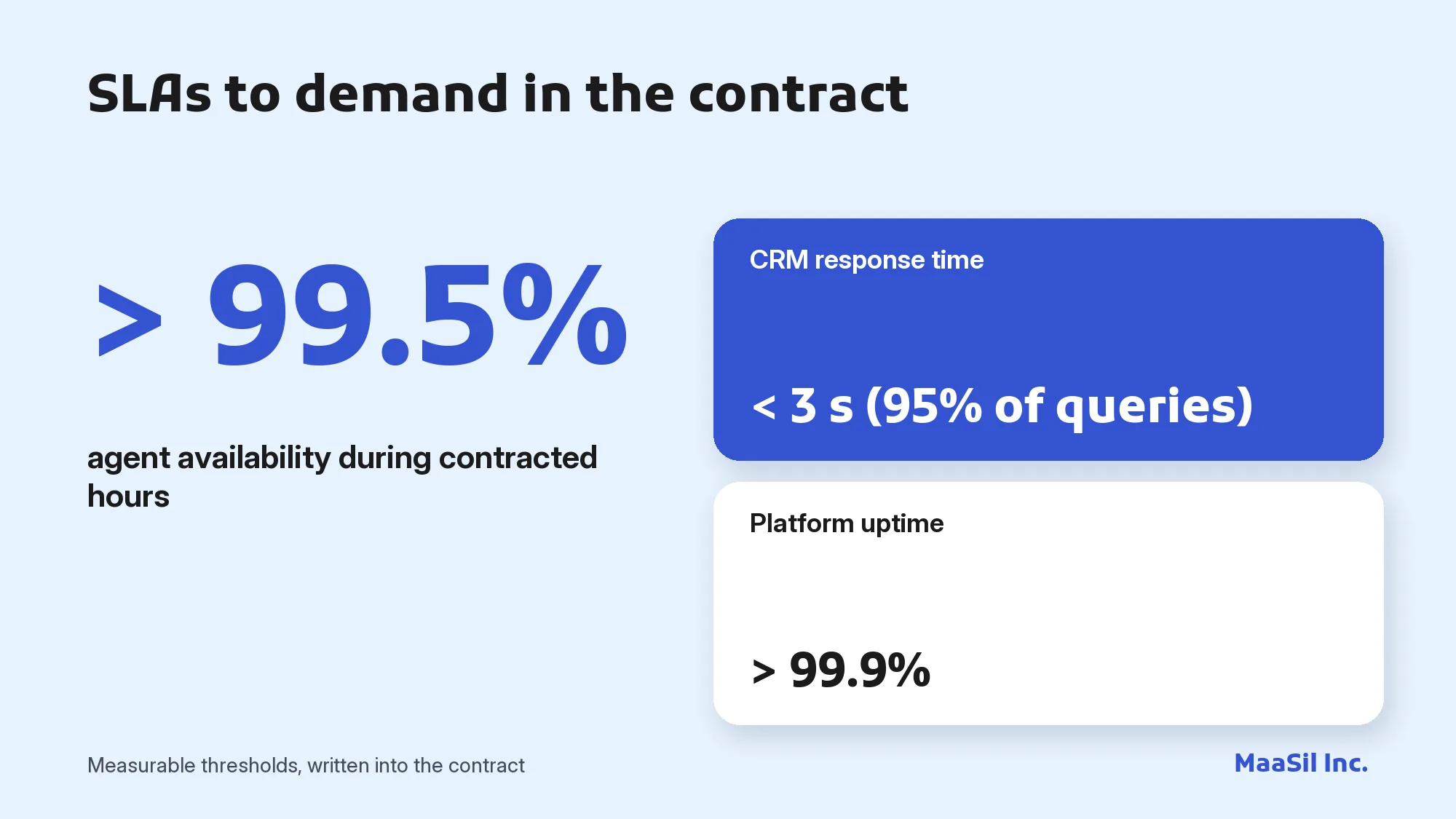
Quantified, measurable commitments protect the client from day one.
Vague SLAs enable quality degradation.
Uptime/availability (operational):
Agent availability >99.5% during contracted hours
CRM system response time <3 seconds for 95% of queries
Platform uptime >99.9% (voice, chat, email channels)
Quality metrics (customer experience):
Metric | Target | Measurement | Penalty |
|---|---|---|---|
CSAT | >85% | Survey 20% of interactions | <80% = 5% fee reduction |
FCR | >80% | 7-day callback tracking | <75% = 10% fee reduction |
AHT | <6 min | Automated platform reporting | >7.5min = performance review |
Abandon rate | <5% | Calls disconnected before answer | >8% = capacity addition required |
Compliance metrics (risk management):
PCI-DSS: Zero card data exposure incidents (breach = contract termination)
Data protection: <24hr breach notification (delay = $50K penalty)
Recording retention: 60-day minimum (compliance failure = $10K penalty)
Moreover, SLAs must specify measurement methodology:
CSAT: Survey sent within 1 hour of interaction to 20% random sample, minimum 15% response rate
FCR: Customer doesn't re-contact within 7 days about same issue (email/chat/call any channel)
AHT: Measured from call connection to disconnection including hold time and after-call work
Reporting requirements:
Daily dashboard: Real-time metrics accessible 24/7
Weekly report: Trending analysis with issue root cause identification
Monthly business review: Executive summary with improvement initiatives
Additionally, audit rights:
Client can conduct unannounced facility visits quarterly
Client can listen to random call samples without provider pre-selection
Client receives raw data exports for independent analysis
Financial consequences calibration:
SLA breach severity tiers:
Minor (CSAT 82-85%): 5% monthly fee reduction
Moderate (CSAT 78-82%): 10% reduction + corrective action plan required
Major (CSAT <78%): 15% reduction + client may halt traffic pending improvement
Critical (data breach, fraud): Immediate termination + liability for damages
However, penalties alone don't drive improvement. Bonus structures for exceeding SLAs create positive motivation:
CSAT >90%: 5% bonus payment
FCR >85%: 3% bonus
Cumulative annual excellence: 10% bonus
How Do You Monitor Call Center Outsourcing Quality Without Micromanaging?

Continuous quality monitoring without micromanagement is the key to successful outsourcing.
Trust-but-verify frameworks prevent quality decay.
Automated monitoring tools:
Speech analytics platforms (CallMiner, Observe.AI) score 100% of interactions for:
Compliance: Required disclosures, prohibited language
Sentiment: Customer frustration level by voice tone analysis
Soft skills: Empathy phrases, active listening indicators
Efficiency: Dead air >8 seconds, excessive holds
This costs $18 per agent monthly but eliminates sampling bias. Traditional QA reviews 2% of calls selected by supervisors—usually their best agents' best calls. AI reviews everything, catching issues supervisors miss or hide.
Customer feedback loops:
Post-interaction surveys capturing:
Satisfaction rating (1-5 scale)
Specific dissatisfiers (accent, wait time, resolution, agent knowledge)
Likelihood to recommend (NPS)
Open comments (text analysis identifies trending themes)
Survey timing matters: Send within 1 hour of interaction (78% response rate) vs next-day surveys (31% response). Additionally, offer incentives: $5 Amazon gift card for completion increases responses 340%.
Random call auditing:
Client QA team (can be former internal agents in specialist roles) reviews:
20 calls per agent per month (random selection, not supervisor-picked)
Scoring rubric aligned with internal standards
Calibration sessions: Client and provider QA teams jointly review calls ensuring consistent scoring
Findings feed coaching plans: Agent with low scores receives 1-on-1 training, not just general feedback.
Operational metrics dashboard:
Real-time visibility into:
Current queue depth (30-second refresh)
Longest wait time (SLA risk indicator)
Agent status distribution (available, on call, break, training)
Hourly volume vs forecast (capacity adequacy)
Alert thresholds trigger notifications:
Queue >3 minutes: SMS to client operations manager
Abandon rate >8%: Escalation to provider director
System downtime >5 minutes: Conference bridge auto-dial (client IT + provider IT)
Quarterly business reviews (QBR):
Executive-level meeting covering:
SLA performance trends (6-month rolling)
Customer verbatim feedback themes
Cost per contact evolution
Technology roadmap (platform upgrades, new capabilities)
Market benchmarking (how performance compares to industry standards)
QBR outputs:
90-day improvement initiatives with named owners and deadlines
Investment decisions (incremental training, technology upgrades)
Contract amendments (volume changes, scope expansions)
Conclusion: The Call Center Client Outsourcing Transition Playbook
Call center clients outsourcing successfully through four-phase migration: knowledge capture from internal teams over 4 weeks documenting edge cases and tier-complexity mapping, provider selection validating customer demographic matching and technology compatibility through POC testing, parallel operation ramping traffic from 10% to 80% over 8 weeks while tracking metrics daily, and optimization transitioning internal agents to specialist roles preventing sabotage.
Incentive alignment prevents knowledge withholding—$4,500 transition bonuses tied to offshore success metrics cost less than the $180,000 failure recovery expenses. Transparent communication in monthly town halls and individual career discussions addresses agent fears about job security and legacy value.
SLAs must specify measurement methodology, not just targets: CSAT surveyed within 1 hour achieving 15% response rates, FCR tracked across channels for 7-day periods, AHT including hold time and after-call work, with financial consequences calibrated across minor/moderate/major/critical severity tiers.
Quality monitoring combines speech analytics scoring 100% of interactions for compliance and sentiment, post-interaction surveys capturing specific dissatisfiers with open comment text analysis, random call auditing by client QA teams reviewing 20 calls monthly per agent, and real-time dashboards with alert thresholds triggering SMS notifications when queues exceed 3 minutes.
The decision framework: Document tier-1/2/3 interaction complexity keeping tier-3 internal initially, select providers matching customer demographics through accent tolerance data, negotiate contracts with 90-day implementation support and performance ratchets increasing SLA targets monthly, conduct parallel runs extending training when offshore metrics miss decision thresholds, and retain internal high performers in specialist roles preserving institutional knowledge. Companies rushing single-phase cutovers suffer 18% customer churn and $340,000 revenue declines; those investing 24-week structured transitions capture 70% cost reductions without quality destruction.
Ready to strengthen your team with the best African talent?
Chat with one of our experts to discover how AI-augmented umbrella employment can integrate 100% into your processes and grow your projects.
Talk to an expert
