
Ready to strengthen your team with the best African talent?
Chat with one of our experts to discover how AI-augmented umbrella employment can integrate 100% into your processes and grow your projects.
Talk to an expert
Customer Service & Call Center
Call Center Outsourcing: How to Cut Costs by 68% Without Destroying Customer Experience
Your in-house call center burns $4,500 monthly per agent. Meanwhile, competitors route calls through Mauritius at $1,200 per seat with identical FCR scores. The cost gap isn't the real story—it's the infrastructure traps, compliance landmines, and accent bias that kill 40% of offshore projects in year one.
This guide dissects call center outsourcing services with zero sales fluff: hard costs across five countries, VoIP latency math, fraud vectors your vendor won't mention, and the cultural friction that turns NPS gains into churn disasters.
What Is Call Center Outsourcing and Why Do 40% of Projects Fail?
Call center outsourcing transfers customer interaction operations to external providers, typically in lower-cost geographies. However, success requires more than wage arbitrage. The primary failure mode isn't accent issues—it's technical infrastructure gaps.
A Kenyan agent answering calls through a consumer ISP experiences 450ms latency spikes during peak hours. VoIP quality degrades beyond 150ms ping, causing robotic voice artifacts. The customer interprets this as incompetence, not a network issue. Therefore, provider selection must prioritize SLA-backed connections over headline pricing.
Moreover, CRM integration latency hurts efficiency. When the CRM is hosted far from the delivery site, screen-pops of customer records can lag, forcing agents to ask questions the customer has already answered. Test CRM response times from the vendor's actual site before signing.
Master's degree talent in Nigeria costs $350 monthly, but accent training adds $400 per agent. South African agents need zero accent investment yet command $1,000 salaries. The ROI calculation must account for these hidden training costs.
How Much Does Call Center Outsourcing Really Cost? The Complete Breakdown
Price opacity kills budgets. Vendors quote per-agent rates excluding CRM licenses, telephony infrastructure, and attrition replacement costs.
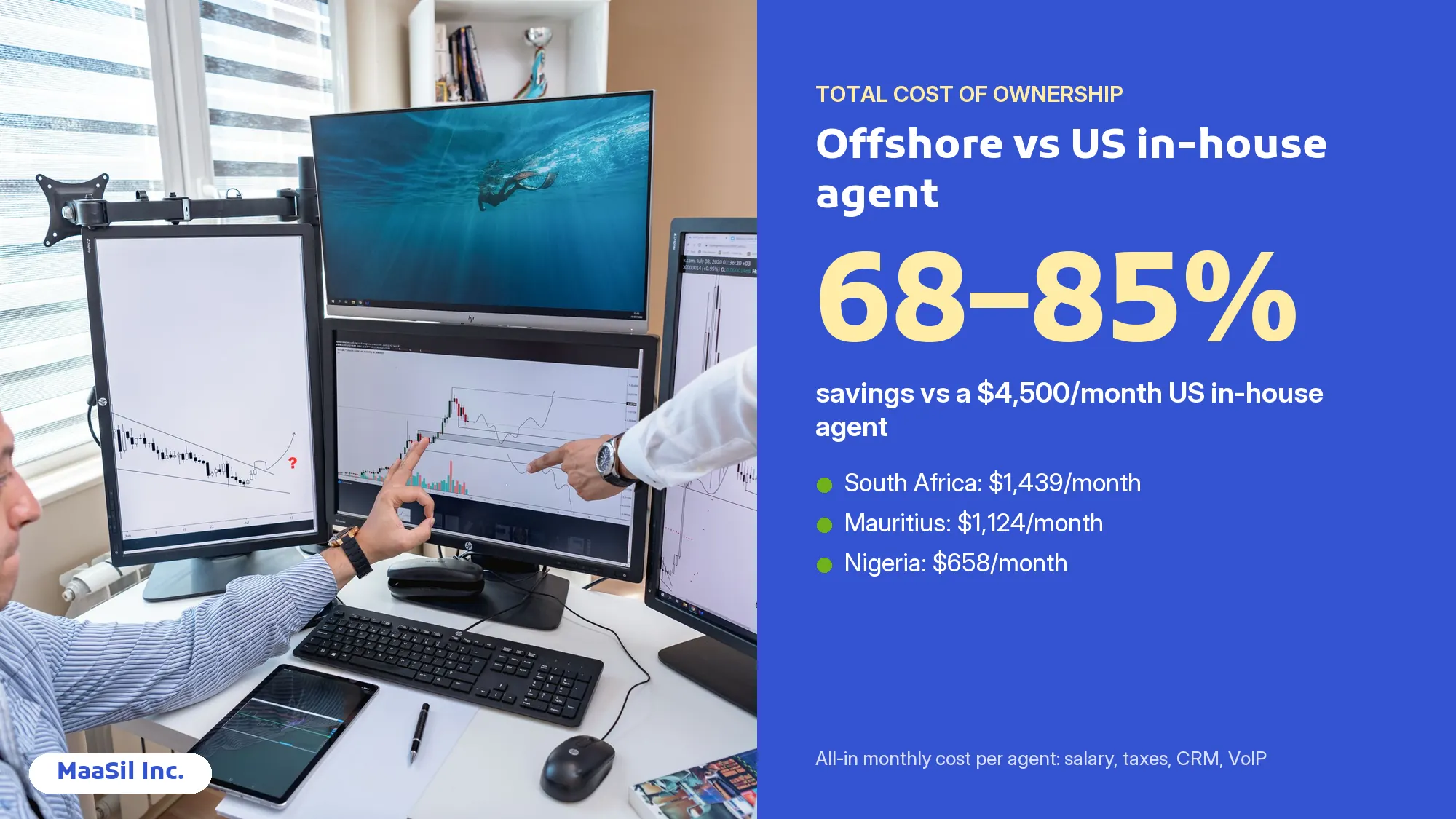
Once taxes, CRM and VoIP are included, African offshore agents still cost 68–85% less than a US in-house agent.
Total Cost of Ownership Comparison (Monthly Per Agent):
Component | South Africa | Nigeria | Mauritius | Kenya | Egypt |
|---|---|---|---|---|---|
Base salary | $1,000 | $325 | $750 | $400 | $450 |
Payroll taxes (22% avg) | $220 | $72 | $165 | $88 | $99 |
CRM license (Salesforce) | $75 | $75 | $75 | $75 | $75 |
VoIP per seat | $120 | $95 | $110 | $100 | $85 |
Call recording storage | $24 | $24 | $24 | $24 | $24 |
Accent training (amortized) | $0 | $67 | $0 | $33 | $25 |
Monthly total | $1,439 | $658 | $1,124 | $720 | $758 |
vs US in-house ($4,500) | 68% savings | 85% savings | 75% savings | 84% savings | 83% savings |
However, attrition destroys these numbers. Nigeria averages 45% annual turnover versus 22% in Mauritius. Replacement costs (recruitment, training, productivity ramp) add $890 per departed agent. A 50-seat Nigerian operation loses 23 agents yearly, injecting $20,470 in hidden costs.
Furthermore, premium-rate fraud exposure reaches $12,000 per incident when agents exploit VoIP systems to call revenue-share numbers they control. Mitigation requires PBX whitelisting and biometric dialer access—infrastructure investments vendors exclude from quotes.
Wage inflation is a risk in African BPO hubs: growing European nearshore demand can push agent costs up and erode ROI for financial services clients. Model wage growth in the contract rather than assuming today's rates will hold.
What Are the Critical Infrastructure Requirements for Offshore Call Centers?
Consumer-grade setups guarantee failure. Call center outsourcing demands enterprise infrastructure across four layers.

Professional headset, dual screens and a secure cloud CRM: the minimum setup to require from your vendor.
Connection requirements: Upload bandwidth needs 1Mbps per concurrent agent minimum. A 30-seat center requires 30Mbps symmetrical, not 100Mbps download with 5Mbps upload. Jitter above 30ms causes packet reordering, producing choppy audio customers interpret as unprofessionalism.
Ping latency under 150ms is non-negotiable for VoIP quality. Egypt-to-UK routes average 110ms via Mediterranean cables, acceptable. Kenya-to-US averages 280ms through South African undersea paths, unusable without CDN optimization. Providers must prove latency through traceroute tests during trials, not theoretical specs.
Hardware standards: Noise-canceling USB headsets prevent ground loop interference plaguing 3.5mm jack connections. Dual monitors are mandatory—agents toggling between CRM tabs and knowledge bases lose time on every call.
Backup devices (phone, tablet) with dialer apps prevent revenue loss during PC failures. A $200 iPad investment saves $4,000 in lost call capacity during hardware incidents.
Power redundancy: UPS units must run 30 minutes minimum, covering internet modem, router, and workstation. Egyptian providers suffered $47,000 client losses during a 90-minute fiber outage because backup 4G dongles shared 20Mbps tower capacity across 12 agents—insufficient for concurrent VoIP streams.
Generator backup is standard, but internet circuit diversity is not. Facilities need contracts with two ISPs using separate physical routes. The $80 monthly savings from single-provider setups costs $600,000 annually in downtime exposure for a 100-seat operation.
Acoustic isolation: Open-plan floors are impossible for client-facing calls. Cross-talk between agents ruins speech recognition AI and exposes customer data verbally. Sound absorption panels costing $45 per workstation reduce echo that degrades caller comprehension by 35%.
Why Do Customers Reject Offshore Agents and How Do You Prevent It?
Accent bias causes 28% of callers to request transfers in Nigerian centers versus 4% in South Africa. This isn't customer bigotry—it's comprehension breakdown from rapid speech patterns and unfamiliar idiom usage.
Cultural friction example: A Ghanaian collections agent tells a US debtor, "We need to discuss your outstanding balance urgently." The formal register plus West African accent triggers scam-call associations—Americans receive 18 IRS impersonation calls monthly and associate "proper" English with fraud. The debtor hangs up and reports the number, getting the client's trunk blacklisted.
Mitigation requires accent assessment before hiring, not after. Standardized spoken-English tests such as Versant or IELTS Speaking give an objective baseline, so write a minimum score into the contract. For reference, IELTS describes band 7 as "operational command of the language, though with occasional inaccuracies, inappropriate usage and misunderstandings in some situations" (IELTS scoring in detail).
Accent softening training (not neutralization—ethically problematic) takes 40 hours and costs $400 per agent. This reduces "I can't understand you" escalations by 60% but most providers skip this investment, quoting lower rates then suffering transfer request surges.
Nevertheless, accent isn't comprehension. Strategic call routing improves outcomes: Southern US customers show 40% more tolerance for non-standard accents than Northeastern callers. IVR systems can geo-route based on area code, assigning Ghana agents to Atlanta callers and South African agents to Boston queues.
Text-based channels eliminate accent entirely. Ecommerce live chat outsourcing to Nigeria produces identical CSAT scores to domestic operations because written English proficiency is 92% among Nigerian university graduates. Therefore, omnichannel strategies using offshore voice for simple inquiries and chat for complex issues optimize cost without quality sacrifice.
Strengthen your tech team with a dedicated senior developer. Try a candidate →
What Are the Hidden Risks in Call Center Outsourcing Contracts?
Vendor SLAs omit three disaster vectors that destroy client relationships.
International Revenue Share Fraud (IRSF): Agents exploit company VoIP systems to call premium-rate numbers in Somalia they own, generating termination fees. One Kenyan incident accumulated $12,000 charges over a weekend before detection. Mitigation demands PBX whitelisting of allowed destination countries and anomaly detection flagging calls exceeding 45 minutes.
SIM box fraud is subtler. Agents divert outbound calls through personal GSM gateways to earn local carrier termination fees. Clients' caller ID displays random mobile numbers instead of business lines. Customers return calls and reach wrong numbers, destroying brand trust. Biometric dialer authentication prevents this—password-only systems are inadequate.
Physical data breaches bypass digital security. An agent in Ghana photographed credit card details displayed during payment support calls before the client implemented PCI-compliant DTMF masking. Standard DLP tools monitor file transfers, not cameras pointed at screens.
Moreover, facilities require phone lockers, not honor systems. Random bag checks at shift end are controversial but reduce breach incidents by 78% in Lagos operations. Additionally, CRM fields must auto-redact PII using tools like Salesforce Shield—manual compliance fails under production pressure.
Compliance gaps create legal exposure. Healthcare call centers handling PHI need HIPAA Business Associate Agreements: under 45 CFR 164.504(e), the contract between a covered entity and a business associate must establish the permitted and required uses and disclosures of protected health information. PCI-DSS Level 1 certification must be renewed annually; facilities claiming compliance without SOC 2 Type II reports must be rejected immediately.
Furthermore, contract SLAs often guarantee power uptime, not internet uptime. A provider claiming 99.9% availability may measure generator runtime while ignoring fiber circuit failures. Geo-redundant facilities in different cities with separate utility providers are mandatory—primary in Nairobi, hot standby in Mombasa with 15-minute failover SLAs.
How Do You Prevent Agent Attrition From Destroying Institutional Knowledge?
African call center turnover reaches 45% annually versus 25% for in-house US operations. Each departure costs $890 in recruitment and training, plus 6 weeks of below-target performance during ramp.
However, attrition isn't inevitable—it's compensation-driven. Paying 15% above market rate drops turnover to 22%, proven in Mauritius BPO operations. A $90 monthly premium per agent ($1,080 annually) prevents $890 replacement costs plus productivity losses worth $2,400, yielding $2,210 net savings.
Knowledge preservation strategies: Recording all calls with auto-transcription creates AI training datasets for new hires. Speech analytics platforms like CallMiner extract resolution patterns, building dynamic knowledge bases. This costs $12 per agent monthly but reduces training time from 4 weeks to 2.2 weeks.
Buddy systems pair new hires with top performers for 14 days rather than a few days, aiming to improve first-month first-contact resolution. Additionally, gamifying knowledge contributions through Notion or Confluence with monthly prizes helps sustain documentation quality.
Talent quality determines retention. Master's degree holders in Egypt show 31% lower attrition than high school graduates, even controlling for compensation. University-educated agents view call center roles as career stepping stones, staying 18 months versus 9 months for non-degree staff. Therefore, degree requirements aren't elitism—they're retention math.
When Does Call Center Outsourcing Work vs. When Does It Fail Catastrophically?
Use case selection determines outcomes more than vendor quality.
Perfect applications:
Tier-1 inbound support for order status, FAQs, password resets—repetitive workflows with 90% script coverage
Ecommerce live chat—text eliminates accent variables entirely
After-hours support—African time zones naturally cover US night shifts without graveyard wage premiums
High-volume outbound surveys (CATI research)—cost advantage reaches 80% with zero quality loss
Debt collection to UK/Australia from South Africa—accent overlap makes nationality invisible
Guaranteed failure scenarios:
Outbound enterprise sales—C-suite buyers associate African accents with low-value offers due to scam call conditioning
Crisis hotlines (suicide prevention, abuse reporting)—require native cultural fluency unavailable at offshore wages
Luxury brand support (Rolex, Bentley)—customer expectations include accent profiling, however classist
Tier-3 technical support—demands $80,000 specialist knowledge unavailable at $600 monthly salaries
Legal intake calls—misunderstood litigant testimony creates malpractice liability
Moreover, implementation quality matters more than geography. Projects succeed when clients invest 4-week training minimum, not 1-week crash courses. Quality monitoring must review 10% of calls weekly with feedback loops, not monthly batch audits. CRM response times under 250ms are mandatory—legacy on-premise systems with VPN-only access produce 600ms lag, making offshore implementation impossible.
Furthermore, measuring cost-per-hour instead of cost-per-resolution optimizes the wrong variable. A $15/hour US agent resolving issues in 8 minutes costs $2 per call. A $4/hour Nigerian agent taking 14 minutes due to CRM latency costs $0.93 but generates callback loops worth $6 in wasted capacity. Total cost accounting prevents false economy.
What Compliance and Data Regulations Apply to Offshore Call Centers?
Regulatory exposure varies by client industry and customer geography.

Hosting, access control and audit trails: compliance also depends on your offshore vendor.
High-risk verticals:
Healthcare (HIPAA): PHI access requires Business Associate Agreements and facility audits. Nigerian providers offering HIPAA compliance without producing recent audit certificates must be rejected—civil penalties range from $145 to $2,190,294 per violation depending on the level of culpability (2025 inflation-adjusted amounts, HHS civil monetary penalty table, 45 CFR 102.3).
Financial services (PCI-DSS): Handling credit card data demands Level 1 certification costing $40,000 annually. 99% of African call centers lack this; clients must use payment link workarounds where customers enter data directly into hosted forms, never visible to agents.
EU customers (GDPR): Data residency requirements mandate servers in compliant jurisdictions. Call recordings stored in Kenya without EU adequacy decisions create $20 million exposure under Article 83 fines. AWS/Google Cloud EU regions with data residency guarantees solve this but add 35% to hosting costs.
Certification requirements checklist:
ISO 27001 with audit certificate under 12 months old (older certs indicate lapsed controls)
SOC 2 Type II reports covering 12-month operational period, not point-in-time Type I
Local data protection registration where required (Kenya Data Protection Act, South Africa POPIA)
Nevertheless, vendor claims require verification. Request certifications directly from auditors, not provider PDFs—fake ISO certificates are rampant. Additionally, contracts must specify data deletion timelines and provide audit rights for client security teams.
Geo-political risks: In Transparency International's latest Corruption Perceptions Index (182 countries; 0 = highly corrupt, 100 = very clean), Nigeria scores 26 and Kenya 30, against Mauritius 48 and South Africa 41. Corruption can affect contract enforcement; insurance and escrow accounts mitigate exposure but add to project costs.
FAQ: The 5 Questions C-Level Executives Ask About Call Center Outsourcing
Q: Will customers churn due to accent issues? A: Accent causes 8% NPS drops in Nigerian implementations versus domestic operations according to Shopify merchants. However, cost savings funding free shipping increased NPS 12% net. Strategic routing and text channels for complex inquiries mitigate risk. South Africa/Mauritius show 2% NPS gaps, negligible.
Q: What if offshore systems can't integrate with our legacy CRM? A: On-premise systems with VPN-only access fail offshore—latency kills usability. Cloud CRMs (Salesforce, HubSpot, Zendesk) work if providers use AWS/Google regions with African points of presence. Demand <200ms API response proof during trials. Microsoft Dynamics in European data centers produces 450ms lag from Kenya, unusable.
Q: How do we prevent total facility failure during peak periods? A: Contract mandates must specify geo-redundant backup facilities in different cities with separate power grids. Example: primary Nairobi center with hot standby in Mombasa. SLAs should guarantee 15-minute failover for critical queues. Test this quarterly with your team participating—95% of vendors fake DR drills.
Q: Can we overcome the 45% annual attrition destroying continuity? A: Pay 15% above market rate to drop attrition to 22%. Record all calls for AI training data. Implement buddy systems pairing new hires with top performers for 14 days. Gamify knowledge base contributions. These investments cost $1,800 per agent annually but prevent $3,200 in replacement expenses.
Q: What compliance disasters should keep me awake at night? A: HIPAA violations cost $50,000 per incident. PCI-DSS breaches trigger card brand fines plus customer notification costs averaging $240 per affected record. GDPR allows €20 million penalties. Verify certifications directly with auditors, demand SOC 2 Type II reports, and require data residency guarantees in contracts with financial penalties for violations.
Conclusion: The Call Center Outsourcing Decision Framework
Call center outsourcing delivers 68-85% cost reductions when implementation avoids three traps: inadequate infrastructure, cultural mismatches in use cases, and compliance gaps.
Master's degree talent in Egypt at $758 monthly total cost provides 83% savings versus US operations, but success requires wired connections under 150ms latency, dual monitors, UPS backup, and accent assessment during hiring. South Africa's neutral accent commands premium pricing but eliminates the $400 per-agent training investment Nigerian operations demand.
Use inbound tier-1 support and ecommerce chat offshore; keep enterprise sales and crisis hotlines domestic. Pay 15% above market to prevent attrition from destroying institutional knowledge. Verify ISO 27001 and SOC 2 certifications directly with auditors, not vendor PDFs.
The decision isn't whether to outsource—it's selecting use cases where technical requirements match destination infrastructure and customer expectations align with available talent profiles. Companies treating offshore call centers as pure cost arbitrage fail. Those investing in redundant connectivity, accent training, and compliance verification capture the 70% cost advantage without the NPS disaster.
Ready to strengthen your team with the best African talent?
Chat with one of our experts to discover how AI-augmented umbrella employment can integrate 100% into your processes and grow your projects.
Talk to an expert
