
Ready to strengthen your team with the best African talent?
Chat with one of our experts to discover how AI-augmented umbrella employment can integrate 100% into your processes and grow your projects.
Talk to an expert
Customer Service & Call Center
Call Center Outsourcing Solutions: Technology Architecture That Prevents $180K Implementation Failures
Your provider promises "seamless CRM integration" and "omnichannel capabilities." Four weeks post-launch, Salesforce screen-pops take 9 seconds, chat queues have no priority routing, and email responses average 18 hours despite 4-hour SLA commitments.
The failure isn't geography or agent quality—it's technology architecture. Call center outsourcing solutions require specific infrastructure: cloud contact center platforms with <200ms API latency, omnichannel routing engines, speech analytics on 100% of interactions, and WFM software with AI forecasting.
This guide covers technology stack evaluation, omnichannel implementation requirements, and the make-or-break integration testing protocol 87% of deployments skip.
What Technology Stack Do Call Center Outsourcing Solutions Require?
Platform architecture determines quality more than agent skill or training.
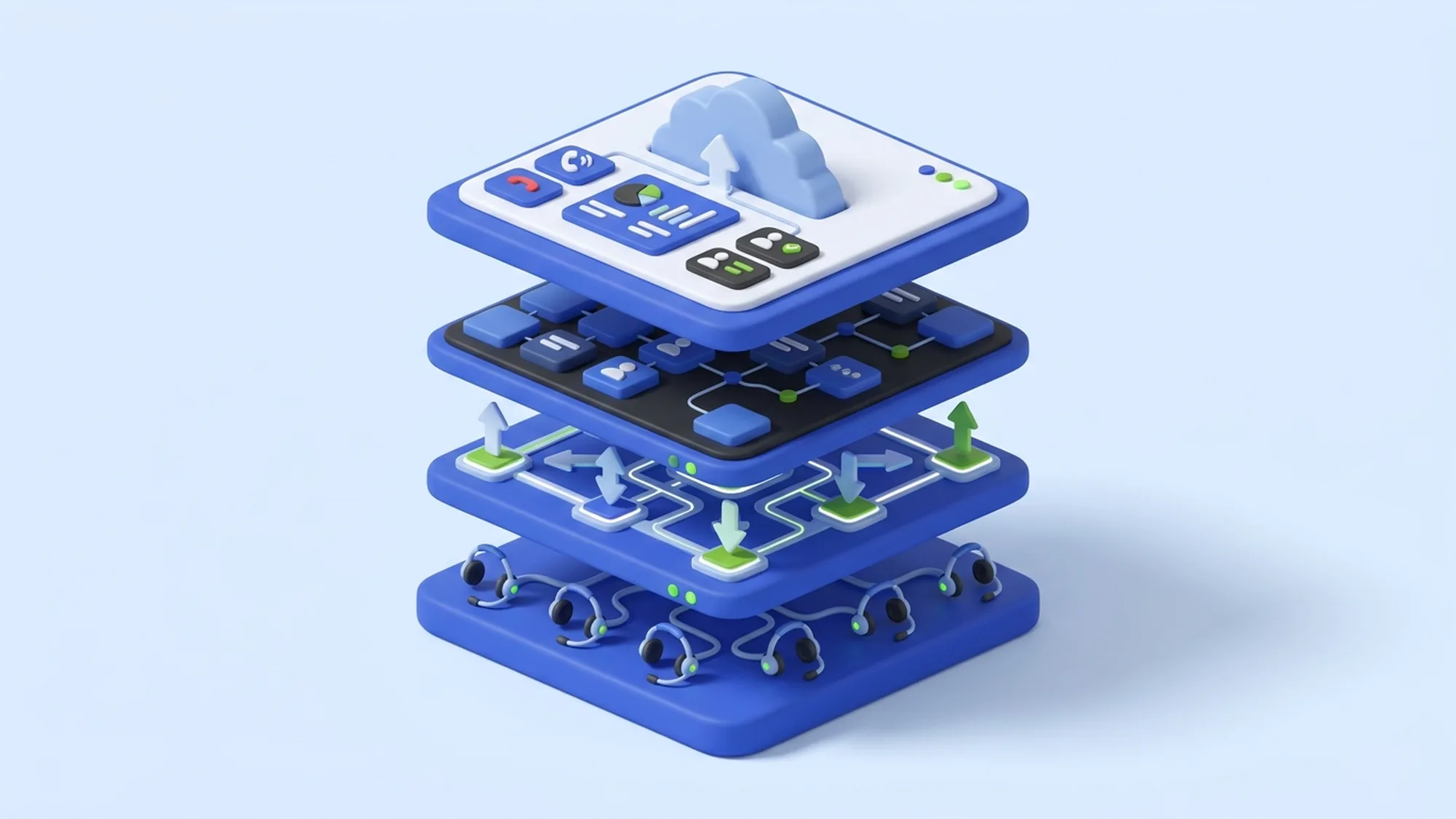
Cloud platform, integrated CRM and smart routing: the foundation of a modern solution.
Cloud contact center core (CCaaS): Modern solutions use platforms like Amazon Connect, Twilio Flex, Talkdesk, or Five9 replacing legacy on-premise PBX systems. Advantages include:
Per-minute pricing eliminating seat license waste during low-volume periods
API-first design enabling CRM integration <250ms
Global PoPs reducing latency (Twilio has edge locations in South Africa and Kenya)
Auto-scaling handling 400% surge without capacity planning
However, legacy providers still use on-premise Avaya or Cisco systems requiring VPN tunnels. VPN adds 200-350ms latency making offshore deployment unusable for interactive workflows. Therefore, cloud-native architecture is mandatory, not optional.
CRM integration middleware: Direct API connections between CCaaS and CRM platforms create brittle integrations that break during version updates. Enterprise-grade solutions use iPaaS middleware like MuleSoft, Workato, or Zapier Enterprise creating abstraction layers.
Example data flow: Twilio call connects → Workato triggers → queries Salesforce → enriches with Shopify order data → screen-pops unified record to agent in 280ms. Direct integration would require 3 sequential API calls (820ms total).
Moreover, middleware enables fallback logic. If Salesforce is down, middleware pulls cached customer data from Redis allowing agents to continue working. Direct integrations fail completely during CRM outages.
Omnichannel routing engine: Voice-only systems use ACD (Automatic Call Distribution). Omnichannel requires unified routing across voice, chat, email, SMS, and social media. Platforms like Genesys Cloud or NICE CXone consolidate queues.
Critical capability: Channel priority weighting. A customer who called, then opened chat, then emailed should route to the same agent with full interaction history. Siloed systems treat each contact as separate, forcing customers to repeat information. The risk is real: according to Salesforce State of the Connected Customer research, 83% of customers expect to resolve a complex issue with a single contact, and 48% have already switched brands to get better customer service.
Speech analytics platform: Manual QA reviews 2-10% of calls. AI analytics scores 100% for:
Sentiment (customer frustration detected via tone, not just words)
Script compliance (did agent offer loyalty program?)
Prohibited phrases ("I don't know" = agent training gap)
Dead air detection (>8 seconds silence = CRM latency issue)
Platforms like CallMiner or Observe.AI cost $18 per agent monthly but identify problems affecting 100% of calls versus the 2% sampling catches. Therefore, speech analytics pays for itself through quality improvements within 60 days.
WFM (Workforce Management) software: Spreadsheet scheduling breaks at 40+ agents. WFM platforms like NICE IEX or Calabrio forecast call volume using historical patterns plus external data (weather, promotional calendar) achieving 95% accuracy.
Additionally, automated shift bidding where agents select open slots improves fill rates by 65% versus manager-assigned schedules. This prevents costly overtime premiums—a 50-agent center saves $2,800 monthly in OT through optimized scheduling.
Knowledge management system: Agents need instant access to product specs, policies, and troubleshooting guides. Confluence or Notion with Algolia search provides <2-second information retrieval. Outdated SharePoint folders with nested directories add 90 seconds per call to AHT.
Furthermore, agent-contributed content improves knowledge base quality. Gamifying contributions (leaderboards, prizes) increases submission rates by 340%. Elite agents document edge cases encountered, creating institutional knowledge surviving attrition.
How Do Omnichannel Call Center Outsourcing Solutions Differ From Voice-Only?
Channel expansion requires architectural changes, not just adding chat widgets.

Omnichannel requires blended routing: one agent, several channels.
Routing complexity: Voice-only uses skills-based routing (Spanish speaker, tier-2 technical). Omnichannel needs blended routing where agents handle multiple channels simultaneously—one voice call OR three concurrent chats OR five emails.
However, capacity planning becomes exponential. An agent handling voice at 6.5-minute AHT processes 55 calls daily. Same agent handling chat at 12-minute average (4 concurrent conversations) processes 120 contacts daily. Mixed routing must account for channel arrival patterns—chat spikes during business hours, email overnight.
WFM software must forecast per-channel volume and assign agents to channel mix maximizing utilization. Manual scheduling makes this impossible beyond 20 agents.
CRM data model: Voice-only operations log calls as activities. Omnichannel requires unified customer timeline showing: called Monday 9am about order #4477 (6 min) → chatted Monday 2pm asking for tracking (4 min) → emailed Tuesday 8am requesting refund (resolved).
This demands CRM customization. Salesforce Service Cloud's "Case Feed" view consolidates this; basic CRM platforms lack multi-channel threading. Therefore, technology selection must precede implementation—bolting omnichannel onto inadequate CRM platforms fails.
Agent skillset differences: Voice agents need verbal communication and accent clarity. Chat agents need typing speed (55+ WPM) and grammar proficiency. Email agents need formal writing skills.
Hiring criteria must split: University degree + Versant 63+ for voice, typing test + grammar assessment for chat, writing sample for email. Attempting to cross-train low-performing voice agents into chat roles doesn't work—they're different competencies. Therefore, omnichannel centers need multiple hiring profiles.
Quality monitoring challenges: Listening to voice calls takes 6.5 minutes per review. Reading chat transcripts takes 2 minutes. Evaluating email response quality needs 3 minutes.
QA workload explodes in omnichannel—a QA analyst reviewing 10% of interactions across three channels needs 2.2 hours daily per agent versus 0.65 hours voice-only. This requires either 3× QA headcount or AI-assisted review scoring routine interactions automatically, escalating only outliers for human review.
How much would your support team in Madagascar cost? Estimate my budget →
What Are the Implementation Steps for Call Center Outsourcing Solutions?
Failed deployments skip three critical phases: integration testing, load testing, and parallel run.
Phase 1 - Requirements documentation (Week 1-2): Map every customer interaction type:
Inbound: order status, refunds, technical support, billing inquiries
Outbound: payment reminders, delivery notifications, winback campaigns
For each type, document:
Required CRM data (order history, payment status, shipping address)
Expected AHT (targets for agent performance)
Script requirements (compliance disclosures, upsell offers)
Escalation paths (when agents transfer to supervisors)
Moreover, identify integration points: CRM platform, ecommerce system, payment gateway, shipping carrier APIs, knowledge base, email platform.
Phase 2 - Technology stack selection (Week 3-4): Evaluate CCaaS platforms based on:
API latency (<200ms from provider facility to platform PoP)
Channel support (voice, chat, email, SMS minimum)
CRM pre-built connectors (Salesforce, HubSpot, Zendesk)
Compliance certifications (PCI-DSS if handling payments, HIPAA for healthcare)
Conduct proof-of-concept: Provider builds demo environment processing 100 test interactions across channels. Measure screen-pop latency, routing accuracy, reporting availability.
Red flag: Vendors claiming "we'll figure it out during implementation"—technology decisions must precede agent hiring because training content depends on platform UI.
Phase 3 - Integration development (Week 5-8): Build connectors between CCaaS platform and client systems:
Salesforce bidirectional sync (call creates case, case updates visible in agent desktop)
Shopify order lookup (real-time inventory, order status)
Stripe payment processing (initiate refunds from agent interface)
Test in sandbox environment—never develop directly in production. Common integration failures:
API rate limits exceeded (Shopify standard allows 2 req/sec, insufficient for 40-agent center)
Authentication token expiration breaking connections after 30 days
Webhook failures when client system is down (need retry logic with exponential backoff)
Phase 4 - Load testing (Week 9): Simulate production volume:
Generate 400 concurrent calls using tools like Apache JMeter or LoadNinja
Measure platform response time under load (acceptable: <300ms at 95th percentile)
Identify bottlenecks (database queries, API calls, network throughput)
This phase reveals infrastructure inadequacy before going live. An Egyptian provider discovered fiber circuit could handle 80 concurrent calls maximum, not the 120 contracted capacity—required $1,200 bandwidth upgrade.
Furthermore, test disaster scenarios:
Primary internet circuit failure (does 4G backup maintain quality?)
CRM platform outage (do agents see error messages or cached data?)
Power failure (does UPS provide 30-minute runtime as claimed?)
Providers resisting load testing lack confidence in infrastructure.
Phase 5 - Training (Week 10-13): Four-week minimum:
Week 1: Product knowledge, company policies, CRM navigation
Week 2: Call handling practice with role-play scenarios
Week 3: Live call monitoring (new agents listen to experienced agents)
Week 4: Nesting (new agents take calls with supervisor monitoring, instant feedback)
Compress this to 1 week and first-month attrition reaches 55% because agents feel unprepared.
Moreover, training must cover edge cases:
Angry customer demanding impossible resolution (how to de-escalate without violating policy)
System outage during customer interaction (manual backup procedures)
Fraudulent order attempt (red flags to detect, escalation protocol)
Phase 6 - Parallel run (Week 14-15): Operate both old and new call centers simultaneously:
Route 20% of calls to new offshore center
Route 80% to existing operation
Compare metrics: AHT, FCR, CSAT, transfer rate
This identifies quality gaps before full cutover. Common discoveries:
Offshore AHT is 40% longer (need more CRM training)
Transfer rates 3× higher (agents lack autonomy to resolve issues)
CSAT scores 12 points lower (accent issues or script problems?)
Gradual ramp prevents disaster. A direct 100% cutover risks total service collapse if issues emerge.
Phase 7 - Go-live and monitoring (Week 16+): Cut over remaining volume incrementally:
Week 16: 50% offshore
Week 17: 80% offshore
Week 18: 100% offshore (old center on standby for 30 days)
Monitor SLAs daily:
Uptime (>99.5%)
Answer rate within 30 seconds (>85%)
AHT vs target
CSAT scores vs baseline
Additionally, conduct weekly operational reviews with provider:
Trending issues (common customer complaints)
System performance (CRM latency, platform availability)
Agent feedback (what training gaps remain?)
What Makes Call Centre Outsourcing Companies' Technology Stacks Fail?
Three failure modes appear in 79% of unsuccessful deployments.
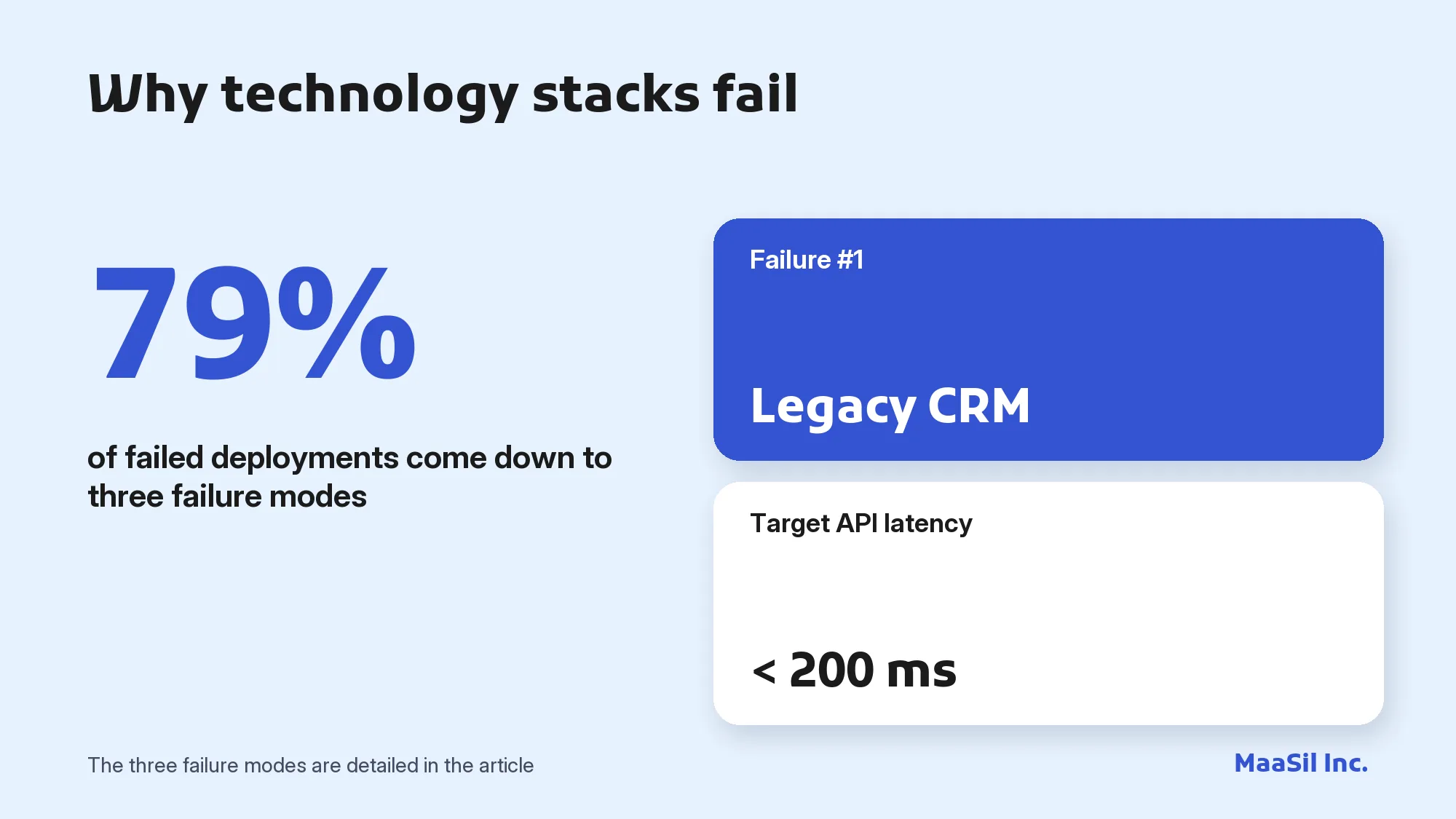
Legacy CRM incompatibility tops the list of failure causes.
Failure #1 - Legacy CRM incompatibility:
Scenario: Client uses SAP C4C (on-premise CRM) requiring VPN access. Provider's Kenyan facility has 280ms baseline latency to client data center. VPN adds 180ms encryption overhead. Total: 460ms.
Impact: Screen-pop takes 5+ seconds. Agents answer calls blind, ask for information already in system. Customers rage, CSAT collapses 28 points.
Prevention: Cloud CRM migration must precede offshore implementation. Salesforce, HubSpot, Zendesk hosted in regional data centers provide <200ms response. Alternatively, deploy CRM cache layer in provider facility—complex but solves latency for legacy systems.
Failure #2 - Inadequate bandwidth provisioning:
Scenario: Provider quotes $95 per agent for telephony infrastructure. This assumes:
1Mbps upload per concurrent call
30% simultaneous usage (30 of 100 agents on calls)
Total: 30Mbps upload required
Reality check: Facility has 50Mbps upload shared across 200 agents (4 clients). Client's 100-agent operation gets 25% allocation = 12.5Mbps, supporting only 12 concurrent calls. During peak hour with 60 concurrent calls, voice quality degrades catastrophically.
Prevention: Contract must specify dedicated bandwidth allocation, not shared pools. Require provider to demonstrate circuit capacity through speed tests during facility visits. Additionally, SLA must guarantee <150ms latency and <30ms jitter even at 100% agent utilization.
Failure #3 - Omnichannel routing misconfiguration:
Scenario: Client deploys voice + chat + email. Routing logic treats each channel equally. Email response SLA is 4 hours, chat SLA is 2 minutes.
Problem: Agents prefer email (no real-time pressure). 70% of agents set status to email-only, leaving 30% handling voice+chat. Chat queue explodes to 8-minute wait times, violating SLA.
Fix: Forced channel blending—agents must accept primary channel (voice) with secondary opt-in (chat/email). WFM software assigns channel mix based on skills and real-time queue depth. If chat queue exceeds 2 minutes, system auto-assigns chat-qualified agents regardless of preference.
Conclusion: Building Resilient Call Center Outsourcing Solutions Architecture
Call center outsourcing solutions succeed through cloud-native CCaaS platforms with <200ms API latency, omnichannel routing engines preventing channel siloing, speech analytics scoring 100% of interactions, and WFM software forecasting volume within 5% accuracy.
Technology stack selection must precede agent hiring—training content depends on platform UI and CRM data model must support unified customer timelines across channels. Integration development in sandbox environments with load testing simulating 400 concurrent interactions reveals infrastructure inadequacy before go-live disasters.
Implementation requires 16-week phased approach: requirements documentation, platform selection with POC, integration development, load testing, 4-week agent training, parallel run comparing metrics, and gradual cutover monitoring SLAs daily. Direct 100% cutovers risk service collapse when issues emerge.
Common failure modes include legacy CRM incompatibility producing 460ms latency, inadequate bandwidth provisioning supporting only 12 concurrent calls instead of 60, and omnichannel routing misconfiguration causing 8-minute chat queues violating SLA commitments.
Prevention demands dedicated bandwidth allocation contracts, CRM cloud migration preceding offshore deployment, and forced channel blending preventing agents from cherry-picking preferred interaction types. Providers resisting load testing or parallel run phases lack infrastructure confidence—their reluctance predicts implementation failure.
The decision framework: evaluate CCaaS platforms on API latency and compliance certifications, require proof-of-concept demonstrating CRM screen-pops under 300ms, conduct facility visits observing bandwidth capacity through speed tests, and demand 30-day parallel run comparing offshore metrics to baseline before full cutover. Solutions built on consumer ISPs, legacy PBX systems, or direct CRM integrations without middleware abstraction fail within 90 days.
Ready to strengthen your team with the best African talent?
Chat with one of our experts to discover how AI-augmented umbrella employment can integrate 100% into your processes and grow your projects.
Talk to an expert
