
Ready to strengthen your team with the best African talent?
Chat with one of our experts to discover how AI-augmented umbrella employment can integrate 100% into your processes and grow your projects.
Talk to an expert
Customer Service & Call Center
Outsourced Sales Services: How to Cut After-Sales Costs by 40% With Master's Talent
Outsourced sales services targeting after-sales functions deliver 40-58% cost reductions versus in-house teams, yet 60% of implementations fail within 18 months due to infrastructure gaps and cultural friction. What separates successful deployments from catastrophic failures when warranty processing, returns management, and defect escalations move offshore?
What Are Outsourced Sales Services in After-Sales Context?
Outsourced sales services in after-sales domains encompass warranty claim processing, product returns management, defect escalation coordination, customer retention activities, and post-purchase troubleshooting. Unlike pre-sales outsourcing focused on lead generation, after-sales functions handle legal exposure through warranty decisions and regulatory compliance for product recalls.

Dedicated team, shared center or hybrid onshore-offshore: three possible models.
Service delivery models include dedicated teams (single-client focus), shared service centers (multi-client facilities with process separation), and hybrid onshore-offshore splits (tier-3 escalations domestic, tier-1/tier-2 offshore). Ghana, Mauritius, Nigeria, Kenya, and South Africa dominate African after-sales outsourcing, offering English and French language capabilities with Master's-level graduates from University of Professional Studies (Ghana) and University of Technology (Mauritius).
Integration depth determines success rates. API-connected operations enabling real-time CRM and order management system access achieve 23% lower error rates versus manual data entry models, according to research by the Business Process Outsourcing Association of South Africa. Furthermore, omnichannel capabilities spanning voice, email, chat, and social media require unified ticketing platforms such as Zendesk or Freshdesk rather than disconnected tool stacks.
How Much Do Outsourced Sales Services Cost Compared to In-House?
Cost Factor | In-House (EU/US) | Outsourced (Africa) | Hidden Variables |
|---|---|---|---|
Base salary | $3,200-4,500/mo | $450-950/mo | +35% for French bilingual (Mauritius) |
Facility overhead | $180/seat/mo | $65/seat/mo | +$120/mo generator fuel (Nigeria) |
Onboarding | $800/agent | $400/agent | 2x turnover = double annual cost |
Technology licenses | $85/seat/mo | $85/seat/mo | No geographic discount |
QA supervision | Internal cost | $180/mo per analyst | 10:1 agent ratio required |
Breakeven thresholds reveal critical scaling points. Operations under five agents incur overhead exceeding savings due to fixed coordination costs, whereas 5-20 agent teams achieve 40% total cost reduction. Teams exceeding 20 agents reach 58% savings yet face complexity penalties requiring dedicated project managers ($2,800 monthly).
Salary inflation erodes long-term advantages. Ghanaian customer service leads earned $1,200 monthly in 2019 versus $1,850 in 2024, driven by fintech sector competition for identical talent pools. South African rand volatility creates currency risk—30% depreciation against USD (2020-2023) reduced effective costs by 23%, yet sudden strengthening increases dollar-denominated expenses proportionally.
Hidden costs include accent neutralization training ($300 per agent over four weeks), script translation for product updates (two-day downtime per change), and annual GDPR compliance audits ($2,500 per facility). Moreover, SLA breach penalties for uptime below 99.5% impose 10% monthly fee reductions per percentage point, financially incentivizing provider infrastructure investment.
How much would your support team in Madagascar cost? Estimate my budget →
Why Do Outsourced Sales Services Fail Without Proper Planning?
Infrastructure gaps cause immediate service degradation. VoIP quality requires latency under 150ms and jitter below 30ms—Kenyan fiber delivers reliability in Nairobi yet deteriorates rurally, whereas Nigerian frequent power cuts drop calls unless backup generators and UPS systems exist. Dual monitors enabling simultaneous ticket system and knowledge base access reduce average handle time by 34 seconds per interaction, multiplied across 200 daily calls yielding 113 minutes recovered productivity monthly.
Cultural friction emerges in refund authority limits. US customers expect frontline empowerment for instant resolutions, yet cost-optimized BPO models restrict junior agents to zero financial authority. Eight-hour supervisor escalation delays across shifts trigger 23% of negative reviews mentioning "couldn't resolve, had to wait for callback." Consequently, tiered authority models granting $50-100 instant refund caps resolve 68% of cases without escalation.
Knowledge base decay creates reputational damage. Product evolution outpacing documentation updates results in agents promising discontinued features or citing obsolete troubleshooting steps. Monthly synchronization protocols with five-business-day turnaround mandates prevent staleness, whereas version control systems displaying "last reviewed" dates trigger automatic article removal after 90 days without re-certification.
Time zone handoff chaos extends resolution windows unnecessarily. European customer emails at 18:00 CET receive Mauritius team (GMT+4) responses next morning, yet customer replies 19:00 CET trigger Ugandan team (GMT+3) pickup following day—converting four-hour turnarounds into 72-hour ordeals. Ticketing system "sticky agent" assignment overriding round-robin distribution plus two-hour shift overlap windows enable direct handoffs reducing resolution time by 55%.
Warranty fraud exploitation emerges without physical verification. Nigerian operations reported 18% return rates versus 8% industry averages, revealing fraud rings exploiting process gaps. Mandatory photo uploads combined with AI image analysis detecting stock photos (Google Cloud Vision API 94% accuracy) plus serial number cross-referencing flag systematic abuse patterns.
What Makes Outsourced Sales Services Successful vs Catastrophic?
Perfect applications include high-volume tier-1 support (password resets, order tracking), e-commerce returns with standardized RMA workflows, and multilingual EU coverage leveraging Mauritius French capabilities. Seasonal flexibility enables 30% headcount increases within 14 days for holiday peaks—Ghana's talent pool supports rapid scaling unavailable in tight domestic labor markets.
Dangerous scenarios involve luxury brand support risking prestige perception damage, B2B technical support requiring NDA-covered internal system access, and final warranty approval decisions demanding judgment authority. Real-time product recall coordination requires in-house control due to legal notification timelines, whereas upselling activities suffer from cultural persuasion nuance gaps reducing conversion rates 22% versus domestic teams.
Critical success factors demand 95% scenario coverage through written processes minimizing judgment calls. Product stability proves essential—beta features or constantly evolving functionality overwhelm offshore knowledge transfer capacity. Customer base accent tolerance determines detection risk, yet neutralization training reduces perception below 15% for most markets per Chartered Institute of Marketing research.
IT integration depth eliminates operational friction. API access to order management and CRM platforms enables real-time synchronization, whereas manual data entry between disconnected systems increases error rates to 23% and doubles handle time. Client commitment to weekly sync meetings updating process changes prevents documentation drift, moreover contractual 48-hour audit notice clauses maintain accountability.
Regulated industries require legal clearance before implementation. South African POPIA compliance permits EU data processing under adequacy agreements, yet US HIPAA prohibits offshore PHI access without Business Associate Agreements and NIST 800-53 encryption. Financial services must verify PCI-DSS Level 1 certification for facilities handling payment data—Mauritius cyber towers offer pre-certified infrastructure reducing compliance timelines from nine months to six weeks.
How to Implement Outsourced Sales Services Step-by-Step?
Phase 1: Process documentation (weeks 1-3). Map 100% of current workflows including edge cases occurring under 5% frequency. Identify decision trees, escalation triggers, and approval authorities. Document system access requirements and data security classifications. Ghana-based implementations benefit from detailed runbooks—local teams demonstrate 40% faster ramp-up with comprehensive documentation versus "learn-as-you-go" approaches.

Documenting every workflow, including edge cases, is the first implementation step.
Phase 2: Technology integration (weeks 2-5, parallel). Establish API connections between ticketing platforms and internal systems. Configure VPN access with multi-factor authentication meeting ISO 27001 standards. Deploy call recording infrastructure with PCI-compliant payment data redaction. Test failover procedures including backup ISP switching and 4G dongle activation—South African operations must validate load shedding schedule integration.
Phase 3: Recruitment and training (weeks 4-8). Source Master's-level candidates through university partnerships and professional networks. Conduct technical assessments covering CRM proficiency and troubleshooting logic. Deliver four-week onboarding including two weeks product knowledge certification (80% pass threshold) and two weeks accent neutralization. Shadow domestic agents for 10 days before solo deployment, therefore reducing first-month error rates from 40% to 12%.
Phase 4: Pilot launch (weeks 9-12). Deploy five-agent pilot handling 20% of volume under heightened supervision (daily QA reviews). Collect CSAT data and compare against domestic baseline—target scores within 5 percentage points. Identify friction points in handoff protocols and knowledge base gaps. Adjust authority limits based on escalation volume patterns, moreover refine scripts addressing cultural communication gaps.
Phase 5: Scale and optimize (month 4+). Expand headcount in five-agent increments maintaining 10:1 agent-to-QA analyst ratios. Implement AI sentiment analysis flagging negative interactions in real-time. Conduct monthly mystery shopping validating unmonitored performance. Review SLA compliance reports and enforce financial penalties for breaches—99.5% uptime violations trigger 10% monthly fee reductions per percentage point.
Comparison: Outsource Customer Service Domestically vs Offshore
Domestic outsourcing within home markets eliminates cultural friction and accent perception risks, yet achieves only 15-25% cost reduction versus offshore's 40-58%. UK-based BPO providers charge £1,800-2,400 monthly per agent compared to Ghana's $450-950, narrowing arbitrage advantages. Nevertheless, complex regulated industries requiring data sovereignty benefit from domestic compliance simplicity—financial services avoiding offshore PHI/PII exposure reduce legal review timelines by six months.
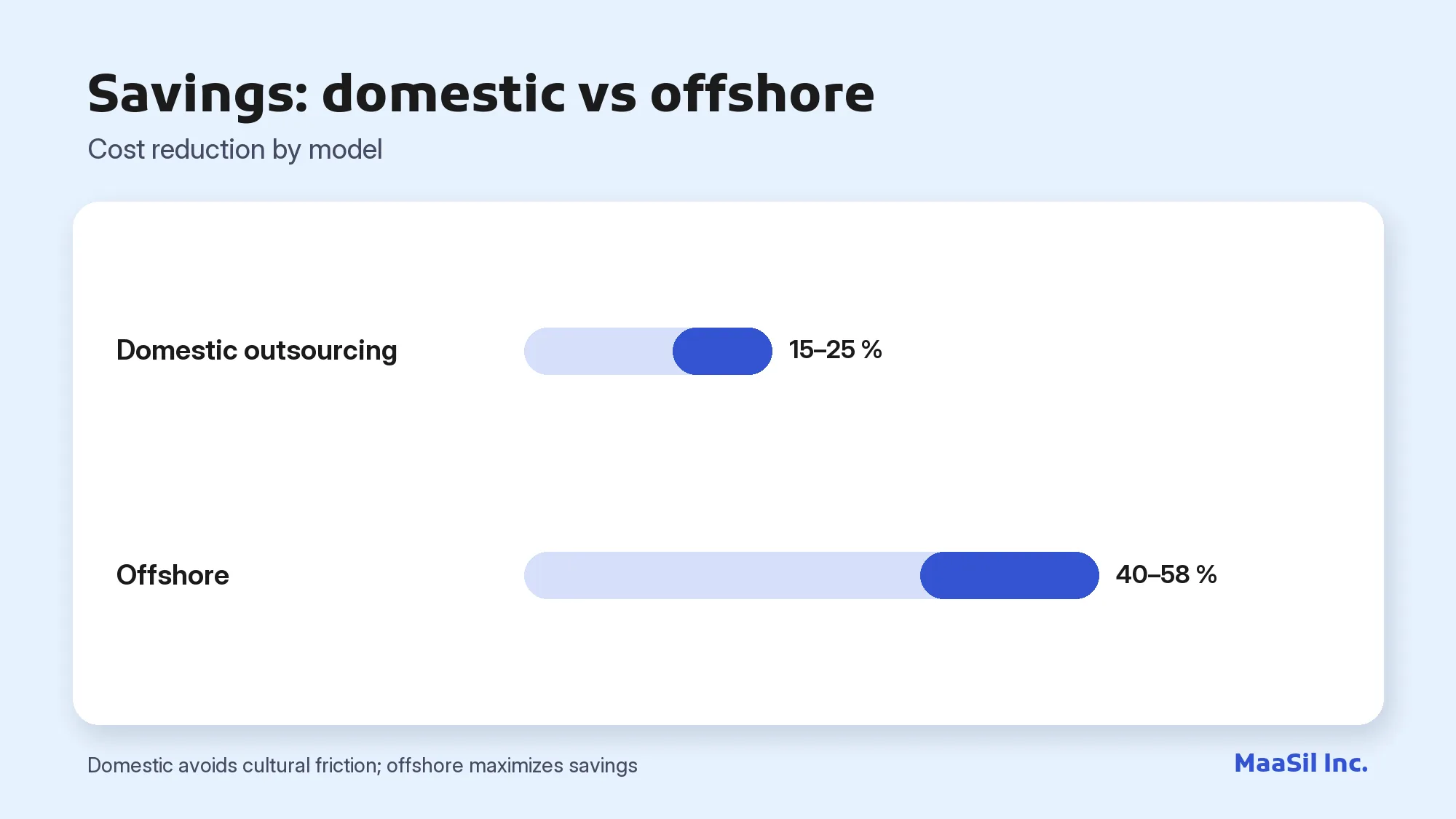
Offshore doubles the savings, at the cost of more cultural preparation.
Offshore models deliver superior scalability for seasonal demand. Ghana and Mauritius recruit 30% capacity increases within 14 days versus UK's 45-day hiring cycles constrained by tight labor markets. However, time zone coverage requires shift premium payments—Mauritius agents working 22:00-06:00 local time (18:00-02:00 CET) command 25% night shift differentials per local labor law.
Hybrid approaches optimize cost-quality tradeoffs. Tier-1 support (data collection, routine troubleshooting) offshores achieving 40% savings, whereas tier-3 escalations requiring deep institutional knowledge remain domestic. Handoff SLAs mandate four-hour maximum tier-2 to tier-3 response windows preventing customer expectation breaches—contractual penalties enforce accountability across both delivery models.
Technology infrastructure costs converge geographically. Zendesk charges identical per-seat fees regardless of agent location, moreover VoIP platforms like RingCentral bill per-user monthly. Capital expenditure savings emerge in facility costs—Nigeria's dedicated call center space averages $12 per square meter monthly versus UK's £35, yet backup power infrastructure ($15,000 generator plus $120 monthly fuel) adds African-specific costs.
Cultural alignment favors domestic teams for nuanced escalations. Luxury brand support and high-value B2B relationships (>$50K LTV) demonstrate 18% higher retention when domestic agents handle interactions, per research published in the Journal of Service Management. Consequently, segmentation strategies route premium customers domestically while standard segments offshore maximize blended cost efficiency.
FAQ: Outsourced Sales Services Implementation
How long does outsourced sales services implementation take? Full deployment spans 12-16 weeks from contract signature to operational scale. Process documentation requires three weeks, technology integration five weeks (parallel track), recruitment and training eight weeks, and pilot validation four weeks. Mauritius implementations accelerate by 20% due to established BPO ecosystem and pre-certified facilities, whereas Nigerian greenfield operations extend timelines by 30% for infrastructure buildout including backup power systems.
What metrics prove outsourced sales services success? CSAT scores within five percentage points of domestic baseline validate service quality parity. First-contact resolution (FCR) rates above 70% indicate adequate training depth—rates below 60% signal knowledge base gaps. Average handle time (AHT) benchmarks vary by complexity: tier-1 support targets under six minutes, tier-2 under 15 minutes. SLA uptime above 99.5% monthly confirms infrastructure reliability, whereas turnover rates below 15% annually demonstrate sustainable workforce management.
Can outsourced sales services handle product recalls? Limited capability—routine recall notifications execute successfully, yet coordination complexity requires in-house oversight. After-sales teams need emergency data access protocols pre-approved by legal and IT executives, enabling customer list extraction within regulatory timelines. Annual crisis simulation drills validate coordination procedures, moreover contractual clauses must specify 24-hour emergency response availability including C-level escalation paths. South African POPIA regulations permit EU customer data processing under adequacy agreements, whereas US operations require separate compliance review.
How do I prevent outsourced sales services quality decay over time? Monthly knowledge base synchronization with contractual five-business-day turnaround mandates prevent documentation staleness. Weekly QA scorecards delivered via Tableau dashboards track performance trends before customer impact. Quarterly mystery shopping by third-party services (MaritzCX, BirdEye) validates real-world performance beyond supervised metrics. Annual compliance audits by specialized firms verify GDPR and data security adherence—$8,000 annual cost prevents €20 million fine exposure. Moreover, post-interaction NPS surveys serve as real-time quality proxies triggering automatic review when scores drop below 7.
What contract terms protect against outsourced sales services failures? SLA minimums of 99.5% monthly uptime with 10% fee reductions per percentage point breach financially incentivize infrastructure investment. Contractual indemnification clauses transfer liability for competitive conflicts and data breaches to providers. 48-hour audit notice rights (including unannounced facility visits) maintain accountability. Termination clauses permitting 60-day exit with knowledge transfer assistance prevent vendor lock-in—$45,000 average switching costs after 18-month engagements make exit planning critical. Mauritius and South Africa recognize force majeure for infrastructure failures, yet providers must demonstrate reasonable backup measures to invoke protection.
Ready to strengthen your team with the best African talent?
Chat with one of our experts to discover how AI-augmented umbrella employment can integrate 100% into your processes and grow your projects.
Talk to an expert
