
Prêt à renforcer votre équipe avec les meilleurs talents africains ?
Discutez avec l'un de nos experts pour découvrir comment le portage salarial augmenté à l'IA peut s'intégrer à 100 % à vos process et faire grandir vos projets.
Échangez avec un expert
Stratégie d'Externalisation & BPO
Secteur du BPO : le guide stratégique de l'outsourcing offshore
Le secteur du BPO promet une réduction des coûts de 40 à 60 %, pourtant 34 % des contrats d'externalisation échouent dans les trois ans. Pourquoi ? Les dirigeants d'entreprise s'engagent dans des relations de BPO en se concentrant uniquement sur l'arbitrage salarial tout en ignorant la fragilité des infrastructures, les risques d'arbitrage réglementaire et la stratification des talents. Ce guide décortique ce que révèlent plus de 200 collaborations BPO : la différence entre les coûts annoncés et réels, les raisons pour lesquelles les petits prestataires s'effondrent et comment les plus grandes entreprises de BPO exploitent la mutualisation pour vous verrouiller.
Qu'est-ce que le secteur du BPO et comment fonctionne-t-il réellement ?
Le secteur du BPO fournit des processus métiers — service client, finance et comptabilité, support informatique — par le biais de prestataires tiers situés dans des zones géographiques aux coûts avantageux. Trois modèles principaux dominent : le BPO tiers (le prestataire opère), le BPO captif (vous possédez le centre offshore) et le modèle hybride (mélange des deux). Le secteur a généré 245 milliards de dollars à l'échelle mondiale en 2023, les Philippines capturant 15 %, l'Inde 42 % et les hubs émergents comme le Kenya, Maurice et l'Afrique du Sud se partageant 8 %.

BPO tiers, centre captif ou hybride : trois façons d'externaliser un processus.
Les exigences en matière d'infrastructures critiques séparent les opérations de BPO fonctionnelles de celles qui échouent. Des centres de données de niveau Tier-3 avec alimentation de secours N+1 s'avèrent non négociables aux Philippines (sujettes aux typhons) et au Nigeria (les pannes quotidiennes de 12 à 18 heures nécessitent des systèmes hybrides diesel, onduleur, solaire). Les certifications ISO 27001 et SOC 2 Type II ne sont pas du marketing — les contrats de BPO financiers et de santé les exigent légalement. La téléphonie cloud (Genesys, Five9, NICE CXone) a remplacé les standards téléphoniques sur site ; les prestataires utilisant encore des systèmes hérités font face à une dégradation de la qualité des appels de 18 à 22 %.
Le piège des 20 ETP détruit les petits projets pilotes. L'économie du BPO exige l'absorption des coûts fixes. En dessous de 20 ETP, les frais généraux liés aux chefs d'équipe atteignent 15 %, contre 6 % pour 50 ETP. Les infrastructures de formation (LMS, équipes AQ, formateurs) restent sous-utilisées. En cas d'attrition — une démission équivaut à une perte de capacité de 10 % dans une opération de 8 postes. Étude de cas au Nigeria : un service client de 8 postes a fait face à 50 % d'attrition au cours du troisième mois (Andela a débauché le personnel). Le coût par contact a dépassé les tarifs internes de Londres après les cycles de recrutement.
Entreprises de BPO : comment évaluer la stabilité et les capacités d'un prestataire
La fragilité des petites entreprises de BPO découle du risque de concentration des talents. Scénario de BPO de santé au Kenya : 18 ETP spécialisés dans la facturation médicale américaine (formés sur Epic/Cerner — des compétences rares à Nairobi). Un BPO éthiopien a débauché 4 des meilleurs facturiers avec des augmentations de 400 $/mois. Le petit prestataire n'a pas pu les remplacer (la formation Epic prend 3 mois et coûte 4 000 $ par personne). L'arriéré de facturation du client est passé de 18 à 120 jours. L'avantage d'un BPO d'envergure : plus de 300 ETP dans le même domaine absorbent l'attrition grâce à la profondeur des effectifs de réserve, et des opérations multisites (Nairobi et Kampala) permettent l'arbitrage des talents.
Les services de conseil en BPO introduisent des pièges de conflit d'intérêts. La plupart des « consultants en BPO » fonctionnent comme des courtiers d'apport d'affaires percevant des commissions de 8 à 15 % de la part des prestataires recommandés. Exemple au Kenya : un consultant a orienté un client britannique vers un BPO de Nairobi (taux d'attrition de 60 %) tout en touchant une commission de recommandation de 40 000 $. Le client a perdu 180 000 $ en 9 mois. Alternative : engager des consultants en mise en œuvre (ISG, Pace Harmon, Everest Group) facturant des honoraires fixes de 12 à 18 % de la valeur du contrat de la première année, sans aucune relation avec les prestataires.
La pauvreté technologique paralyse les petits prestataires. Un BPO de Mombasa a proposé un tarif de 650 $/ETP contre 950 $ pour les tarifs de premier niveau à Nairobi. Réalité cachée : utilisation de la version gratuite de Zoho CRM (limite de 5 utilisateurs dépassée, provoquant des échecs de synchronisation), aucun système de gestion des effectifs (les agents déclaraient eux-mêmes leurs heures, 22 % de vol de temps découvert plus tard), trunk SIP public via MTN Kenya (taux d'échec des appels de 18 % contre 2 % avec des lignes dédiées). Les plaintes des clients ont augmenté de 40 %. Coût total de l'échec : 650 $ × 30 ETP × 4 mois + 60 000 $ de transition + 950 $ × 30 × 8 mois = 314 000 $ contre 273 000 $ en commençant avec un prestataire de premier niveau.
Solutions BPO : structures de coûts et économies cachées dévoilées
| Composante de coût | Visible (Annoncé) | Caché (Réel) | Écart par pays |
|---|---|---|
| Agent ETP (support L1) | 800-1 200 $/mois | +200 $ d'amortissement de remplacement d'attrition | Kenya 850 $, Philippines 950 $, Afrique du Sud 1 100 $ |
| Chef d'équipe (ratio 1:15) | Inclus | 2 400 $/mois (frais de gestion) | Maurice 2 800 $, Ghana 1 900 $ |
| Infrastructure par poste | 50 $/mois | 180 $/mois (électricité, espace, pile technologique) | Nigeria 320 $ (carburant de générateur), Ouganda 140 $ |
| Transition/formation | « Gratuit » (marketing) | 600-900 $ par ETP (rampe de 4 semaines) | Processus complexes 1 500 $/ETP |
| Licences technologiques | Fournies par le client | Le BPO applique une marge de 30-50 % (revente Salesforce/Zendesk) | — |
| Conformité/audit | 0 $ | 15 000-40 000 $/an (renouvellements ISO, tests d'intrusion) | Clients britanniques +25 000 $ (audits RGPD) |
La surchauffe salariale effondre les projections de ROI. Les salaires du support technique aux Philippines ont bondi de 18 % en glissement annuel (2023-2024) en raison de la guerre des BPO entre Concentrix, TaskUs et Alorica. Au Kenya, les analystes financiers ont connu des augmentations de 22 % alors qu'Equity Bank et M-Pesa internalisaient leurs talents. Un BPO sud-africain ayant proposé 1 100 $/ETP a vu ses coûts réels atteindre 1 510 $ après l'ajout de 180 $ de technologie, 90 $ d'installations et 140 $ de frais de « récupération de transition ».
L'arbitrage réglementaire de l'industrie offshore crée des risques de rupture brutale. Nigeria 2023 : l'application du NDPR (règlement sur la protection des données) a soudainement exigé que toutes les données des citoyens restent dans le pays. Les BPO étrangers servant des clients européens avec des clients nigérians ont dû se précipiter pour construire des centres de données au Nigeria. Des retards de neuf mois ont entraîné la résiliation de contrats. Exemple à Maurice : des clients de BPO attirés par une retenue à la source de 0 % ont fait face à la loi de finances de 2022 introduisant une taxe sur les services numériques de 3 %. Les réclamations rétroactives de l'administration fiscale (3 ans d'arriérés d'impôts plus pénalités) ont contraint les BPO à absorber les coûts (anéantissement des marges) ou à rompre les contrats à prix fixe.
Quels processus externaliser en premier ? Faisons le point en 30 min. Réserver un audit gratuit →
Quels sont les risques critiques dans les relations avec les prestataires de BPO ?
Le verrouillage du prestataire par des guides méthodologiques propriétaires piège les clients. Un BPO au Ghana a développé des flux de travail d'API Zendesk personnalisés. À la fin du contrat, le nouveau prestataire n'a pas pu reproduire la logique. Un vide de six semaines a provoqué des taux d'échec de SLA de 40 %. L'atténuation nécessite des clauses contractuelles : « Toute la documentation des processus doit être dans un format transférable par le client (Visio, BPMN 2.0) » ainsi qu'un dépôt fiduciaire trimestriel des processus où des tiers détiennent les exportations de flux de travail.
Les collisions technologiques multi-locataires créent des failles de sécurité. Scénario aux Philippines : une organisation Salesforce partagée entre le Client A (traitement des paiements PCI-DSS Niveau 1) et le Client B (aucune préoccupation de résidence des données) risque des fuites de données croisées entre clients. Les instances dédiées coûtent 180 $/utilisateur/mois contre 75 $ en environnement partagé. Un client bancaire égyptien exigeant des serveurs sur site a fait face à une incompatibilité avec le modèle exclusivement cloud du prestataire, entraînant l'échec de la transaction. Demandez des piles technologiques dédiées (surcoût de 40 à 60 %) ou acceptez une ségrégation des plages horaires (votre équipe de 6h à 14h, celle du concurrent de 14h à 22h sur les mêmes systèmes).
La paralysie de l'escalade découle d'écarts de hiérarchie culturelle. Un BPO sud-africain au service d'une fintech britannique : les agents ont interprété « approbation du manager » comme désignant uniquement le superviseur sur site (hypothèse de hiérarchie britannique). Les managers virtuels/offshore étaient exclus de leur schéma mental. Résultat : une transaction de 12 000 £ a été approuvée par un agent L1 par déférence culturelle envers un « collègue senior » (un pair latéral, non un supérieur direct). Solution : remplacer « escalader vers le Manager » par « déclencher le flux de travail d'approbation ID #4427 » — imposé par le système, non basé sur le jugement.
Les inversions de qualité lors des montées en charge saisonnières détruisent les relations clients. BPO de comptabilité fiscale à Maurice : 15 ETP de janvier à décembre, besoin de 60 de février à avril pour les déclarations fiscales américaines. Le BPO a embauché 45 travailleurs saisonniers (attrition acceptable). Chute libre de la qualité : les nouvelles recrues manquaient de nuances sur le code fiscal américain (une mauvaise classification 1099 contre W2 a causé des pénalités fiscales pour les clients). Le taux d'erreur a atteint 18 % contre 3 % avec des équipes stables. Le cabinet d'expertise comptable a dû faire face à un règlement pour faute professionnelle de 240 000 $. Modèle alternatif rarement proposé : maintenir 30 ETP toute l'année, les former de manière polyvalente sur la tenue de livres en basse saison, accepter 50 % de sous-utilisation d'octobre à janvier — coût inférieur à celui d'un échec de qualité.
Quels processus externaliser en premier ? Faisons le point en 30 min. Réserver un audit gratuit →
En quoi les grandes entreprises de BPO diffèrent-elles des prestataires de taille intermédiaire ?
Les plus grandes entreprises de BPO (Accenture, Genpact, Wipro) exploitent 50 à 200 sites mondiaux permettant de transférer les équipes de travail d'un fuseau horaire et d'une zone de coûts à l'autre en quelques heures. Les plateformes propriétaires (Genpact Cora AI, Accenture myWizard) créent des risques de dépendance technologique. Les contrats dépassant 500 ETP bénéficient de centres de prestation isolés (pas d'infrastructure partagée). Cependant, les comptes en dessous de 200 ETP sont attribués à des « équipes PME » avec un management junior.
Une étude de cas sur une fintech britannique expose les lacunes des grands prestataires face aux petits clients. Une entreprise en phase de Série B (200 employés) a signé avec Accenture pour un support client de 30 ETP. Le seuil de compte viable minimal d'Accenture : plus de 200 ETP. Résultat : un gestionnaire de compte jonglant avec 15 autres clients (non dédié), une intégration standardisée (guide méthodologique standard non adapté), des demandes de changement prenant 3 semaines contre les 5 jours promis. Les BPO de taille intermédiaire (Webhelp, Foundever) considèrent 30 ETP comme des comptes significatifs et offrent un meilleur service.
Les variations d'aptitudes géographiques des prestataires de services BPO nuisent à la réputation de la marque. Concentrix se classe dans le Top 5 mondial, pourtant Concentrix Kenya (Nairobi ouvert en 2021) subit 40 % d'attrition contre 22 % sur les sites des Philippines, en plus de problèmes d'alimentation et de viviers de talents limités (6 grands BPO se disputant les mêmes 5 000 agents qualifiés). Les clients qui supposent une « qualité Concentrix » uniforme font face à des risques spécifiques à la localisation. Atténuation : exiger des données de performance spécifiques au site — « Présentez les indicateurs du centre de Nairobi (attrition, performance SLA) des 12 derniers mois. » Les nouveaux sites de moins de 3 ans justifient des remises ou des garanties de bonne exécution.
La méthodologie de classement des 50 meilleures entreprises de BPO privilégie le chiffre d'affaires par rapport à l'adéquation. HFS/Gartner accordent un poids important au chiffre d'affaires. Teleperformance (Top 10) excelle dans l'expérience client (CX) de détail, mais s'avère faible dans le BPO de santé (ce n'est pas leur spécialité). Meilleure approche : utiliser des classements spécifiques au domaine, comme la PEAK Matrix de l'Everest Group pour le BPO bancaire dans les services financiers. L'équipe F&A de Genpact bénéficie de plus de 20 ans d'expérience (98 % de SLA), tandis que le support informatique acquis il y a 5 ans présente une intégration incomplète (84 % de SLA masqués dans les rapports globaux). Exigez des SLA spécifiques par domaine : « F&A : 97 %, CX : 93 %, IT : 95 % » séparément — n'acceptez jamais d'indicateurs fusionnés.
Services BPO aux Philippines : analyse approfondie de l'externalisation des processus financiers
Le BPO financier aux Philippines se concentre à Makati/BGC/Ortigas (Manille) où se trouvent 86 % des talents d'experts-comptables (CPA). Les coûts atteignent 1 100 à 1 400 $/ETP contre 850 $ dans les villes de province manquant de talents. Les certifications obligatoires comprennent le titre de CPA (Philippine Accountancy Act) pour les rôles seniors, ce qui limite les viviers de talents — 12 000 nouveaux CPA par an desservent plus de 800 BPO. La circulaire 765 de la BSP régit l'externalisation bancaire, exigeant des audits annuels des installations, interdisant la sous-traitance (il doit s'agir d'employés directs) et imposant que les données restent dans des centres de données approuvés par la BSP.
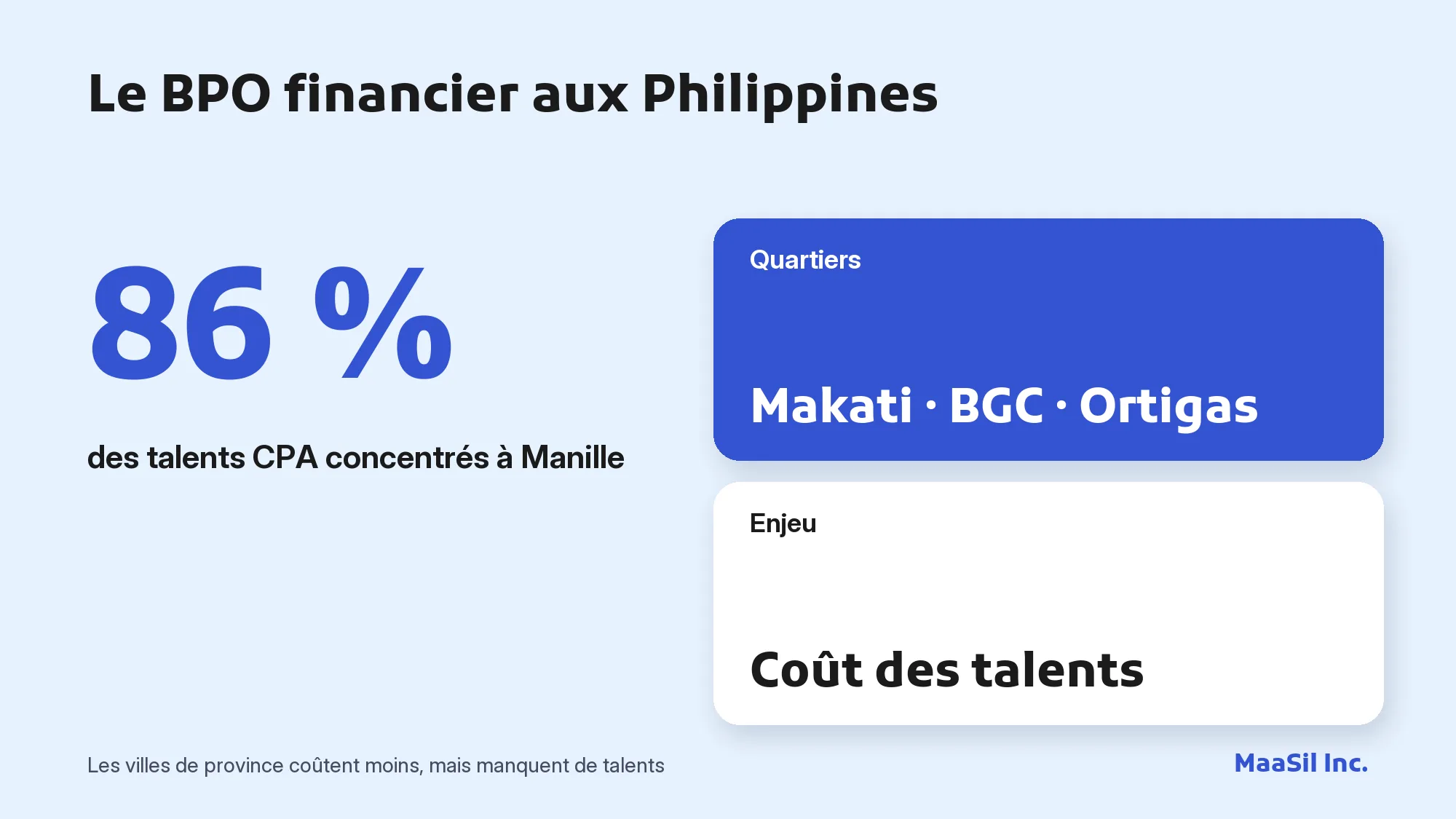
La concentration des talents explique l'écart de coût entre Manille et la province.
La stratification des talents nuit aux hypothèses de qualité. Les meilleurs 15 % des experts-comptables philippins travaillent dans les Big 4 à Manille (1 800-2 400 $/mois) ou émigrent. Les BPO recrutent des talents de niveau Tier 2-3 (900-1 200 $/mois) — des exécutants compétents mais non des penseurs stratégiques. Un client SaaS américain utilisant la reconnaissance des revenus ASC 606 a exigé une analyse de contrat. Le personnel du BPO formé sur des organigrammes de processus manquait de compréhension de la logique des revenus par rapport aux reports de revenus. Résultat : 12 % des contrats mal classés, l'auditeur (Deloitte) a signalé une faiblesse significative. Cause profonde : formation basée sur les règles aux Philippines contre PCGR basés sur les principes aux États-Unis.
Les conflits de fuseaux horaires lors de la clôture mensuelle créent des défaillances critiques. Un client américain (siège à Boston) clôture ses livres à 17h ET au jour 5. Manille a 12 heures d'avance. Au jour 4, à 15h à Boston (3h du matin à Manille), il ne reste qu'une équipe réduite sans personnel senior. Le directeur financier envoie un e-mail demandant d'« ajuster la provision pour bonus du T4 » (un élément important). Le BPO le voit 5 heures plus tard (8h du matin à Manille) après le verrouillage des livres dans le système américain. Atténuation : diviser les équipes avec une partie du personnel travaillant aux heures de Boston (19h-3h du matin à Manille) nécessitant une prime de nuit de 30 %, ou accepter une « Clôture au jour 6 », perdant ainsi 1 jour de réactivité.
La culture de la déférence aux Philippines risque d'entraîner des échecs d'audit financier. Une équipe d'audit interne (États-Unis) examine le traitement des comptes fournisseurs (AP) d'un BPO de Manille. L'auditeur : « Pourquoi cette dépense de 15 000 $ a-t-elle été codée en R&D et non en frais généraux ? » Le personnel du BPO : « Le système l'a suggéré, personne n'a dit le contraire. » Écart culturel : déférence hiérarchique philippine (on ne remet pas en question la hiérarchie) contre attente américaine (signaler si le codage semble incorrect). Des dépenses mal codées découvertes lors de l'audit sur six mois ont nécessité un reclassement de 240 000 $ et une nouvelle présentation des états financiers. Solution : responsabilisation explicite — « Vous DEVEZ contester le codage s'il contredit le type/la description du fournisseur » — accompagnée d'une gamification récompensant la détection d'erreurs.
Services financiers BPO : exigences de conformité et d'infrastructure
Les violations de la circulaire 765 de la BSP déclenchent des pénalités catastrophiques. Une banque philippine a externalisé le traitement des prêts à un BPO de Manille. Le BPO, confronté à un manque de capacité, a sous-traité 30 % à un BPO de Clark Pampanga (main-d'œuvre moins chère). Un audit de la BSP a découvert la sous-traitance. Pénalité : la banque a écopé d'une amende de 50 millions de PHP (900 000 $) et a été contrainte d'internaliser (contrat BPO annulé). Les clients internationaux risquent d'être exposés — si votre BPO sert des banques philippines, vous êtes sous la surveillance de la BSP. L'infrastructure partagée place vos données dans le champ d'application des audits de la BSP sans votre consentement.
Les seuils d'incitation fiscale de la PEZA créent des risques de choc tarifaire. Les BPO situés dans les zones PEZA bénéficient d'exonérations d'impôt sur le revenu (4 à 6 ans), puis de taux préférentiels de 5 % contre 25 % pour le taux de droit commun. Tactique de vente : proposer des prix bas en absorbant les économies d'impôt. L'expiration à l'année 7 déclenche des augmentations de prix de 15 à 20 % via des « clauses de répercussion fiscale » enfouies dans les contrats. Cas de 2021 : le BPO de Manille d'une fintech américaine (contrat de 6 ans signé en 2015) a atteint l'expiration PEZA, invoquant un « ajustement des coûts » — une augmentation annuelle de 180 000 $. Le client manquait d'alternatives (coût de transfert de 400 000 $). Correction de la formulation du contrat : « Le BPO absorbe toute modification fiscale (expiration PEZA, modifications de taux). »
La dépendance de l'infrastructure internet philippine vis-à-vis des câbles sous-marins crée des risques systémiques. Quatre-vingt-dix pour cent de la bande passante internationale philippine transite par 6 câbles sous-marins atterrissant à Luzon. Une rupture de câble en 2023 (ancre de navire) a éliminé 40 % de la bande passante pendant 3 jours. Les clients de BPO financiers n'ont pas pu accéder à l'ERP cloud (NetSuite, Workday). Les cycles de clôture ont été retardés de 2 jours, manquant les échéances de reporting des investisseurs. L'action d'un client a chuté de 3 % suite au dépôt tardif du formulaire 10-Q. Exception contractuelle de SLA requise : « Force majeure pour rupture de câbles sous-marins ». Atténuation par répartition géographique : 70 % Manille, 30 % Cebu (autre point d'atterrissage du câble) assure la redondance.
Entreprises de BPO au Royaume-Uni : analyse économique Onshore vs Nearshore
Les coûts de main-d'œuvre du BPO au Royaume-Uni atteignent 24 000 à 32 000 £/an (30 000 à 40 000 $) contre 8 000 à 12 000 £ (10 000 à 15 000 $) pour les équivalents offshore. La justification n'existe que pour les secteurs réglementés (activités agréées par la FCA) ou les processus complexes spécifiques au Royaume-Uni (taxes HMRC, allocations DWP). Les postes de BPO à Londres/Manchester coûtent 8 000 à 12 000 £/poste/an contre 600 à 1 200 £ en offshore. Quatre-vingt pour cent des « BPO britanniques » opèrent en réalité selon des modèles hybrides — management au Royaume-Uni et exécution offshore en Inde/Philippines/Afrique du Sud.
Le « blanchiment local » des BPO britanniques trompe les clients soucieux de conformité. Les prestataires commercialisent des « équipes basées au Royaume-Uni » alors que les agents travaillent depuis chez eux en Inde/Philippines en utilisant des numéros de téléphone britanniques (VoIP) et des arrière-plans Zoom du Royaume-Uni. Cas d'audit de la FCA en 2022 : une banque a externalisé des conseils réglementés par la FCA à un « BPO britannique ». La FCA a demandé une visite sur site. Le BPO a admis que 70 % du personnel était à l'étranger. Pénalité de la FCA : la banque a écopé d'une amende de 1,2 million de £ pour surveillance inadéquate des fonctions externalisées. Atténuation par clause contractuelle : « Droit à des visites sur site inopinées » (toute résistance est un signal d'alarme). La surveillance des adresses IP permet de suivre l'endroit réel d'où se connectent les agents.
Les réglementations TUPE créent des pièges de structures de coûts héritées. Un distributeur britannique externalisant l'administration RH à un BPO basé au Royaume-Uni a déclenché le TUPE (Transfer of Undertakings). Le BPO doit embaucher le personnel interne existant (40 employés) à leurs salaires actuels. Le personnel interne gagne 32 000 £ (inflation salariale de la distribution). Le salaire standard du BPO : 26 000 £. Écart TUPE : le BPO se retrouve contraint de payer 6 000 £/an supplémentaires par ETP, détruisant ses modèles de tarification. Les BPO renégocient les prix (+18 %) ou procèdent à des licenciements sélectifs (suppression de postes, réembauche de nouveaux collaborateurs à des salaires inférieurs — légal mais risqué pour la réputation).
L'incertitude sur l'adéquation des données post-Brexit menace les flux de BPO entre le Royaume-Uni et l'UE. Avant 2021 : le Royaume-Uni équivalait à un État membre de l'UE avec des flux de données libres vers les BPO de l'UE (Pologne, Roumanie). Post-Brexit : le Royaume-Uni reçoit le statut « adéquat » (décision de l'UE, temporaire). Risque : l'UE peut révoquer l'adéquation suite à des recours de type Schrems. Une compagnie d'assurance britannique utilisant un BPO polonais à Cracovie pour le traitement des sinistres s'expose à de potentielles exigences de CCT/AIPD si l'adéquation est perdue — un projet de 6 mois doublé d'une augmentation des coûts de 15 %. L'avantage des plus grands BPO : Genpact, Accenture opèrent de manière multijuridictionnelle (transfert des tâches britanniques vers des centres de données au Royaume-Uni en quelques semaines). Les petits BPO bloqués sur un seul site ne peuvent pas pivoter.
Quels problèmes les solutions BPO résolvent-elles et quand échouent-elles ?
Cas d'usage parfaits du BPO : processus basés sur des règles à volume élevé comprenant le traitement des sinistres, le support de niveau 1, la saisie de données où une précision de 80 à 90 % s'avère acceptable (qualification des prospects). Couverture 24h/24, 7j/7 qui suit le soleil (centre d'assistance mondial, modération des réseaux sociaux). Pics saisonniers évolutifs (support e-commerce pour les fêtes, saison fiscale avec des délais de préparation de 6 mois). Flux de travail documentés et matures (paie RH, traitement des factures avec des procédures d'exploitation standardisées claires). Interactions clients transactionnelles (statut de commande, réinitialisation de mot de passe, prise de rendez-vous).
Applications dangereuses du BPO : décisions nuancées basées sur le jugement nécessitant un support au diagnostic médical, des conseils juridiques, des réponses de relations publiques en cas de crise. Domaines zéro erreur (étiquetage pharmaceutique, audit financier, registres de maintenance d'aéronefs). Exigences de connaissances institutionnelles approfondies (maintenance de systèmes hérités, due diligence de fusions-acquisitions). Besoins de pivots/innovation rapides (itérations de produits de startup, sprints de développement agiles). Processus non définis ou en évolution (support au lancement de nouveaux produits, campagnes de marketing expérimentales). Points de contact critiques pour la relation (gestion de grands comptes au niveau de la direction, accompagnement des patients, crises de réputation de marque).
Les opérations financières et de trésorerie stratégiques s'avèrent à haut risque pour l'offshore. Les capacités des prestataires de services BPO excellent dans la comptabilité transactionnelle (comptes fournisseurs, comptes clients, traitement de la paie de plus de 1 000 factures/mois) et le reporting selon les PCGR américains (les comptables philippins étant formés aux normes américaines). Cependant, la modélisation de fusions-acquisitions, les prévisions FP&A, l'optimisation fiscale et les opérations de trésorerie en temps réel (opérations de change, positionnement de trésorerie) se heurtent à des risques de fuseaux horaires et nécessitent une réflexion stratégique qui dépasse les capacités du personnel du BPO. Un modèle hybride fonctionne : le BPO philippin exécute la clôture mensuelle (écritures de journal, rapprochement de comptes, analyse des écarts) tandis que le directeur financier basé aux États-Unis gère les interactions avec les auditeurs partenaires et les décisions stratégiques.
Comment auditer la qualité d'un prestataire de BPO lorsque les équipes opèrent à 8 000 km
Le contrôle de la qualité basé sur la technologie élimine les barrières de la distance. Exigez des tableaux de bord d'AQ en temps réel — NICE Enlighten AI évalue les appels automatiquement plutôt que de s'en remettre à l'auto-évaluation du BPO. Écoute silencieuse aléatoire de 5 % des interactions quotidiennes (les agents ne savent jamais quand). Audits ponctuels côté client à l'aide d'outils comme Tethr (analyse vocale) sur 100 % des appels. Clauses contractuelles strictes : les pénalités de SLA sont automatiquement déduites des factures (par ex., un CSAT inférieur à 92 % déclenche une réduction de 10 % des frais). Exemple : un client SaaS a utilisé BlackLine pour scanner les écritures du BPO, découvrant un taux d'erreur de 4 % contre moins de 1 % revendiqué par le BPO — des pénalités contractuelles ont été appliquées.

Tableaux de bord qualité en temps réel et écoute à distance effacent la distance.
La due diligence financière prévient l'exposition à l'effondrement d'un petit BPO. Petit BPO (Kenya, 25 ETP) vivant au jour le jour avec un client représentant 80 % de son chiffre d'affaires. Le client a suspendu le contrat pendant 2 mois (gel budgétaire interne). Le BPO n'a pas pu payer les salaires (pas de réserves de trésorerie), le personnel a démissionné, le BPO a fermé ses portes. Le client a perdu 22 000 $ d'investissement en formation ainsi que la connaissance institutionnelle, avec un vide de 6 à 8 semaines pour intégrer un nouveau prestataire. Outils de contrôle : exiger 3 ans d'états financiers audités (les petits BPO ne peuvent souvent pas les fournir, ce qui est un signal d'alarme). Dispositifs de séquestre : le client dépose 3 mois de frais auprès d'un tiers (le BPO les retire si le client fait défaut, le client les retire si le BPO s'effondre).
La vérification des diplômes met fin à la fraude au titre de CPA. Les BPO promettent du « personnel qualifié CPA », mais certains revendiquent un titre « équivalent CPA » (non agréé — désignation dénuée de sens). La PRC (Professional Regulation Commission) philippine tient un registre public. Exigez les numéros PRC, vérifiez en ligne. Formulation du contrat : « Au moins 60 % de l'équipe doit détenir une licence PRC-CPA active » (indicateur vérifiable). Cas d'un BPO de Manille en 2023 : le client a découvert que le BPO utilisait une version piratée du logiciel Sage, s'exposant à des menaces d'audit de la BSA (Business Software Alliance) — contrat résilié.
Pourquoi la plupart des recommandations des services de conseil en BPO échouent-elles ?
La corruption liée aux commissions de recommandation des consultants fausse les incitations. Les cabinets de conseil revendiquant leur « indépendance » gèrent des panels de prestataires privilégiés (système pay-to-play). Exemple au Kenya : un consultant a recommandé le « Top 3 des BPO du Kenya » — tous payaient des frais de panel annuels de 15 000 à 30 000 $. Le prestataire le mieux adapté (un cabinet de 40 postes à Eldoret, sans frais de panel) a été exclu de l'appel d'offres. Clause d'atténuation du contrat : « Le consultant doit divulguer TOUTE relation financière avec les prestataires recommandés (frais de recommandation, frais de panel, participation au capital). » Utilisez des classements validés publiquement (Gartner Magic Quadrant, ISG Provider Lens).
L'inadéquation des visites sur site des consultants fait l'impasse sur la réalité opérationnelle. Un conseil en BPO au Nigeria a recommandé de « déplacer le traitement des comptes fournisseurs à Lagos (40 % d'économies) ». Le consultant a testé internet depuis l'hôtel Eko doté de la fibre, a rencontré le directeur général qui avait étudié au Royaume-Uni. Réalité de la semaine 3 : bureau à Ikeja (à 5 km) avec un FAI fournissant un taux de disponibilité de 60 % contre les 99,5 % promis. Les agents parlaient un anglais fluide mais n'avaient aucune connaissance de la terminologie comptable (« accruals » confondu avec « accurals », provoquant des erreurs de saisie de données). Une pénurie de diesel a laissé les générateurs hors service 14 heures par jour. Cause profonde : la visite sur site de 2 jours du consultant a montré les meilleurs scénarios sans déployer d'équipes de due diligence technique testant les infrastructures au domicile réel des agents (et non dans les centres de démonstration des BPO).
L'instabilité financière d'un petit BPO crée une exposition catastrophique pour le client. L'expertise d'un prestataire boutique est concentrée sur 2 ou 3 employés clés qui peuvent partir. Un BPO de facturation médicale au Kenya (18 ETP) était spécialisé dans Epic/Cerner (rare au Kenya). Un BPO éthiopien a débauché les 4 meilleurs facturiers (augmentations de 400 $/mois). Le petit BPO n'a pas pu les remplacer (formation Epic de 3 mois et 4 000 $/personne). L'arriéré de facturation du client a explosé. Atténuation par l'audit des compétences : exiger une matrice des compétences anonymisée (combien de collaborateurs ont la certification X ?). Signal d'alarme : « 8 personnes connaissent la facturation Epic » mais le contrat en nécessite 6 équivaut à une redondance nulle. Garanties de rétention : clause contractuelle « Le BPO doit maintenir un minimum de 4 collaborateurs formés sur Epic à tout moment sous peine de pénalité. »
Plus grandes entreprises de BPO : avantages d'échelle et faiblesses cachées
La dilution multi-activités masque l'hétérogénéité des compétences. Un client engage Genpact pour une prestation de bout en bout (F&A, CX, support informatique) sur la base de l'argument « un prestataire unique simplifie la gouvernance ». Réalité : l'équipe F&A de Genpact opère avec plus de 20 ans d'expérience (98 % de SLA), tandis que le support informatique représente une compétence plus récente acquise il y a 5 ans avec une intégration incomplète (84 % de SLA). Les rapports globaux masquent les écarts de performance. Les BPO grandissent par des acquisitions en greffant des compétences. L'intégration s'avère inégale, certaines équipes acquises souffrant d'un sous-investissement. Atténuation par SLA spécifiques : exiger « F&A : 97 %, CX : 93 %, IT : 95 % » rapportés séparément — n'acceptez jamais d'indicateurs fusionnés.

50 à 200 sites dans le monde : l'échelle a ses avantages et ses angles morts.
La contamination des services partagés crée des vulnérabilités de sécurité. Les grands BPO gèrent une infrastructure multi-locataire — vos données partagent des serveurs/réseaux avec des concurrents. Genpact sert Barclays et HSBC sur le même cluster CRM (séparation logique, partage physique). Événement de risque en 2021 : un bac à sable Salesforce mal configuré a rendu les données de test du Client A visibles pour l'équipe du Client B (les deux banques). Pas de faille (détectée lors d'un audit) mais l'exposition réglementaire existait. Défense des plus grands BPO : « Nous avons 17 niveaux de sécurité. » Réalité : la complexité crée davantage de points de défaillance. L'alternative d'un SLA d'infrastructure dédiée coûte 40 à 60 % de plus mais élimine les risques de la multi-location.
L'optimisation furtive de l'offshoring capte les économies de coûts. Le contrat spécifie « exécution au Royaume-Uni ». Année 2 : le BPO propose une « optimisation » — déplacer 50 % en Inde (« même qualité, coût inférieur, nous vous répercutons les économies »). Intention cachée : expansion de la marge du BPO (ils empochent la majeure partie des économies). Le client perd le contrôle (n'avait pas planifié d'offshore) avec en plus des risques de conformité s'il s'agit d'activités réglementées par la FCA/ICO. Protection contractuelle : « Lieux d'exécution géographique fixes sans approbation écrite du Client » ainsi que « Toute économie de coûts résultant de changements de localisation est partagée à hauteur de 70 % pour le client et 30 % pour le BPO ».
FAQ complète : questions de direction sur les décisions relatives au secteur du BPO
Comment savoir si le consultant ne m'oriente pas vers son partenaire de rétrocommission ? Insérez une clause contractuelle de divulgation : « Le consultant doit révéler toute commission, frais de recommandation ou participation au capital chez les prestataires recommandés. » Utilisez des outils gratuits (Gartner Peer Insights, avis sur Clutch.co) pour vérifier la liste restreinte du consultant. Exemple au Kenya : un client a découvert que le profil LinkedIn d'un conseiller affichait un rôle de « Consultant en partenariat » auprès de l'entreprise recommandée (non divulgué) — conseiller licencié.
Les petits BPO proposent 30 % de moins — pourquoi payer plus pour de grands cabinets ? Comparaison des coûts réels : un petit BPO à 650 $/ETP plus 200 $ de transition plus 50 % d'attrition équivaut à un coût effectif de 975 $/ETP plus un risque de qualité. Un BPO de premier niveau à 950 $/ETP plus 600 $ de transition plus 18 % d'attrition plus des pénalités de SLA équivaut à 1 020 $/ETP avec assurance. Le premier niveau ajusté au risque coûte 5 % de plus mais élimine le risque de défaillance catastrophique (fermeture d'un petit BPO).
Comment valider des recommandations de consultants telles que « le Kenya pour les coûts, Maurice pour la finance » ? Utilisez les évaluations de localisation de l'Everest Group (données publiques). Kenya : solides talents techniques, faibles talents financiers (le secteur bancaire absorbant les CPA). Maurice : BPO financier mature (plus de 20 ans d'expérience), tarifs premium. Exigence de preuve : « Montrez-moi 3 clients que vous avez placés au Kenya pour des travaux similaires ainsi que leurs données de performance. »
Et si l'expertise spécialisée d'un petit BPO ne repose que sur 2 ou 3 employés clés qui peuvent partir ? Audit des compétences : exigez une matrice des compétences anonymisée (combien de collaborateurs ont la certification X ?). Signal d'alarme : « 8 personnes connaissent la facturation Epic » mais le contrat en nécessite 6 équivaut à une redondance nulle. Garanties de rétention : clause contractuelle « Le BPO doit maintenir un minimum de 4 collaborateurs formés sur Epic à tout moment sous peine de pénalité. » Exemple : un client de facturation médicale au Kenya a exigé que le BPO forme 10 collaborateurs de manière polyvalente (et non 4 seulement). Coût de 12 000 $ supplémentaires au départ, mais a permis d'absorber le départ de 3 personnes sans aucune violation de SLA.
Le modèle de ROI du consultant affiche 45 % d'économies — qu'en est-il en réalité ? Modélisation honnête du TCO : l'année 1 apporte 20 à 25 % d'économies (après coûts de transition, courbe d'apprentissage). L'année 2 et les suivantes atteignent 35 à 40 % d'économies (si l'attrition se stabilise). Un consultant affichant 45 % dès l'année 1 relève du fantasme. Exigez une analyse de scénarios : « Montrez-moi le modèle si l'attrition est de 40 % et non de 20 %. » Exemple au Nigeria : un consultant prévoyait 600 000 $ d'économies, l'année 1 réelle a généré 180 000 $ (la transition a débordé, des problèmes de qualité ont nécessité des corrections), l'année 2 a atteint 520 000 $ (stabilisation).
Les BPO philippins sont des « experts financiers » — peuvent-ils gérer les nuances fiscales américaines ? Clarté du périmètre : les BPO philippins excellent dans la tenue de livres et le reporting (écritures de journal conformes aux PCGR, états financiers). Ils ne sont PAS des fiscalistes stratégiques — le code fiscal américain (complexités de l'IRC) exige un CPA américain (le personnel philippin ne peut pas signer les déclarations). Modèle hybride : BPO philippin pour le traitement des transactions, CPA basé aux États-Unis pour les déclarations fiscales/le conseil.
Comment vérifier que le BPO n'utilise pas de logiciels sans licence m'exposant à un audit ? Clause d'audit des licences : le contrat exige que le BPO fournisse des preuves de licences (captures d'écran, factures de prestataires) chaque trimestre. Utilisez des licences appartenant au client : fournissez au BPO vos propres accès SAP/Oracle (vous contrôlez la conformité). Exemple : un BPO de Manille utilisait une version piratée de Sage — le client a fait face à des menaces d'audit de la BSA, contrat résilié.
Si la relation avec le BPO se détériore, comment en sortir sans détruire les opérations ? SLA de sortie/transition : le contrat doit inclure une « phase de désengagement coopérative de 90 jours » (le prestataire aide au transfert de compétences). Dispositifs de séquestre : tous les documents de processus, matériels de formation et configurations système sont détenus par un tiers (libérés lors de la résiliation). Assurance d'exécution parallèle : conservez 20 % de capacité en interne ou chez un prestataire de secours (coûte 15 % de plus mais élimine le risque de rupture brutale). Exemple à Maurice : un client a résilié un BPO pour non-performance, le contrat manquait de clause de sortie, bataille juridique de 6 mois et règlement de 400 000 $ pour récupérer les données/processus.
Les 50 meilleurs BPO semblent similaires dans leurs propositions — comment les différencier ? Des preuves plutôt que des promesses : « Fournissez 3 références pour des travaux similaires (secteur et échelle) avec coordonnées de contact » (pas des études de cas triées sur le volet). « Démonstration en direct de votre plateforme gérant notre processus » (pas une démo commerciale). « Visite sur site du centre de prestation proposé » (voir les opérations réelles, pas l'espace d'exposition). Projet pilote : « Pilote payant de 3 mois (20 % de l'échelle proposée) avant un engagement complet. »
Si je choisis un BPO du Top 50 et qu'il se fait racheter, que se passe-t-il ? Clause de changement de contrôle : « Si le BPO est racheté, le Client peut résilier le contrat dans les 90 jours sans pénalité » (offre une option de sortie si le nouveau propriétaire change de stratégie). Garantie de continuité de service : « L'acquéreur doit respecter les SLA existants pendant au moins 12 mois. » Exemple de 2023 : lorsque Teleperformance a racheté Majorel, certains clients ont invoqué des clauses de changement de contrôle par crainte de perturbations liées à l'intégration.
Prêt à renforcer votre équipe avec les meilleurs talents africains ?
Discutez avec l'un de nos experts pour découvrir comment le portage salarial augmenté à l'IA peut s'intégrer à 100 % à vos process et faire grandir vos projets.
Échangez avec un expert
