
Prêt à renforcer votre équipe avec les meilleurs talents africains ?
Discutez avec l'un de nos experts pour découvrir comment le portage salarial augmenté à l'IA peut s'intégrer à 100 % à vos process et faire grandir vos projets.
Échangez avec un expert
Service Client & Call Center
Prestataires d'externalisation de centres d'appels : comment évaluer les fournisseurs sans se faire piéger par de fausses certifications
Votre appel d'offres reçoit 14 réponses. Toutes revendiquent la certification ISO 27001, une disponibilité de 99,9 % et un anglais de "niveau langue maternelle". Trois mois après le lancement, vous découvrez que la certification ISO a expiré il y a 18 mois, que la disponibilité ne mesure que l'alimentation électrique (pas Internet) et que le "niveau langue maternelle" signifie que les agents ont regardé YouTube pour apprendre des expressions idiomatiques américaines.
Le choix du prestataire détermine les résultats bien plus que la géographie ou le prix. Ce guide décortique les cadres d'évaluation des meilleures entreprises d'externalisation de centres d'appels, les 5 clauses contractuelles qui détruisent les clients, et le processus de vérification des certifications que 92 % des acheteurs ignorent.
Qu'est-ce qui distingue les meilleures entreprises d'externalisation de centres d'appels des prestataires de piètre qualité ?
La différence de catégorie n'est pas évidente dans les documents marketing ; tous les prestataires revendiquent un service de "classe mondiale". Pourtant, la maturité opérationnelle transparaît dans trois domaines.

Infrastructure, conformité, contrat : vérifiez les preuves, pas les promesses.
Redondance de l'infrastructure : Les prestataires de premier plan exploitent des installations géo-redondantes dans différentes villes avec des fournisseurs de services publics distincts. Exemple : centre principal à Lagos avec secours immédiat à Abuja (gestionnaire de réseau électrique différent). Les SLA garantissent un basculement en 15 minutes pour les files d'attente critiques, l'équipe informatique du client participant aux tests de reprise d'activité trimestriels.
Les prestataires bas de gamme revendiquent des installations de secours, mais utilisent le même bâtiment avec un second circuit internet : une panne d'électricité met les deux hors service. De plus, le "secours" signifie souvent le routage des appels vers une messagerie vocale grand public, et non vers des agents en direct. Lors d'une panne d'électricité du réseau, ces prestataires n'ont alors aucune capacité de basculement.
Rigueur d'acquisition des talents : Les prestataires d'élite exigent des diplômes universitaires ainsi que des scores d'expression orale Versant supérieurs à 63 (taux de compréhension de 95 %). Le ratio de recrutement est de 12:1 ; douze candidats sont interviewés pour chaque agent embauché. La durée de la formation est de 4 semaines minimum avec des scénarios de jeux de rôle couvrant les cas particuliers.
Les prestataires à bas prix embauchent des diplômés du secondaire avec des ratios de 2:1 et une formation d'une semaine. Le taux de rotation atteint 65 % par an car l'aptitude des agents n'est pas évaluée. L'économie de 180 $ par agent et par mois engendre un coût de 1 200 $ en frais de remplacement.
Investissement technologique : Les meilleures entreprises déploient l'analyse vocale sur 100 % des appels (pas un échantillonnage de 10 %), utilisent la mise en cache Redis pour des affichages de fiches CRM en moins de 250 ms, et fournissent un logiciel de gestion des effectifs (WFM) avec prévisions par IA. Cela coûte 28 $ par agent et par mois en frais de plateforme.
Les prestataires bas de gamme utilisent Excel pour la planification, n'ont pas d'analyse des appels et intègrent le CRM via des robots de capture d'écran qui tombent en panne lors des mises à jour de la plateforme. L'économie mensuelle de 28 $ engendre 840 $ de pertes de productivité lorsque les agents ne peuvent pas accéder aux données clients.
Vérification de la stabilité financière : Demandez des états financiers audités ; les prestataires dont le chiffre d'affaires annuel est inférieur à 2 millions de dollars manquent de capitaux pour investir dans les infrastructures. De plus, vérifiez les notations de crédit D&B. Un score inférieur à 60 indique un risque de défaut de paiement ; le prestataire pourrait ne pas payer les salaires des agents pendant votre contrat, ce qui provoquerait des démissions massives.
Comment vérifier les certifications de conformité des prestataires d'externalisation de centres d'appels ?
Les fausses certifications sont courantes parce que les acheteurs ne procèdent pas à des vérifications directes auprès des organismes d'audit.
Processus de vérification ISO 27001 :
Demandez le numéro de certificat et le nom de l'organisme d'audit (ex : BSI, SGS, TÜV)
Contactez l'auditeur directement via son site web officiel (pas via les coordonnées fournies par le prestataire)
Vérifiez les dates de validité du certificat ; les certifications expirent tous les 3 ans avec des audits de surveillance annuels
Confirmez le périmètre : les "opérations de centre d'appels" doivent apparaître explicitement, et non de génériques "services informatiques"
Signal d'alarme : le prestataire ne peut pas produire le certificat dans les 24 heures ou donne des excuses ("il est en cours de renouvellement"). Les certificats valides sont vérifiables publiquement via les bases de données des auditeurs.
Validation SOC 2 Type II :
Les rapports de Type I prouvent que des contrôles existent à un instant T (inutiles)
Les rapports de Type II prouvent que les contrôles ont fonctionné de manière efficace pendant 12 mois (obligatoires)
Demandez le rapport directement à l'auditeur du prestataire (cabinets d'audit du Big 4 ou cabinets d'expertise comptable qualifiés)
Vérifiez que le rapport couvre au moins les critères de service de confiance "Sécurité" et "Confidentialité"
De plus, les rapports SOC 2 doivent dater de moins de 12 mois. Les rapports plus anciens ne reflètent pas les opérations en cours ; les modifications d'infrastructure annulent les audits précédents.
Vérification PCI-DSS pour le traitement des paiements :
Certification de Niveau 1 requise pour plus de 6 millions de transactions par an
Demandez l'Attestation de conformité (AOC) signée par un évaluateur de sécurité qualifié (QSA)
Vérifiez la qualification du QSA dans la liste officielle des QSA du PCI Security Standards Council
Confirmez que le périmètre inclut les opérations du centre d'appels, et pas seulement la passerelle de paiement
Signal d'alarme : le prestataire revendique la conformité PCI mais ne peut pas produire d'AOC ; il s'agit d'une auto-évaluation (insuffisante pour le traitement des données de cartes). De plus, 99 % des centres d'appels africains manquent de certification de Niveau 1, ce qui les rend inadaptés au traitement des paiements. Utilisez plutôt des solutions de contournement par liens de paiement.
Contrôles RGPD / protection des données :
Demandez le modèle d'accord de traitement des données (DPA) avant la signature du contrat
Vérifiez que le DPA spécifie les lieux de stockage des données (centres de données de l'UE pour les clients de l'UE)
Confirmez la liste des sous-traitants ultérieurs (tiers ayant accès aux données)
Vérifiez la conformité aux règles d'entreprise contraignantes ou au cadre de protection des données UE-États-Unis
En outre, les prestataires doivent démontrer des contrôles techniques : chiffrement au repos (AES-256), chiffrement en transit (TLS 1.3), journalisation des accès et tests de pénétration réguliers. Demandez le rapport de test de pénétration le plus récent ; 90 % des prestataires n'ont jamais réalisé d'évaluations de sécurité formelles.
Combien coûterait votre équipe support à Madagascar ? Estimer mon budget →
Quelles sont les 5 clauses contractuelles qui détruisent les clients dans l'externalisation de centres d'appels ?
Les contrats standards des prestataires protègent ces derniers, pas les clients. La négociation permet d'éviter les catastrophes.

Plafond de responsabilité, sortie, pénalités : certaines clauses se négocient avant la signature.
Piège n°1 - Plafonds de responsabilité illimités :
Clause standard : "La responsabilité totale du prestataire ne dépassera pas les frais payés au cours des 3 mois précédents."
Scénario catastrophe : une faille RGPD expose 50 000 dossiers clients. L'UE inflige une amende de 4 millions d'euros au client. Les frais trimestriels du prestataire étaient de 45 000 $ ; le client absorbe une perte de 3 955 000 $.
Correction négociée : Plafond de responsabilité égal à 12 mois de frais OU 2 millions de dollars minimum, le montant le plus élevé étant retenu. De plus, exigez que le prestataire maintienne une assurance cyber-responsabilité, le client étant désigné comme assuré supplémentaire. Demandez l'attestation d'assurance chaque année.
Piège n°2 - Définitions floues de la disponibilité :
Clause standard : "Le prestataire garantit une disponibilité de 99,9 %" (sans définition de la "disponibilité").
Réalité : le prestataire mesure la disponibilité de l'alimentation électrique, et non celle des agents. Les pannes d'internet, les défaillances du CRM et les absences massives d'agents pour cause de maladie ne sont pas comptabilisées comme des temps d'arrêt. Vous subissez 8 heures mensuelles de service inutilisable mais ne pouvez pas réclamer de crédits de pénalité.
Correction négociée : Définissez la disponibilité comme "le pourcentage de temps pendant lequel les agents peuvent traiter avec succès les interactions clients de bout en bout". Incluez un temps de réponse CRM inférieur à 3 secondes dans la définition. Les temps d'arrêt incluent toute période durant laquelle plus de 10 % des agents ne peuvent pas accéder aux systèmes requis.
Piège n°3 - Frais cachés de capacité de pointe :
Clause standard : "Capacité flexible disponible sur demande" (sans tarification spécifiée).
Catastrophe : le volume d'appels du Black Friday bondit de 340 %. Le prestataire exige des tarifs 3 fois supérieurs aux tarifs normaux pour les agents supplémentaires (1 800 $ par agent contre 600 $ habituellement). Soit vous payez, soit vous perdez 180 000 $ en appels abandonnés.
Correction négociée : Le contrat doit spécifier à l'avance la tarification de pointe. Une majoration raisonnable se situe entre 25 et 40 % au-dessus des tarifs standards, et non 300 %. De plus, incluez un SLA d'activation de pointe : le prestataire doit fournir la capacité demandée sous 4 heures, sans quoi le client peut s'approvisionner ailleurs sans pénalité.
Piège n°4 - Pénalités de résiliation unilatérales :
Clause standard : "Le client peut résilier moyennant un préavis de 90 jours et le paiement de 6 mois de frais à titre de pénalité de résiliation anticipée."
Calcul : Résilier un contrat mensuel de 50 000 $ coûte 300 000 $ de pénalité plus 150 000 $ pour la période de préavis de 90 jours = 450 000 $ pour s'en libérer.
Correction négociée : La résiliation pour motif valable (manquements aux SLA, violations de conformité) ne doit comporter aucune pénalité. La résiliation pour convenance après 12 mois doit comporter un préavis maximum de 60 jours avec 2 mois de pénalité (et non 6). De plus, incluez une clause de "manquement grave" permettant une résiliation immédiate si le prestataire ne remédie pas aux violations de SLA dans un délai de 30 jours.
Piège n°5 - Vol de propriété intellectuelle :
Clause standard : "Le prestataire conserve la propriété des processus, méthodologies et supports de formation développés au cours de la mission."
Catastrophe : vous passez 6 mois à développer des scripts personnalisés, des bases de connaissances produits et des grilles d'évaluation de l'assurance qualité. Lors de la résiliation, le prestataire garde tout. Votre nouveau prestataire doit repartir de zéro.
Correction négociée : Le contrat doit stipuler que "le client conserve la propriété de tout le contenu spécifique au client, y compris les scripts, les procédures, les supports de formation et les données clients". Le prestataire peut conserver les méthodologies BPO génériques, mais rien de ce qui est unique à votre activité. De plus, incluez une clause de restitution des données : le prestataire doit livrer tout le contenu dans des formats exploitables dans les 10 jours suivant la résiliation.
Comment évaluer les cabinets de conseil en externalisation de centres d'appels par rapport à un engagement direct auprès d'un prestataire ?
Les intermédiaires de conseil ajoutent des coûts mais apportent de la valeur dans des scénarios complexes.
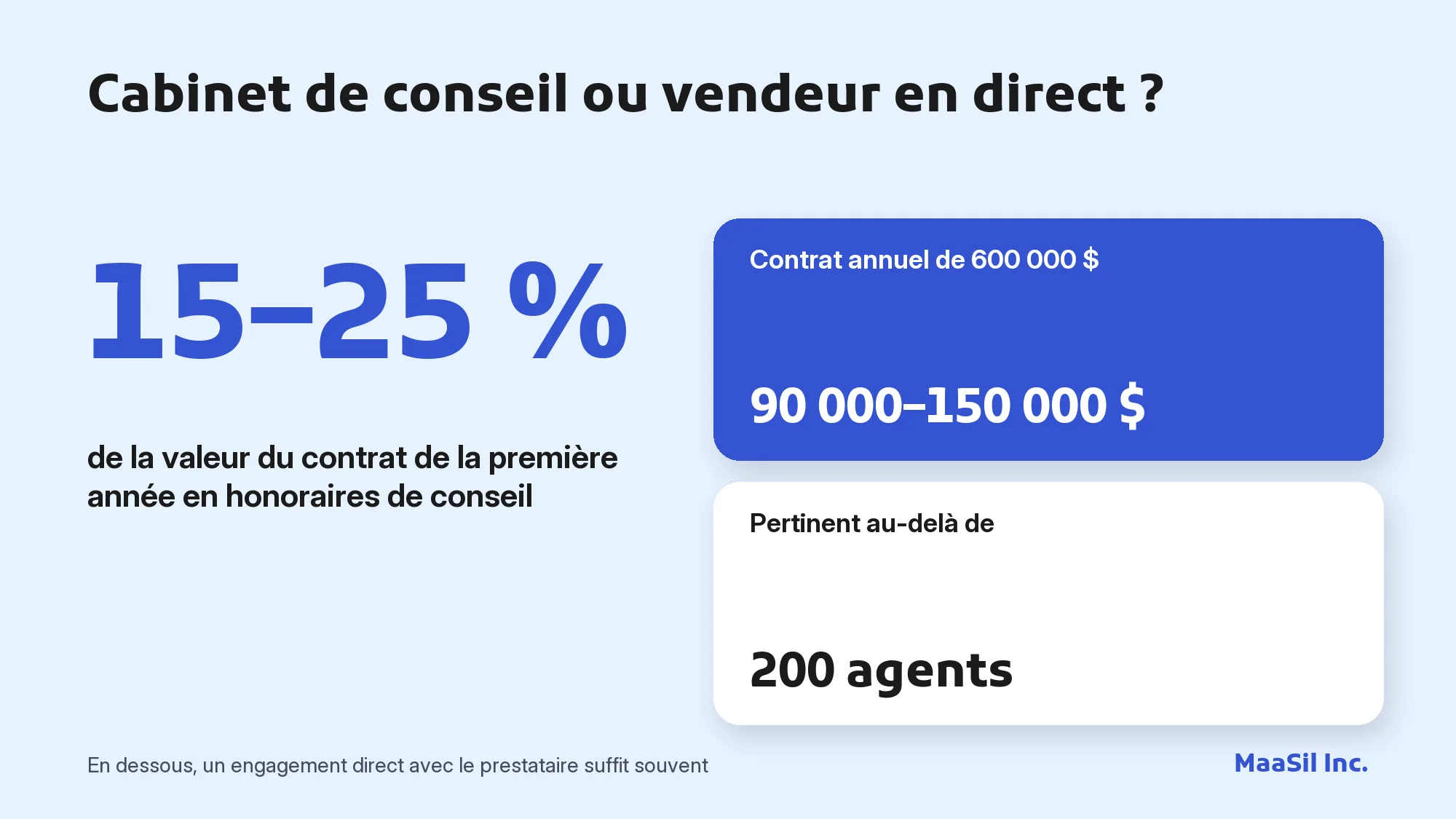
Le conseil se justifie surtout pour les opérations de plus de 200 agents.
Quand les consultants sont pertinents :
Premier engagement offshore (aucune expertise interne pour évaluer les prestataires)
Besoins multi-pays (clientèles basées en UE, aux États-Unis et en APAC)
Secteurs réglementés exigeant une expertise en matière de conformité (santé, finance)
Opérations de plus de 200 agents (la complexité exige une gestion de projet spécialisée)
Proposition de valeur du consultant :
Élaboration d'appels d'offres avec des spécifications techniques que les acheteurs oublient (SLA de latence CRM, évaluation des accents)
Audit préalable des prestataires, y compris visites des installations et vérifications des références
Négociation de contrats s'appuyant sur la connaissance sectorielle des conditions standards
Suivi de la mise en œuvre pour détecter les problèmes avant qu'ils ne se transforment en catastrophes
Cependant, les consultants facturent généralement entre 15 et 25 % de la valeur du contrat de la première année. Un contrat annuel de 600 000 $ coûte entre 90 000 $ et 150 000 $ en honoraires de conseil. Par conséquent, le retour sur investissement dépend de l'évitement d'une défaillance majeure (violation du RGPD, effondrement des SLA) dont le coût serait supérieur à l'investissement dans le conseil.
Quand l'engagement direct fonctionne :
Remplacement d'une opération offshore existante (vous savez à quoi ressemble le succès)
Cas d'usage simples (support entrant de niveau 1 avec moins de 50 agents)
Expertise interne disponible (équipe d'achats ayant une expérience du BPO)
Contraintes budgétaires strictes (honoraires de conseil inabordables)
Approche hybride : Engagez un consultant uniquement pour la sélection du prestataire et la négociation du contrat (frais fixes de 25 000 $), puis gérez la mise en œuvre en interne. Cela permet de bénéficier de la valeur de l'audit préalable sans les coûts de conseil continus.
De plus, certains consultants ont conclu des accords de partage de revenus avec des prestataires ; ils sont donc incités à recommander les partenaires qui versent les commissions les plus élevées, et non les mieux adaptés. Demandez une déclaration écrite de toutes les relations avec les prestataires avant de vous engager.
Quelles questions posées lors de l'appel d'offres démasquent les prestataires d'externalisation de centres d'appels de piètre qualité ?
Les questions génériques obtiennent des réponses apprises par cœur. Ces questions révèlent la réalité opérationnelle.
Q1 : "Montrez-moi le schéma de la topologie du circuit Internet de votre installation avec les noms des FAI et le routage de basculement."
Ce que cela révèle : Les prestataires sérieux disposent de schémas réseau montrant deux FAI avec des itinéraires physiques distincts. Les prestataires bas de gamme ne peuvent pas produire cela car ils utilisent des connexions uniques de classe affaires grand public.
Q2 : "Quelle a été votre latence moyenne d'affichage de fiche CRM le mois dernier pour les intégrations Salesforce ?"
Ce que cela révèle : Les meilleurs prestataires suivent cet indicateur et peuvent afficher des moyennes inférieures à 300 ms. Les prestataires à bas prix ne le mesurent pas ; "nous n'avons jamais eu de plaintes" n'est pas une réponse basée sur les données.
Q3 : "Décrivez votre dernier test de reprise d'activité. Qu'est-ce qui a échoué et comment y avez-vous remédié ?"
Ce que cela révèle : Les prestataires honnêtes admettent les problèmes découverts lors des tests (le délai de transfert de l'alimentation a dépassé le SLA, les agents de secours n'ont pas pu accéder au VPN). Les prestataires suspects prétendent une "exécution sans faille" ; soit ils mentent, soit ils n'ont jamais effectué de test réel.
Q4 : "Quel pourcentage d'agents embauchés le trimestre dernier détenait un diplôme universitaire ?"
Ce que cela révèle : Les prestataires d'élite maintiennent des exigences de diplôme supérieures à 80 %. Les prestataires à bas prix disent "nous recrutons sur l'attitude plutôt que sur l'éducation", ce qui se traduit par des diplômés du secondaire. Les études universitaires sont corrélées à un taux de rotation inférieur de 31 %.
Q5 : "Présentez-moi trois clients de référence dans notre secteur d'activité dont l'activité a démarré au cours des 12 derniers mois."
Ce que cela révèle : Les références récentes comptent ; les réussites vieilles de 3 ans ne reflètent pas la qualité actuelle. De plus, des références dans le même secteur prouvent une expertise thématique. Les prestataires proposant des références génériques de commerce de détail pour des clients du secteur de la santé manquent d'expérience pertinente.
Q6 : "Si notre migration CRM dépasse de 2 semaines le calendrier prévu, quel est votre plan d'urgence ?"
Ce que cela révèle : Les prestataires matures disposent de plans d'urgence documentés (fonctionnement en parallèle avec l'ancien CRM, processus de secours manuels). Les prestataires inexpérimentés promettent "nous ferons en sorte que ça marche" ; catastrophe garantie.
Q7 : "Quel a été votre taux de rotation moyen des agents au quatrième trimestre 2023 ?"
Ce que cela révèle : Les prestataires qui annoncent un taux de rotation annuel inférieur à 20 % sont soit de premier ordre, soit des menteurs (exigez des preuves mensuelles). Les réponses honnêtes se situent entre 35 et 45 % sur la plupart des marchés africains. Les prestataires revendiquant 15 % sans preuve manipulent les définitions (en ne comptant que les départs involontaires).
Conclusion : Le cadre de sélection des prestataires d'externalisation de centres d'appels
Les meilleures entreprises d'externalisation de centres d'appels se distinguent par la redondance de leurs infrastructures, la rigueur de leur recrutement et la validité de leurs certifications, et non par des promesses marketing. Une vérification directe auprès des auditeurs permet d'éviter les catastrophes de fausse conformité qui exposent les clients à des amendes RGPD pouvant atteindre 20 millions d'euros.
La négociation des contrats doit traiter cinq pièges : les plafonds de responsabilité inférieurs aux risques encourus, les définitions floues de la disponibilité, l'ambiguïté des tarifs de pointe, les pénalités de résiliation unilatérales et la propriété intellectuelle. Les prestataires d'élite acceptent des minimums de responsabilité de 2 millions de dollars, définissent la disponibilité comme l'accès au service de bout en bout, spécifient les prix de pointe à l'avance, autorisent la résiliation pour motif valable sans pénalité et cèdent la propriété intellectuelle des contenus spécifiques au client.
Le conseil en externalisation de centres d'appels offre un retour sur investissement pour les premiers lancements offshore, les secteurs réglementés et les opérations dépassant 200 agents ; les frais de 15 à 25 % sont justifiés par l'évitement d'une seule faille de conformité. L'engagement direct convient aux cas d'usage simples avec une expertise BPO interne.
Les questions de l'appel d'offres doivent mettre au jour la réalité opérationnelle : demandez des schémas de topologie réseau, des mesures de latence CRM, des rapports de défaillance de tests de reprise d'activité, le pourcentage de diplômés parmi les recrues, des références récentes dans le même secteur, des documents d'urgence et des taux de rotation vérifiés. Les prestataires incapables de répondre avec des données manquent de maturité opérationnelle.
Le cadre de sélection : vérifiez les certifications auprès des auditeurs, négociez les pièges contractuels, évaluez la stabilité financière à l'aide d'états financiers audités, effectuez des visites des installations pour observer directement l'infrastructure et exigez des programmes pilotes de 30 jours prouvant le respect des SLA avant le lancement à grande échelle. Les prestataires qui refusent les pilotes manquent de confiance dans leur capacité d'exécution.
Prêt à renforcer votre équipe avec les meilleurs talents africains ?
Discutez avec l'un de nos experts pour découvrir comment le portage salarial augmenté à l'IA peut s'intégrer à 100 % à vos process et faire grandir vos projets.
Échangez avec un expert
