
Prêt à renforcer votre équipe avec les meilleurs talents africains ?
Discutez avec l'un de nos experts pour découvrir comment le portage salarial augmenté à l'IA peut s'intégrer à 100 % à vos process et faire grandir vos projets.
Échangez avec un expert
Service Client & Call Center
Externalisation de centre d'appels entrants : comment gérer 10 000 appels mensuels à 0,80 $ par contact
Votre file d'attente de support atteint 340 appels entrants par jour. Les agents locaux coûtent 18 $ par contact si l'on prend en compte le salaire, les taxes et l'infrastructure. Pendant ce temps, un centre à Nairobi traite des demandes de niveau 1 identiques à 5 $ par contact avec des taux de FCR (résolution au premier contact) de 89 %.
L'écart de coût n'est pas le défi principal — il s'agit plutôt d'éviter les pannes de remontée de fiche (screen-pop) CRM qui obligent les agents à poser des questions redondantes, et d'éviter les biais d'accent qui déclenchent 22 % de demandes de transfert. Ce guide couvre l'infrastructure d'externalisation de centre d'appels entrants, les exigences spécifiques à l'e-commerce et les variables de qualité VoIP que les fournisseurs omettent.
Qu'est-ce qui différencie l'externalisation de centre d'appels entrants des opérations sortantes ?
Les opérations entrantes réagissent aux contacts initiés par les clients, ce qui nécessite une infrastructure différente de celle des campagnes d'appels sortants. La principale distinction technique est la gestion de la simultanéité.
Les campagnes sortantes contrôlent le rythme — les numéroteurs prédictifs lancent les appels lorsque les agents se libèrent. Les files d'attente entrantes ne peuvent pas contrôler les flux d'arrivée. Une vente flash générant 400 % du volume normal à 7h du matin EST nécessite une évolutivité instantanée. Par conséquent, les sites entrants ont besoin de logiciels de WFM (gestion des effectifs) prédisant les pics de volume et d'une capacité d'agents élastique.
De plus, les appels entrants exigent une récupération plus rapide des données CRM car les clients s'attendent à ce que les agents connaissent leur historique. Les agents sortants travaillent à partir de listes ; les agents entrants ont besoin de remontées de fiches en temps réel affichant les détails du compte dans les 3 secondes suivant la connexion de l'appel. Une latence au-delà de ce seuil oblige les agents à demander des informations que les clients supposent visibles, ce qui détruit la confiance.
Différences dans la suite technologique :
Exigence | Priorité Entrant | Priorité Sortant |
|---|---|---|
Sophistication du routage ACD | Critique (routage par compétences) | Modérée |
Vitesse d'intégration CRM | Remontée de fiche <3s | <10s acceptable |
Complexité du SVI (IVR) | Élevée (déviation vers le self-service) | Faible |
Stockage des enregistrements d'appels | Axé sur la conformité | Échantillonnage d'assurance qualité (QA) |
Capacité omnicanale | Obligatoire (voix/chat/e-mail) | Axé sur la voix |
En outre, les opérations entrantes nécessitent des systèmes SVI sophistiqués déviant 40 à 60 % des appels vers des options de self-service. Les demandes de solde de compte, les suivis de commande et les réponses aux FAQ ne devraient jamais atteindre les agents en direct. Le déploiement d'un SVI en Afrique du Sud avec l'attribution de numéros locaux coûte 450 $ par mois mais évite 2 800 $ de frais de personnel d'agents pour des contacts qui peuvent être déviés.
L'externalisation de centres d'appels e-commerce introduit une complexité liée au catalogue de produits. Les boutiques Shopify avec plus de 500 références ont besoin d'agents accédant aux bases de données d'inventaire en temps réel. Un client demandant si l'article #4472 est expédié en Alaska nécessite une recherche instantanée — les agents ne peuvent pas mettre les appelants en attente pour des vérifications du système. Par conséquent, l'intégration CRM doit inclure des API d'inventaire, et pas seulement les dossiers clients.
Combien coûte l'externalisation d'un centre d'appels entrants par rapport aux opérations locales ?
Le coût total par contact révèle mieux le ROI que la tarification par agent car le volume entrant fluctue.
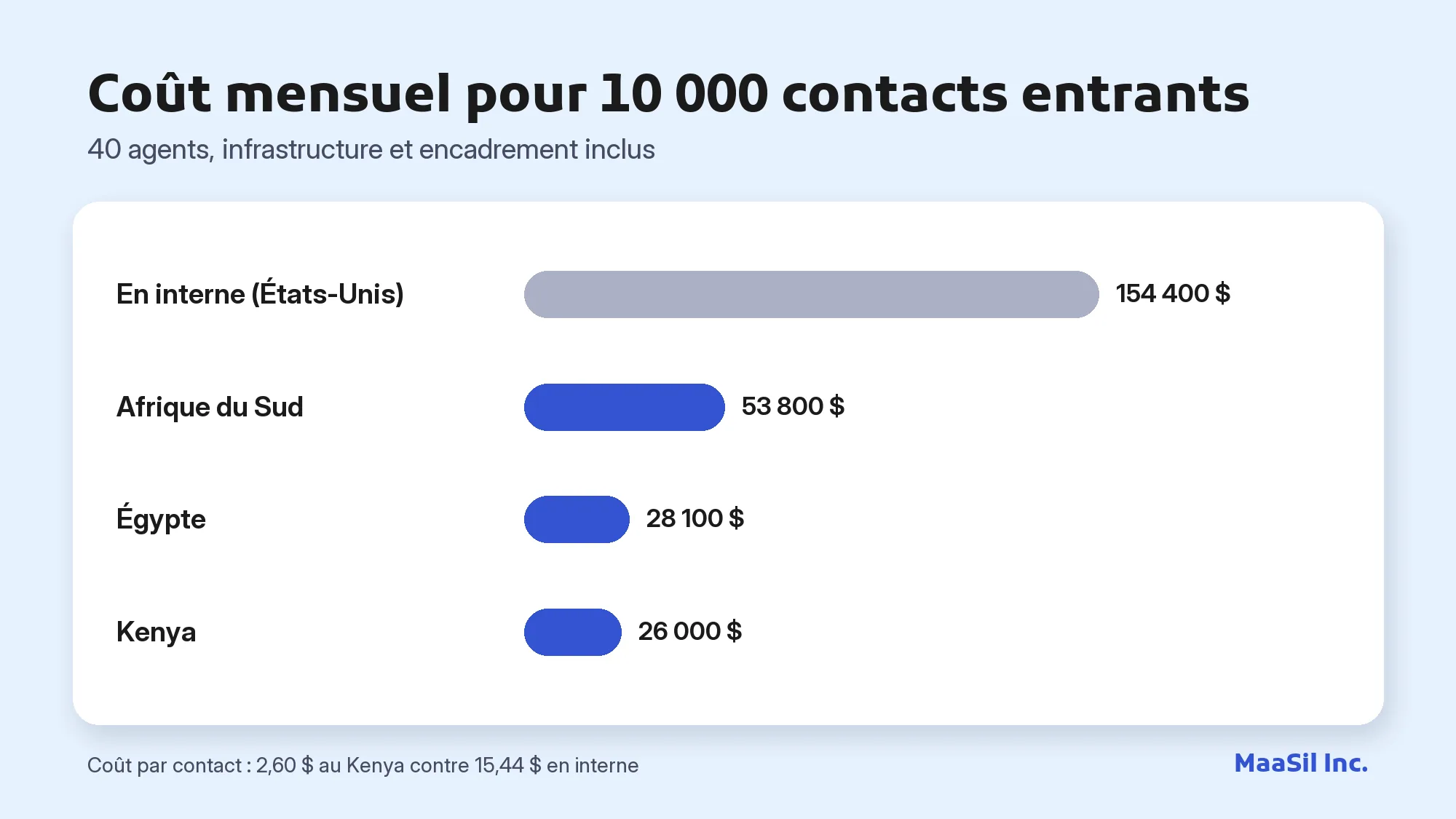
Le Kenya et l'Égypte réduisent le coût de plus de 80 % par rapport à une équipe interne.
Répartition des coûts pour 10 000 contacts entrants mensuels :
Composant | En interne aux États-Unis | Afrique du Sud | Kenya | Égypte |
|---|---|---|---|---|
Agents nécessaires (250 appels/agent/mois) | 40 | 40 | 40 | 40 |
Coût mensuel de base par agent | 3 200 $ | 1 000 $ | 400 $ | 450 $ |
Main-d'œuvre totale | 128 000 $ | 40 000 $ | 16 000 $ | 18 000 $ |
Infrastructure (VoIP, licences CRM) | 7 200 $ | 7 800 $ | 7 600 $ | 7 400 $ |
Frais généraux de gestion (15 %) | 19 200 $ | 6 000 $ | 2 400 $ | 2 700 $ |
Total mensuel | 154 400 $ | 53 800 $ | 26 000 $ | 28 100 $ |
Coût par contact | 15,44 $ | 5,38 $ | 2,60 $ | 2,81 $ |
Économies vs local | Référence | 65 % | 83 % | 82 % |
Cependant, des coûts cachés modifient ces chiffres. Les opérations kenyanes nécessitent 200 $ d'atténuation d'accent par agent, ce qui ajoute 8 000 $ d'investissement initial. Les agents sud-africains n'ont besoin d'aucune formation sur l'accent mais exigent des salaires plus élevés.
De plus, le stockage des enregistrements d'appels évolue avec le volume. Les appels entrants durent en moyenne 6,5 minutes contre 3 minutes pour les sortants. À 0,08 $ par heure de stockage (hébergement conforme au RGPD), 10 000 appels mensuels coûtent 867 $ en conservation d'enregistrements. Les prestataires qui proposent des coûts d'infrastructure inférieurs à 180 $ par agent et par mois sous-dimensionnent leurs capacités — attendez-vous à des failles de qualité.
Coûts des pics saisonniers : Le volume entrant de l'e-commerce augmente de 340 % pendant le Black Friday. Une mise à l'échelle élastique de 40 à 136 agents pendant 10 jours nécessite :
Le recrutement d'agents temporaires (150 $ par embauche)
Une formation accélérée (5 jours vs 3 semaines, qualité inférieure)
Le routage de débordement vers des centres de secours (2 $ par appel)
Coût total du pic : 38 000 $ pour la période. Par conséquent, les contrats devraient spécifier des plafonds de tarification pour les pics — les clauses de « capacité flexible » illimitée permettent aux prestataires de facturer 3 fois les tarifs normaux pendant votre haute saison.
De plus, les licences CRM imposent souvent des niveaux d'engagement minimums. Salesforce Service Cloud commence à 75 $ par utilisateur et par mois avec un minimum de 10 utilisateurs. Passer à 136 agents pendant un pic nécessite l'achat de 126 licences supplémentaires pour un mois puis un retour au niveau inférieur, entraînant 9 450 $ de frais de plateforme. Les plateformes de centre de contact cloud comme Talkdesk avec une tarification à la minute éliminent ce piège.
Combien coûterait votre équipe support à Madagascar ? Estimer mon budget →
Quelle infrastructure empêche les pannes de centres d'appels entrants lors des pics de volume ?
La planification des capacités sépare les implémentations réussies des désastres.
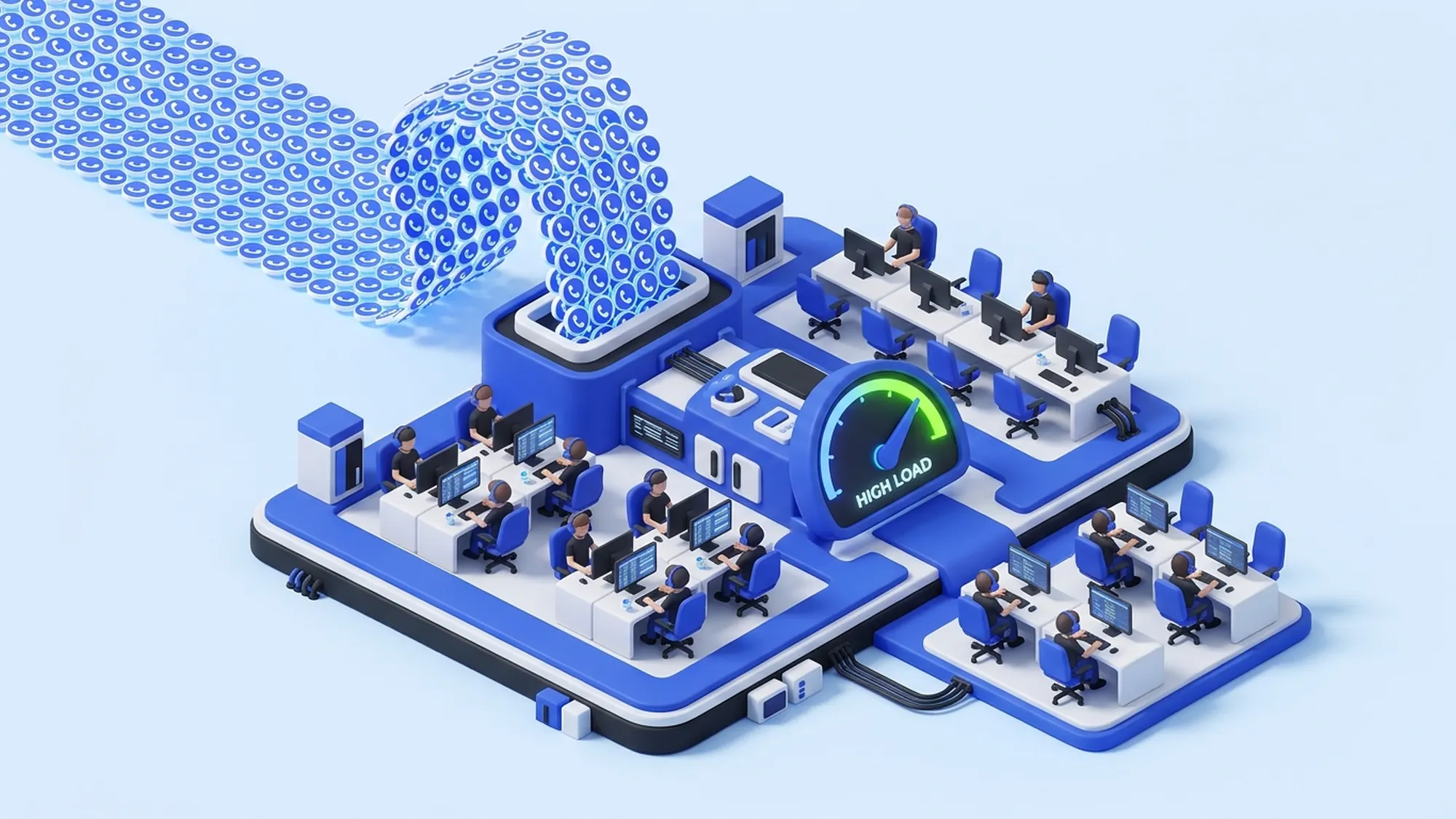
Les appels entrants ne se planifient pas : la capacité doit suivre les pics.
Calculs de capacité d'appels simultanés : 40 agents gérant 250 appels par mois (10 000 au total) avec un DMT (Durée Moyenne de Traitement) de 6,5 minutes travaillent 1 625 minutes par mois chacun, soit 27 heures. À 160 heures de travail par mois, le taux d'occupation est de 17 %, ce qui est absurdement bas. Calcul réaliste : 10 000 appels × 6,5 min = 65 000 minutes par mois = 1 083 heures = 27 ETP à 80 % d'occupation (norme du secteur).
Par conséquent, 34 agents gèrent le volume de base, laissant 6 agents pour l'improductivité (pauses, formation, attrition). Pendant les périodes de pic à 340 %, 116 agents sont nécessaires — soit 82 recrutements temporaires avec une formation de 5 jours.
Exigences en matière de logiciels de WFM : Pour capter la saisonnalité, la prévision s'appuie généralement sur au moins 12 mois de données historiques. Les nouvelles marques d'e-commerce manquent de cet historique, ce qui impose d'utiliser des hypothèses de référence du secteur (à titre illustratif : bijouterie = pic de 40 % en décembre, habillement = pic de 60 % en novembre). Le blog de NICE détaille l'usage des données historiques pour la prévision en centre de contact.
Néanmoins, la planification manuelle s'effondre lors des pics. Les systèmes automatisés d'attribution des horaires où les agents sélectionnent les créneaux vacants répondent à une attente forte des agents : selon l'enquête mondiale NICE 2022, 47 % citent des options d'horaires flexibles parmi les facteurs qui comptent dans leur décision de rester. Cela coûte 12 $ par agent et par mois mais évite 15 000 $ de majorations pour heures supplémentaires forcées.
Sophistication du routage ACD : Le routage par compétences associe les types d'appels à l'expertise des agents. Les politiques de remboursement de Shopify diffèrent des demandes d'expédition — diriger les questions de produits vers des agents formés sur les systèmes d'inventaire améliore le FCR de 31 %. Cependant, une sur-segmentation crée des agents inactifs dans des files d'attente spécialisées tandis que d'autres débordent.
Le routage optimal utilise un modèle à 3 niveaux :
Niveau 1 généralistes (70 % des appels) : statut de commande, FAQ de base
Niveau 2 spécialistes (25 %) : remboursements, problèmes techniques
Niveau 3 escalades (5 %) : interventions des superviseurs
Redondance pour les pannes de courant : Les installations égyptiennes subissent 12 coupures de réseau annuelles d'une durée moyenne de 45 minutes. Un centre de 40 agents perd 30 heures par mois en temps d'arrêt, soit 1 200 $ de salaire perdu. Une alimentation de secours par onduleur (UPS) empêche cela mais coûte 125 $ par poste de travail (5 000 $ au total). Le seuil de rentabilité du ROI est de 4,2 mois.
De plus, la diversité des circuits internet nécessite des contrats avec deux FAI. Les configurations avec un seul fournisseur permettent d'économiser 95 $ par mois mais risquent une perte totale lors des coupures de fibre. Une panne de 4 heures coûte 6 800 $ en capacité perdue, sans compter les dommages pour la marque en raison de lignes d'assistance injoignables. Par conséquent, la redondance n'est pas négociable.
Comment résoudre la latence de remontée de fiche CRM dans les centres entrants offshore ?
La colère des clients face à des agents qui demandent des informations déjà fournies détruit le NPS plus rapidement que les problèmes d'accent.
Le problème technique : Salesforce hébergé dans AWS EU-West-1 (Irlande) sert un agent basé au Kenya. L'appel arrive :
Le système de téléphonie (Twilio) envoie l'identifiant de l'appelant à l'API Salesforce (180 ms)
Salesforce interroge le dossier client (420 ms en raison de la latence interrégionale)
La remontée de fiche s'affiche dans le navigateur de l'agent (210 ms)
Total : 810 ms, mais l'appel se connecte à 2 secondes. L'agent répond à l'aveugle pendant 800 ms, demandant « Comment puis-je vous aider ? » au lieu de « Je vois que vous appelez au sujet de la commande #4477, est-ce toujours d'actualité ? »
Solution #1 - Hébergement régional du CRM : La région Salesforce Afrique du Sud réduit la latence à 95 ms. Cependant, la résidence des données en Afrique du Sud déclenche des préoccupations de conformité RGPD pour les clients de l'UE. Alternative : Des instances Salesforce distinctes par zone géographique avec un middleware de synchronisation (coûteux).
Solution #2 - Cache CRM local : Déployer un cache Redis dans le centre de données du site pour stocker les dossiers fréquemment consultés (clients actifs depuis 90 jours). Un taux de réussite de 78 % réduit les requêtes Salesforce de 72 %, ramenant le temps moyen de remontée de fiche à 240 ms. Coût d'implémentation : 180 $ par mois.
Solution #3 - Pré-remontée lors de la sonnerie : Le SVI capture l'identifiant de l'appelant pendant la navigation dans le menu (15 secondes en moyenne). Le système interroge le CRM pendant cette période de sorte que le dossier s'affiche lorsque l'agent accepte l'appel. Nécessite une intégration CTI entre les plateformes SVI et CRM — tous les fournisseurs ne la prennent pas en charge.
De plus, les plateformes d'e-commerce ont besoin d'une intégration directe de l'inventaire. Un client demandant « Avez-vous la taille 8 en rouge ? » nécessite des appels API Shopify en temps réel. Un inventaire mis en cache amène les agents à confirmer du stock qui a été épuisé 10 minutes auparavant, créant des échecs de livraison.
Bonne pratique : Les webhooks Shopify poussent les modifications d'inventaire vers le CRM : le sujet inventory_levels/update se déclenche à chaque mise à jour d'un niveau de stock. Une rupture de stock peut ainsi mettre à jour les dossiers en quasi temps réel. Cela évite que les agents prennent des commandes pour des articles indisponibles et limite les annulations.
Néanmoins, les limites de taux d'API contraignent les opérations à volume élevé. Shopify Plus autorise 4 000 requêtes par minute ; un centre de 40 agents avec des appels de 6,5 minutes effectue 370 vérifications d'inventaire simultanées. À raison de 5 vérifications par appel, cela représente 1 850 appels API par minute, ce qui est bien en deçà des limites. Shopify standard ne permet que 2 requêtes par seconde (120/minute), rendant l'intégration en temps réel impossible — la mise à niveau coûte 2 000 $ par mois.
Quels sont les meilleurs pays pour l'externalisation de centres d'appels entrants et pourquoi ?
La géographie détermine l'acceptabilité de l'accent, la couverture des fuseaux horaires et l'infrastructure technique.

Des agents formés et bien équipés font la qualité d'un centre d'appels entrants.
Avantages de l'Afrique du Sud :
Accent neutre : taux de demande de transfert de 4 % contre 22 % au Nigeria
Fuseau horaire (GMT+2) : couvre parfaitement les heures de bureau de l'UE, et la côte Est des États-Unis avec un décalage de 6 heures
Infrastructure : pénétration de la fibre à 71 %, latence moyenne de 45 ms vers Londres
Éducation : 34 % des candidats aux centres d'appels détiennent un diplôme universitaire contre 18 % au Kenya
Coût : 1 000 $ par mois et par agent, soit 68 % d'économie par rapport au Royaume-Uni/États-Unis
Inconvénients de l'Afrique du Sud :
Délestage électrique (Load-shedding) : les défaillances du réseau d'Eskom provoquent des coupures quotidiennes de 4 heures en 2023-2024
Inflation des salaires : augmentation de 22 % entre 2022 et 2024 en raison de la demande de nearshoring européen
Exigences de visa : complexes pour les visites de clients sur site
Avantages du Kenya :
Coût : 400 $ par mois, 84 % d'économie
Hub technologique : Nairobi compte plus de 340 sites de BPO avec un management mature
Fuseau horaire (GMT+3) : couvre les heures de bureau du Moyen-Orient, chevauche les après-midis de l'UE
Infrastructure mobile : secours 4G pour les pannes de lignes fixes
Inconvénients du Kenya :
Formation sur l'accent nécessaire : 200 $ par agent, durée de 6 semaines
Latence vers les États-Unis : 280 ms en moyenne via les câbles sous-marins sud-africains
Instabilité électrique : 8 coupures de courant annuelles d'une durée moyenne de 2 heures
Avantages de l'Égypte :
Multilingue : agents en arabe + anglais pour les bases de clients du Moyen-Orient
Coût : 450 $ par mois, 83 % d'économie
Câbles méditerranéens : latence de 110 ms vers l'UE
Grand vivier de talents : Le Caire compte 85 000 professionnels de centres d'appels
Inconvénients de l'Égypte :
Clarté de l'accent : nécessite une formation de 150 $ pour les clients des États-Unis/Royaume-Uni
Infrastructure : coupures de courant tournantes pendant les pics de demande estivaux
Conservatisme culturel : besoin d'installations séparées par genre (impacte la planification des horaires)
Avantages de Maurice :
Bilingue français + anglais : sert les marchés africains et européens
Accent neutre : l'histoire coloniale permet d'obtenir un anglais britannique quasi-natif
Stabilité politique : indice de démocratie de 8,2 contre 4,3 en moyenne pour l'Afrique subsaharienne
Lois sur la protection des données : alignées sur le RGPD
Inconvénients de Maurice :
Coût : 750 $ par mois, seulement 72 % d'économie (marge la plus faible)
Échelle limitée : la population de 1,3 million d'habitants limite le vivier de talents pour les opérations de plus de 500 positions
Emplacement éloigné : vols de 15 heures pour les visites de clients sur site
Matrice de sélection :
Besoin du client | Meilleur pays |
|---|---|
Clients de l'UE, langue française | Maurice |
Clients américains, priorité au coût | Kenya + formation sur l'accent |
Clients britanniques, sensibilité à l'accent | Afrique du Sud |
Clients du Moyen-Orient, arabe nécessaire | Égypte |
Pic saisonnier e-commerce (mise à l'échelle rapide) | Kenya (grand vivier de talents) |
De plus, la conformité réglementaire varie. La loi POPIA en Afrique du Sud s'aligne sur le RGPD, simplifiant la gestion des données des clients de l'UE. Le Nigeria manque de lois complètes sur la protection des données, ce qui crée des failles de conformité pour les services financiers. Par conséquent, les réglementations spécifiques à chaque secteur l'emportent sur les pures considérations de coûts.
Comment prévenir les 3 désastres les plus courants dans un centre d'appels entrants ?
Les échecs d'implémentation se regroupent autour de modes de défaillance prévisibles.
Désastre #1 - Effondrement de la capacité lors d'une vente flash :
Scénario : Une boutique Shopify organise une vente à -50 %, annoncée auprès de 140 000 abonnés à sa newsletter. Le volume d'appels quotidien normal est de 120 ; le jour de la vente, il grimpe à 890 appels. La capacité de base de 34 agents gère 850 appels avec un taux d'occupation de 100 % (niveau d'épuisement professionnel).
Cascade de défaillances :
Heure 1 : Le temps d'attente atteint 12 minutes (les clients abandonnent)
Heure 2 : 340 abandons, 47 000 $ de ventes perdues
Heure 3 : Le responsable du site retire des agents d'autres clients (rupture de SLA)
Heure 4 : Le client exige un remboursement, résilie le contrat
Prévention : Le contrat doit spécifier une capacité de pointe avec un SLA d'activation sous 4 heures. Le prestataire maintient une réserve d'agents formés mais non affectés (coûtant 20 % du tarif d'un agent à plein temps). Alternativement, utilisez un débordement local avec un routage automatique lorsque la file d'attente offshore dépasse 3 minutes — cela coûte 2,50 $ par appel mais évite un effondrement total.
Désastre #2 - Rupture de l'intégration CRM pendant la migration :
Scénario : Le client migre de Zendesk à Salesforce en milieu de contrat. Le prestataire avait promis une transition « transparente » en 2 semaines. Réalité : l'authentification de l'API échoue, les agents perdent la remontée de fiche pendant 6 jours.
Impact : Les agents doivent demander manuellement leurs numéros de commande aux clients. Le DMT passe de 6,5 à 11 minutes (perte de productivité de 69 %). Les clients perçoivent le service comme « incompétent ».
Prévention : Le contrat doit imposer un fonctionnement en parallèle sur un environnement de test pendant 10 jours avant la bascule en production. Le prestataire doit faire la démonstration de remontées de fiches réussies dans l'environnement de test sous la surveillance du service informatique du client. De plus, prévoyez une clause de retour arrière (rollback) : revenir à l'ancien CRM sous 4 heures si des problèmes de production apparaissent.
Désastre #3 - Violation du RGPD en raison d'un stockage incorrect des enregistrements :
Scénario : Un prestataire égyptien stocke des enregistrements d'appels contenant des données de paiement de clients de l'UE sur des serveurs AWS US-East-1 (Virginie). Un client de l'UE dépose une plainte pour non-respect du RGPD.
Risque juridique : amende maximale de 20 millions d'euros ou 4 % du chiffre d'affaires annuel en vertu de l'article 83. Même si l'amende est moins élevée, les coûts d'audit atteignent 80 000 $, plus l'obligation de notifier la violation à tous les clients concernés (4,50 $ par notification).
Prévention : L'accord de traitement des données (DPA) doit spécifier :
Le lieu de stockage des enregistrements (centres de données de l'UE pour les clients de l'UE)
La période de conservation (60 jours maximum sauf obligation réglementaire)
La certification de suppression (le prestataire doit prouver la destruction)
Les normes de chiffrement (AES-256 au repos, TLS 1.3 en transit)
Demandez un rapport SOC 2 Type II chaque année pour vérifier ces contrôles. De plus, exigez que le prestataire souscrive une assurance cyber-responsabilité avec une couverture minimale de 2 millions de dollars, désignant le client comme assuré supplémentaire.
FAQ : Questions cruciales sur l'externalisation de centres d'appels entrants
Q : Les agents offshore peuvent-ils gérer des clients en colère sans remonter constamment les appels ? R : C'est la formation aux compétences comportementales (soft skills) qui détermine cela, pas la géographie. Les prestataires proposant des formations accélérées d'une semaine produisent des agents qui escaladent 45 % des appels difficiles contre 12 % pour ceux issus de programmes de formation de 4 semaines. Des questions d'entretien comportemental lors du recrutement prédisent mieux la capacité de résolution de conflits que le niveau d'éducation. Recherchez une expérience préalable dans l'hôtellerie ou la vente au détail.
Q : Comment maintenir la qualité alors que nous ne pouvons pas écouter chaque appel ? R : Les plateformes d'analyse de la parole (speech analytics) comme CallMiner évaluent automatiquement 100 % des appels pour détecter le sentiment, le respect du script et les blancs dans la conversation. L'assurance qualité humaine examine 10 % des appels signalés (l'IA identifiant les interactions problématiques). Cela coûte 18 $ par agent et par mois mais offre une visibilité totale par rapport à l'échantillonnage manuel de 2 % réalisé par l'assurance qualité traditionnelle.
Q : Que se passe-t-il si notre catalogue de produits change chaque semaine — les agents resteront-ils à jour ? R : La synchronisation de la base de connaissances est essentielle. Implémentez Confluence ou Notion avec des webhooks Shopify qui mettent à jour automatiquement les spécifications des produits. Les agents voient des notifications de changement lors du lancement de nouvelles références. De plus, des briefs hebdomadaires de formation produit de 15 minutes permettent de maintenir les équipes à jour. L'attrition est le véritable ennemi — les nouveaux agents mettent 3 semaines pour apprendre les catalogues, donc les investissements dans la fidélisation (salaires 15 % au-dessus du marché) évitent les coûts de formation continue.
Q : Devrions-nous externaliser le chat et l'e-mail ou seulement le téléphone ? R : Le chat et l'e-mail s'externalisent mieux que la voix car ils éliminent les variables d'accent. Les canaux textuels permettent aux agents nigérians et kenyans d'exceller — la maîtrise de l'anglais écrit est de 92 % parmi les diplômés universitaires. De plus, les canaux asynchrones permettent à un agent de gérer 4 conversations simultanées contre 1 seul appel téléphonique, améliorant le coût par contact de 75 %. Commencez par l'offshore pour l'omnicanal, gardez la voix au niveau national au début, puis migrez la voix après avoir prouvé le succès du texte.
Q : Comment empêcher les prestataires d'affecter nos agents à d'autres campagnes de clients ? R : Les clauses d'équipe dédiée l'interdisent mais coûtent 15 à 20 % de plus que les pools d'agents partagés. Modèle hybride : 70 % d'agents dédiés avec 30 % de capacité flexible provenant d'un pool partagé pendant les pics. Effectuez un suivi via des audits de connexion — les agents doivent afficher plus de 95 % du temps connectés à vos campagnes. De plus, des visites d'installations avec des passages imprévus sur le plateau permettent de détecter les infractions (agents portant des casques de concurrents, double écran affichant d'autres CRM).
Combien coûterait votre équipe support à Madagascar ? Estimer mon budget →
Conclusion : Construire une stratégie d'externalisation de centre d'appels entrants évolutive
L'externalisation de centres d'appels entrants permet de réduire les coûts de 72 à 83 % lorsque l'infrastructure correspond à la variabilité de la demande. Des talents diplômés d'un master au Kenya traitent le support de niveau 1 à 2,60 $ par contact contre 15,44 $ au niveau local, mais le succès nécessite des logiciels de WFM prédisant la capacité de pointe et une intégration CRM assurant des remontées de fiches en moins de 3 secondes.
L'accent neutre de l'Afrique du Sud justifie des tarifs plus élevés mais élimine les demandes de transfert qui détruisent le NPS. La capacité multilingue de l'Égypte dessert des marchés du Moyen-Orient que les opérations locales ne peuvent pas cibler. Maurice offre une protection des données alignée sur le RGPD pour les bases de clients de l'UE.
Utilisez l'externalisation entrante pour le support de niveau 1 (statut de commande, FAQ de base) et le chat e-commerce. Gardez les escalades de niveau 3 et les appels de crise au niveau local. Les termes contractuels doivent spécifier une capacité de pointe avec des SLA d'activation sous 4 heures et des installations de secours géo-redondantes sur des réseaux électriques distincts.
Vérifiez l'intégration CRM dans des environnements de test avant la bascule en production. Exigez des rapports SOC 2 Type II prouvant un stockage des enregistrements conforme au RGPD. Payez 15 % au-dessus du tarif du marché pour éviter que l'attrition ne détruise la connaissance institutionnelle.
Le cadre de décision : calculez le coût par contact à travers les différentes zones géographiques, ajoutez les coûts cachés (formation sur l'accent, licences CRM, capacité de pointe), puis sélectionnez le pays où la maturité de l'infrastructure correspond à vos exigences de disponibilité et où les profils d'accent s'alignent avec la démographie de vos clients. Les entreprises qui traitent l'externalisation entrante comme un pur arbitrage de coûts subissent des effondrements de qualité ; celles qui investissent dans la redondance et la conformité capturent l'avantage de coût de 75 % sans le désastre opérationnel.
Prêt à renforcer votre équipe avec les meilleurs talents africains ?
Discutez avec l'un de nos experts pour découvrir comment le portage salarial augmenté à l'IA peut s'intégrer à 100 % à vos process et faire grandir vos projets.
Échangez avec un expert
