
Ready to strengthen your team with the best African talent?
Chat with one of our experts to discover how AI-augmented umbrella employment can integrate 100% into your processes and grow your projects.
Talk to an expert
IT, Tech & Web Agency
Outsourced IT Support: How to Cut Costs by 75% Without Sacrificing Quality
Hiring in-house IT support drains budgets fast: $4,000-5,000 monthly per technician in the US or EU. Outsourced IT support offers 75% savings, but only if you avoid infrastructure mistakes that kill productivity. This guide covers hidden costs, compliance traps, and technical prerequisites most companies discover too late.
What Is Outsourced IT Support and Why Companies Get It Wrong
Outsourced IT support means delegating helpdesk functions—password resets, ticket triage, remote troubleshooting—to offshore teams in Kenya, South Africa, Mauritius, or Nigeria. Monthly costs drop from $4,000 to $1,000 per agent, therefore many assume immediate 75% savings.
However, reality differs. The 90% mistake: hiring cheap without investing in infrastructure. An agent on a $400 salary with inadequate setup costs more per productive hour than a properly equipped $800 agent. Insufficient bandwidth, outdated hardware, and missing software licenses reduce output by 40%, raising effective costs from $666 to $1,000 per productive equivalent.
Remote IT productivity also depends on infrastructure investment, not just labor cost. Companies achieving actual 75% savings provision $200-350 monthly per agent for tools, connectivity, and backup systems.
Critical Infrastructure Requirements for Remote IT Helpdesk

Dual screens are mandatory: technicians juggle the ticket and the remote desktop.
Hardware That Determines Productivity
Dual monitors are mandatory, not optional. Tier 1 agents juggle ticketing systems and remote client screens simultaneously. Single-monitor setups double resolution time because agents constantly switch windows.
RAM requirements: 16GB minimum. Multiple virtual machines, remote sessions, and documentation open concurrently max out 8GB systems, causing lag that frustrates clients and agents alike.
Headsets need active noise cancellation (ANC) ≥25dB. Offshore locations experience ambient noise from shared workspaces, traffic, or household activity. USB connections outperform 3.5mm jacks for VoIP stability. Professional-grade Plantronics or Jabra models ($80-150) deliver clarity; $15 Amazon specials generate client complaints about audio quality.
Ergonomic workstations matter for 12-hour shift standards in offshore IT support. Inadequate seating and desk setup drive turnover, costing $1,200 per replacement in training expenses.
Connectivity: The Make-or-Break Factor
Download speed: 25 Mbps minimum. Upload: 10 Mbps minimum. These aren't aspirational targets but operational requirements. Remote desktop protocols (RDP, TeamViewer, AnyDesk) demand low-latency connections. Ping >200ms renders screen sharing unusable for real-time troubleshooting.
Jitter must stay <30ms. VoIP quality degrades with packet variation, moreover video calls become choppy. Clients perceive this as incompetence rather than technical limitations.
Backup ISP is mandatory, not optional. Fiber primary with 4G LTE failover ensures <30-second downtime during outages. Single-connection setups in Kenya, Nigeria, or Ghana face frequent power grid instability. Consequently, a UPS (1500VA minimum) providing 3-4 hour runtime becomes essential infrastructure, costing $800-1,200 per agent.
Cloudflare found that in March 2024, undersea cable cuts (WACS, MainOne, SAT-3 and ACE) disrupted internet connectivity in 13 African countries. Thus, redundancy investments pay for themselves within the first service interruption.
Software Licensing: The Hidden Cost That Exceeds Salaries
Ticketing systems (Zendesk, Freshdesk, ServiceNow, Jira Service Management) cost $49-89 per agent monthly. Remote access tools add substantial expenses: TeamViewer Enterprise runs $660 yearly per seat, AnyDesk Professional $300 annually, LogMeIn charges $1,200+ annually.
Password managers (LastPass Teams, 1Password Business) are compliance requirements, not conveniences. They cost $48-96 per user yearly but prevent security audit failures.
Windows Pro licenses become necessary for RDP hosting functionality absent in Home editions. That's $199 per machine versus zero assumed cost. Many companies discover this during deployment, adding unexpected $200 per agent to setup budgets.
How Offshore IT Support Actually Costs 75% Less (Not 85%)
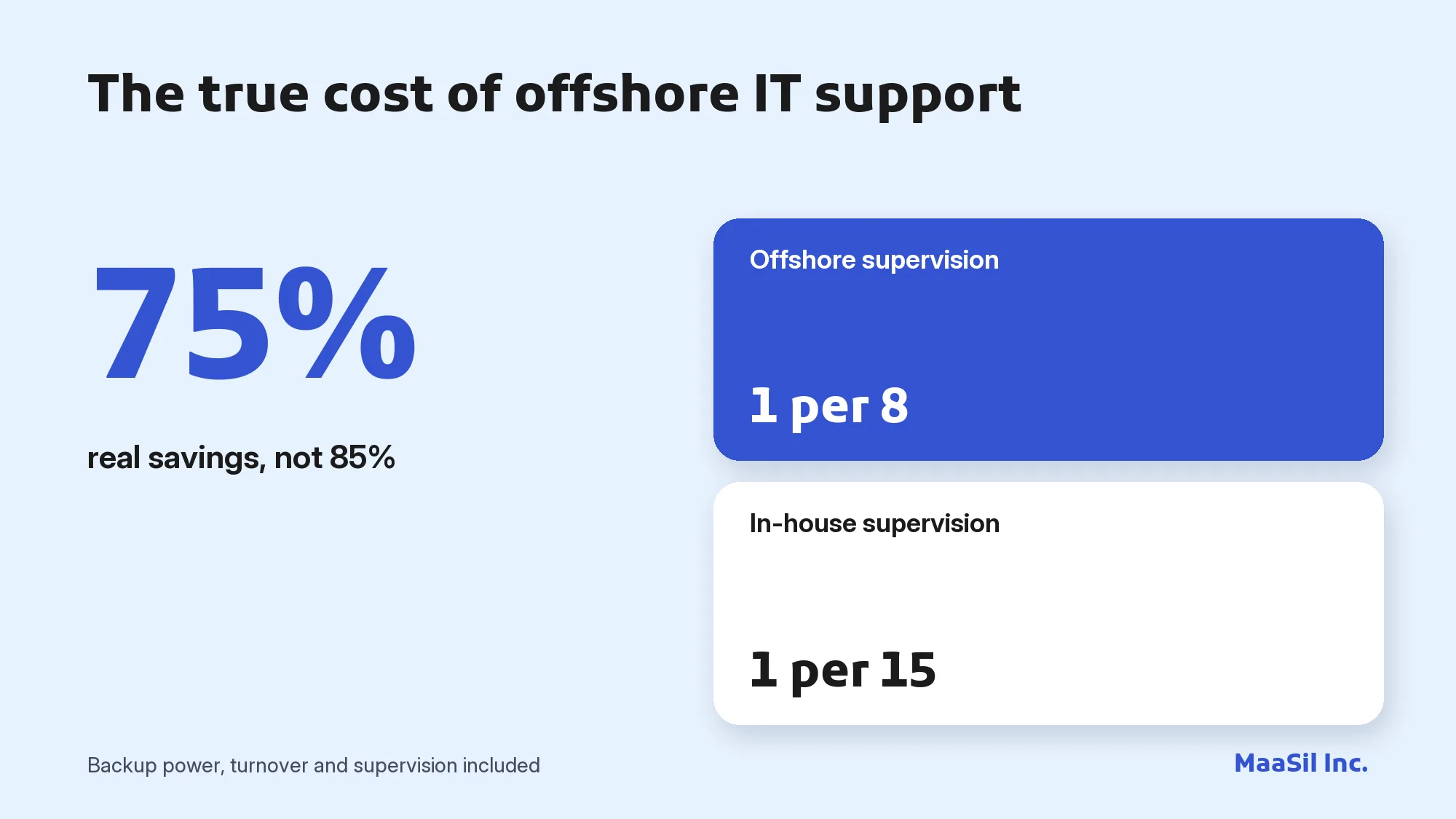
Backup power, turnover and tighter supervision bring savings down to 75%.
Cost Element | In-House US/EU | Offshore Africa | Hidden Offshore Additions |
|---|---|---|---|
Tier 1 Salary | $3,500-5,000 | $400-800 | - |
Software Licenses | $150 | $150 | No geo-pricing exists |
Infrastructure | $200 | $200 | +$150 backup power/ISP |
Training/Certification | $100 | $100 | +$200 higher turnover |
Management Overhead | 1:15 ratio | 1:8 ratio | +$300 supervision |
Effective Monthly Cost | $4,000 | $1,000 | True Savings: 75% |
South Africa's Cape Town experienced 35% Tier 2 support salary inflation since 2022 due to tech hub competition. Kenya's Nairobi saw 40% increases for cloud support specialists driven by AWS and Azure demand. Mauritius commands 25% premiums for bilingual English/French IT support.
Night shift penalties add 50-80% to base salaries for US hours coverage in Egypt, Kenya, and Ghana. Average tenure under 12 months creates constant retraining costs. CompTIA A+ and Network+ certifications require $300 renewals every three years per agent because clients demand current credentials.
Therefore, realistic savings land at 75%, not the 85% marketing materials promise. Nevertheless, $3,000 monthly savings per agent compound significantly across teams.
Strengthen your tech team with a dedicated senior developer. Try a candidate →
What Problems Does Outsourced IT Support Solve?
Budget Compression Without Headcount Reduction
Economic downturns force IT budget cuts while ticket volumes remain constant. Outsourced IT support maintains service levels at 25% of previous costs, thus avoiding layoffs or service degradation.
24/7 Coverage Without Night Shift Premiums
Domestic night shifts cost 40-60% wage premiums. Offshore teams in different time zones provide overnight coverage during their standard daytime hours. However, true 24/7 requires three shifts in the offshore location: day (9am-5pm), evening (5pm-1am), and night (1am-9am). The night shift still incurs 70% premiums locally.
Moreover, time zone gaps create dead zones. Kenya (UTC+3) covering US East Coast (UTC-5) has an 8-hour difference. Kenya's 9am-5pm equals US 1am-9am, and Kenya's 6pm-2am equals US 10am-6pm. But US 6pm-1am falls during Kenya's 2am-9am, requiring expensive night coverage.
Explicit SLA definitions prevent misunderstandings: "business hours" versus "after hours" response times must be contractually clear.
Why Most Outsourced IT Support Fails: The 20% Nobody Discusses
Active Directory Access: The Authentication Nightmare
Remote agents can't authenticate internal systems without site-to-site VPN or Entra ID (Azure AD) cloud synchronization. Traditional Active Directory requires domain controller exposure (a security nightmare) or always-on VPN (causing latency problems).
Consequently, 99% of companies don't realize this until deployment. Privileged Access Management solutions like BeyondTrust or CyberArk solve this but cost $100-200 per user monthly versus assumed "free" AD access.
Specific scenario: An agent in Uganda needs to reset a password for a Dallas office employee. Without AD access, they can't verify user identity in the corporate directory. Using spreadsheet workarounds creates GDPR and SOC2 violations. Read-only AD access still prevents password reset execution. Proper RBAC configuration (Role-Based Access Control) with MFA for privileged actions requires 40-60 setup hours, not "plug and play."
Cultural Deference Versus Technical Priority
Ticket prioritization failures emerge from cultural hierarchies. A Mauritius-based agent receives two simultaneous alerts: a VP's email about a laggy mouse and an automated system alert showing database server CPU at 98%.
Agents from hierarchical cultures prioritize the VP's request because senior person equals urgent by definition. Thus, 300 users lose CRM access for 45 minutes while the agent troubleshoots a Bluetooth mouse issue.
Western IT culture treats severity/impact matrices as absolute. Hard-coded priority rules in ticket systems remove agent discretion. P1 (system down) auto-assigns and can't be overridden. Explicit training emphasizes: "Ignore who sent the ticket; only severity level matters."
Compliance Audit Failures Nobody Anticipates
Outsourced IT support works perfectly until PCI-DSS compliance audits. Ninety percent of offshore teams use shared credentials or password sharing tools. Audit question: "Show individual authentication logs for each person accessing cardholder data environments."
Reality check: five agents share "support@company" login credentials. Remote sessions log under generic TeamViewer accounts. No MFA exists on privileged access. PCI-DSS 3.2.1 Requirement 8.2 fails instantly.
Compliance officers issue findings. Companies have 90 days to remediate, requiring PAM solution implementation ($15,000-50,000) or terminating outsourced support relationships. Prevention requires pre-audit compliance mapping for SOC2 Type II, PCI-DSS, HIPAA, or ISO 27001 before hiring, not after audit failures.
The UK ACAS provides guidance on the transfer of employees when an activity is outsourced (TUPE regulations), including informing and consulting the employees affected.
How to Prevent Knowledge Transfer Breakdown
IT environments contain 1,000+ undocumented "tribal knowledge" procedures. In-house technicians know "server reboots Tuesdays at 2am, ignore alerts 1:55-2:10am." Offshore agents lack this context, consequently paging on-call engineers at 2am for expected reboots.
After five false pages, engineers stop responding. Then real incidents get missed. Mitigation requires 90-day knowledge transfer periods, not 30-day handoffs. Mandatory documentation sprints convert every procedure into runbook entries. Shadow periods let offshore agents observe two weeks before touching production systems. Weekly knowledge gap reviews continue for six months.
What Security Risks Exist in Multi-Tenant Support Models?
Offshore providers serving eight clients with the same agent pool create credential security nightmares. One agent accesses Client A's Office 365 admin portal, Client B's AWS root credentials, and Client C's network switches simultaneously.
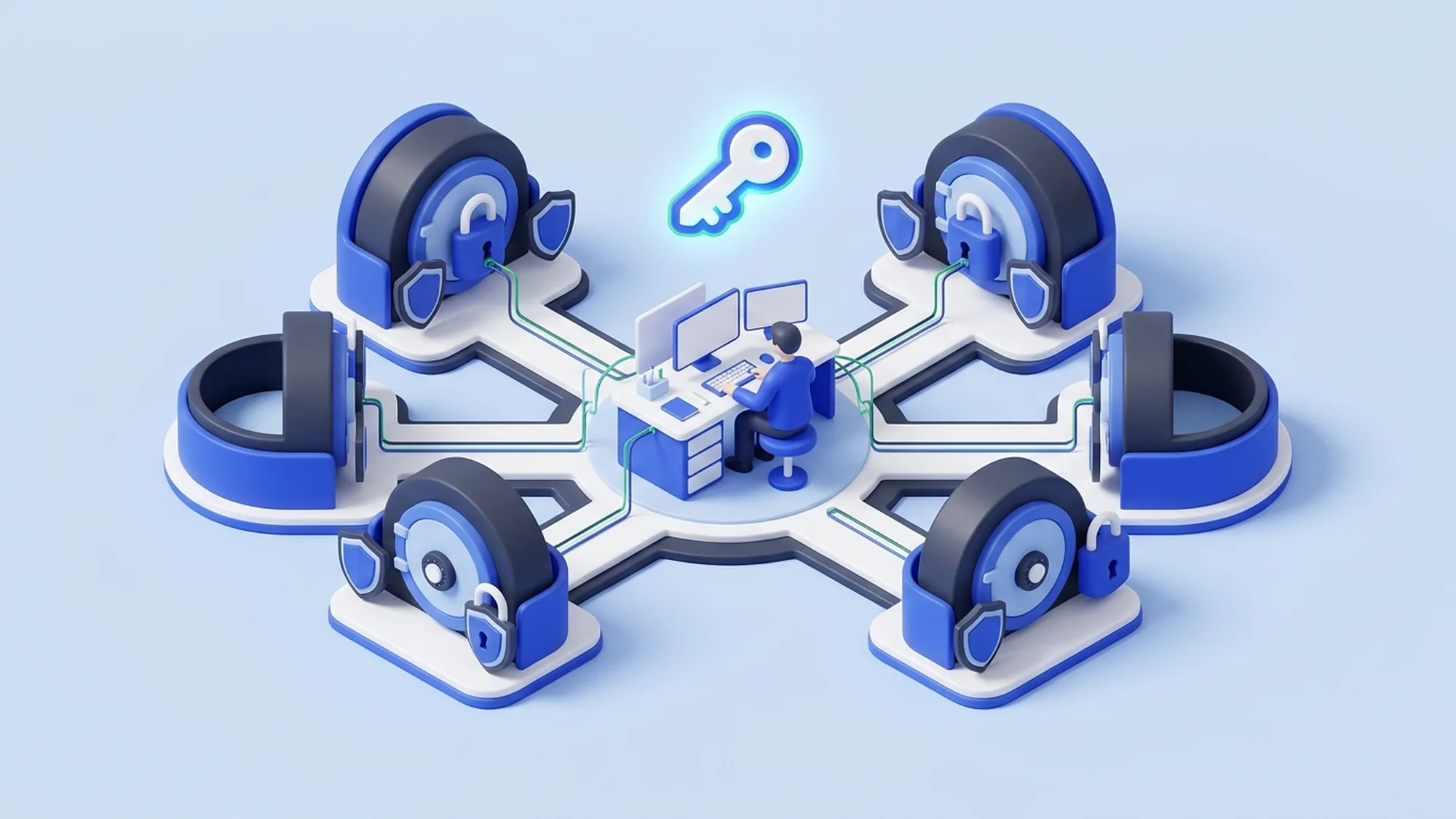
One agent, several clients: privileged access must be segregated.
When agents leave providers and join competitors, they retain mental maps of client infrastructures. No technical exfiltration is needed for reconnaissance. A real 2023 Nigeria incident involved an ex-agent who remembered a client used default Cisco IOS passwords. Six months post-departure, he participated in ransomware attacks using that knowledge.
Mitigation strategies include dedicated agent teams per client (15-20% cost increase), mandatory password rotation on agent departure, NDAs with financial penalties (enforceability varies by jurisdiction), and credential vaulting where agents never see actual passwords, only temporary session tokens.
What Are the Technical Solutions to Common C-Level Fears?
Fear: Offshore Agents Cause Problems Then Fix Them for Productivity Metrics
Implement read-only access for the first 90 days. Agents diagnose but don't execute changes. All privileged actions require approval workflows using Jira Service Management approval gates.
Audit logging captures every command and action with timestamps plus session recordings via Teramind or ActivTrak. Track "tickets created by agent" versus "tickets resolved by agent" ratios. Normal ratios run 1:8 (one ticket created for every eight resolved). Suspicious ratios of 1:2 indicate possible ticket farming.
Fear: Customers Stuck on 45-Minute Calls Without Resolution
Hard-code escalation SLAs. If Tier 1 can't resolve within 15 minutes, auto-escalate to Tier 2. Time-to-escalate becomes a tracked KPI; agents face penalties for holding tickets excessively long.
Smart routing sends repeat issues directly to Tier 2, skipping Tier 1 entirely. Customer callback protocols activate when hold times exceed 10 minutes, with agents scheduling callbacks and providing ETAs. Skill-based routing tags tickets by product or service, routing them to specialized agents automatically.
Fear: Data Breaches from Offshore Support Teams
Data residency compliance ensures agents never download data locally; web-based tools only. DLP (Data Loss Prevention) endpoint agents block USB drives, screenshots, and email of sensitive data.
NDAs require local legal enforceability assessment (Mauritius and South Africa have strong IP law; others remain weak). Cyber insurance requirements mandate providers carry E&O plus cyber liability coverage ($2M minimum). SOC2 Type II certification provides annual security control audits.
Contractual data breach clauses trigger immediate termination plus liquidated damages. According to ICO guidance on international data transfers, any international transfer must be covered by an adequacy decision, appropriate safeguards or an exception.
Fear: Quality Degradation Without Physical Supervision
Call and chat recording captures 100% of interactions using Five9 or Talkdesk. QA sampling reviews minimum 10% of tickets manually. Scorecard metrics track FCR (First Contact Resolution), CSAT (Customer Satisfaction), handle time, and after-call work time.
Side-by-side monitoring with screen recording tools (Hubstaff, Time Doctor) enables random audits. Weekly calibration sessions review edge cases with teams. Customer satisfaction surveys auto-send after ticket closures; CSAT scores below 4.0/5 trigger reviews.
Fear: Internet Outages During Critical Incidents
Redundant connectivity uses primary fiber plus 4G LTE backup with auto-failover in under 30 seconds. Generators and UPS systems provide 48-hour runtime without grid power. Backup workspaces in secondary locations use different ISPs and power grids.
Failover protocols activate when sites become unreachable for over 15 minutes, auto-routing tickets to backup teams. Hybrid reserves maintain 1-2 in-house agents trained as emergency backup. SLA credits apply when downtime exceeds 30 minutes due to provider infrastructure failures.
Comparison: When to Use Outsourced IT Support vs. In-House Teams
Perfect for Outsourcing | Dangerous to Outsource |
|---|---|
Password resets, account unlocks (procedural, low-risk) | Active Directory architecture changes (requires institutional knowledge) |
Tier 1 triage for ticket backlogs (high volume, low complexity) | Root cause analysis of intermittent issues (needs on-site observation) |
After-hours monitoring (overnight coverage, alert response) | VIP/C-level support (political sensitivity, relationship management) |
Software installation troubleshooting (remote executable) | Hardware troubleshooting requiring physical access |
Knowledge base article creation (documentation from tickets) | Emergency incident response with <15 min SLA (latency kills this) |
SaaS application support (cloud-based, no network access needed) | On-premise legacy system support (undocumented, requires "being there") |
Mobile device management (MDM solutions like Intune) | Network infrastructure changes (VLAN, firewall rules have high blast radius) |
How Does Salary Inflation Affect Offshore IT Support Markets in 2024?
South Africa's Cape Town shows 35% Tier 2 salary increases since 2022 due to competing tech hubs. Kenya's Nairobi experienced 40% cloud support specialist wage inflation driven by AWS and Azure demand. Mauritius charges 25% premiums for bilingual English/French IT support talent.
Night shift penalties add 50-80% to base salaries for US hours coverage in Egypt, Kenya, and Ghana. Average tenure below 12 months creates constant retraining cycles. Certification maintenance for CompTIA A+ and Network+ renewals costs $300 every three years per agent because clients demand current credentials.
Therefore, budget for 10-15% annual wage inflation in competitive markets. Lock multi-year contracts with wage caps where possible, moreover build retention programs reducing turnover costs.
FAQ: Outsourced IT Support Decision-Making
How quickly can outsourced IT support teams become productive?
Expect 90 days for full productivity, not 30 days. Knowledge transfer, system access provisioning, and cultural calibration require three months minimum. Rushing this timeline causes service quality issues that damage client relationships.
What metrics prove outsourced IT support delivers value?
Track First Contact Resolution (FCR) rates, Mean Time To Resolution (MTTR), ticket backlog reduction, and cost per resolved ticket. Compare quarterly; improvements should appear within six months. Additionally, monitor agent utilization rates and customer satisfaction scores.
Can outsourced IT support handle multiple time zones effectively?
Yes, with proper shift structuring. However, true 24/7 coverage requires three shifts in offshore locations or follow-the-sun models using multiple countries. Clarify coverage windows explicitly in SLAs to avoid misunderstandings about "24/7 support" promises.
What happens when offshore providers serve multiple clients simultaneously?
Multi-tenancy creates security risks. Dedicated agent teams per client cost 15-20% more but prevent credential crossover and knowledge leakage. Request dedicated teams for sensitive environments; accept shared pools only for low-security scenarios.
How do compliance requirements affect outsourced IT support feasibility?
PCI-DSS, HIPAA, SOC2, and ISO 27001 requirements add $15,000-50,000 in PAM solutions and audit costs. Budget these before hiring. Non-compliance discovered during audits forces expensive emergency remediation or relationship termination. The OECD guidelines on privacy protection and transborder flows of personal data provide frameworks for international data management standards.
Outsourced IT support delivers legitimate 75% cost savings when infrastructure investments match service requirements. Companies failing to provision proper connectivity, hardware, software licenses, and backup systems watch productivity collapse, erasing supposed savings. Moreover, cultural training, compliance preparation, and knowledge transfer protocols separate successful implementations from failed experiments. Calculate total cost of ownership including hidden infrastructure expenses, then decide based on realistic 75% savings, not aspirational 85% marketing claims.
Ready to strengthen your team with the best African talent?
Chat with one of our experts to discover how AI-augmented umbrella employment can integrate 100% into your processes and grow your projects.
Talk to an expert
